
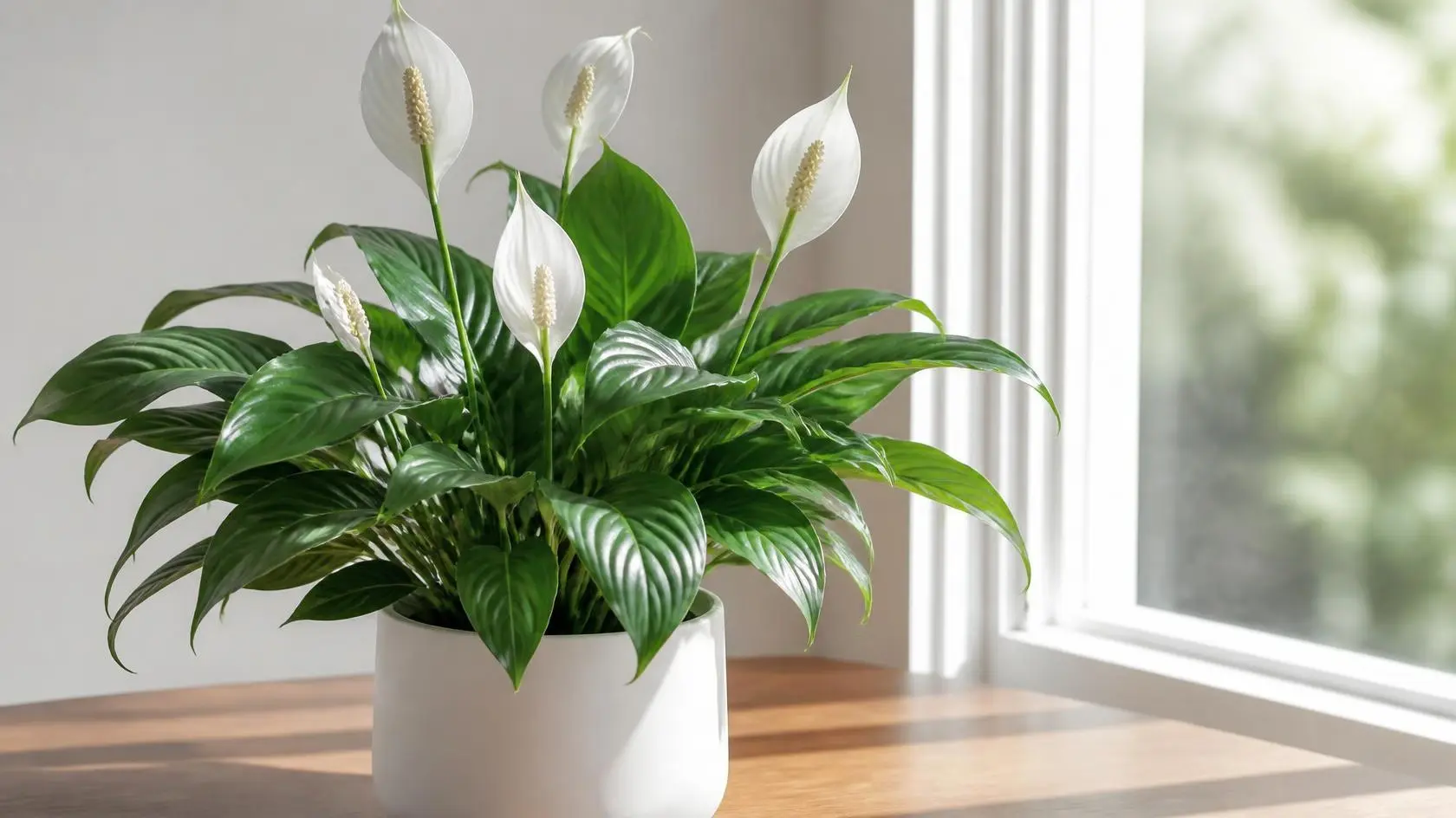
Peace lily care comes down to three things: soil kept consistently moist but never sitting in water, bright indirect light with no direct sun, and warm temperatures, ideally 75 to 85°F according to the University of Florida IFAS. Feed lightly, keep it slightly pot-bound, and keep it away from pets. To encourage new blooms, a mature plant responds to shorter days and cooler temperatures, the same natural cue described by UF/IFAS Extension.
The peace lily (Spathiphyllum) is one of the most forgiving flowering houseplants, but “forgiving” is not “indestructible”. It is not a succulent, and despite the marketing it is not an air purifier. It is a tropical understory plant with specific, well-documented needs, and every one of them is covered below with named university extension sources.
Peace Lily Care at a Glance
| Need | Ideal | Avoid |
|---|---|---|
| Light | Bright, indirect light (UF/IFAS); partial to deep shade (NC State) | Any direct sun |
| Water | Moist but not soggy; watering from below works very well (NC State) | Standing water in the saucer; severe wilting |
| Soil | Rich, organic, peat- or bark-based potting soil (UF/IFAS) | Heavy garden soil |
| Temperature | 75 to 85°F (UF/IFAS); 68 to 85°F by day, no more than 10°F cooler at night (NC State) | 40 to 60°F slows growth; below 40°F damages the plant (NC State) |
| Fertilizer | Low dose about three times a year (UF/IFAS), or one-quarter strength with flushing (NC State) | Full-strength or frequent feeding |
| Pot | Somewhat pot-bound (NC State) | Oversized pots |
| Pets | Out of reach | Toxic to cats and dogs (ASPCA) |
What Is a Peace Lily (and Is It a Lily)?
No, it is not a true lily. NC State Extension places Spathiphyllum in the arum family (Araceae), making it a relative of anthuriums and dieffenbachia, and lists its native range as Mexico, tropical America, Malesia and islands of the western Pacific.
The white “flower” is a modified leaf called a spathe, wrapped around a central spike (the spadix) that carries many tiny true flowers. If you are curious what the blooms symbolize, we cover peace lily meaning and gifting etiquette in a separate post.
How Much Light Does a Peace Lily Need?
Bright, indirect light with no direct sun. UF/IFAS gives “bright, indirect light, no direct sun”, and NC State Extension recommends partial to deep shade and warns against direct sun.
Peace lilies tolerate low light better than most flowering houseplants, which is why they end up in dim offices. Tolerating is not thriving: a plant in a dark corner will produce few or no blooms. At the other extreme, the University of Florida’s commercial production guide notes that excessive light bleaches the leaves, and the pale color is often mistaken for a nutrient deficiency.
Short on bright windows? Our grow light guide explains how to choose and set one up.
How Often Should You Water a Peace Lily?
There is no honest fixed schedule. UF/IFAS says to keep the soil moist but never let the plant sit in water, and NC State Extension says to keep the soil moist but not soggy, letting it dry between waterings. Check the soil every few days and water thoroughly when the top starts to dry.
Do
- Water from below: NC State says it “works very well” for peace lilies
- Let the pot drain fully and empty the saucer
- Water before the plant collapses
Avoid
- Standing water around the roots
- Repeated severe wilting, which the UF/IFAS production guide calls “crashing”
- Ice cubes: frozen water against warm-loving roots delivers little water and risks chilling
To bottom water, stand the pot in a tray or sink of water until the top of the mix feels damp, then let it drain completely. See our step-by-step guide to bottom watering.
Soil and Fertilizer
UF/IFAS recommends a rich, organic, peat- or bark-based bagged potting soil. Good-quality bagged houseplant mix fits that description; if you mix your own, our aroid soil mix guide follows the same principles. NC State Extension adds that the plant should be kept somewhat pot-bound, so move up only one pot size at a time.
Peace lilies are light feeders. UF/IFAS suggests a low dose of liquid fertilizer about three times a year; NC State suggests one-quarter of the recommended strength and flushing the soil with plain water between feedings to prevent salt buildup, a common cause of brown tips.
What Temperature Does a Peace Lily Need?
- 75 to 85°F: preferred range (UF/IFAS)
- 68 to 85°F by day, no more than 10°F cooler at night (NC State)
- 40 to 60°F: growth slows considerably (NC State); active growth reduced at or below 50°F (UF/IFAS)
- Below 40°F: damages leaves, stems and roots (NC State); some cultivars can be injured at 35°F (UF/IFAS)
A heated home usually sits comfortably in the safe range. The risk points are cold windowsills at night, drafty doors and air-conditioning vents blowing directly on the leaves.
How to Get a Peace Lily to Bloom Again
UF/IFAS Extension Charlotte County explains that peace lilies “naturally set flowers in response to short days/long nights and lower temperatures” (Ralph Mitchell, 2023). The UF/IFAS production guide adds that most cultivars flower naturally only from January to August, so a plant without blooms in autumn may simply be on schedule.
- Check maturity. A young division may need more growing time before it can bloom.
- Increase light. Move it to the brightest spot that still gets no direct sun; too little light is a common reason for no flowers.
- Give it the natural cue. Let it experience shorter days and slightly cooler nights, staying within NC State’s comfortable range (no more than about 10°F cooler at night, and well above 60°F).
- Keep care steady. Water consistently and feed lightly during the growing season.
Commercial growers skip the natural cue: the UF/IFAS production guide describes a single gibberellic acid (GA3) spray, after which flowers appear in 9 to 12 weeks depending on cultivar. That is a professional production technique, not something home growers need.
Do Peace Lilies Really Clean the Air?
Not meaningfully. Peace lilies are often sold with the claim that NASA proved houseplants purify indoor air, but that 1989 work ran in sealed chambers, nothing like a ventilated home.
196 experiments re-analyzed
Bryan Cummings and Michael Waring reviewed 12 chamber studies and converted 196 results into clean air delivery rates, published in the Journal of Exposure Science & Environmental Epidemiology.
0.023 m³/h per plant
The median single plant cleaned air at just 0.023 cubic meters per hour, according to the study abstract.
10 to 1,000 plants per m²
That is how many plants per square meter of floor space they calculated would be needed to match normal building air exchange.
Grow a peace lily because the blooms last for weeks and the foliage handles real indoor light, not as an air purifier. For cleaner air, ventilation does far more.
What Is Wrong With My Peace Lily?
| Symptom | Most likely cause | Fix |
|---|---|---|
| Whole plant drooping, soil dry | Underwatering (“crashing”) | Water thoroughly, ideally from below, and let it drain |
| Drooping with wet soil | Roots damaged by standing water | Unpot, check the roots, remove soft ones and repot in fresh mix |
| Yellow leaves | Soggy soil most often; one older leaf yellowing is normal aging | Let the top dry between waterings; check the drainage holes |
| Brown leaf tips | Direct sun, underwatering or low humidity (NC State); salt buildup from feeding | Move out of sun, raise humidity, flush the soil with plain water |
| Pale, washed-out leaves | Too much light, often misread as nutrient deficiency (UF/IFAS) | Move back from the window or add a sheer curtain |
| No flowers | Immature plant, too little light, or off-season | More bright indirect light; follow the bloom steps above |
If problems persist, our Infirmary troubleshooting hub covers diagnosis in more depth.
How to Propagate a Peace Lily
By division. A peace lily grows as a clump of crowns, so you separate offshoot crowns that each have their own roots, ideally when repotting in late winter or spring.
- Water the day before so the root ball slides out more easily.
- Remove the plant and shake off loose mix until you can see the separate crowns.
- Pull the crowns apart gently by hand, using a clean knife only where roots won’t separate.
- Pot each division in fresh, rich potting mix at the same depth, in a pot with drainage holes and only a little larger than its root ball.
- Water, drain and keep warm. Hold off on fertilizer until new growth appears.
Is a Peace Lily Safe for Cats and Dogs?
No, keep it out of reach
The ASPCA lists the peace lily as toxic to dogs and cats because of insoluble calcium oxalates, causing oral irritation, intense burning and irritation of the mouth, tongue and lips, excessive drooling, vomiting and difficulty swallowing. If you suspect your pet has eaten any part of the plant, contact your veterinarian or the ASPCA Animal Poison Control Center at (888) 426-4435.
It is not a true lily (Lilium); the two are different plants with separate ASPCA toxicity listings, so check the botanical name on the label. For pet-friendly choices, see our cat-safe plants guide.
Frequently Asked Questions
How often should I water a peace lily?
No fixed schedule works, because pot size, light and season change how fast the soil dries. Keep the soil moist but never standing in water, check every few days, and water, ideally from below, when the top starts to dry.
Why is my peace lily drooping even after I watered it?
Wet soil with limp leaves points to damaged roots rather than thirst. Unpot the plant, remove soft or black roots, and repot in fresh, well-draining mix. Avoid leaving it in standing water afterward.
How do I get my peace lily to bloom again?
Make sure the plant is mature, give it more bright indirect light, and let it experience shorter days and slightly cooler nights. UF/IFAS notes peace lilies set flowers naturally in response to short days and lower temperatures, and most cultivars bloom between January and August.
Why does my peace lily have brown leaf tips?
NC State Extension attributes brown tips to excessive direct sun, underwatering or low humidity; salt buildup from fertilizer can also cause them. Move the plant out of direct sun, raise humidity and flush the soil with plain water.
Is the peace lily a true lily?
No. It belongs to the arum family (Araceae), according to NC State Extension, and is related to anthuriums and dieffenbachia. The white “flower” is a modified leaf called a spathe.
Is a peace lily safe for cats and dogs?
No. The ASPCA lists it as toxic to dogs and cats because of insoluble calcium oxalates, which cause mouth irritation, drooling, vomiting and difficulty swallowing. Call ASPCA Poison Control at (888) 426-4435 if a pet chews it.
Sources
- UF/IFAS EP477: Florida Foliage House Plant Care: Spathiphyllum (Henny and Chen)
- UF/IFAS EP161: Cultural Guidelines for Commercial Production of Interiorscape Spathiphyllum (Chen et al.)
- NC State Extension Plant Toolbox: Spathiphyllum
- UF/IFAS Extension Charlotte County: The Peace Lily (Ralph Mitchell, 2023)
- ASPCA: Peace Lily
- Cummings and Waring, Potted plants do not improve indoor air quality (J Expo Sci Environ Epidemiol, 2020)