
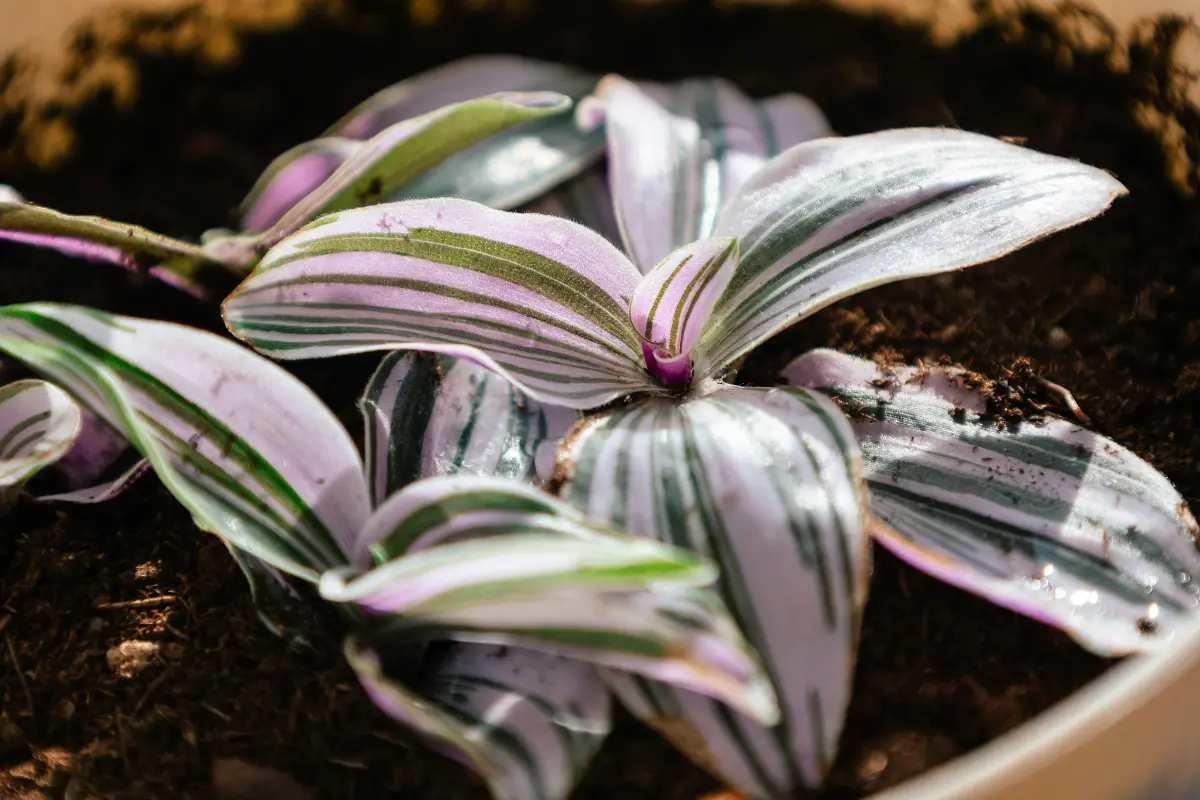
Tradescantia Nanouk care has a reputation for being effortless, and most of that reputation holds. The thick, pink-flushed stems and stripy purple-green leaves look like something a florist engineered, which is close to the truth: it is a patented, bred cultivar. But the plant does have one non-negotiable demand, and if you miss it, the colors fade and the stems stretch into bare, leggy threads within a month or two.
This guide covers the full protocol: light, water, soil, feeding, pruning, propagation, and the pet-safety question the pretty foliage tends to distract people from.
Tradescantia Nanouk Care Snapshot
| Parameter | Ideal | Avoid |
|---|---|---|
| Light | Bright indirect light; a little gentle morning sun | Deep shade (color fades), harsh afternoon sun |
| Water | Water when the top inch of soil is dry | Fixed schedules and constantly soggy soil |
| Soil | Well-draining houseplant mix with added perlite | Heavy, slow-draining soil |
| Humidity | Average household humidity; appreciates extra | Very dry air, which crisps the leaf edges |
| Temperature | 65 to 75°F (18 to 24°C) | Cold drafts and chilly winter windowsills |
| Fertilizer | Balanced indoor plant food at half strength, spring through summer | Feeding in fall and winter |
| Pruning | Pinch growing tips regularly to force branching | Letting stems trail bare |
| Repotting | When rootbound, into a pot one size up | Oversized pots that stay wet too long |
| Propagation | Tip cuttings in water or soil; roots in about two weeks | Waiting for the plant to decline before replacing it |
| Pet safety | Out of reach of cats and dogs | Chewing; the sap can irritate skin and mouths |
Where Nanouk Comes From
Almost no care guide mentions this, and it is the most interesting thing about the plant: Nanouk is a patented commercial cultivar with a documented paper trail. U.S. Plant Patent PP29,711 names Dutch breeder Wander Durk Tuinier as the inventor and Dümmen Group B.V. (Dümmen Orange) as the assignee, filed in March 2017 and granted in September 2018. The patent describes the plant as arising from a planned breeding program in Sappemeer, the Netherlands.
Two details from that patent document are genuinely useful for growers. First, the official leaf description: light purple, green, and greyed-green striped blades, about 4.2 cm long and 2.8 cm wide, on thick, slightly succulent stems. If your “Nanouk” has thin, floppy stems and small plain-green leaves, you may have a different Tradescantia entirely, Its species name is also less simple than labels suggest. The patent describes Nanouk as the result of a 2012 cross, made in Sappemeer in the Netherlands, between two unnamed seedling selections of Tradescantia albiflora. That name has since been treated as a synonym of T. fluminensis, which is how many nurseries label it, while the specialist site tradescantia.uk argues the plant actually belongs to T. cerinthoides. So treat any single botanical name on a label with caution.
Second, the breeding goal: according to the patent, the program aimed to create new compact Tradescantia plants with attractive flower coloration and good performance. That compact habit is why a well-grown Nanouk tends to look fuller than a trailing wandering dude (T. zebrina). It still needs your help to stay that way, and the pruning section below covers exactly how.
How Much Light Does a Tradescantia Nanouk Need?
Bright indirect light is the answer, and for this cultivar it is not negotiable. The genus-level guidance from NC State Extension’s Plant Toolbox says Tradescantia does best in filtered sun, that full sun brings out the strongest color (although strong southern sun can wash it out), and that in low light the stems can lose their lower leaves. Nanouk growers commonly report the pink fading in dim spots, which fits that picture.
Here is the physiology behind it. The pink and cream sections of a variegated leaf contain less chlorophyll than the green sections, so the plant needs more total light, not less, to photosynthesize enough to sustain growth. Dim the light and the plant quietly sheds its expensive variegation first. A spot within a few feet of an east or west window keeps the palette saturated, and a south window works if a sheer curtain filters the harshest midday hours.
If your home simply does not have a bright window, a full-spectrum grow light run 10 to 12 hours a day will keep a Nanouk compact and colored. Rotate the pot a quarter turn each week; the stems lean hard toward their light source, and a weekly rotation is the difference between a symmetrical plant and a lopsided one.
Water When the Top Inch Dries Out
Forget the calendar. The reliable trigger is the soil itself: water thoroughly when the top inch of potting mix has dried, and let excess drain freely from the bottom of the pot. NC State Extension’s guidance for the genus is to water regularly but allow the soil to dry out between waterings, and to reduce watering during the winter months when growth slows.
Two failure modes bracket the correct rhythm. Overwater, and the semi-succulent stems rot from the base upward; if you catch soft, mushy stems or a plant that wilts despite wet soil, read our guide to treating root rot before it spreads. Underwater, and the leaf edges brown and crisp while the plant sheds lower leaves to conserve moisture. Our overwatered vs. underwatered diagnostic walks through telling those two apart, because the symptoms look similar from across the room.
One Nanouk-specific habit worth building: pour water directly onto the soil, not over the foliage. Water that pools in the tight crevices where leaves meet stem invites stem rot, and this cultivar’s dense, upright leaf arrangement holds water longer than its trailing cousins. If you do wet the crown, blot it dry with a paper towel.
Soil and Potting
Standard houseplant potting mix amended with a generous handful of perlite hits the target: moisture-retentive enough to buffer your watering schedule, porous enough that roots never sit in an anaerobic slurry. NC State Extension describes the genus preference as moist but well-drained soil, and “moist but well-drained” is exactly what a perlite-lightened mix delivers.
Choose a pot with a drainage hole, full stop. Terracotta is a sensible default for heavy-handed waterers because the porous wall wicks moisture away from the root zone faster than plastic or glazed ceramic. As for pot size, err small: Nanouk tolerates being slightly rootbound, and an oversized pot holds wet soil around a modest root system for days, which is the textbook setup for the rot described above.
Humidity and Temperature
Good news for dry-climate growers: the genus tolerates average home humidity. NC State Extension lists average household humidity as acceptable for Tradescantia, and Nanouk follows suit. Higher humidity (around a kitchen or bathroom, or near a small humidifier) produces lusher growth and completely eliminates the crispy-edge problem, but it is a preference, not a requirement.
Temperature is equally unfussy. The NC State target for the genus is 65 to 75°F (18 to 24°C), which is the middle of what most homes already are. The two real risks are cold drafts and contact with chilly window glass in winter; a Nanouk parked against a December windowpane can pick up cold damage on the leaves that press the glass even when the room reads comfortable.
Fertilizing for Steady Growth
Nanouk is a fast grower and will happily use what you offer it during the growing season. From spring through early fall, feed every two to four weeks with a balanced indoor plant fertilizer diluted to half the label strength. Full-strength synthetic fertilizer pushes soft, sappy growth that looks impressive for three weeks and then collapses under the first pest or watering mistake, and this plant grows fast enough at half strength to not need the extra push.
Stop feeding in late fall and winter. Growth slows in the shorter days, and fertilizer applied to a resting plant accumulates in the soil as unused salts, which burn root tips. If you see white crust on the soil surface in spring, flush the pot with several volumes of water before the season’s first feeding.
Prune Often to Keep It Full
This is the section that separates a showpiece Nanouk from a sad string of bare stems. The cultivar was bred to branch, but branching is triggered by pruning, not by goodwill. Wisconsin Horticulture notes that Tradescantia tolerates heavy pruning and that pinching the growing tips promotes denser foliage; the New York Botanical Garden’s plant information service gives the same advice, recommending regularly nipping out growing tips to encourage bushy growth.
The mechanics are simple. Each stem ends in a growing tip that produces a hormone suppressing side shoots. Cut or pinch that tip off, and the suppression lifts; within a week or two the stem pushes two or more lateral shoots from the nodes just below your cut. Do this every few weeks through the growing season and the plant converts from a few long runners into a dense, cushion-shaped mound. Do not be timid: the plant tolerates being cut back hard, and stems pruned in spring regrow fast.
Prune out any bare stretches too. Stems that have lost their lower leaves will not regrow foliage from those bare sections no matter how good the light gets, so cut the stem back to just above a leaf or node and let it resprout from there.
Repotting a Rootbound Nanouk
Nanouk grows quickly enough to need repotting roughly every one to two years. Check in spring: roots emerging from the drainage hole, a root mat coiled around the soil surface, or water that runs straight through the pot without wetting anything are your three signals.
Repot into a container only one size up, in fresh mix, and water thoroughly afterward. Spring is the ideal window because the plant is entering its strongest growth phase and will colonize the new soil in weeks. This is also the perfect moment to take a few tip cuttings before you disturb the root ball, since the prunings and the repotting share one cleanup.
Propagating Nanouk From Tip Cuttings
Propagation is where this plant turns generous. The New York Botanical Garden’s protocol for the genus is a reliable template: NYBG recommends 3-inch tip cuttings, rooted several to a small pot in bright filtered light, with roots developing in about two weeks. Here is the process end to end.
- Select and cut healthy tip growth. Choose stems with firm, well-colored leaves. Using clean scissors, cut a 3 to 4 inch section ending just below a node, the slightly swollen ring on the stem where leaves and roots emerge.
- Strip the lower leaves. Remove the leaves from the bottom inch or two of the cutting so no foliage will sit below the waterline or in the soil. Let the cut end callus for an hour if you are rooting in soil.
- Root in water or soil. For water, stand the cutting in a small jar so at least one node is submerged and no leaves touch the water; change the water weekly. For soil, insert the cutting into moist, well-draining mix and keep it barely moist, not wet, while roots form.
- Provide bright, filtered light and warmth. A bright windowsill out of direct sun, or under a grow light, is ideal. Roots should appear within about two weeks.
- Pot up or top up. Once water roots reach an inch or two, move the cutting to soil. Water-rooted cuttings also transition happily straight back into the mother plant’s pot, which is the fullness trick covered in the pro tip below. Soil-rooted cuttings get a gentle tug test: resistance means roots have grabbed the mix.
Pro tip: Do not throw pruned tip cuttings away or root them in a separate jar. Poke five or six fresh tip cuttings straight back into the bare spots of the mother plant’s own pot, as Wisconsin Horticulture suggests for renewing Tradescantia containers. They root in place within weeks, and the plant fills in from the inside instead of trailing thinly over the rim.
Common Problems and Their Fixes
Nanouk is genuinely trouble-free when its core conditions are met. When something goes wrong, it is almost always one of these four issues, and the fix is nearly always on this list.
- Fading pink and purple color. The classic complaint, and the answer is light. Move the plant closer to a bright window or add a grow light. Color lost to low light returns on new growth within a few weeks of the move.
- Long, leggy stems with bare lower sections. Insufficient light plus zero pruning. Raise the light level, then cut the bare stems back to just above a node and pinch new tips as they extend.
- Crispy brown leaf edges. Dry air, underwatering, or too much direct sun. Check the watering rhythm first, then move the plant back from harsh rays; a humidifier resolves the rest.
- Soft, mushy stems near the soil line. Overwatering and stem rot. Unpot, trim rotted tissue, and repot into fresh dry-ish mix; review your watering trigger. Caught early, this is recoverable.
On pests: NC State Extension flags aphids, mealybugs, scale, whiteflies, and spider mites as the genus’s usual suspects. Nanouk’s dense crown gives pests plenty of shelter, so inspect the growing tips whenever you water. If you find aphids clustered on the new growth, our guide to aphids on indoor plants covers the full treatment protocol.
Is Tradescantia Nanouk Toxic to Pets?
Treat it as toxic and place it accordingly. The ASPCA lists the closely related inch plant (Tradescantia flumeninsis) as toxic to dogs and cats, with dermatitis as the clinical sign, and NC State Extension rates the genus as low severity, noting that mouth and stomach irritation can result if it is eaten. Nanouk’s exact parentage is undisclosed, but it sits squarely within the same spiderwort group, and NC State Extension notes that the genus’s watery sap can cause skin irritation in people as well. Chewing can irritate a pet’s mouth and skin.
Pet safety
If you suspect your cat or dog has eaten any part of this plant, contact your veterinarian or the ASPCA Animal Poison Control Center at (888) 426-4435 immediately. Hanging baskets and high shelves keep trailing stems out of chewing range, which solves the problem elegantly.
Frequently Asked Questions
Why is my Nanouk losing its pink color?
Low light. The pink and cream leaf sections contain less chlorophyll, so the plant needs brighter light than a solid-green plant to sustain them. Move it within a few feet of an east or west window or add a grow light, and new growth comes in vivid again within weeks.
How often should I water a Tradescantia Nanouk?
Water when the top inch of soil dries out, not on a schedule. In a bright, warm spot that may mean weekly in summer and every two to three weeks in winter. Always drain excess water fully, and cut back on frequency when growth slows in the darker months.
Why is my Nanouk getting leggy?
Insufficient light is the primary cause; the stems stretch toward the window and shed lower leaves as they go. Raise the light level, then pinch or prune the stretched stems back to just above a node. New lateral shoots branch from the cut point within one to two weeks.
Can Tradescantia Nanouk live in water permanently?
Yes. Tip cuttings root readily in water and the plant can grow indefinitely in a jar, vase, or hydroponic setup, though growth is usually slower and less compact than in soil. Refresh the water weekly and keep at least one node submerged, with no leaves rotting below the line.
Sources & Further Reading
- US Plant Patent PP29,711: Tradescantia plant named ‘Nanouk’
- tradescantia.uk: The ‘Nanouk’ controversy
- NC State Extension Plant Toolbox: Tradescantia zebrina
- Wisconsin Horticulture: Tradescantia zebrina
- New York Botanical Garden: Tradescantia zebrina care and propagation
- ASPCA: Inch Plant toxicity listing