
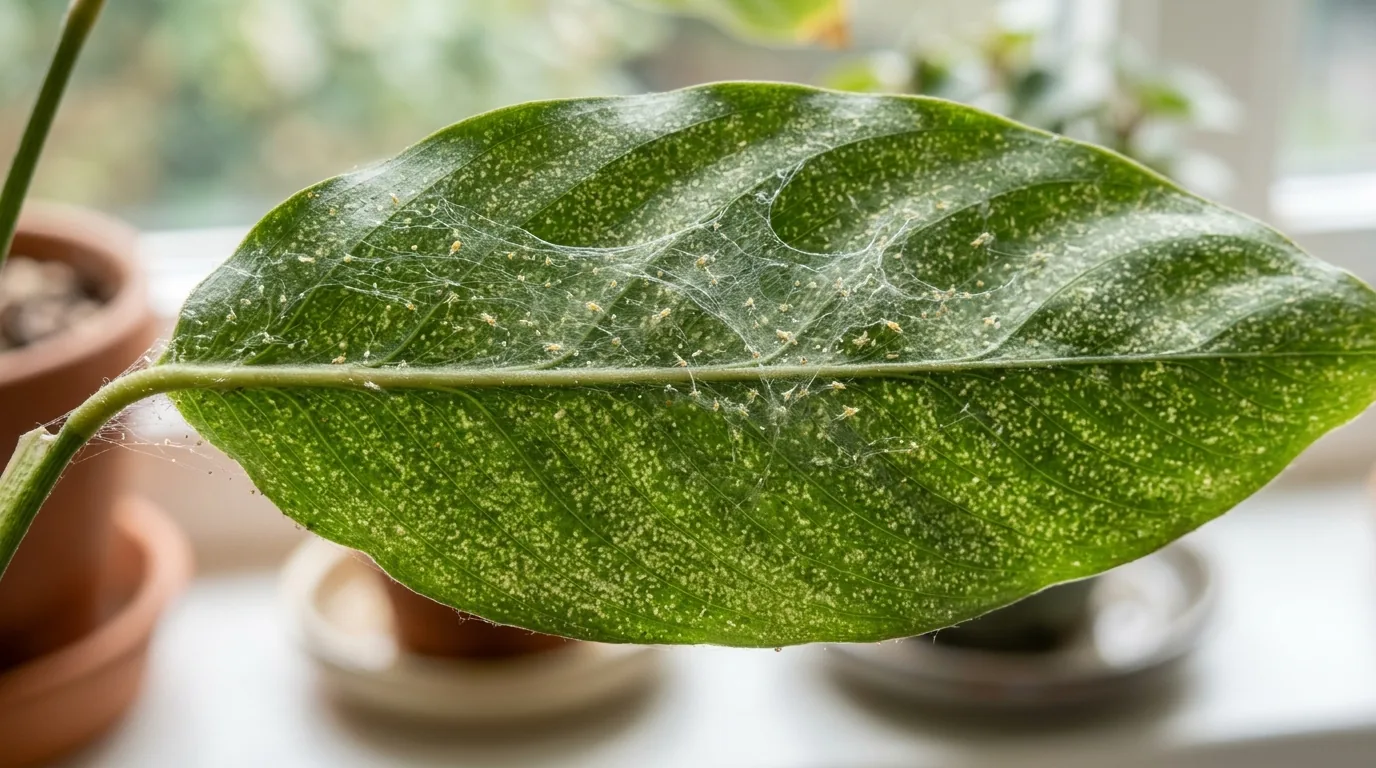
Fine speckling on the leaves, a dull or bronzed look, and then delicate webbing between leaves and stems: that is the classic sign of spider mites. They are not insects but tiny arachnids, less than 1/20 inch long, and in warm, dry conditions a new generation can develop in under a week (UC IPM). That is why an infestation seems to appear overnight, and why one spray is never enough. This guide explains how to get rid of spider mites on houseplants step by step, which treatments work, which make mites worse, and how to stop them coming back, using UC IPM, Colorado State and Iowa State Extension.
How to Tell It Is Spider Mites
Spider mites on houseplants are hard to see with the naked eye. UC IPM describes adults as less than 1/20 inch long with eight legs and an oval body; the common two-spotted spider mite has a dark blotch on each side of its body. A 10x hand lens shows them clearly. Colorado State Extension notes their color varies from red and brown to yellow and green.
| Sign | What you see | Source |
|---|---|---|
| Stippling | Tiny pale or yellow speckles on the upper leaf surface | UC IPM, Colorado State, Iowa State |
| Bronzing | Leaves turn dull, gray or bronze, then yellow, tan or red and drop | UC IPM, Colorado State, Iowa State |
| Spider mite webbing | Fine silk on leaf undersides, between leaves and stems | UC IPM: webbing separates them from other mites, aphids and thrips |
| Moving dots | Tiny specks crawling on the underside of leaves | UC IPM, Iowa State |
Sources: UC IPM Pest Notes 7405 (2011); Colorado State University Extension 5.507 (reviewed 2025); Iowa State University Extension (2024).
If you see speckling but no webbing or mites, check for other pests: thrips leave silvery scars and black specks (see how to get rid of thrips), and aphids are larger and visible as clusters (see aphids on indoor plants).
Why Spider Mites Spread So Fast
- Fast generations: UC IPM says a generation can be completed in less than a week under favorable conditions, and Colorado State says mites can be full-grown in as little as a week after hatching.
- Lots of eggs: a mature female may lay about a dozen eggs a day for a couple of weeks (Colorado State).
- Eggs survive sprays: Colorado State notes that most miticides do not affect eggs, so a single treatment always leaves the next generation behind.
- Dry indoor air: Colorado State says dry conditions greatly favor spider mites, because low humidity lets them get rid of excess water and feed more. Heated homes in winter are ideal for them; see our winter houseplant care guide for raising humidity.
- Stressed plants: UC IPM says mites prefer hot, dusty conditions and water-stressed plants, and damage is worse when plants are thirsty.
How to Get Rid of Spider Mites on Indoor Plants: 6 Steps
- Isolate the plant. Iowa State advises isolating any infested plant so pests cannot spread, and Colorado State says to treat all susceptible houseplants at the same time. Check every plant nearby.
- Cut off the worst leaves. Trim, bag and throw away heavily infested leaves and stems (Colorado State, Iowa State). Iowa State adds that destroying a heavily infested plant is often better than letting it infest others.
- Rinse the plant. Iowa State says to rinse foliage thoroughly in a shower or outdoors; Colorado State suggests hosing small plants in a sink or shower and wiping the leaves of larger plants with a soft, damp cloth. Spraying knocks mites off, kills some and breaks up webbing.
- Spray the undersides with soap or oil. Insecticidal soap and horticultural oil only kill mites they touch, so cover the undersides of the leaves thoroughly (UC IPM, Iowa State). Follow the label, test on a small area a few days first, and do not spray water-stressed plants or treat above 90°F (UC IPM).
- Repeat, repeat, repeat. Iowa State says multiple applications every week for 4 to 6 weeks will be needed for complete control; Colorado State suggests repeating at 1 to 2 week intervals while mites persist. This catches the mites that hatch from eggs after each treatment.
- Fix the conditions. Keep the plant well watered (UC IPM) and raise the humidity: Iowa State says increasing humidity can slow population growth, and UC IPM suggests misting the undersides of infested plants at least once a day.
Treatments Compared
| Treatment | What the sources say | Verdict |
|---|---|---|
| Shower or hose rinse | Removes and kills mites, breaks webbing (Iowa State, Colorado State) | First step, repeat often |
| Horticultural oil (2% summer rate) | “Perhaps the most effective miticide available for home use” (Colorado State) | Best home spray; cover undersides |
| Insecticidal soap | Marginally effective against two-spotted spider mite, weaker through webbing (Colorado State) | Use after rinsing off webbing; repeat |
| Neem oil | A horticultural oil product; same contact and coverage rules apply | See our neem oil guide |
| Predatory mites (Phytoseiulus persimilis and others) | Have worked on interior plants but often need high humidity (Colorado State); about 1 predator per 10 spider mites (UC IPM) | Option for large collections |
| Miticides | Most do not kill eggs; repeat at 10 to 14 days; resistance develops often (Colorado State) | See our best miticide for houseplants guide |
Sources: Colorado State University Extension 5.507 (reviewed 2025); UC IPM Pest Notes 7405 (2011); Iowa State University Extension (2024).
Colorado State is blunt about houseplants: there are generally few effective chemical options indoors beyond soaps and horticultural oils, so thorough, repeated coverage matters more than which bottle you buy.
How to Get Rid of Spider Mites Naturally
The most effective approach is also the least toxic. To get rid of spider mites naturally on indoor plants:
- Water: regular rinsing in the shower and wiping leaves with a damp cloth (Iowa State, Colorado State).
- Humidity: grouping plants, pebble trays or a humidifier, because dry air favors mites (Colorado State, Iowa State).
- Soap and oil: insecticidal soap and horticultural oils have no lasting residue and act only on contact (Iowa State), which is why they are low-risk indoors and why they must be repeated.
- Plant-extract miticides: UC IPM lists products based on garlic extract, clove oil, mint oils, rosemary oil and cinnamon oil.
- Predatory mites: a biological control that can work on indoor plants kept humid (Colorado State).
What Makes Spider Mites Worse
| Mistake | Why it backfires |
|---|---|
| Spraying general insecticides | UC IPM says pyrethroids and organophosphates are not very effective against mites and likely to cause population spikes; carbaryl and malathion kill their natural enemies (Colorado State) |
| Soil-applied imidacloprid | Colorado State says it has contributed to some spider mite outbreaks |
| One treatment and done | Eggs survive most sprays (Colorado State) |
| Letting plants dry out | Water-stressed plants suffer more damage (UC IPM) and may be more nutritious to mites (Colorado State) |
| Spraying in heat | UC IPM: do not use soaps or oils above 90°F or on water-stressed plants |
| Same miticide every time | Resistant strains frequently develop (Colorado State) |
Sources: UC IPM Pest Notes 7405 (2011); Colorado State University Extension 5.507 (reviewed 2025).
Prevention
- Scout often. Iowa State’s first rule is to catch spider mites early. Turn leaves over when you water and do the paper tap test on susceptible plants.
- Quarantine new plants for a couple of weeks, and check plants before bringing them indoors in fall (see bringing plants indoors for winter).
- Keep humidity up and dust down. Colorado State notes dust on foliage interferes with mite predators, and dry air helps mites; wipe leaves regularly.
- Water consistently so plants are never drought-stressed (UC IPM).
Dealing with several pests at once? See our guides to getting rid of fungus gnats and rubbing alcohol for mealybugs.
Frequently Asked Questions
What kills spider mites instantly?
Nothing kills a whole infestation at once, because most sprays do not kill the eggs (Colorado State). A strong rinse in the shower removes many mites immediately, and horticultural oil or insecticidal soap kills the mites it touches, but you need to repeat treatments every week for 4 to 6 weeks (Iowa State).
What causes spider mites on indoor plants?
Mites can arrive on new plants or on plants brought back in from outdoors, then thrive in dry indoor air. Colorado State says dry conditions greatly favor them, and UC IPM says they prefer water-stressed plants.
Does spider mite webbing mean a bad infestation?
Usually, yes. Colorado State and Iowa State say webbing is produced when populations are large. Rinse it off before spraying, because Colorado State notes webbing makes insecticidal soap less effective.
Can spider mites live in soil?
Spider mites live and feed on the leaves, mostly on the undersides (Iowa State), not in the potting mix. Treat the foliage, and clean up fallen leaves around the pot.
Does neem oil kill spider mites?
Neem oil is a horticultural oil and, like other oils, kills the mites it covers. Colorado State considers horticultural oil at the summer rate one of the most effective home miticides. Cover the undersides of the leaves and repeat; see our neem oil guide for safe use.
Do spider mites come back?
Often, if eggs or a few mites survive or conditions stay dry. Keep treating for the full 4 to 6 weeks, keep humidity up and check susceptible plants every week.
Are spider mites harmful to people or pets?
No. They feed on plants by piercing leaf cells (Iowa State). The concern is the damage to your plants and any pesticide you use, so follow label directions around pets.
Sources
- Godfrey, L.D. (2011). Pest Notes: Spider Mites. UC IPM Publication 7405
- Cranshaw, W.S. and Sclar, D.C. Spider Mites. Colorado State University Extension Fact Sheet 5.507 (reviewed 2025)
- Steil, A. (2024). Diagnosing Houseplant Problems Caused by Insect Pests. Iowa State University Extension
- Iowa State University Extension: Two-spotted spider mite