
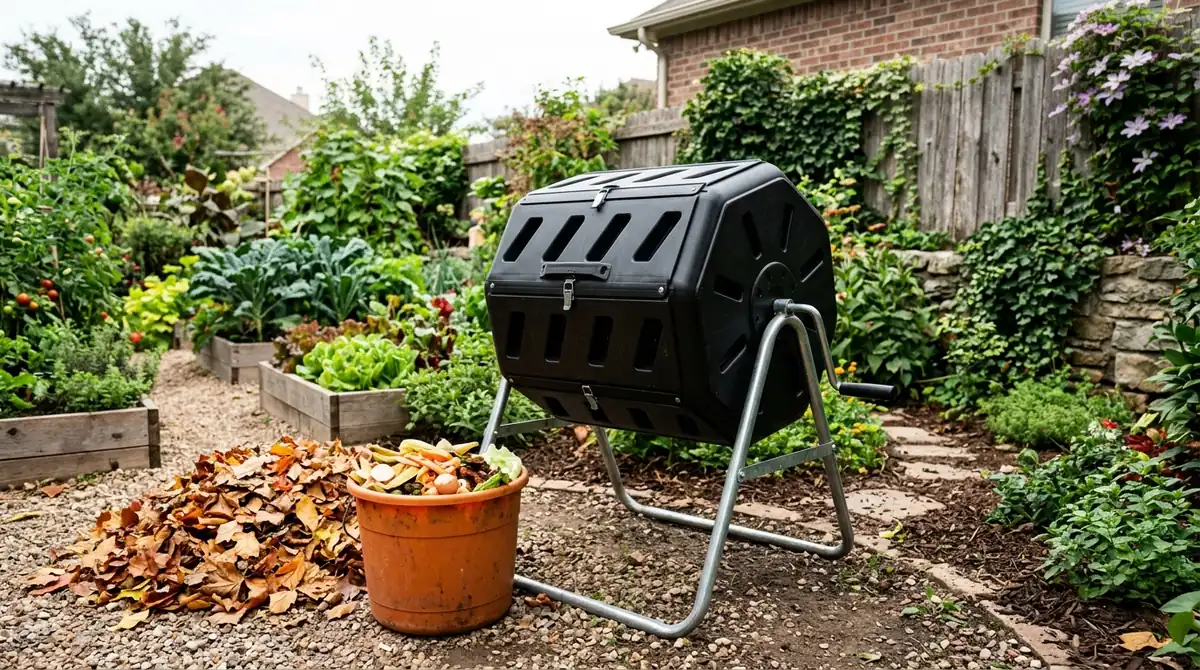
A compost tumbler is a closed drum on a frame or base that you rotate to mix and aerate the contents, instead of turning a pile with a fork. Clemson Extension describes it simply as a single bin with a mechanism for rotation, which aids aeration. Tumblers are tidy, small and easy to turn, but they are not magic: they hold less than a pile, they can turn soggy and smelly if you overload them with kitchen scraps, and they still need the right mix of greens and browns. This guide explains how to use a compost tumbler, how it compares with a bin or pile, whether it is worth buying, and how to fix common problems, using Clemson, University of Maryland and UC Master Gardener guidance.
What Is a Compost Tumbler?
A tumbler is an enclosed container, usually a drum or barrel, mounted so it can be rotated by hand, either on an axle or on a base with rollers. Rotating it mixes the materials and lets air in, the same job a garden fork does with an open pile. Clemson Extension notes one catch: materials may slide rather than mix when you turn a tumbler, and interior baffles (fins inside the drum) help break them up. Some models have two chambers, so one batch can finish while you fill the other.
Composting itself works the same way in a tumbler as anywhere else: microbes break down a mix of nitrogen-rich “greens” and carbon-rich “browns” when they have enough moisture and air. For the basics, see our step-by-step guide to how to compost at home.
Compost Tumbler vs Bin vs Pile
| Feature | Tumbler | Bin | Open pile |
|---|---|---|---|
| Look | Neat, closed, self-contained | Neat | Untidy |
| Turning | Easy: rotate the drum | Can be hard to turn materials inside | Fork or shovel |
| Volume | Small; usually too little for hot composting (Maryland) | Medium to large | Large |
| Hot composting | Limited by volume | Hot or cool (Maryland) | Hot or cool |
| Animals and odor | Closed; odor not usually a problem (UC Master Gardeners) | Depends on lid | Open to pests |
| Cost | Costly (Maryland, UC Master Gardeners) | Buy or build | Free |
| Best for | Small yards, patios, kitchen scraps in batches | Steady household and yard waste | Lots of leaves and garden waste |
Sources: University of Maryland Extension, How to Make Compost at Home (2024); UC Master Gardener Program of Contra Costa County (2026); Clemson HGIC 1600 (2024).
The compost tumbler vs bin choice comes down to volume and convenience. University of Maryland Extension lists tumblers as neat, good for aeration, good for small spaces and well suited to cool composting, but costly, usually too small for hot composting, awkward to fill or empty, and needing close attention. The UC Master Gardeners add that tumblers are self-contained, not messy and do not leach nutrients into the ground.
How to Use a Compost Tumbler, Step by Step
- Place it on a level, convenient spot near the kitchen door or garden, where you can reach it to load and turn it easily.
- Collect materials first, then fill in one go. The UC Master Gardeners say a tumbler works best when material is added all at once. Keep a container of kitchen scraps and a bag of dry leaves or shredded paper until you have enough for a batch. With a two-chamber tumbler, fill one side, then start collecting for the other.
- Mix greens and browns. Clemson and Maryland Extension give an ideal of about 30 parts carbon to 1 part nitrogen by weight, and Maryland says microbes work well anywhere from 25:1 to 40:1. In practice that means plenty of browns, such as dry leaves and shredded paper, with your kitchen scraps.
- Chop large pieces. Clemson lists oversized materials as a cause of slow decomposition, so cut up stems and big scraps.
- Check the moisture. Maryland and Clemson both describe the target as a wrung-out sponge: moist but not soggy.
- Turn it regularly. Rotation is what a tumbler is for. Clemson suggests turning an ordinary pile about once a week, and the UC Master Gardeners turn hot piles as often as once a day, so turning a tumbler every few days sits comfortably between the two. If the contents slide as one lump, the drum needs baffles or more coarse material (Clemson).
- Stop adding to a finished batch. Let it cure, then empty it when the material looks dark and crumbly and you can no longer recognize the original scraps.
What to Put In (and What to Keep Out)
| Greens (nitrogen) | Browns (carbon) | Keep out |
|---|---|---|
| Fruit and vegetable scraps (C:N 15-20:1) | Fall leaves (30-80:1) | Meat, fish and dairy |
| Coffee grounds (20:1) | Straw (40-100:1) | Oils and grease |
| Grass clippings (15-25:1) | Paper (150-200:1) | Pet and animal waste |
| Fresh plant trimmings | Wood chips (200-500:1), in small amounts | Diseased plants and weed seeds |
Source: Clemson Cooperative Extension HGIC 1600, Composting (revised 2024). Carbon to nitrogen ratios by weight.
Coffee grounds and eggshells are popular tumbler additions; see what they really add in our guides to coffee grounds for plants and eggshells for plants. Banana peels compost well too: see banana peel fertilizer.
How Long Does a Tumbler Take?
There is no single answer, because speed depends on the mix, moisture, particle size, volume and temperature, and tumblers are usually too small to stay as hot as a big pile (Maryland). The UC Master Gardeners say tumblers can produce quick compost. For comparison, the sources give these times for the two classic methods:
| Method | How it works | Time to compost |
|---|---|---|
| Hot composting | Balanced mix, frequent turning, pile heats up | As little as 2 weeks (UC Master Gardeners); 6 to 8 weeks (Maryland) |
| Cool composting | Materials added over time, little turning | 3 months or longer (UC Master Gardeners); about a year (Maryland) |
Sources: UC Master Gardener Program of Contra Costa County (2026); University of Maryland Extension (2024).
A tumbler loaded as one balanced batch and turned often behaves more like the fast method; one that is topped up with scraps every day behaves more like the slow one. Clemson notes that pathogens and weed seeds are only reliably killed above 140°F, which small tumblers rarely reach, so keep diseased plants and seedy weeds out.
Troubleshooting: Smell, Wet, Slow
| Problem | Likely cause | Fix |
|---|---|---|
| Rotten smell | Too wet, too many food scraps, clumping (Clemson) | Add browns and coarse material, turn; keep the lid closed in rain |
| Ammonia smell | Too many grass clippings or scraps, too little air (Clemson) | Add browns, break up clumps, turn |
| Soggy, slimy contents | Too many kitchen scraps, too few browns (Maryland) | Mix in dry leaves, shredded paper or cardboard |
| Nothing happening | Too dry, too little nitrogen, pieces too big, batch too small (Clemson) | Add water to wrung-sponge moisture, add greens, chop, fill the drum |
| Material slides in one lump | No mixing inside the drum (Clemson) | Add coarse browns; choose a tumbler with baffles |
Sources: Clemson HGIC 1600, Table 2 (2024); University of Maryland Extension (2024).
Is a Compost Tumbler Worth It?
Many gardeners use both: a tumbler for kitchen scraps and a bin or pile for fall leaves, which also gives you a store of browns to add to the tumbler all year.
Compost Tumbler DIY
You can build a tumbler from a food-grade plastic drum. The University of Arkansas Cooperative Extension publishes a plan (FSA-6034, Compost Tumblers) for a tumbler made from one 55-gallon food-grade drum on a wooden 2×4 frame with a steel axle rod, with 2×4 baffles bolted inside the drum to mix the contents. The plan uses hinges and a hasp for the loading door. Use only a drum that held food-safe contents.
Once you have compost, use it to enrich garden beds or mix a little into potting soil; see our guide to homemade plant food and synthetic vs organic fertilizer.
Frequently Asked Questions
How do you use a compost tumbler for beginners?
Collect enough scraps and browns to fill it at once, mix in plenty of dry browns so the batch is close to 30 parts carbon to 1 part nitrogen (Clemson, Maryland), moisten it like a wrung-out sponge, close it and turn it every few days. Empty it when the contents are dark and crumbly. The UC Master Gardeners say tumblers work best when material is added all at once.
Is a compost tumbler better than a bin?
Not better, just different. Maryland Extension says tumblers are neat, easy to aerate and good for small spaces but costly and usually too small for hot composting, while bins hold more and can be used for hot or cool composting.
Why does my compost tumbler smell?
Usually it is too wet with too many kitchen scraps. Clemson Extension lists excess moisture, too many food scraps and clumping as causes of a rotten smell; add dry browns, break up clumps and turn it.
How often should you turn a compost tumbler?
Every few days is a practical rhythm. Clemson suggests turning an ordinary pile about once a week, and UC Master Gardeners turn hot piles as often as once a day; a tumbler makes frequent turning easy.
Can you keep adding to a compost tumbler?
You can, but it slows the batch, because fresh scraps keep restarting it. The UC Master Gardeners say tumblers work best when material is added all at once. A two-chamber tumbler lets one side finish while you fill the other.
Do compost tumblers get hot enough to kill weed seeds?
Usually not. Maryland Extension says tumbler volume is usually inadequate for hot composting, and Clemson says weed seeds and pathogens are destroyed above 140°F, so keep seeding weeds and diseased plants out of a tumbler.
Is a compost tumbler worth it?
For small yards and kitchen scraps, often yes: it is tidy, closed and easy to turn. For lots of leaves and garden waste, a bin or open pile is cheaper and holds far more.
Sources
- Polomski, R.F., Doubrava, N. and Lott, T. Composting. Clemson Cooperative Extension HGIC 1600 (revised 2024)
- University of Maryland Extension: How to Make Compost at Home (2024)
- UC Master Gardener Program of Contra Costa County: Composting (2026)
- Hirrel, S.S. Compost Tumblers, FSA-6034. University of Arkansas Cooperative Extension Service