
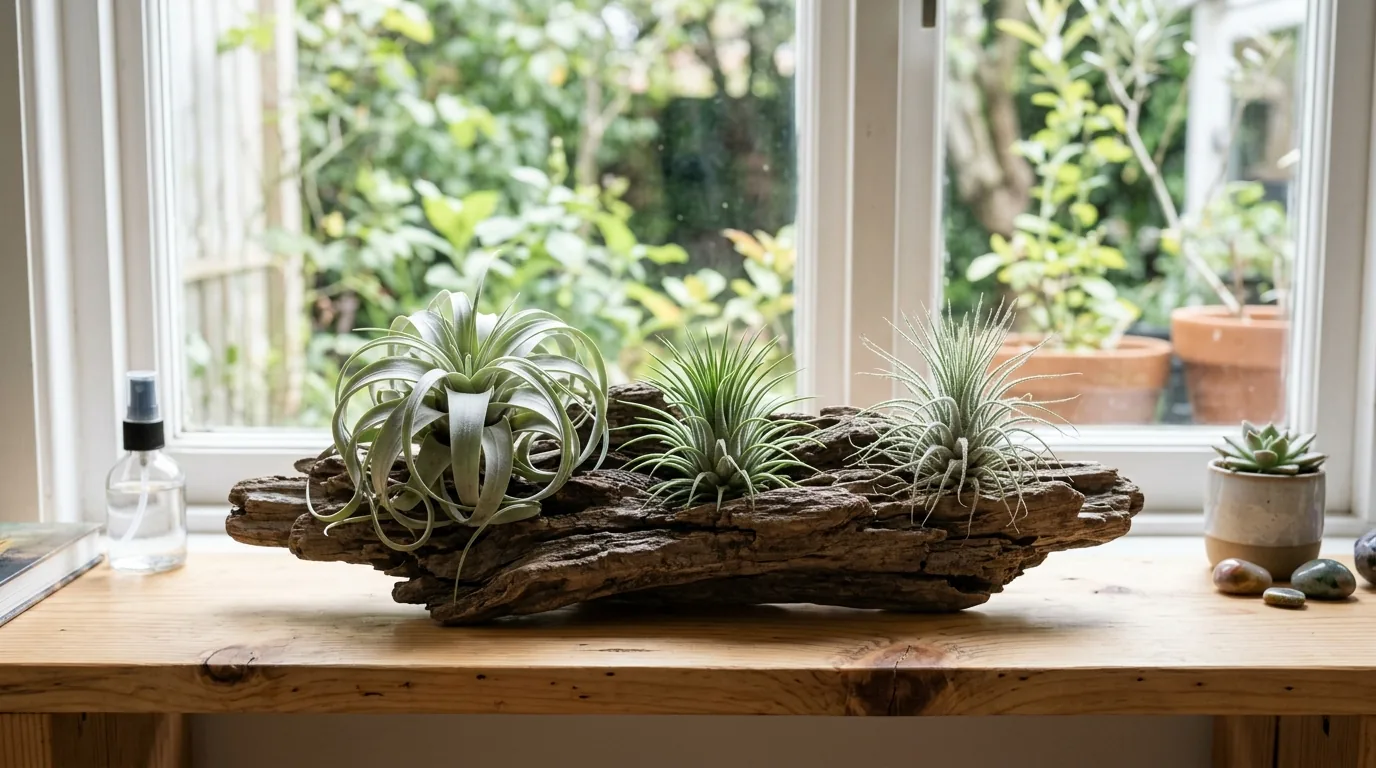
Air plants (Tillandsia) are bromeliads that grow without soil. Clemson HGIC counts over 500 species native to Central and South America, the southern United States and the West Indies (UVM Extension says more than 600), and explains that their roots serve only to attach them to trees or rocks. They take water and nutrients in through their leaves, which NC State describes as covered in silvery scales. This guide covers air plant care indoors: light, how to water air plants (soaking, misting and drying), feeding, mounting, flowers and pups, and problems, as clear air plant care instructions drawn from Clemson, Penn State, UF/IFAS, NC State and UVM Extension.
Air Plant Care at a Glance
| Need | What the sources say |
|---|---|
| Light | Bright, filtered or indirect light; keep out of direct sun (Clemson, UVM, UF/IFAS) |
| Temperature | Nights above 55°F, days 65 to 90°F (Penn State); 50 to 90°F with good air circulation (UVM) |
| Water | About once a week: soak 20 to 30 minutes or mist well (Clemson); soak 20 minutes to 1 hour (Penn State); soak 30 to 60 minutes (UVM) |
| Drying | Shake out water and dry upside down (Clemson); 1 to 2 hours on the side or upside down (UVM) |
| Fertilizer | Optional; bromeliad fertilizer at one-fourth strength monthly (Clemson); half strength or less (NC State) |
| Soil | None; roots are only for attachment (Clemson, NC State) |
| Flowers | Once per plant, then pups form at the base (Clemson, UVM) |
Sources: Clemson HGIC 1515; Penn State Extension (2024); UVM Extension (2026); UF/IFAS Gardening Solutions; NC State Extension.
Light and Temperature
All the sources agree on bright light without direct sun. Clemson recommends bright, filtered light from an eastern, southern or western exposure, UF/IFAS says near a south, east or west window, and Penn State Extension prefers an east or west window. UVM says never direct sun.
For temperature, Penn State gives nights above 55°F and days between 65 and 90°F, while UVM says 50 to 90°F with good air circulation. Penn State also warns that air conditioners and heating vents dry air plants out, so keep them away from blowing air. If you put them outside for summer, UVM says to bring them back in before the first frost.
How to Water Air Plants
There are two methods, soaking and misting, and the sources differ on the details:
| Source | Soaking | Misting or rinsing |
|---|---|---|
| Clemson HGIC | Submerge 20 to 30 minutes, once a week | Or mist well, once a week |
| Penn State | Submerge weekly for 20 minutes to an hour | Mist until runoff every other day in dry homes, or rinse under tepid water twice a week |
| UVM Extension | Soak 30 to 60 minutes in room-temperature water, once a week | Or mist two to three times a week |
| UF/IFAS | Not specified | A good misting once a week, then let dry |
Sources: Clemson HGIC 1515; Penn State Extension; UVM Extension; UF/IFAS Gardening Solutions.
A weekly soak is the most common advice among these sources. Use room-temperature water. UVM Extension suggests rainwater, bottled water, or tap water left to stand overnight so chlorine can escape, and says to avoid softened, filtered or distilled water. In a very dry, heated home, add misting between soaks. Clemson lists the signs of thirst: leaves that curl or roll, dull foliage and brown tips.
Drying: The Step That Prevents Rot
Air plants need water but cannot stay wet. UVM warns that water collecting in the crevices between leaves can cause rot, and Clemson says to shake out water caught between the leaves and turn the plant upside down to drain and dry, with good air circulation helping it dry between waterings.
- After soaking, lift the plant out and gently shake it.
- Set it upside down or on its side on a towel or dish rack. UVM suggests one to two hours.
- Return it to its display only when dry. For terrariums, Penn State says to let plants dry at least four hours first.
- Keep flowers dry: UVM notes a wet flower can turn mushy and rot.
Fertilizer
Feeding is optional, and the sources differ on strength:
- Clemson: not necessary, but plants are more vigorous with a light application: a liquid bromeliad fertilizer diluted to one-fourth the recommended rate, once a month, added to the normal watering.
- Penn State: monthly, with a bromeliad or orchid formula, citing Clemson’s one-fourth rate.
- NC State: during the growing season, a dilute liquid fertilizer at half strength or less.
- UVM: no need to fertilize; if you do, use a product made for air plants and follow the label.
The common ground: weak, occasional feeding in the soaking water, and none at all is fine. Penn State says maximum allowable light, enough water and fertilizer can encourage blooming.
Mounting and Display (Including Terrariums)
Because the roots only anchor the plant, air plants should not be planted in soil (NC State). Clemson suggests bark, shells, rocks, a shallow dish, glass globes or stands, or hanging from fishing line or thin wire, and stresses that whatever you use must not hold water. UF/IFAS describes attaching plants with hot glue allowed to cool slightly first, or tying them on with wire. NC State lists wood, ceramic and glass mounts.
- Glued or mounted plants: water them by misting or by soaking the whole mount if it tolerates water, then dry it upside down.
- Air plants in a terrarium: Penn State’s four-hour drying rule applies; open containers suit air plants better than closed ones.
- Grouped displays: keep enough space between plants for air to move.
Flowers and Pups
Each air plant blooms only once in its life (UVM, Penn State). Clemson and UF/IFAS say the flowers are usually under 2 inches and that indoor blooms come in late winter and mid-summer; UF/IFAS adds that they can last days or even months. In Tillandsia ionantha, NC State says the top leaves turn bright red before blooming.
After flowering, the parent slowly dies and new plants, called pups, form at its base (Clemson, UF/IFAS). Penn State and UVM both say to separate a pup once it is about one-third the size of the parent; UVM suggests a gentle twist and tug. You can also leave pups attached: NC State notes that T. ionantha forms clumps.
Problems and Fixes
| Symptom | Likely cause | Fix |
|---|---|---|
| Leaves curling or rolling, dull color, brown tips | Dehydration (Clemson) | Soak for 20 to 60 minutes, then dry; water weekly; keep away from heaters and AC (Penn State) |
| Center turns brown or black and falls apart | Rot from water trapped between leaves (UVM, Clemson) | Shake out water and dry upside down after every watering; remove plants whose center has collapsed |
| Plant fading slowly after blooming | Normal: the parent dies after flowering (Clemson) | Keep caring for it until pups are a third of its size, then separate them |
| Pale, stretched plant | Too little light | Move to bright, filtered light near an east, south or west window |
| Bleached or scorched leaves | Direct sun (Clemson, UVM) | Move out of direct sun |
| Dead or damaged outer leaves | Normal aging or past dryness | Trim them off (UVM) |
Sources: Clemson HGIC 1515; UVM Extension; Penn State Extension.
Are Air Plants Safe for Pets?
The ASPCA’s toxic and non-toxic plant list has no entry for Tillandsia, and NC State’s air plant page does not address toxicity, so we cannot give a sourced rating. The ASPCA notes in general that eating any plant material can cause vomiting and stomach upset in dogs and cats. Place them out of reach of pets that chew plants, and call your veterinarian or the ASPCA Animal Poison Control Center at (888) 426-4435 if a pet eats one. For plants with a confirmed ASPCA rating, see our lists of cat-safe plants and plants safe for dogs.
Air plants are relatives of the potted bromeliads. For other easy, soil-free or small-space ideas, see our guides to kokedama and low-maintenance indoor plants. For other bromeliads, see our guides to bromeliad care.
Frequently Asked Questions
How often should I water air plants?
About once a week. Clemson suggests misting well or soaking for 20 to 30 minutes weekly; UVM suggests a weekly 30 to 60 minute soak or misting two to three times a week; Penn State adds extra misting in dry homes.
Should I soak or mist my air plant?
Both work: Clemson lists either a good misting or a 20 to 30 minute soak. Misting is the practical choice for glued or mounted plants. Either way, shake off excess water and let the plant dry upside down (Clemson).
How long should air plants dry after soaking?
UVM suggests one to two hours on the side or upside down. Penn State says at least four hours before putting them back into a terrarium.
Do air plants need sunlight?
They need bright, filtered or indirect light, such as near an east, south or west window, but not direct sun (Clemson, UF/IFAS, UVM).
Do air plants need fertilizer?
No, but it helps. Clemson suggests a bromeliad fertilizer at one-fourth strength once a month in the soaking water; UVM says it is not required.
Why is my air plant dying after it bloomed?
That is normal. Each air plant flowers once; afterwards the parent slowly dies while pups form at its base (Clemson). Separate the pups at about one-third of the parent’s size (Penn State, UVM).
Can you use tap water for air plants?
UVM says tap water is fine if you let it stand overnight so chlorine escapes, and to avoid softened, filtered or distilled water. Rainwater and bottled water also work.
Sources
- Smith, B. H. Clemson HGIC 1515: Air Plants (reviewed 2021)
- Papas, C. Penn State Extension: Tillandsias as Houseplants (2024)
- Benoit, D. J. UVM Extension: Tillandsia, the captivating world of soil-less air plants (2026)
- UF/IFAS Gardening Solutions: Air Plants (Tillandsia)
- NC State Extension Gardener Plant Toolbox: Tillandsia ionantha
- ASPCA: Toxic and Non-Toxic Plants