
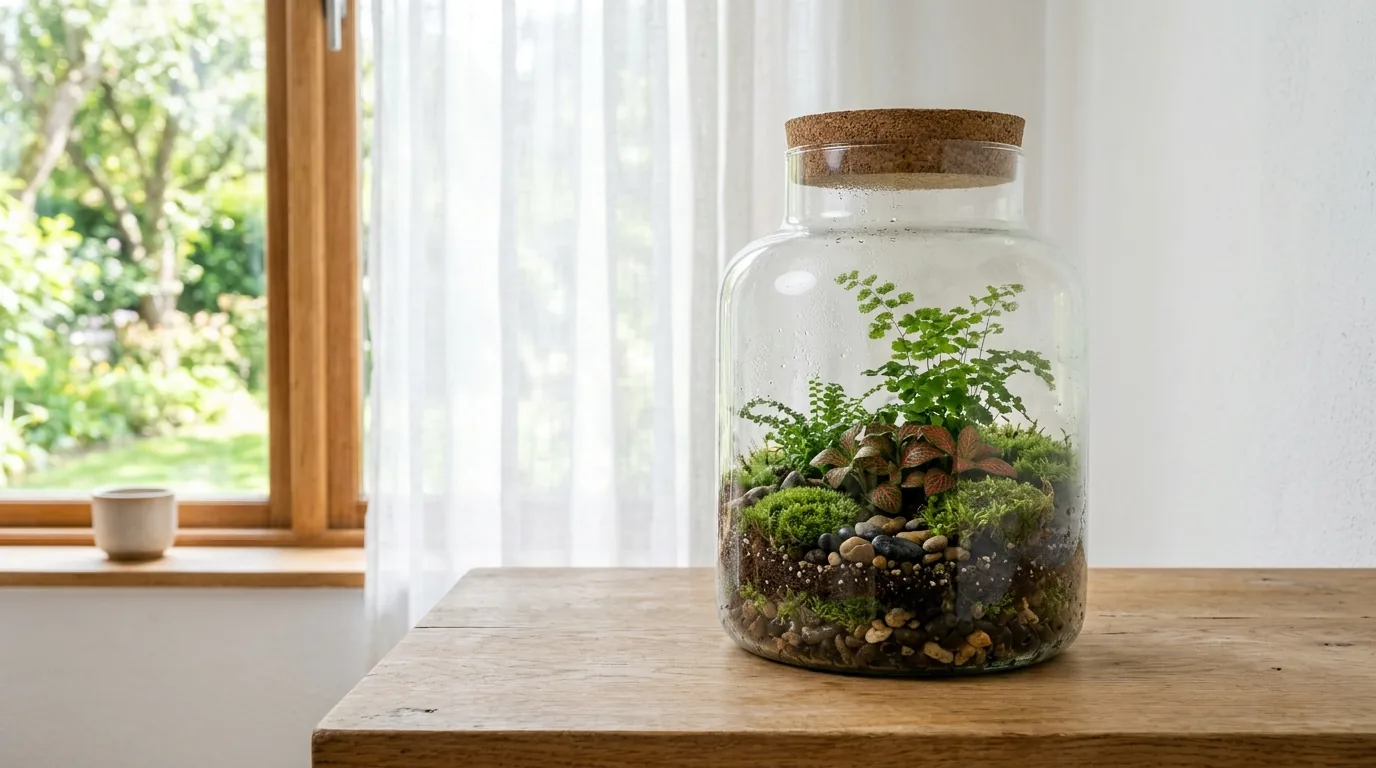
A terrarium is a small garden inside a clear container. A closed one recycles its own water: moisture evaporates, condenses on the glass and drips back to the soil, so it may need watering only every few months. A Penn State Master Gardener article traces the idea to Nathaniel Ward’s glass cases of 1833, in which it says 95% of plants survived compared with 5% outside them. This guide covers how to make a terrarium step by step, closed terrarium layers (and the gravel debate), the best closed terrarium plants, terrarium plants for beginners, how to make a terrarium in a jar, and aftercare, following Iowa State, Oregon State and Penn State Extension.
Open vs Closed Terrariums
| Closed terrarium | Open terrarium | |
|---|---|---|
| Container | Glass with a lid: jar, aquarium, bowl with a glass cover (Iowa State) | Bowl or vase with a wide opening (Oregon State) |
| Humidity | High; water recycles inside | Room humidity |
| Best plants | Small tropicals, ferns, mosses that like humidity (Iowa State) | Succulents and cacti (Oregon State) |
| Watering | Many need water only every 3 to 6 months (Iowa State); rarely needed once established (Penn State) | Check weekly; succulents once a month or less (Oregon State) |
| Main risk | Disease or algae from trapped humidity (Oregon State) | Drying out |
Sources: Iowa State Extension (2024); Oregon State Extension (2024); Penn State Extension (2026).
Oregon State Extension recommends that beginners start with an open container, because closed ones trap humidity that can lead to disease or algae. If you want the self-watering effect of a closed terrarium, the steps below show how to keep that risk low. Cacti and succulents do not belong in a closed terrarium: Iowa State Extension says they suffer in the humidity.
What You Need
- A clear container you can reach into: Iowa State suggests an old 10-gallon fish tank, a large glass jar or a large glass bowl with a glass lid. Penn State says to wash it in hot, soapy water, rinse well and dry it.
- Horticultural charcoal (Iowa State, Oregon State) or activated charcoal (Penn State).
- Potting mix: light, well-drained potting soil (Iowa State) or soilless potting mix (Oregon State).
- Optional gravel, pebbles or perlite for a bottom layer (see the debate below).
- Small plants with the same light and water needs.
- Tools: a spoon or funnel for soil, long tweezers or a chopstick for planting (Penn State), and a mister.
- Decorations (optional): stones, shells, preserved moss. Iowa State says not to add wood, because driftwood and similar products break down quickly and can bring in insects and fungi; Oregon State and Penn State list driftwood as decor. If you use wood in a closed terrarium, Iowa State’s warning is worth weighing.
Closed Terrarium Layers (and the Gravel Debate)
Terrariums have no drainage holes, so the classic design puts a “drainage” layer at the bottom. The three extension sources do not agree on whether that is needed:
| Layer | Iowa State | Oregon State | Penn State |
|---|---|---|---|
| Gravel, pebbles or perlite | 2 inches at the bottom | Skip it: stones can let water pool and cause root rot | Optional; once thought to aid drainage, now an aesthetic choice |
| Charcoal | 1/4 inch, aids drainage and controls odors | 1 to 1½ inches of horticultural charcoal, absorbs runoff and odors | A handful of activated charcoal mixed into the soil |
| Soil | 1 to 4 inches of light, well-drained potting soil | 3 to 4 inches of soilless mix, depending on container and roots | Enough to hold the root mass of the largest plant |
| Top | Shape hills and valleys in larger terrariums | Thin layer of small decorative rock, kept thin near plant crowns | Mound for height; gravel can go on top instead |
Sources: Iowa State Extension; Oregon State Extension; Penn State Extension.
The common ground is simple: charcoal plus enough light potting mix for the roots. A gravel layer is a personal choice. What every source agrees on is that a terrarium has nowhere for extra water to go, so the real protection against rot is watering sparingly, not the bottom layer.
How to Make a Terrarium, Step by Step
- Clean the container in hot, soapy water, rinse and dry it (Penn State).
- Add the base: if you use gravel, pour it in first (Iowa State uses 2 inches), then the charcoal. If you skip gravel, start with the charcoal (Oregon State), or mix a handful into the soil (Penn State).
- Add the potting mix deep enough for the largest root ball, and shape it into slopes if you like (Iowa State, Penn State). Tap it gently to settle it.
- Plan the layout: Iowa State suggests one upright, one trailing and one intermediate plant as a general guide; Penn State suggests an anchor plant as the focal point.
- Plant: remove each plant from its pot and shake off excess soil. Iowa State says you may need to loosen or remove part of the root ball to fit. Use tweezers or a chopstick in narrow containers and firm the soil around the roots.
- Decorate with stones, shells or preserved moss.
- Water lightly: Iowa State suggests misting heavily or using a bulb sprinkler to moisten the soil, then trickling a little water down the glass to rinse off soil.
- Close it: Penn State says to let the foliage dry before putting the lid on. Iowa State suggests a lid, a piece of glass or plastic wrap.
Closed Terrarium Plants
Iowa State’s rule: choose plants with slow growth, high humidity tolerance and small leaves, and make sure every plant in the container needs the same moisture and light. Oregon State adds: buy the smallest plants you can find so they don’t outgrow the container quickly. Iowa State’s suggestions for closed terrariums include:
| Role | Plants (Iowa State) |
|---|---|
| Upright, taller | Sweet flag, holly fern, bird’s nest fern, small dracaena, peacock plant |
| Mid-size | Nerve (net) plant, aluminum plant, prayer plant, radiator plant (peperomia), begonia, maidenhair fern, rabbit’s foot fern, mini African violet, table fern, pitcher plants, sundew, Venus fly trap |
| Low or trailing | Earth star, creeping moss, baby’s tears, creeping fig, strawberry vine |
| Avoid in closed terrariums | Cacti and succulents (they suffer in humidity); common philodendron and spider plant (Iowa State lists them as not suitable) |
Source: Iowa State Extension, How to Create and Care for a Terrarium.
Terrarium plants for beginners: from Iowa State’s list, nerve plant, small ferns, baby’s tears and creeping fig are widely sold in small pots. For their care outside glass, see our guides to nerve plant care, maidenhair fern care, prayer plant (Maranta) care, begonia care and African violet care. Pitcher plants, sundews and Venus fly traps are also on Iowa State’s list; for carnivorous houseplants, see our guide to carnivorous plants for fungus gnats. Live moss needs more water than most plants, so Oregon State suggests preserved moss for decoration.
For an open succulent terrarium, use a wide container and a mix made for succulents and cacti (Oregon State); Penn State suggests two parts potting soil to one part coarse sand, perlite or bonsai grit. See our guide on how to grow succulents.
How to Make a Terrarium in a Jar
A large glass jar is on Iowa State’s list of containers, and Penn State mentions mason jars. The method is the same, scaled down:
- Choose a jar with an opening wide enough for your hand or for long tweezers.
- Use thin layers: a little charcoal and just enough potting mix for one or two small root balls.
- Pick one or two tiny plants, such as a small fern or nerve plant, plus moss or stones.
- Use a funnel or rolled paper to add soil without dirtying the glass.
- Water very little. A small jar holds little soil, so too much water has nowhere to go.
- Close the lid and watch the condensation for the first days (see below).
Light, Water and Aftercare
Light: Iowa State recommends medium to bright, indirect light, such as an east or north window, and warns against direct sun because heat builds up quickly inside the glass. Penn State says bright light but not direct sunlight. If the room is dim, a grow light works well for terrariums.
Water: Iowa State says to check every few weeks and add water only when the soil becomes dry; many closed terrariums need it every 3 to 6 months. For open terrariums, Oregon State suggests checking with a finger to the first knuckle and watering at the base of each plant, about once a week or less.
Condensation: some fog on the glass is normal (Iowa State). If the glass stays heavily fogged or water runs down it, Iowa State says to uncover the terrarium until some moisture evaporates, or leave the lid cracked; Penn State suggests sponging or siphoning excess water out.
Feeding: Iowa State says to generally avoid fertilizer, because it speeds growth and crowding; only if plants show signs of low fertility, use a balanced fertilizer such as 10-10-10 at quarter strength. Oregon State suggests half-strength water-soluble fertilizer about once a month, or skipping it to keep plants small longer.
Pruning and replacing: trim plants as they grow and remove any foliage showing disease (Iowa State, Penn State). Iowa State notes that no terrarium plant is permanent: all eventually outgrow the space and need replacing.
Problems and Fixes
| Problem | Likely cause | Fix |
|---|---|---|
| Glass always fogged, water running down | Too much water | Remove the lid for a while or leave it cracked (Iowa State); sponge out excess (Penn State) |
| Mold, fuzzy growth, rotting leaves | Trapped humidity (Oregon State), dead leaves left inside | Remove affected foliage or plants (Penn State); air it out; water less |
| Green film on glass or soil | Algae from trapped humidity (Oregon State) | Wipe the glass, reduce water, keep out of direct sun |
| Plants wilting, soil smells | Root rot from pooled water (Oregon State) | Remove the plant, let the soil dry, water much less |
| Plants pressing against the glass | Normal growth | Prune, or replace with a smaller plant (Iowa State) |
| Leaves scorched or plants cooked | Direct sun (Iowa State) | Move to bright, indirect light |
| Small mushrooms or tiny flies | Fungi or fungus gnats in moist soil; wood can bring in fungi and insects (Iowa State) | See mushrooms in houseplant soil and getting rid of fungus gnats |
Sources: Iowa State Extension; Oregon State Extension; Penn State Extension.
For another small indoor garden project without a pot, see our guide to kokedama, the Japanese moss ball.
For humid indoor growing setups, see our guides to greenhouse cabinets. For other small indoor garden projects, see our guides to air plant care. Venus flytraps are also on Iowa State’s list of closed-terrarium plants; see our guide to Venus fly trap care.
Frequently Asked Questions
What are the layers of a closed terrarium?
Typically charcoal and light potting mix, with an optional gravel layer underneath. Iowa State uses 2 inches of gravel, 1/4 inch of charcoal and 1 to 4 inches of soil; Oregon State skips gravel and uses 1 to 1½ inches of charcoal under 3 to 4 inches of soilless mix.
Do you need rocks at the bottom of a terrarium?
No. Oregon State advises against a stone layer because water can pool there and cause root rot, and Penn State says gravel is an aesthetic choice, not a requirement. Iowa State still recommends 2 inches of gravel, pebbles or perlite.
What plants are best for a closed terrarium?
Small, slow-growing plants that like humidity, such as nerve plant, small ferns, baby’s tears, creeping fig, aluminum plant, prayer plant and mini African violets (Iowa State). Avoid cacti and succulents in closed containers.
How often do you water a closed terrarium?
Rarely. Iowa State says to check every few weeks and water only when the soil is dry, which for many closed terrariums is every 3 to 6 months. Penn State says supplemental watering is rarely needed once established.
Where should I put my terrarium?
In medium to bright, indirect light, such as an east or north window (Iowa State). Never in direct sun, which heats the inside of the glass quickly.
Why is my terrarium so foggy?
Some condensation is normal. If the glass stays heavily fogged, there is too much water: take the lid off until some evaporates, or leave it cracked (Iowa State).
Do terrariums need charcoal?
All three extension sources we used include it. Iowa State says it aids drainage and controls soil odors; Oregon State says it absorbs runoff and odors and discourages bacterial growth.
Sources
- Steil, A. Iowa State University Extension: How to Create and Care for a Terrarium (reviewed 2024)
- Pokorny, K. Oregon State University Extension: Tiny gardens, big impact: how to make (and care for) a terrarium (2024)
- Janosko, C. B. Penn State Extension Master Gardeners: How to Create a Closed Terrarium (2026)