
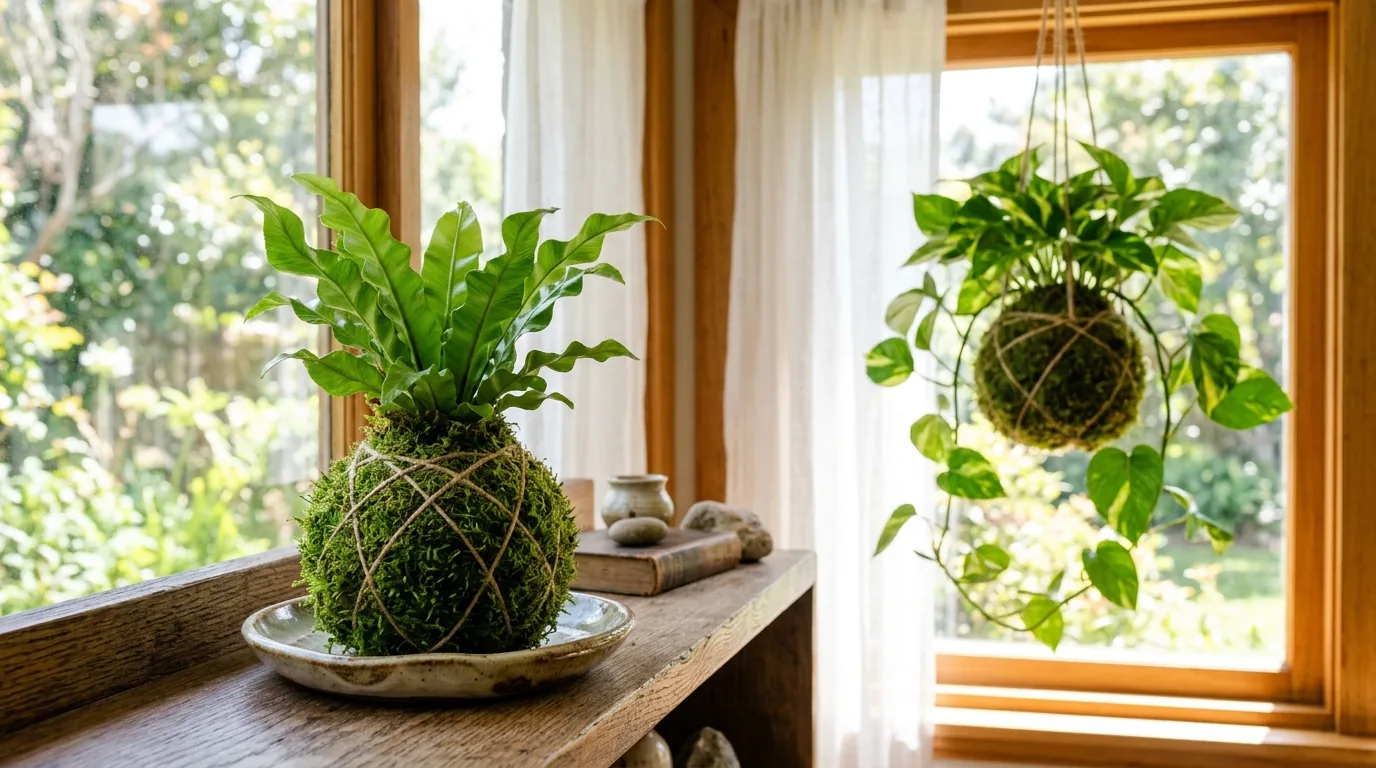
Kokedama is a plant grown in a ball of soil wrapped in moss and tied with string, with no pot at all. Penn State Extension explains that the word is Japanese: koke means moss and dama means ball, and that the practice is akin to bonsai. The finished kokedama moss ball can sit on a saucer, rest on driftwood or hang in a “string garden” (University of Illinois Extension). This guide covers how to make kokedama step by step, the soil mix, the best kokedama plants, watering by soaking, and care, following Illinois Extension and Penn State Extension.
What You Need
| Material | What the sources say |
|---|---|
| Plant | A plant from a 4 to 5 inch pot (Illinois 2019); any size works, the ball just grows with the root mass (Illinois 2022) |
| Soil | Lightweight potting mix or peat moss plus bonsai soil (akadama) or clay-based cat litter (Illinois) |
| Moss | Sheet moss or Spanish moss (Illinois); sheet moss (Penn State) |
| Binding | String or twine (Illinois); twine or wire (Penn State) |
| Tools | Scissors, a bucket for mixing and soaking, gloves, newspaper or a tarp (Illinois 2019) |
| Display | Saucer, tray, bowl, teacup, driftwood, or a hanger (Illinois, Penn State) |
Sources: University of Illinois Extension (Anderson 2019; Haag 2022); Penn State Extension (Papas 2026).
The Kokedama Soil Mix
The ball has to hold together when wet, which ordinary potting mix alone does poorly. Both Illinois Extension articles use 70% potting mix or peat moss and 30% bonsai soil. Illinois describes akadama as a coarse, clay-like mineral used as bonsai soil, and its 2019 article offers clay-based cat litter as a substitute. Add water slowly and mix until you can press it into a ball that does not fall apart.
Penn State takes a slightly different view: plain potting soil works for most plants, and it suggests about one-third akadama or clay cat litter mixed into potting soil for trees and shrubs that need more water or are heavily root-bound. So the 70:30 mix is a safe default, and the clay part matters most for woody plants and for any ball that keeps crumbling.
How to Make Kokedama, Step by Step
- Soak the moss. Put dried sheet or Spanish moss in a bucket of water for about an hour to rehydrate it, then squeeze out the excess (Illinois).
- Mix the soil. Combine 70% potting mix or peat with 30% akadama or clay cat litter, adding water until it holds a firm ball (Illinois).
- Prepare the plant. Take it out of its pot, dust off excess soil and gently break apart the root ball so most roots are exposed (Illinois).
- Make the ball. Either push a hole into the soil ball and set the roots in, or split the ball in two, lay the roots on one half and press the halves back together. Firm the soil around the base of the stem (Illinois).
- Wrap in moss. Press moss over the whole ball, or lay a thin sheet of moss flat, set the ball in the middle and fold it up around it (Illinois 2022).
- Tie it. Fix the end of the string, then wind it around the ball in every direction, at least two passes over the surface (Illinois 2019), and tie it off tightly for a firm, sturdy ball. Penn State says to squeeze the finished ball firmly.
- Finish. Trim loose string ends, then set the ball on a saucer, mount it on wood, or add a hanging loop (Illinois 2019).
Best Kokedama Plants
Illinois Extension lists ferns, philodendron, dracaena, spider plants and small orchids as good kokedama plants, and says succulents can be used but need less water. Penn State adds pothos cuttings, an overwintering succulent, an amaryllis bulb, and small bonsai trees or shrubs. Pick a plant whose light and water needs you can meet in the spot where the ball will live.
| Plant | Source | Care guide |
|---|---|---|
| Pothos | Penn State | Pothos care |
| Philodendron | Illinois | Heartleaf philodendron care |
| Ferns | Illinois | Boston fern care |
| Dracaena | Illinois | Dracaena care |
| Spider plant | Illinois | Spider plant care |
| Small orchids | Illinois | Orchid care for beginners |
| Succulents (water less) | Illinois, Penn State | How to grow succulents |
| Amaryllis bulb | Penn State | Amaryllis care |
| Small bonsai tree or shrub | Penn State | Bonsai tree care |
Sources: University of Illinois Extension; Penn State Extension.
Penn State notes one trade-off: a plant in a moss ball will not reach the size and vigor of the same plant in a pot of soil. Kokedama suits small, slow, decorative plants better than ones you want to grow big.
Watering a Kokedama
A kokedama has no pot to hold water, so you water it by soaking. How to tell when: push a finger into the top of the ball near the base of the plant, or lift it: a ball that feels light is dry (Illinois). The sources do not give a fixed schedule, because it depends on the plant, the room and the size of the ball.
- Submerge the whole ball, plant side up, in room-temperature or lukewarm water.
- Soak it until bubbles stop rising: Illinois’s 2019 article says 10 to 25 minutes, its 2022 article 15 to 20 minutes.
- Lift it out and gently squeeze out the excess water.
- Let it drip dry, for example in a colander, before putting it back (Illinois 2019).
- Between soakings, mist the moss so it doesn’t dry out completely (Illinois 2022; Penn State).
Penn State also suggests soaking at the sink or adding water to the saucer or vessel, and warns that wet moss can damage furniture, so use a saucer or tray. Succulent kokedama need less water (Illinois). For the same soak-from-below idea in pots, see our guide on how to bottom water plants.
Light, Display and Long-Term Care
- Light: follow the needs of the plant you chose; Illinois says to hang the ball in an appropriately lit area, and Penn State hangs pothos in front of a bright window. Use the care guides linked in the table above.
- Humidity: Penn State says kokedama thrive in humid rooms such as a bathroom, which also slows drying.
- Display: on trays, dishes, bowls, saucers or driftwood, or hung from a window or ceiling (Illinois); in vintage cups, under a cloche or in a macrame hanger (Penn State).
- Rewrapping: as the plant grows, the ball eventually fills with roots. Penn State compares rewrapping a kokedama with repotting a root-bound plant but gives no schedule. When roots fill the ball, you can rewrap the plant in a larger ball using the steps above, or move it to a pot. See our guide on how to repot a plant for signs a plant is root-bound.
Problems and Fixes
| Problem | Likely cause | Fix |
|---|---|---|
| Ball crumbles while shaping | Mix too dry or too little clay | Add water slowly; keep about 30% akadama or clay litter (Illinois) |
| Plant wilting, ball feels light | Ball dried out | Soak until bubbles stop, then mist between soakings (Illinois) |
| Soft, rotting bulb or stem base | Moss staying soggy against it (Penn State) | Let the ball drain fully; water the root zone, not the bulb |
| Water marks on furniture | Wet moss on the surface (Penn State) | Use a saucer or tray; drip dry before returning it |
| Plant stays small | Normal for moss balls (Penn State) | Expected; rewrap in a larger ball or pot it if you want more growth |
| String loosening, moss slipping | Too few wraps | Rewind with at least two passes in every direction and tie tightly (Illinois) |
Sources: University of Illinois Extension; Penn State Extension.
For another small indoor garden project, see our guide on how to make a terrarium.
For other small indoor garden projects, see our guides to air plant care.
Frequently Asked Questions
What does kokedama mean?
Kokedama is Japanese for moss ball: koke means moss and dama means ball. Penn State describes it as akin to bonsai.
What soil do you use for kokedama?
Illinois Extension uses 70% potting mix or peat moss and 30% bonsai soil (akadama) or clay-based cat litter, wetted until it holds a ball. Penn State says plain potting soil works for most plants, with about one-third akadama for trees and shrubs.
How often do you water kokedama?
There is no fixed schedule. Water when the ball feels light or the top feels dry near the plant’s base, by soaking it in room-temperature water for about 10 to 25 minutes, then mist between soakings (Illinois).
What plants are good for kokedama?
Ferns, philodendron, dracaena, spider plants and small orchids (Illinois), plus pothos, amaryllis bulbs and small bonsai trees or shrubs (Penn State). Succulents work but need less water.
Can you make kokedama without akadama?
Yes. Illinois Extension suggests clay-based cat litter as a substitute, and Penn State says ordinary potting soil works for most plants.
How long does a kokedama last?
The sources give no fixed lifespan. The plant keeps growing until roots fill the ball; then it needs rewrapping in a bigger ball, much like repotting (Penn State). Plants in moss balls also stay smaller than in pots.
Can kokedama hang?
Yes. Illinois Extension describes hanging kokedama from a window or ceiling as a “string garden,” and Penn State suggests macrame hangers or letting a pothos trail in front of a bright window.