
Hydrangea macrophylla not blooming has three primary causes. Any pruning after August 1 removes old wood flower buds that formed the previous summer. Winter temperatures below 5 degrees Fahrenheit kill dormant buds in Zones 5 to 6 even when stems survive. Excess nitrogen from lawn fertilizer or heavy compost forces leafy growth at the expense of flower bud initiation. Correcting these three factors restores bloom reliably within one growing season.
Bigleaf hydrangea is the most biochemically theatrical flowering shrub in temperate gardens. The same plant produces blue flowers one year and pink the next depending on soil aluminum ion availability. It also fails to bloom more often than any other common landscape shrub. Most failures stem from mismanaged pruning timing, winter bud kill, or nitrogen overload. Not from disease, poor soil, or inadequate water. For comprehensive troubleshooting approaches, visit The Infirmary.
Quick Answer: Hydrangea macrophylla not blooming is caused by (1) pruning after August 1 which removes old wood flower buds, (2) winter temperatures below 5 degrees Fahrenheit killing dormant buds in Zones 5 to 6, or (3) excess nitrogen forcing vegetative growth over flowers. Fix by pruning only in June to July, protecting buds with burlap cages filled with leaves in winter, and switching to low nitrogen, high phosphorus fertilizer.
Table of Contents
- What Is Hydrangea macrophylla and Where Should You Plant It?
- Why Is My Hydrangea macrophylla Not Blooming?
- What Is the Difference Between Mophead and Lacecap Hydrangeas?
- How Does Aluminum Ion Chemistry Control Hydrangea Flower Color?
- How Do You Change Hydrangea Color from Pink to Blue?
- How Do You Change Hydrangea Color from Blue to Pink?
- When Should You Prune Hydrangea macrophylla?
- How Do You Protect Hydrangea macrophylla Buds in Winter?
- How Much Water and Fertilizer Does Hydrangea macrophylla Need?
- Is Hydrangea macrophylla Safe for Pets?
- What Are the Most Common Hydrangea macrophylla Problems?
| Parameter | Ideal | Avoid |
|---|---|---|
| Light | Morning sun 4-6 hours, afternoon shade | Full midday sun or deep shade under 3 hours |
| Soil pH for blue | 5.0-5.5 with available aluminum ions | pH above 6.0 or high phosphorus fertilizer |
| Soil pH for pink | 6.5-7.0 with low aluminum availability | pH below 5.5 or acidifying amendments |
| Pruning window | June to July immediately after flowering | Any cut after August 1 through spring |
| Winter protection | Wire cage filled with leaves or straw, 8-12 inches | Plastic sheeting or pruning in fall |
| Fertilizer | Balanced 10-10-10 at 2 cups per 100 sq ft | High nitrogen lawn fertilizer or late season N |
| Water | 1 inch per week, deep infrequent application | Overhead irrigation or shallow daily watering |
| Hardiness | Zone 6 to 9 with minimal protection | Zone 5 without winter bud protection |
What Is Hydrangea macrophylla and Where Should You Plant It?
Hydrangea macrophylla is a deciduous flowering shrub native to Japan and China. According to the Missouri Botanical Garden, it grows 3 to 6 feet tall and wide in the St. Louis area. It requires morning sun with afternoon shade, moist well-drained soil rich in organic matter, and consistent moisture. Large leaves lose water rapidly. Afternoon shade prevents transpiration crisis during peak summer heat.
The genus name derives from the Greek ‘hydor’ meaning water and ‘aggeion’ meaning vessel. This references both the cup-like capsular fruits and the plant’s extraordinary water demand. Large leaf blades 10 to 20 centimeters across present significant transpiration surface area. On hot afternoons when temperature exceeds 30 degrees Celsius, water vapor loss through stomata can exceed root uptake capacity. Leaves droop dramatically even in moist soil. Recovery by morning is normal. Persistent wilting means drought.
According to the Clemson Cooperative Extension, bigleaf hydrangea performs best in areas with dappled sunlight, partial shade, or deep shade. It tolerates full sun only if grown in consistently moist soils. Avoid hot, dry, exposed sites. East-facing exposure provides ideal morning sun and afternoon shade. North-facing sites are unsuitable. They provide insufficient total daily photon flux for consistent bloom initiation.
Why Is My Hydrangea macrophylla Not Blooming?
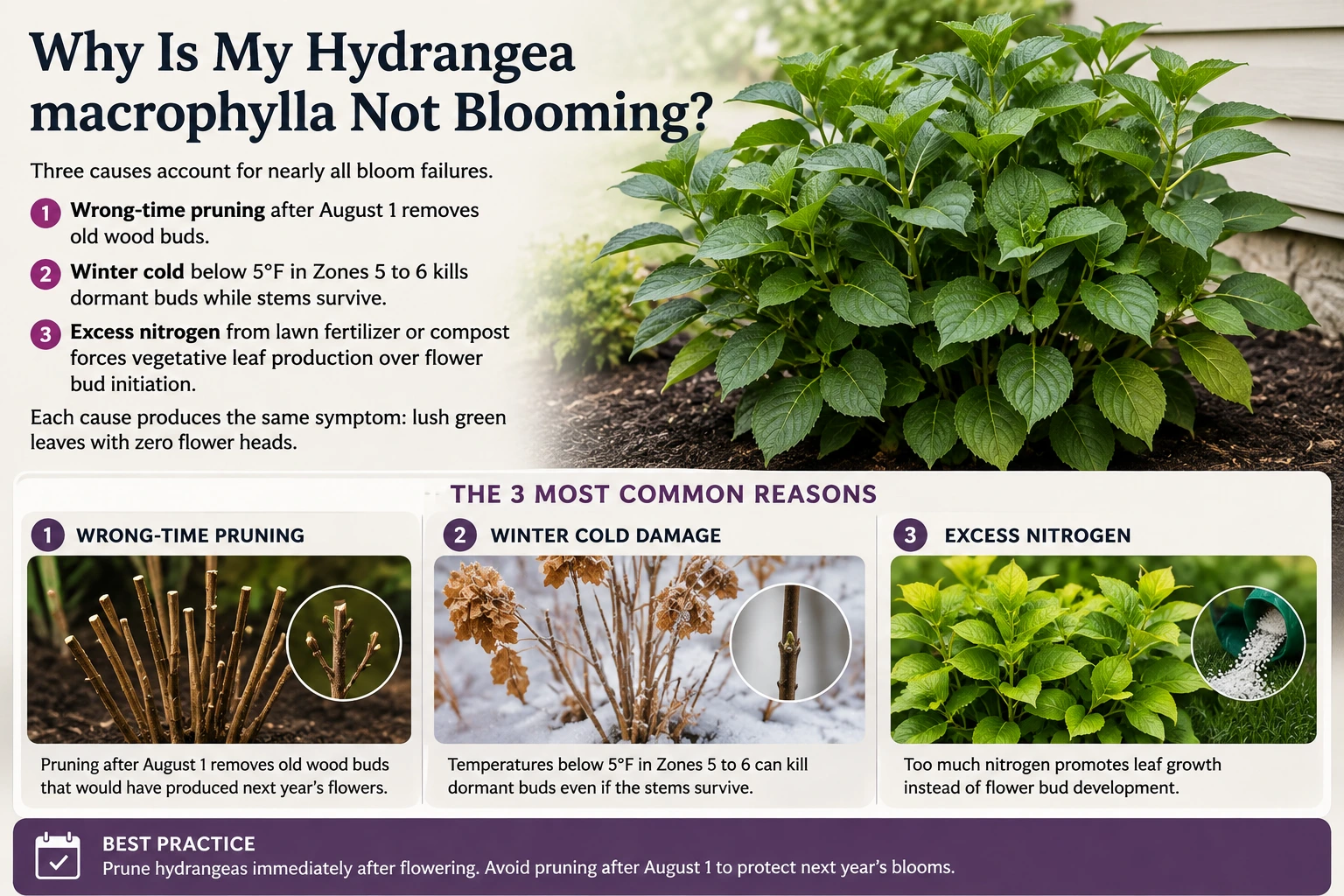
Three causes account for nearly all bloom failures. Wrong-time pruning after August 1 removes old wood buds. Winter cold below 5 degrees Fahrenheit in Zones 5 to 6 kills dormant buds while stems survive. Excess nitrogen from lawn fertilizer or compost forces vegetative leaf production over flower bud initiation. Each cause produces the same symptom. Lush green leaves with zero flower heads.
According to Clemson Cooperative Extension, the best time to remove dead canes or rejuvenate an older plant is immediately after flowering. Avoid pruning after August 1 to prevent removing flower buds for the next season. The extension notes that ill-timed pruning is often to blame for a lack of blooms. Many gardeners cut their hydrangeas back in autumn, winter, or early spring. Each cut removes tissue carrying next year’s flowers.
Winter bud kill is the second major cause. According to the Missouri Botanical Garden, plants grown in USDA Zone 5 should be sited in sheltered locations and given additional winter protection. Extended temperatures below minus 10 degrees Fahrenheit, desiccating winter winds, and early spring temperature fluctuations kill most or all old wood flower buds in many years. The plant leafs out vigorously in spring. No flowers appear.
The third cause is nitrogen-induced vegetative dominance. Excess nitrogen stimulates leafy growth. The plant directs energy toward leaves rather than flowers. Common sources include lawn fertilizer overspray and heavy compost applications. Suspend nitrogen after June to avoid delaying bud differentiation. For related nutrient management protocols, see our pH lockout and nutrient guide.
What Is the Difference Between Mophead and Lacecap Hydrangeas?
Mophead and lacecap are two inflorescence types of Hydrangea macrophylla with identical care requirements. Mopheads produce globe-shaped clusters of entirely sterile sepals. Lacecaps produce flat-topped heads with a ring of sterile sepals surrounding a center of fertile florets. Both respond identically to soil chemistry, pruning, and hardiness. Selection is purely aesthetic.
Mopheads, also called Hortensia types, produce large globe-shaped flower clusters consisting almost entirely of sterile sepals. The showy colorful structures are not true petals but enlarged calyx sepals evolved for pollinator attraction. These produce the classic snowball appearance. Common cultivars include ‘Nikko Blue’, ‘Endless Summer’, and ‘Glowing Embers’.
Lacecaps, also called Normalis types, produce flat-topped flower heads with two distinct zones. A ring of large sterile sepals forms the outer visible edge. A central mass of small fertile florets contains functional reproductive structures. The fertile center produces viable seeds. Cultivars include ‘Twist-n-Shout’, ‘Blue Wave’, and ‘Lanarth White’. According to NC State Extension, both types bloom on last year’s growth and require identical pruning timing.
How Does Aluminum Ion Chemistry Control Hydrangea Flower Color?
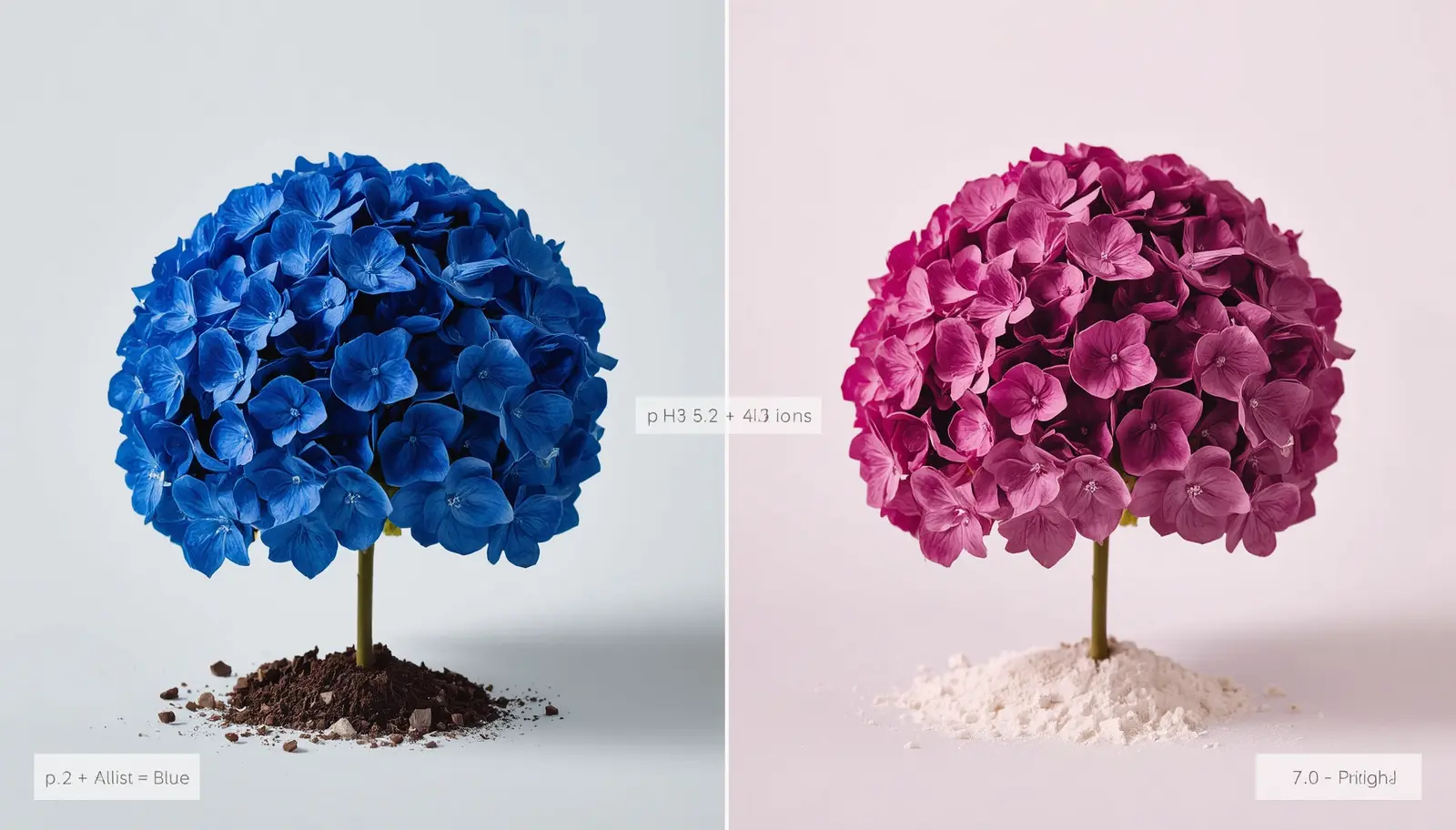
Flower color is controlled by aluminum ion availability, not pH directly. In acidic soil at pH 5.0 to 5.5, aluminum is soluble and forms blue coordination complexes with delphinidin-3-glucoside anthocyanins in sepal vacuoles. At pH 6.5 to 7.0, aluminum precipitates as insoluble hydroxide. The same pigment appears pink without aluminum coordination. Phosphorus further blocks aluminum uptake by forming insoluble aluminum phosphate.
Research published in PMC found blue hydrangea cells contain 2.4 equivalents of aluminum per anthocyanin molecule. Red cells contain only 0.3 equivalents. The difference was statistically significant at P less than 0.001. This confirms aluminum-anthocyanin complexation as the direct color mechanism. Vacuolar pH showed no correlation with cell color within purple sepals.
Soil pH controls the outcome by determining aluminum solubility. At pH 5.0 to 5.5, aluminum is highly soluble as Al3+ ions in soil solution. These ions are available for root absorption. Once inside the plant, Al3+ encounters delphinidin-3-glucoside in sepal vacuoles and forms the blue-producing coordination complex. At pH 6.5 to 7.0, aluminum is nearly completely insoluble as aluminum hydroxide. Root uptake is minimal. Anthocyanins present without aluminum coordination produce pink coloration.
According to Clemson Cooperative Extension, white-flowered cultivars such as ‘Madame Emile Mouillere’ lack sufficient delphinidin anthocyanin concentration to show color response to aluminum availability. They will remain white regardless of soil pH or aluminum application. Color chemistry protocols apply exclusively to cultivars that produce pink or blue flowers under varying conditions.
How Do You Change Hydrangea Color from Pink to Blue?
Lower soil pH to 5.0 to 5.5 and ensure aluminum remains available. Apply aluminum sulfate at 1 pound per 10 square feet of root zone in early spring. Switch to low or zero phosphorus fertilizer. Phosphorus precipitates aluminum into insoluble aluminum phosphate, blocking uptake. Color shift appears gradually over one to two bloom seasons. White cultivars cannot turn blue.
According to Clemson Cooperative Extension, maintain soil pH 5.0 to 5.5 for blue flowers using sulfur or aluminum sulfate when new growth emerges in April. Always test soil before applying sulfur or lime to avoid over-correction. Aluminum sulfate serves double duty. The sulfate acidifies soil while delivering aluminum ions directly. Apply in early spring 2 to 3 months before bloom period expected.
- Test soil pH. Submit to your county extension office or use a digital pH meter. Record the baseline pH. Amend if above 6.0. Maintain if already 5.0 to 5.5.
- Apply aluminum sulfate. Broadcast at 1 pound per 10 square feet of root zone. Work into the top 2 inches of soil. Water in thoroughly.
- Switch to low phosphorus fertilizer. Use a formula with zero or minimal phosphorus such as 10-0-10. Phosphorus blocks aluminum uptake.
- Monitor and maintain. Retest pH in 60 days. Maintain 5.0 to 5.5. Color shifts over 1 to 2 seasons. Use rainwater if tap water pH exceeds 7.5.
Pro Tip: Container-grown hydrangeas allow the most precise color control. Use acidic rhododendron mix at pH 5.0 to 5.5 for blue containers. Use standard potting soil plus lime for pink containers. Water with collected rainwater at pH 5.5 to 6.0 to maintain blue chemistry. Municipal tap water above pH 7.5 gradually shifts containers toward pink.
How Do You Change Hydrangea Color from Blue to Pink?
Raise soil pH to 6.5 to 7.0 using dolomitic lime at 25 to 50 pounds per 1,000 square feet. Apply high phosphorus fertilizer to bind any remaining soluble aluminum. Avoid acidifying inputs such as sulfur or ammonium sulfate. Annual lime application maintains target pH as organic decomposition and rainfall gradually acidify soil over time.
Dolomitic lime is preferred over pure calcium lime. Magnesium competes with aluminum at root uptake sites for additional blocking effect. Apply and work into soil 3 to 6 months before bloom period if possible. Lime reacts slowly. For faster results in containers, use standard potting soil amended with agricultural lime and avoid acidic fertilizers entirely.
Avoid sulfur-containing fertilizers, acidic mulches such as pine bark, or acid-forming irrigation water. Each of these counteracts lime application. Test pH annually. Pink maintenance requires ongoing lime input. Soil naturally tends toward acidification from organic matter decomposition and acid rainfall. Annual light lime application maintains target pH 6.5 to 7.0. Purple coloration at pH 5.5 to 6.5 is an intermediate stage. Commit definitively to one end of the pH spectrum for clear color results.
When Should You Prune Hydrangea macrophylla?
Prune immediately after summer flowering in June to July. This 4 to 6 week window is the only safe period for standard varieties that bloom on old wood. Bud differentiation begins in August. Any cut after August 1 removes next season’s flowers. Remontant cultivars like Endless Summer offer more flexibility because they also bloom on new wood.
According to NC State Extension, bigleaf hydrangea blooms on last year’s woody stems. Late heavy pruning on most varieties will remove blooms for the year. The safest time to prune is immediately after flowering. The extension provides a simple guide. Old wood bloomers prune after flowering. New wood bloomers prune in late winter. Remontant cultivars can be pruned either in early spring or after the first flush of flowers has faded.
According to Clemson Cooperative Extension, if you must prune in winter or spring after buds have formed, take care to remove no more than one third of the canes to ensure at least a few flowers for next season. If your hydrangea has overstepped its bounds, consider pruning it back now and moving it to a more appropriate location. Hydrangeas tolerate transplanting well as long as they receive adequate water and afternoon shade.
June to July is the only safe pruning window. August is caution territory. Bud differentiation begins. September through March is prohibited. Canes that appear dead in March may break dormancy as late as May. Touch nothing until leaves unfurl.
How Do You Protect Hydrangea macrophylla Buds in Winter?
In Zones 5 to 6, build a wire cage around the plant after the first hard frost. Fill the cage with shredded leaves or straw to 8 to 12 inches deep. This insulates dormant buds from desiccating wind and extreme cold. Remove the cage in early April after overnight lows stay above 25 degrees Fahrenheit. Remontant cultivars eliminate this need by blooming on new wood.
According to the Missouri Botanical Garden, a burlap wrap of stems or circle of chicken wire filled with leaves or straw to 8 to 12 inches are time-consuming but effective. Regardless of protective measures taken, most bigleaf hydrangeas simply will not bloom in some years because of winter occurrences beyond gardener control. These include low temperatures, sudden wide temperature fluctuations, icy conditions, and late frosts.
Drive 4 stakes around the plant. Wrap with chicken wire. Fill with shredded leaves or straw to 8 to 12 inches. Do not use fresh leaves that compact. Remove in early April when overnight lows stay above 25 degrees Fahrenheit. Removing too early re-exposes buds to late frosts. Too late risks mold development in wet spring conditions.
Remontant cultivars change the equation entirely. Endless Summer, Bloomstruck, and Twist-n-Shout produce flowers on both old wood and new wood. When winter kills old wood buds, they generate a second bloom opportunity on current season growth. This transforms Zone 5 to 6 cultivation from chronically unreliable to consistently productive. For gardeners unwilling to manage annual winter protection, remontant cultivars are the correct long-term answer.
How Much Water and Fertilizer Does Hydrangea macrophylla Need?
Water deeply once per week providing 1 inch of water during active growth. Drip irrigation or soaker hoses are preferred over overhead watering which wets foliage and promotes powdery mildew. Fertilize with balanced 10-10-10 at 2 cups per 100 square feet in March, May, and July according to Clemson Extension. Avoid high nitrogen which suppresses flower bud initiation.
According to Clemson Cooperative Extension, water deeply once per week or more often during dry conditions. In summer heat, hydrangeas often require deep watering twice weekly in sandy soils. Drip irrigation reduces water waste and helps prevent leaf disease. Maintain a 2 to 3 inch mulch layer to retain soil moisture and moderate temperature.
Fertilize with 10-10-10 at 2 cups per 100 square feet in March, May, and July. Suspend nitrogen after June to avoid delaying bud differentiation. If bloom failure persists despite correct pruning, test surrounding lawn areas for nitrogen runoff. Lawn fertilizers with formulations such as 30-0-4 are common culprits.
Is Hydrangea macrophylla Safe for Pets?
Hydrangea macrophylla is toxic to cats, dogs, and horses according to the ASPCA. All plant parts contain cyanogenic glycosides which release cyanide when chewed. Clinical signs include vomiting, depression, and diarrhea. Cyanide intoxication is rare but possible. Keep hydrangeas out of reach of pets. Contact ASPCA Poison Control at 888-426-4435 if ingestion occurs.
The toxic principle is amygdalin. This cyanogenic glycoside is also found in almonds, apple seeds, and cherry pits. When plant material is chewed, free cyanide releases. Cyanide reduces the body’s ability to process oxygen at the cellular level. Smaller pets are more susceptible. If a pet chews leaves or stems, rinse the mouth with water. Do not induce vomiting without explicit veterinary direction. For pet-safe alternatives, browse our cat-safe plants guide.
What Are the Most Common Hydrangea macrophylla Problems?
The most common problems are bloom failure from pruning or winter damage, color drift from pH changes, iron chlorosis at pH above 7.0, powdery mildew from wet foliage, and afternoon wilting from transpiration stress. Most are preventable through correct siting, pruning timing, and soil management. The diagnostic matrix below matches symptoms to causes and fixes.
| Symptom | Cause | Fix |
|---|---|---|
| Lush green leaves, zero flowers | Wrong-time pruning, winter bud kill, or excess nitrogen | Prune June-July only. Protect buds in winter. Switch to low-N fertilizer. |
| Color shifted toward unwanted hue | Soil pH drift or phosphorus imbalance | Test pH. Apply aluminum sulfate for blue, lime for pink. |
| Yellow leaves with green veins | Iron chlorosis from pH above 7.0 | Apply chelated iron. Lower pH with sulfur if needed. |
| White powdery film on leaves in summer | Powdery mildew from humidity and poor air circulation | Improve air circulation. Avoid overhead irrigation. |
| Flowers bleaching pale after 2-4 weeks | Normal pigment photo-degradation or low aluminum | Deadhead promptly. Verify aluminum availability with pH test. |
| Stem tips wilting and browning in late winter | Late frost bud blast below 28 degrees Fahrenheit | Remove dead tips. Deploy frost cloth for future events. |
Frequently Asked Questions
How do you change hydrangea flower color from pink to blue?
Lower soil pH to 5.0 to 5.5 using aluminum sulfate at 1 pound per 10 square feet. Switch to low or zero phosphorus fertilizer. Phosphorus precipitates aluminum into insoluble form, blocking uptake. Results appear over 1 to 2 bloom seasons. White cultivars cannot turn blue.
Why is my Hydrangea macrophylla not blooming?
Three causes account for most failures. Wrong-time pruning after August 1 removes old wood flower buds. Winter temperatures below 5 degrees Fahrenheit in Zones 5 to 6 kill dormant buds. Excess nitrogen from lawn fertilizer forces vegetative growth over flowers.
What is the difference between mophead and lacecap hydrangeas?
Mopheads produce globe-shaped clusters of entirely sterile sepals. Lacecaps produce flat-topped heads with sterile sepals surrounding fertile center florets. Both have identical care requirements and respond identically to soil chemistry. The difference is purely aesthetic.
Are Endless Summer hydrangeas better than regular hydrangeas?
In Zones 5 to 6, yes. Endless Summer and other remontant cultivars bloom on both old wood and new wood. When winter kills old wood buds, they produce a second flush on new growth. Traditional varieties bloom only on old wood and fail after winter bud kill.
Can I prune hydrangeas in March?
No for standard varieties. March pruning removes old wood flower buds that have already formed. Wait until June or July immediately after flowering. Only remontant cultivars tolerate spring pruning because they also bloom on new wood.
How do I protect hydrangeas from late frost?
Cover plants with frost cloth or burlap when temperatures below 28 degrees Fahrenheit are forecast after bud swell begins in spring. For winter protection in Zones 5 to 6, build a wire cage filled with shredded leaves or straw around the plant after the first hard frost.
Fixing Hydrangea macrophylla not blooming requires understanding old wood biology. The plant sets flower buds in late summer. Any interference after August 1 removes next year’s display. Winter protection in cold zones and restrained nitrogen complete the protocol. Color chemistry adds the final layer of mastery. Manage aluminum, pH, and phosphorus with precision. The result is reliable blooms in the correct color every season. For more troubleshooting guides, explore The Infirmary.