
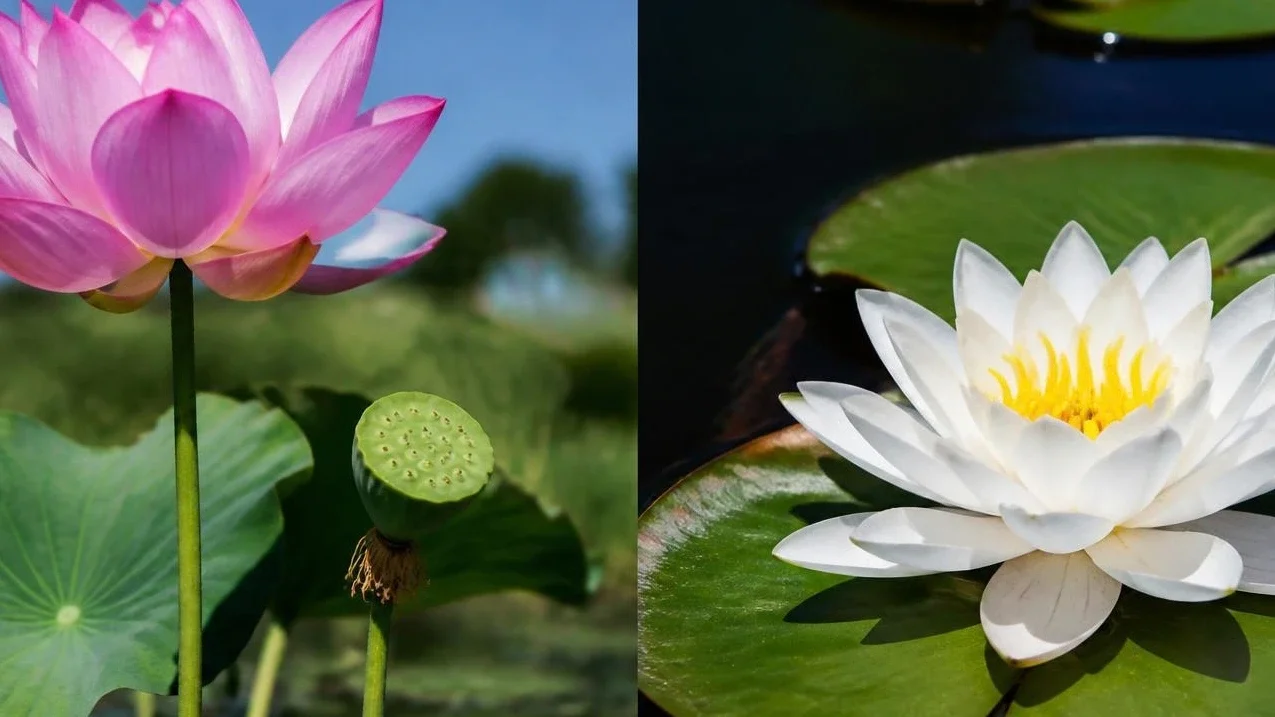
Stand at the edge of a pond in July and the two plants merge into one impression: big round leaves, flowers that open in the sun, a surface gone floral. Nursery pots make it worse, because the tags interchange the names without blinking. But the water lily vs lotus question has a clean answer, and once you see the single structural difference, you will never unsee it.
The Brooklyn Botanic Garden puts it in one line: water-lily leaves and flowers tend to float on the surface, whereas lotuses stretch roughly a foot above it. Everything below is that sentence, expanded.
Not Even Cousins: Why the Confusion Runs So Deep
Water lilies belong to the family Nymphaeaceae, order Nymphaeales. The lotus belongs to Nelumbonaceae, order Proteales, a lineage that sits closer to plane trees and proteas than to water lilies according to APG IV classifications.
Two plant lineages independently arrived at the same look: a floating rosette of round leaves and a large radial flower. Botanists call that convergent evolution, and it is why the two fool everyone from gift-shop taggers to landscape painters. It is also why care advice written for one fails on the other: similar face, different machinery.
The “blue lotus” that is not a lotus at all
The sacred blue flower of ancient Egyptian art, the one pressed into crowns and temple reliefs, is Nymphaea caerulea. It is a water lily. True lotus species (Nelumbo nucifera, Nelumbo lutea) bloom in white, pink, yellow, and cream, never blue. Any “blue lotus” product or photo is almost certainly a blue tropical water lily. If a listing advertises a blue lotus tuber, be skeptical before you buy.
Water Lily vs Lotus: Side-by-Side Comparison
| Criteria | Water Lily (Nymphaea) | Lotus (Nelumbo) |
|---|---|---|
| Family | Nymphaeaceae | Nelumbonaceae (not a close relative; convergent look) |
| Leaf position | Float flat on the surface, with a characteristic notch where the stalk meets the blade | Young leaves float; older leaves are held up to 5 feet above the water on stalks joined to the center of the leaf, no notch (NC State) |
| Leaf texture | Thick and waxy | Thin and papery, with a water-repellent, beading surface |
| Flower position | Float or sit just at the surface | Held well above the water on tall stalks |
| Flower shape | Pointed petals in a star-like rosette | Rounded, sometimes ruffled petals in a cup; up to 8 inches across for sacred lotus (UF/IFAS), up to 10 inches for American lotus (NC State) |
| After flowering | Flowers last up to about two weeks, then wilt and fall beneath the water (NYBG) | Petals fall to reveal a distinctive cone-shaped, showerhead-like seed pod that dries above the water |
| Typical water depth | Prefers 2 to 5 feet of water over the crown for established hardy types | Likes shallow planting, around 6 to 12 inches of water over the container |
| Hardiness | Hardy species survive to zones 3 or 4; tropicals are stored or grown as annuals | Sources differ: N. nucifera zones 5 to 10 (UF/IFAS) or 4 to 10 (NC State); native N. lutea zones 4 to 10 (NC State); NYBG is more cautious |
| Spread and size | Varies by cultivar from a few feet to 6-foot spreads | Large; leaves can reach 2 feet across and demand serious surface area |
Tell Them Apart in the Field: Five Morphological Anchors
When the tag is missing or wrong, these five field marks identify the plant in under a minute. The New York Botanical Garden’s water gardening guide lists the first four directly.
- The notch test: a water lily leaf has a clean slit from edge to center, like a pie with a wedge removed. Lotus leaves are complete circles, with the stalk attached dead center underneath.
- The showerhead: a dried, cone-shaped seed head studded with holes is lotus, full stop. Water lily seed capsules form quietly underwater.
- Waxy versus papery: water lily leaves feel thick and waxy; lotus leaves are thinner, and water beads off them in silver spheres.
- Star versus cup: water lily petals are pointed and radiate like a star; lotus petals are rounded and overlap into a cup or pom-pom.
- The lift: flowers and leaves standing clear of the surface on visible stalks means lotus. Everything resting on the water means lily.
Pro tip: When buying a dormant tuber, the difference is invisible, and this is where mislabeling thrives. Buy named cultivars from aquatic specialists rather than generic marketplace listings, and be doubly wary of anything advertised as a blue lotus.
Which One Belongs in Your Pond?
Choose a water lily when:
- Your water is deeper. Established ornamental lilies handle a broader depth range than lotus; the New York Botanical Garden notes lilies growing in roughly 2 to 5 feet of water where lotus wants about a foot.
- You garden cold. Hardy water lily species survive winters as far north as zones 3 to 4 when planted below the freezing line.
- You want color range. Only tropical water lilies offer blues and purples, plus night-blooming varieties; hardy types stay in whites, pinks, reds, yellows, and oranges.
- Your container is small. Compact cultivars suit barrels and tubs that a lotus would overrun in a season.
Choose a lotus when:
- You can give it sun and square footage. The UF/IFAS Extension assessment calls it a full-sun plant that is spectacular in bloom, but warns it needs plenty of space. Leaves to 2 feet across are normal.
- You have shallow, warm water. Plant the container so the soil line sits below your pond’s freezing line, and expect it to wait: lotus is slow to emerge in spring. In Florida, UF/IFAS also rates sacred lotus as potentially invasive and notes it is not native to North America, so keep it in a container and check local rules.
- You want the full cultural package. The lotus carries thousands of years of religious and culinary weight across Asia, and every part, from rhizome to seed, is traditionally used. A research review in the National Library of Medicine’s PMC archive documents its long medicinal and food history.
- You want a structural specimen. Those showerhead seed pods and 2-foot leaves give the pond a vertical element no water lily offers.
Cost, Complexity, and Care
Both plants want six or more hours of sun and both are planted in containers. However, do not use light, airy mixes like our aroid soil blend. Aquatic plants need heavy clay topsoil capped with gravel so media doesn’t float into the water. The primary differences show up in seasonal upkeep.
Water lilies are the lower-maintenance choice overall. Hardy types go dormant and return; tropical types must be stored over the winter or treated as annuals (NYBG). If you notice plant leaves turning yellow, both respond well to aquatic fertilizer tablets pressed deep into the soil. Never substitute standard liquid feeds, as we explain in our synthetic vs organic fertilizer guide, because broadcasting nutrients directly into pond water will trigger massive algae blooms.
Lotus demands more room and patience: a shallow, wide container rather than a deep one, warm water before it will stir, and a late start every spring. Hardiness ratings vary by source (zones 4 or 5 to 10 in most extension listings, as long as the rhizome stays below the freezing line), and once established it asks for very little beyond sun and space.
Whichever you choose, treat surface coverage as a budget: the New York Botanical Garden advises plants covering roughly 65 percent of the pond surface, balancing shade, oxygen, and algae control.
What About Nuphar, the Third Plant in the Mix-Up?
Once you can separate water lily vs lotus, a third genus ambushes you: Nuphar, the spatterdock or yellow pond-lily. It shares the water lily’s floating, notched leaves but blooms smaller, brighter yellow, and more understated, with a globular capsule that pokes above the surface. If the flower is small, yellow, and held just at the waterline on a plant with a wild, unkempt look, you have probably found Nuphar rather than an ornamental Nymphaea.
Frequently Asked Questions
Is a lotus just a type of water lily?
No. Lotus belongs to Nelumbonaceae while water lilies belong to Nymphaeaceae, and the two families are only distantly related. Their similar looks are convergent evolution, not close kinship.
What is the fastest way to tell a water lily from a lotus?
Look at height. Lotus leaves and flowers stand above the water on stiff stalks; water lily leaves and flowers float flat on the surface. The lotus seed pod, a cone-shaped showerhead, confirms it.
Can lotus survive cold winters?
Yes, if the tuberous rhizome stays below the pond’s freezing line. Extension listings rate Nelumbo nucifera hardy to zone 5 (UF/IFAS) or zone 4 (NC State), and the native American lotus (N. lutea) to zone 4 (NC State). Plant deep and mulch the container where winters are severe.
Is a lily pad a lotus leaf?
No. A lily pad is a water lily leaf: it floats flat and has a notch cut from the edge to the center (NYBG). A lotus leaf is a complete circle with the stalk joined to its center, and older lotus leaves stand above the water instead of floating (NC State).
Why do people call blue water lilies “lotus”?
Centuries of art and language merged the two names. The Egyptian blue lotus is actually Nymphaea caerulea, a water lily. True lotus flowers come in white, pink, and yellow, never blue.
Sources & Further Reading
- New York Botanical Garden: Water Lily and Lotus guide
- UF/IFAS Extension FPS424: Nelumbo nucifera, Sacred Lotus
- Brooklyn Botanic Garden: Lovely Lotuses
- NC State Extension Plant Toolbox: Nelumbo nucifera
- NC State Extension Plant Toolbox: Nelumbo lutea
- PMC review: Phytochemical profile of Nelumbo nucifera