
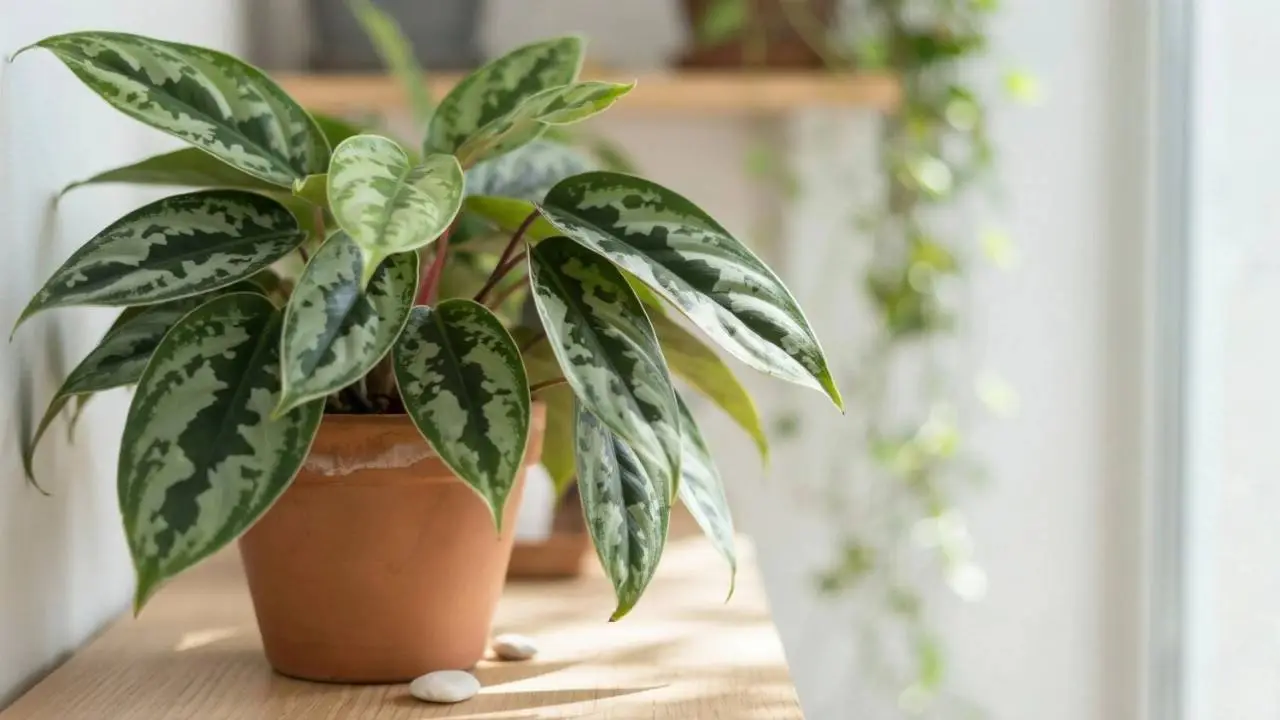
Hold a Scindapsus pictus leaf up to a window and the silver splashes look hand painted, which is what the species name suggests: pictus is Latin for “painted.” Despite being sold as satin pothos or silver pothos, Scindapsus pictus belongs to its own genus, separate from Epipremnum aureum, the true pothos. Scindapsus pictus care is simple once you know its preferences: NC State Extension says it prefers bright indirect light, does not tolerate cool air or direct sunlight, and grows best at room temperatures of 65 to 85 °F in moist, well-drained potting soil.
Scindapsus pictus Care Snapshot
| Factor | Ideal | Avoid |
|---|---|---|
| Light | Bright indirect light | Direct sun; deep shade |
| Water | When the top 1 to 2 inches of mix are dry | Constantly wet soil |
| Soil | Moist but well-drained potting mix; an aroid mix works well | Heavy, dense soil |
| Temperature | 65 to 85 °F | Cool air and cold drafts |
| Fertilizer | Balanced liquid, diluted, in spring and summer | Feeding in winter |
| Pets | Keep out of reach | Toxic to cats, dogs and horses (ASPCA) |
Sources: NC State Extension Plant Toolbox; ASPCA.
Scindapsus pictus Light Requirements
NC State lists Scindapsus pictus as native to tropical areas of Bangladesh and Malesia, where it grows as an evergreen climbing vine. Indoors it prefers bright indirect light, and NC State notes direct sunlight is not tolerated: unfiltered midday sun through a south or west window can scorch the velvety leaves. An east window, or a spot a few feet back from a brighter window, suits it well.
Low light is survivable but costly. Growth slows, stems stretch, and new leaves tend to come out smaller with less silver. If your vine is reaching toward the window on bare stems, move it closer to the light. For dim rooms, a grow light helps; see our grow light guide.
Water on the Dry Side
Water thoroughly, then wait until the top 1 to 2 inches of mix are dry before watering again. Your light, pot and mix set the real pace, so test the soil rather than following a calendar. Satin pothos is generally grown a little drier than true pothos and dislikes soggy soil.
The leaves help you judge. NC State notes that curling leaves may be a sign of underwatering and yellow leaves a sign of overwatering. If curled leaves flatten after a thorough watering, thirst was the problem.
Always use a pot with a drainage hole. If overwatering is your weakness, bottom watering helps. If roots have turned brown and mushy, see our root rot guide.
Soil and Potting
NC State recommends a moist, well-drained potting soil. A common approach is two parts quality potting mix to one part perlite and one part fine orchid bark, which holds some moisture and then drains and breathes. Our aroid soil mix guide covers the options.
Repot when roots circle the drainage holes, moving up just one pot size; an oversized pot holds water long after the roots can use it.
Feeding
Scindapsus pictus is a modest grower and a light feeder. A balanced liquid houseplant fertilizer, diluted, every month or so through spring and summer is plenty. Stop in fall and winter when growth slows. Too much fertilizer builds up salts, showing as brown leaf tips and a white crust on the soil.
Humidity and Temperature
Temperature matters more than humidity. NC State gives room temperatures of 65 to 85 °F as best and notes cooler air is not tolerated, so keep the plant away from cold windows and drafty doors in winter. Average household humidity is generally fine; in very dry winter air you may see brown tips, and a humidifier can help.
Argyraeus, Exotica or Silvery Ann?
Care is the same for all of them. NC State describes these cultivars:
| Cultivar | Leaves |
|---|---|
| ‘Argyraeus’ | Small, dark green leaves with silver edges |
| ‘Exotica’ | Heart-shaped green leaves splashed with shimmery silver variegation |
| ‘Silvery Ann’ | Also listed by NC State; typically grown for its heavier silver coverage |
Source: NC State Extension Plant Toolbox.
Propagating Scindapsus pictus
NC State notes it may be propagated by stem cuttings. A cutting must include a node, the slightly swollen point where a leaf and aerial root emerge; without one it will rot rather than root.
- Cut a piece of vine with at least one node and one or two leaves, using clean scissors.
- Remove any leaf that would sit below the waterline or in the mix.
- Root it in water or moist sphagnum moss in bright indirect light, changing the water when it clouds.
- Once it has a few healthy roots, pot it in a well-draining mix and keep it lightly moist while it settles.
For a fuller plant, root several cuttings in the same pot. Grown up a moss pole or stake, as NC State notes it is often trained, the vine tends to produce larger leaves than when trailing.
Is Scindapsus pictus Toxic to Cats and Dogs?
Not cat safe
The ASPCA lists satin pothos (Scindapsus pictus) as toxic to dogs, cats and horses. Its toxic principle is insoluble calcium oxalates, and clinical signs include oral irritation, pain and swelling of the mouth, tongue and lips, excessive drooling, vomiting (not in horses) and difficulty swallowing. NC State also lists it as poisonous to cats, dogs and horses. If a pet eats it, call your vet or the ASPCA Animal Poison Control Center at (888) 426-4435.
Hang it out of reach, or choose a plant from our cat-safe plants list instead. Compare it with true pothos in our pothos comparison and heartleaf philodendron guide.
Frequently Asked Questions
Is Scindapsus pictus toxic to cats?
Yes. The ASPCA lists satin pothos (Scindapsus pictus) as toxic to cats, dogs and horses because of insoluble calcium oxalates, so it is not cat safe.
What are Scindapsus pictus light requirements?
Bright indirect light. NC State Extension notes that direct sunlight is not tolerated, so keep it out of strong midday sun.
Why is my satin pothos losing its silver?
Usually too little light: new leaves come out smaller and less silvery. Move it closer to a bright window, out of direct sun.
Why are my Scindapsus pictus leaves curling?
Curling leaves may be a sign of underwatering, according to NC State; yellow leaves may point to overwatering. Check the soil before watering.
How often should I water Scindapsus pictus?
When the top 1 to 2 inches of mix feel dry. That varies with light, pot and season, so check the soil rather than following a schedule.
Is satin pothos a real pothos?
No. True pothos is Epipremnum aureum; satin pothos is Scindapsus pictus, a separate genus in the same arum family. Care is similar.