
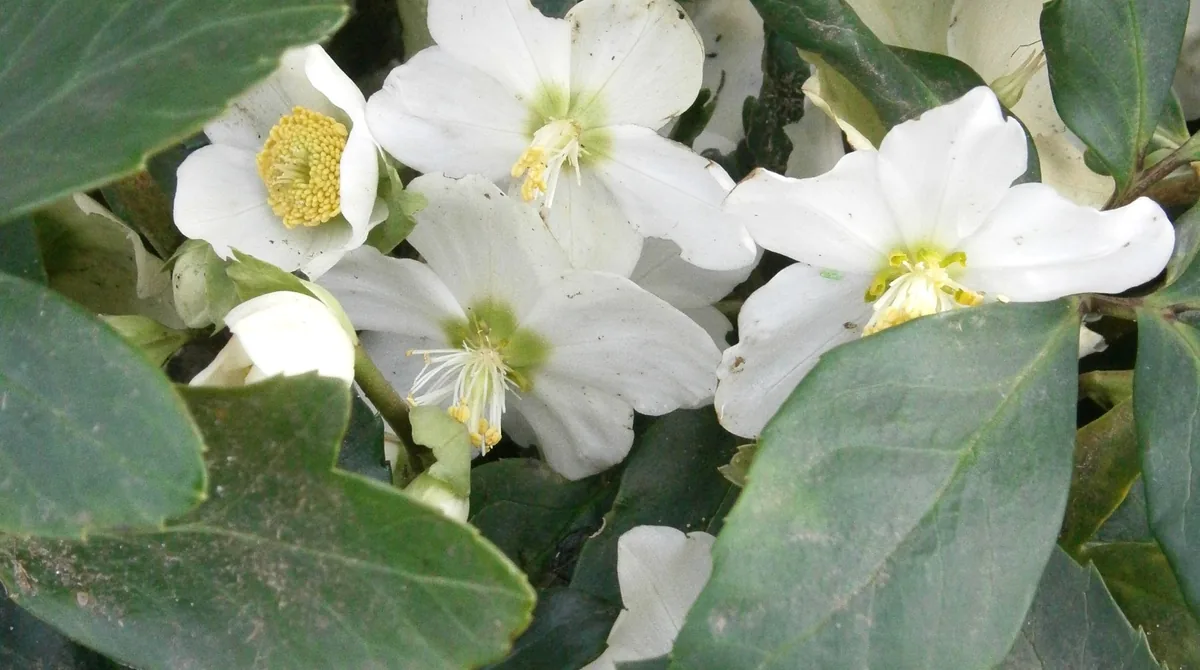
Christmas rose care is not houseplant care. Helleborus niger is a hardy perennial that wants cool air, sharp drainage and a winter spent outdoors or on an unheated porch. The RHS calls it widely grown but challenging to keep going, because it needs excellent drainage in winter, which is the opposite of what a warm room provides.
Christmas Rose Care at a Glance
| Parameter | What it wants | What causes trouble |
|---|---|---|
| Hardiness | USDA zones 5a to 8b | Assuming it is a tender houseplant |
| Light | Light to moderate shade, with sun for part of the day | Deep dry shade, or hot afternoon sun |
| Soil | Organic, well drained, neutral to alkaline | Heavy soil that stays wet in winter |
| Water | Regular in the first season, then in dry spells | Constant wet, especially in winter |
| Position | Sheltered from cold wind; a cool porch or a border | A warm, dark room with still air |
| Size | 12 to 15 inches tall generally; Helleborus niger to about 1 foot | Expecting shrub-sized growth in one season |
Sources: NC State Extension Helleborus page; Royal Horticultural Society (RHS) hellebore growing guide.
Why It Fails Indoors
The RHS is specific about Helleborus niger: it needs excellent drainage in winter and dislikes sitting in cold, damp soil. That is the opposite of the warm, humid, evenly watered conditions most houseplants get. A heated room also dries the air and pushes the plant into growth at the wrong time of year.
A Christmas rose plant bought in flower for the holidays is best treated as a short-term display. The RHS says most hellebores should only be planted temporarily in containers as part of a winter display, then moved into a border in spring after flowering. If you have no garden, keep the plant in a cool porch or an unheated conservatory and accept that it may not last more than a season.
The warm room problem
Warmth and wet compost together are what rot the crown. If the leaves yellow and the base feels soft, the plant is not thirsty. It is drowning.
Light and Position
NC State Extension says hellebores do well in light to moderate shade, in organically rich, well-drained, alkaline soil. The RHS describes most hellebores as happy in partial or dappled shade, with sun for part of the day. For Helleborus niger, the RHS recommends a cool, sheltered spot in light shade with free-draining soil.
Shelter matters as much as light. The RHS advises protecting hellebores from cold winter winds, and placing H. niger at the base of a south- or west-facing wall if it is in a container. That spot gives winter sun, wind protection and drainage away from the pot.
The RHS gives that spacing for hellebores in a border, with larger types needing more room. Set the crown at the same level it sat in its original pot, because hellebores dislike being planted too deep. When dividing, the RHS says the first roots at the base of the shoots should sit 2.5 cm (1 in) below the soil surface.
Planting in a Pot
The RHS recommends a container only slightly larger than the original pot, filled with free-draining, peat-free compost. Its suggested mix is John Innes No.3 with 30 percent peat-free multipurpose compost and 10 to 20 percent horticultural grit by volume. In the US, a good potting soil cut with grit or pumice does the same job.
- Choose a pot with a large drainage hole. A saucer that holds water defeats the purpose.
- Use the gritty mix all the way down. The RHS mix already includes grit, so the drainage is built in rather than added as a single layer.
- Set the crown level. The top of the rootball should sit at the same height it did in the nursery pot, never buried.
- Water it in. Soak once, let it drain, and empty the saucer.
- Top with mulch, not against the stems. The RHS advises leaving a gap around the base of the plant to avoid rot.
Watering and Feeding
Hellebore care in a border is mostly about water and mulch, not feeding. The RHS says hellebores in borders seldom need extra feed, and that poor growth is more likely to come from drying out or waterlogged soil than from a lack of nutrients.
Watering follows the season. Newly planted hellebores need additional watering through their first growing season, from spring to summer, according to the RHS. Established plants only need help in hot dry spells. Plants in containers need regular watering, because they dry out quickly, and the RHS advises keeping them out of summer sun to slow water loss.
If you do feed, the RHS suggests a general-purpose fertilizer at 50 to 70 g per square metre in spring for border plants. Containers get a balanced liquid feed, with a potassium-rich feed such as tomato feed to encourage flowers.
Mulching once a year is the better investment. The RHS recommends a generous layer of organic matter around the plant, topped up as it breaks down, which holds moisture and keeps the root zone cool in summer.
Pruning and Leaf Spot
Old foliage is the first thing to deal with. NC State Extension says old leaves can be cut to the ground before the plants flower, and the RHS says cutting back the old leaves of Helleborus x hybridus in late winter or early spring helps control hellebore leaf spot and shows off the flowers. For H. niger, remove damaged or diseased foliage in autumn and clear the old flower stems after the blooms fade.
NC State Extension lists crown rot and leaf spot as occasional problems, with no serious insect pests. Good drainage prevents the first. Removing spent leaves and old flower stems reduces the second.
Dividing an Old Clump
The RHS calls division the easiest way to make new plants, best done in early autumn, though it can also be done in spring right after flowering. NC State Extension gives late summer to early fall as its window. Replant the divisions with the base of the shoots 2.5 cm (1 in) below the surface, water them through their first season, and expect a couple of years before they flower well.
Not every hellebore divides well. The RHS names Helleborus argutifolius, H. foetidus, H. lividus and H. x sternii as better grown from seed. H. niger is a slow plant from seed as well: NC State Extension says hellebores grown from seed take about two years to bloom.
Is Christmas Rose Poisonous to Pets?
Yes. The ASPCA lists Helleborus niger, with the common names Christmas rose, Lenten rose and Easter rose, as toxic to dogs, cats and horses. The toxic principles are bufadienolides and glycosides, and the clinical signs include drooling, abdominal pain, diarrhea, colic and depression. NC State Extension adds that the leaves, stems and roots are poisonous to humans if ingested.
If you suspect your pet has eaten Christmas rose, contact your veterinarian or the ASPCA Animal Poison Control Center at (888) 426-4435. Keep clippings out of reach of pets and children. Our guide to Christmas plants compares it with the other holiday plants people bring indoors.
Frequently Asked Questions
Does Christmas rose care differ indoors?
Yes, and usually for the worse. Helleborus niger wants cool air and excellent winter drainage, while a house is warm and still. Keep it in a cool porch or unheated room for a short display, then plant it outside in spring.
When does Christmas rose bloom?
Helleborus niger produces white flowers from the festive season onward, according to the RHS. NC State Extension describes hellebore blooms generally as appearing in late winter and extending into early spring.
Is Christmas rose the same as Lenten rose?
No. Christmas rose is Helleborus niger and usually flowers earlier. Lenten rose is the common name for Helleborus x hybridus, which NC State Extension lists as growing up to 2 feet tall with flowers in a range of colors in late winter and early spring.
Can I keep a Christmas rose in a pot forever?
It is possible, but not ideal. The RHS says H. niger is best in a container in a sheltered spot, and that most hellebores in containers are meant as temporary winter displays before being planted out in spring. A permanently potted plant needs regular water, annual mulch and a larger pot when the roots fill it.