
Umbrella plant care comes down to light and water: give Schefflera arboricola medium to bright indirect light, water it thoroughly and then let the top half inch of compost dry, and keep it above 50°F (10°C). Most leaf drop traces back to one of those three being off, not to disease.
Umbrella Plant Care at a Glance
| Parameter | What it wants | What causes trouble |
|---|---|---|
| Light | Medium to bright, filtered light for 3 to 4 hours a day | Direct sun through glass, or deep shade |
| Water | Soak, then let the top half inch of compost dry | Water left in the saucer, or compost kept bone dry |
| Day temperature | 65 to 75°F (18 to 24°C) | Heat vents and radiators |
| Night temperature | Above 60°F (15°C) | Cold windows and open doors in winter |
| Minimum | Above 50°F (10°C) | Chilling, which causes dead patches on the leaves |
| Humidity | Average to high; a pebble tray helps | Dry air from heating, which encourages spider mites |
| Height indoors | 3 to 6 feet in a container; up to 8 feet or more with age | Assuming it stays small without pruning |
Sources: Clemson Cooperative Extension; Missouri Botanical Garden Plant Finder; NC State Extension.
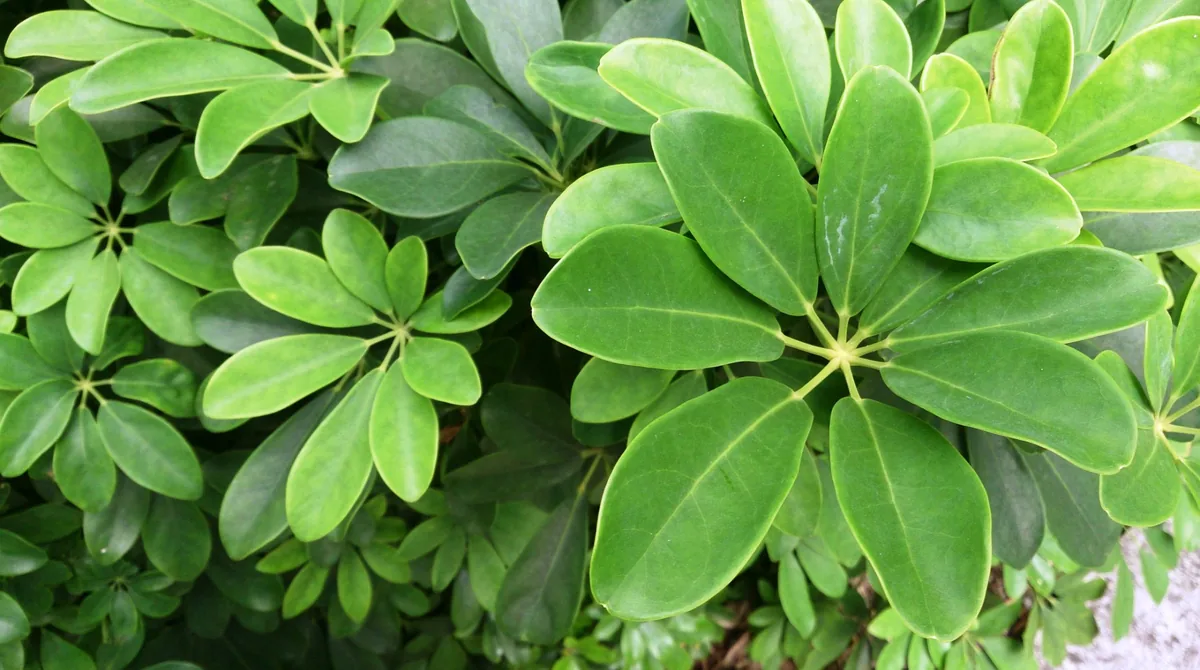
Schefflera or Heptapleurum? Same Plant
If the label on your plant says Heptapleurum arboricola, you have the same umbrella plant. The Missouri Botanical Garden lists the two names as synonymous, and NC State Extension files the dwarf umbrella tree under Heptapleurum arboricola. The older name Schefflera arboricola is still what most nurseries print, so both are worth searching when you look for care information. The dwarf schefflera is the same plant under either name, and schefflera care advice written for one applies to the other.
The plant is native to Taiwan, according to the Missouri Botanical Garden, and grows as an evergreen shrub or small tree in the wild. Indoors it stays much smaller: the Missouri Botanical Garden gives 3 to 6 feet for a houseplant, while Clemson Cooperative Extension says scheffleras are usually 2 to 3 feet tall when sold and can reach 8 feet or more with age.
Clemson Cooperative Extension notes that young scheffleras have small leaves with only three to five leaflets. Older plants develop larger leaves with up to 12 leaflets, each up to 12 inches long. The Missouri Botanical Garden gives 7 to 9 leaflets, each 4 to 6 inches, for a typical houseplant. A plant that suddenly pushes much larger leaves is mature, not sick.
Light: Medium to Bright, Never Blasting
Clemson Cooperative Extension says scheffleras prefer medium to bright light. The Missouri Botanical Garden is more specific for indoors: an east, west or south window with curtain-filtered sun for 3 to 4 hours a day, avoiding direct sun. NC State Extension gives the same 3 to 4 hours and warns that bright direct light will burn the leaves.
Low light is tolerated but not free. Clemson Cooperative Extension says low light causes leaf yellowing with spindly, weak stems, and the Missouri Botanical Garden notes that plants in reduced light need less frequent fertilization. A plant in a dark corner will survive for a while, then thin out.
Signs of too little light
- Yellow leaves on a plant that is not overwatered
- Long stems with wide spaces between leaves
- New leaves smaller than the old ones
- Slow growth even in summer
Signs the light is right
- Leaves are glossy and evenly colored
- New growth appears in spring and summer
- The plant holds its lower leaves instead of shedding them
- Leaflets stay flat rather than curling away from the window
Watering: Soak, Then Let It Dry
Clemson Cooperative Extension gives the clearest rule: water scheffleras thoroughly, then let the soil dry to half an inch deep before watering again, and never let a plant sit with water in its saucer. The Missouri Botanical Garden describes the same cycle as a deep watering followed by allowing the soil to nearly dry, with less water from fall to late winter.
Both directions matter. Clemson Cooperative Extension says root rot usually results from a mix that does not drain quickly or from overly frequent watering, and that leaf drop can be caused by excessive watering. The Missouri Botanical Garden adds that leaves drop if the soil becomes too moist or too dry, so a plant that has been bone dry for weeks will shed leaves too.
- Check the depth, not the surface. Push a finger into the mix. Water when the top half inch is dry.
- Water until it runs through. A shallow splash leaves the lower roots dry.
- Empty the saucer. Standing water is the root rot risk Clemson Cooperative Extension names.
- Stretch the gap in winter. The Missouri Botanical Garden advises reducing water from fall to late winter, when growth slows.
Temperature and Humidity
Clemson Cooperative Extension gives day temperatures of 65 to 75°F (18 to 24°C) and says nighttime temperatures should stay above 60°F (15°C), with a hard minimum of 50°F (10°C). The Missouri Botanical Garden says indoor temperatures should not dip below 60°F in winter. Treat 60°F as the safe floor and 50°F as the point where damage starts.
Cold damage shows up as dead areas on the leaves several days after exposure, according to Clemson Cooperative Extension, which also warns against placing the plant near air conditioning vents. Hot or cold drafts damage the plant, so keep it away from radiators, heat vents and doors that open to the outside.
Humidity is the other half of the equation. NC State Extension says the plant likes high humidity, and both the Missouri Botanical Garden and NC State Extension suggest a tray of wet pebbles under the pot, with the water line below the top of the pebbles so the pot is not sitting in water. Misting helps in dry spells, and a group of plants raises the humidity around each one. Our guide to increasing humidity for plants covers the options that actually move the number.
Potting, Feeding and Pruning
Scheffleras are not fussy about timing. Clemson Cooperative Extension says to repot overcrowded plants at any season, using a general-purpose potting soil. The Missouri Botanical Garden recommends a peaty, well-drained mix. A pot one size wider is enough, and our step-by-step guide to repotting a plant covers the rest.
Feed with a water-soluble or time-release houseplant fertilizer according to the label, as Clemson Cooperative Extension advises. Plants in reduced light need less frequent feeding than plants in bright light, which is a useful brake if your plant sits in a dim room.
Pruning is how you keep an 8 foot plant in a 3 foot space. Clemson Cooperative Extension says to prune just above a leaf, and that it is possible to keep the plant at a lower height with regular cuts. Remove yellow leaves as they appear, as the Missouri Botanical Garden advises, and wipe the foliage with a damp sponge to keep it glossy. Our guide to cleaning plant leaves shows the safe way to do it without damaging the shine.
Why Leaves Drop
| Symptom | Likely cause | What to do |
|---|---|---|
| Leaves drop while the compost is wet | Overwatering or a mix that drains poorly (Clemson, Missouri) | Let it dry, check the drainage holes, and repot into a faster mix if the smell is sour |
| Leaves drop while the compost is bone dry | Underwatering (Missouri) | Soak the pot, drain it, and return to the half inch rule |
| Leaf edges and patches turn brown | Low humidity, or cold damage (Clemson) | Move away from vents and drafts, and add a pebble tray |
| Yellow leaves with weak, spindly stems | Too little light (Clemson) | Move closer to a bright window with filtered sun |
| Fine webbing and dull, speckled leaves | Spider mites, common in dry indoor air (Missouri) | Isolate and treat with our spider mite plan |
| Sticky leaves and small brown bumps | Scale insects (Clemson) | Remove what you can see and treat the whole plant |
Sources: Clemson Cooperative Extension; Missouri Botanical Garden Plant Finder; NC State Extension.
Mealybugs are the third pest Clemson Cooperative Extension names, along with scale and mites. The Missouri Botanical Garden also lists aphids and thrips. None of them are a reason to throw the plant out: isolate it, treat thoroughly, and repeat the treatment as the product label directs so newly hatched insects are caught.
Propagation
Clemson Cooperative Extension lists three methods for schefflera: seed, cuttings and air layering. Stem cuttings in spring or summer are the most practical for a houseplant. Take a tip cutting with several leaves, root it in a loose mix, and keep it warm and bright while it establishes. Air layering is slower but lets you keep the size of the parent plant, which suits a tall specimen you want to shorten.
If you are moving a plant outside for the summer, bring it back in before night temperatures fall below 60°F, as the Missouri Botanical Garden advises. Our guide to bringing plants indoors for winter has a checklist for the transition.
Is Umbrella Plant Toxic to Cats and Dogs?
Yes. The ASPCA lists Schefflera, with the common names umbrella tree, Australian ivy palm, octopus tree and starleaf, as toxic to dogs and cats. The toxic principle is calcium oxalate crystals, and the clinical signs include oral irritation, intense burning of the mouth, lips and tongue, excessive drooling, vomiting and difficulty swallowing. NC State Extension adds that all parts of the dwarf umbrella tree are seriously toxic to dogs and cats.
If you suspect your pet has eaten umbrella plant, contact your veterinarian or the ASPCA Animal Poison Control Center at (888) 426-4435. Keep the plant off the floor if you have a chewer, and pick up fallen leaflets before a pet finds them. Our list of cat safe plants has non-toxic alternatives for the same light level.
Frequently Asked Questions
How often should I water an umbrella plant?
Water when the top half inch of compost is dry, then soak it and empty the saucer. Clemson Cooperative Extension gives that half inch rule, and the Missouri Botanical Garden advises less water from fall to late winter.
Does umbrella plant care change in winter?
Yes. Umbrella plant care in winter means less water, no cold drafts and a spot away from heating vents. Keep the room above 60°F (15°C) if you can, and cut back feeding, since Clemson Cooperative Extension says plants in reduced light need less.
Why is my umbrella plant dropping leaves?
Check the compost first. The Missouri Botanical Garden says leaves drop when the soil is too moist or too dry, and Clemson Cooperative Extension adds low humidity and chilling as causes. Fix the watering before you look for pests.
Can an umbrella plant grow in low light?
It survives, but it thins out. Clemson Cooperative Extension says low light causes yellowing leaves and spindly, weak stems, and the Missouri Botanical Garden notes that plants in reduced light need less fertilizer. Medium to bright filtered light keeps it full.