
String of turtles care follows peperomia rules, not succulent rules: bright filtered light, a loose mix that drains, and water when the top of the compost has started to dry. The plant is Peperomia prostrata, a trailing peperomia rather than a string of pearls, and treating it like a desert succulent is the fastest way to lose it.
String of Turtles Care at a Glance
| Parameter | What it wants | What causes trouble |
|---|---|---|
| Light | Bright, indirect light; an east or west window | Direct summer sun, or deep shade that dulls the marbling |
| Water | Let the top of the mix dry, then soak and drain | Keeping it bone dry, or keeping it permanently wet |
| Mix | Loose, acidic, free-draining; the RHS suggests two parts ericaceous compost, one part perlite and one part orchid bark | Dense all-purpose compost that stays soggy |
| Temperature | 65 to 86°F (18 to 30°C), away from cold drafts | Chilly windows in winter, heat vents |
| Humidity | Average to higher household humidity | Dry air from heating |
| Feeding | Half-strength liquid feed every two weeks from April to October | Feeding through winter |
| Pot | Snug; repot every two or three years in spring | A pot far wider than the rootball |
Sources: Royal Horticultural Society (RHS) Peperomia growing guide; NC State Extension Peperomia prostrata page.
Light: Bright and Filtered, Not Blasting
NC State Extension says string of turtles thrives in bright, indirect light and can tolerate low light, though the leaf color will not be as vibrant. The RHS puts an east or west windowsill at the top of the list, or a spot set back from a south-facing window. Direct summer sun can scorch the foliage, and too much shade leads to poor, straggly growth.
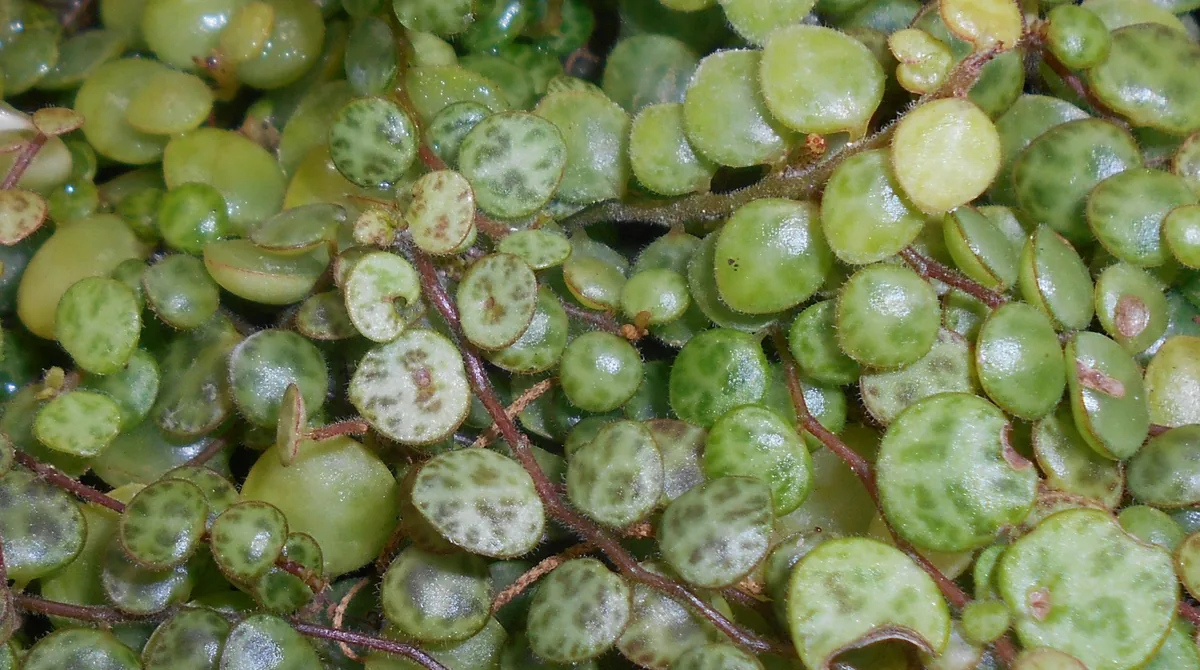
The marbled pattern is the best light meter you have. Leaves that stay dark green and tightly packed are getting enough. Leaves that fade, stretch apart on the vine, or leave long gaps between them are asking for more light, which is the same signal the RHS describes as straggly growth in shade.
Morning sun, soft afternoons
A few hours of gentle morning light and bright shade for the rest of the day. This is the closest match to the RHS recommendation.
Check: leaves stay marbled, vines stay dense.
Strong afternoon light
Good light for most of the year. In July and August, a sheer curtain stops the late sun from scorching the leaf edges.
Check: no pale or crispy patches on the top of the vine.
Set it back
The RHS suggests a spot set back from a south-facing window rather than on the sill. A shelf a foot or two inside the room works.
Check: the vine does not lean hard toward the glass.
Possible, with patience
Low light is tolerated according to NC State Extension, but growth slows and the marbling fades. Expect a thinner plant.
Check: new leaves are still patterned, not plain green.
Water: Damp, Never Soggy
The sources describe slightly different moisture levels, and the difference matters. NC State Extension calls the native habitat wet tropical and says the plant prefers evenly moist soil, while the RHS says to let the compost partially dry out between waterings and to reduce watering in winter. In a closed room with a saucer, the RHS rule is the safer of the two: a mix that never dries is the fast track to root rot, which both sources name as the main risk.
The RHS also flags a problem that few care guides mention: peperomias are sensitive to fluoride in tap water, which can turn the leaf tips brown. Rainwater or filtered water at room temperature avoids it. If the tips are brown but the compost is moist, suspect the water before you suspect the watering schedule.
Signs of too much water
- Yellowing leaves that drop while still soft
- Stems that turn dark and mushy at the base
- Compost that smells sour or stays wet for more than a week
- The whole vine collapsing, which the RHS links to roots kept too wet
Signs the watering is right
- Leaves are plump and the vine keeps extending
- The surface is dry to the touch before you water again
- No water sits in the saucer after the pot drains
- Leaf tips stay green instead of browning
- Test the surface. Press a finger into the mix. Water when the top of the compost feels dry.
- Water at the soil line. Pour until it runs from the drainage holes, keeping the crown of the plant dry.
- Drain and empty. Tip out the saucer once the pot stops dripping.
- Shorten the gap in summer, stretch it in winter. The RHS advises reducing water when growth slows.
Why It Is Not a Succulent String Plant
String of turtles is often sold beside string of pearls and string of hearts, and the three get watered as if they were the same. They are not. String of turtles is a Peperomia from the wet tropics of Ecuador, according to NC State Extension, and its leaves are thin enough that a long drought shows quickly.
A string of pearls or a string of hearts can sit dry for weeks and push out new growth when watered. A string of turtles plant on the same schedule loses leaves and stalls. Give it the peperomia routine instead, which our peperomia care guide covers for the bushy types as well.
Growth rate is the other difference. NC State Extension describes string of turtles as slow growing, with stems that reach about 12 inches at maturity. A plant that adds an inch a month in summer is doing well. If you want a fuller pot faster, buy the fullest plant you can find rather than waiting for a small cutting to fill out.
Humidity and Temperature
NC State Extension gives a preferred range of 68 to 75°F (20 to 24°C) and says to avoid cold drafts. The RHS gives a wider band of 18 to 30°C (65 to 86°F) and places the plant in a warm room. Below 65°F the plant is outside its preferred range, and cold wet compost is the combination that rots the stems.
Average household humidity is usually enough, but this plant prefers average to higher levels, per NC State Extension. Clemson Cooperative Extension notes that peperomia benefits from a humidifier in winter, when indoor air dries out. A tray of wet pebbles under the pot raises the air around the leaves without leaving the pot in water. A bathroom with a window, or a terrarium with an open top, also suits it. Our guide to increasing humidity for plants has the room-by-room options.
Propagation From Stem Cuttings
String of turtles propagation is fastest from stem cuttings. The RHS calls softwood cuttings in spring and summer the easiest method for peperomias. NC State Extension lists leaf cuttings for this species as well. Stem cuttings are faster because each piece already has several leaves and a growing tip.
- Cut a healthy vine. Take a piece with at least three or four leaves and a clean cut below a leaf node.
- Remove the lowest leaf. This gives the stem a clear section to sit in the mix.
- Root it in gritty compost or water. The RHS says either route works: straight into a pot of gritty, free-draining compost, or stood in a glass of water until roots appear.
- Pot up when roots are visible. Move water-rooted cuttings into the same loose mix used for the parent plant.
- Keep it warm and bright. No direct sun, no cold windowsill, and no fertilizer until new growth starts.
Pro tip: Take several short cuttings rather than one long vine. Short pieces with a few leaves are easier to keep moist and upright, and three cuttings make a fuller pot than one long trailer.
Repotting: Stay Snug
Peperomias are slow growers that can usually stay in their original container for two or three years, according to the RHS, or until the roots are densely packed or appear through the drainage holes. Spring is the best time to move them up. Choose a pot only a few centimetres larger than the rootball, because a big pot keeps compost wet for longer. In the US, a bagged African violet mix with extra perlite and orchid bark is the closest match to the RHS ratio.
NC State Extension notes that string of turtles does well pot-bound. That is not a reason to leave it in exhausted compost forever, but it does mean you can ignore the urge to upsize every year.
Problems: Brown Tips, Bald Vines and Rot
| Symptom | Likely cause | What to do |
|---|---|---|
| Brown leaf tips while the mix is moist | Fluoride in tap water, per the RHS | Switch to rainwater or filtered water at room temperature |
| Leaves dropping from the middle of the vine | Compost kept too wet, or left dry for too long | Check the roots, then settle into the partial-dry routine |
| Dark, soft stems at the base | Root or stem rot from overwatering | Cut above the damage and reroot healthy tips |
| Long gaps between leaves | Too little light, per the RHS note on straggly growth in shade | Move closer to an east or west window |
| Fine webbing and speckled leaves | Spider mites, one of the pests NC State Extension lists | Isolate and treat with our spider mite plan |
| White cotton in the leaf joints | Mealybugs | Follow our mealybug treatment |
Sources: RHS Peperomia growing guide; NC State Extension Peperomia prostrata page.
NC State Extension also lists aphids, scale and whiteflies as occasional pests. None of them need a different approach from the two above: isolate the plant, remove what you can see, and treat the whole plant rather than the visible patch.
Is String of Turtles Safe for Cats and Dogs?
The ASPCA lists vining peperomia, Peperomia serpens variegata, as non-toxic to dogs, cats and horses. String of turtles is a different species, Peperomia prostrata, and does not have its own ASPCA entry, but NC State Extension tags it as non-toxic for cats and dogs. A trailing plant is still tempting to a kitten, so hang it out of reach if your pet chews. Our cat safe plants list has more trailing options.
Frequently Asked Questions
How often should I water string of turtles?
Water when the top of the compost feels dry, then soak the pot and empty the saucer. The RHS advises letting the compost partially dry between waterings and reducing water in winter, when growth slows.
Why is my string of turtles losing leaves?
Usually water. The RHS links yellowing and dropping leaves to roots kept too wet, and a long dry spell causes the same leaf loss from the other direction. Check the compost before changing anything else.
Does string of turtles care need high humidity?
It prefers average to higher humidity, according to NC State Extension, but most homes are adequate. A pebble tray or a bathroom windowsill helps if the leaf edges crisp in winter.
Can string of turtles grow in a terrarium?
Yes. The RHS lists small tropical peperomias as ideal terrarium plants, and string of turtles is one of the trailing types it names. Use an open or partially open container so the leaves can dry, and water far less often than you would in a pot.