
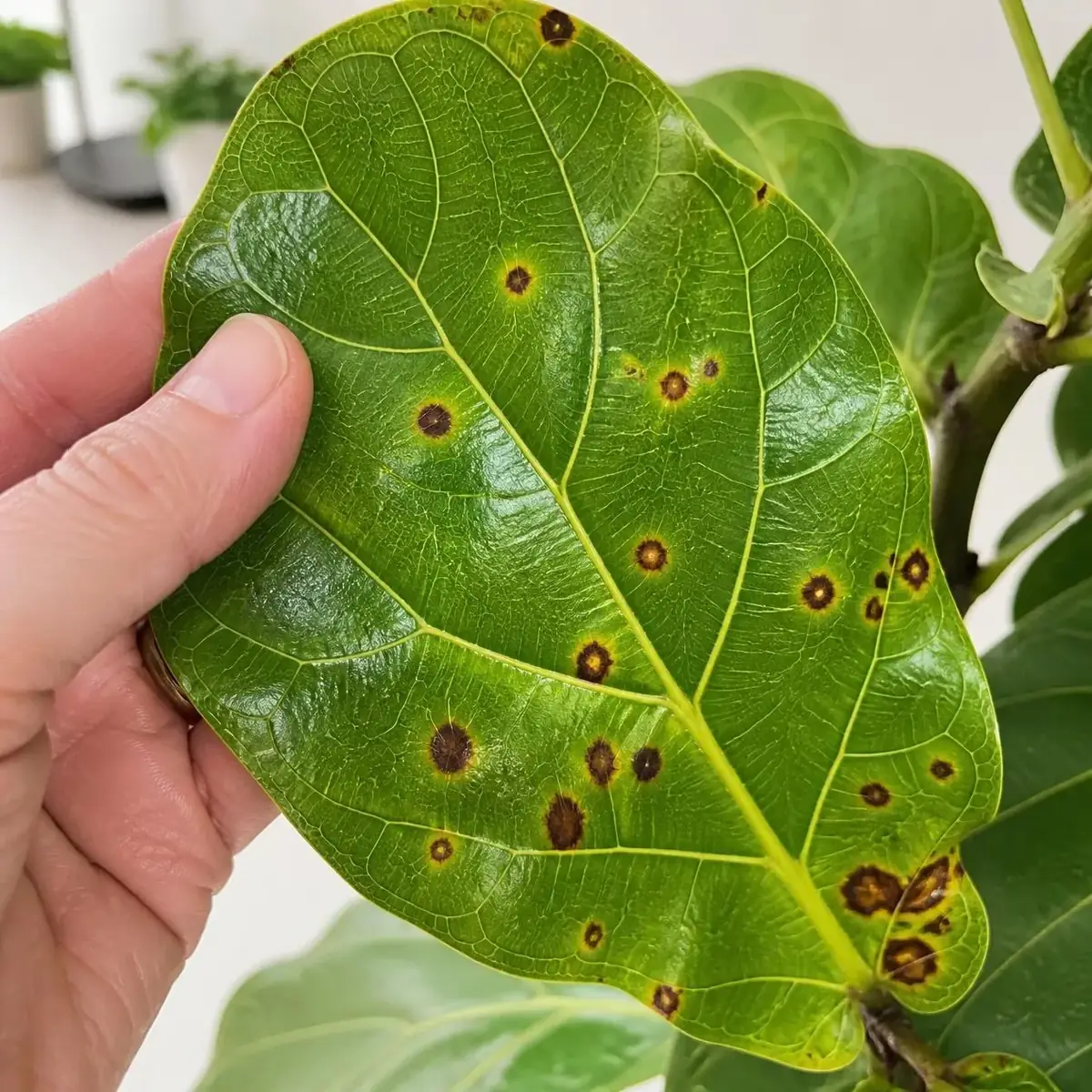
Fiddle leaf fig brown spots usually come from one of a handful of causes: root rot from wet soil, bacterial leaf spot, edema, too much direct sun, temperature swings near a vent, or dry soil. The spots look different for each, and so do the fixes. This guide helps you tell them apart and treat each one. It follows NC State, UF/IFAS and University of Maryland Extension, plus the ASPCA for pet safety.
What Do the Spots Mean?
| What you see | Likely cause | First step |
|---|---|---|
| Dark brown to black spots, often on lower leaves, with soil that stays wet; wilting or yellowing lower leaves | Root rot from overwatering | Check the roots; repot if they are mushy |
| Water-soaked spots scattered over the leaves that turn yellow, then brown | Bacterial leaf spot (UF/IFAS) | Remove affected leaves; keep water off the foliage |
| Small brown, corky, scab-like spots, mostly on the leaf underside | Edema (UMD) | Water less often; improve air movement and warmth |
| Dry, scorched patch on the side facing a window | Too much direct sun (NC State) | Move it out of direct afternoon sun |
| Brown spots on a plant next to a heating or cooling vent | Temperature swings (NC State) | Move it away from the vent |
| Dry, crispy brown edges with dry soil | Underwatering or very dry air | Water thoroughly and more consistently |
Sources: NC State Extension (Ficus lyrata); UF/IFAS PP308; University of Maryland Extension.
Rule Out Root Rot First
NC State Extension says the fiddle leaf fig is sensitive to overwatering and that leaf drop can come from too much or too little water. The University of Maryland Extension explains why wet soil hurts: excess water reduces oxygen in the soil, damages fine roots and leaves the plant unable to take up water, and the main symptom is wilting or yellowing of lower and inner leaves. UF/IFAS lists Pythium and Phytophthora root rots on ornamental ficus, with yellowing leaves, wilting, root dieback and discolored roots, and advises avoiding saturated conditions.
To check, slide the plant out of its pot. Healthy roots are firm and pale. Roots that are brown or black, mushy and sour-smelling are rotting. If you find that, go to the treatment steps below.
Bacterial Leaf Spot
The UF/IFAS guide Ornamental Ficus Diseases (PP308) shows Pseudomonas leaf spot, caused by Pseudomonas cichorii, on Ficus lyrata. It describes water-soaked lesions spaced randomly on the leaves and says warm temperatures and high humidity favor it. The same guide covers Xanthomonas leaf spot on ficus: small, water-soaked, angular lesions that turn yellow, then brown, and can cause leaf drop. A separate UF/IFAS publication on Xanthomonas bacterial blight of ficus (PP305) lists several susceptible Ficus species.
UF/IFAS notes that lesions release bacteria that splash easily from plant to plant. Its advice, written for growers, translates well to a home:
- Keep water off the leaves and water at the soil line (PP308).
- Remove badly affected leaves and keep the plant away from other plants until new growth is clean.
- Disinfect pruning tools. PP305 recommends a 10% bleach solution.
- Copper bactericides are used preventively (PP308). They don’t cure existing spots, and UF/IFAS PP305 says pesticides are of limited value compared with sanitation.
Edema
The University of Maryland Extension describes edema (oedema) as a physiological condition caused by excess soil moisture. Combined with cool temperatures, overcast weather and poor air circulation, water pressure builds in the leaves and ruptures cells on the lower surface, forming brown, corky, scab-like spots that may also show from above. UMD notes that new spots stop forming once conditions change, but existing ones stay. It’s not an infection. Water less often, let the top of the soil dry, and give the plant warmth and air movement.
Sun, Drafts and Dry Soil
Too much sun. NC State advises protecting fiddle leaf figs from afternoon sun and warns that leaf scorch can occur with too much direct sunlight. Scorch shows as dry, pale or brown patches on the side facing the light. Move the plant back from the window or filter the light with a sheer curtain.
Vents and drafts. NC State lists brown spots from temperature swings near heating or cooling vents among its problems, and recommends temperatures above 55 F and medium relative humidity.
Dry soil. NC State notes leaf drop from too little water as well as too much. Dry, crispy browning, usually at the edges, with dry soil points to underwatering. Water thoroughly when the top couple of inches are dry, and don’t leave the pot dry for long.
How to Treat Root Rot
- Remove the plant from its pot and rinse the old mix off the roots so you can see them.
- Cut away soft, dark roots with clean, sharp shears.
- Remove badly damaged leaves.
- Repot into a pot with drainage holes and fresh, well-draining potting mix. Don’t reuse the old mix.
- Water carefully: wait until the top 1 to 2 inches are dry, let excess drain and empty the saucer.
If most of the roots are gone, the plant may not recover. For more detail, see our root rot treatment guide.
Preventing Brown Spots
- Check the soil before watering instead of watering on a schedule; a finger or wooden skewer two inches down tells you if it’s still damp.
- Use a pot with drainage holes and never leave it standing in water.
- Give bright light without direct afternoon sun (NC State).
- Keep it away from heating and cooling vents, above 55 F, in medium humidity (NC State).
- Water at the soil line, not over the leaves (UF/IFAS).
- Wipe dust off the leaves with a damp cloth now and then.
Once the plant is growing well again, you can encourage branching; see our guide to fiddle leaf fig notching.
Is a Fiddle Leaf Fig Safe for Pets?
No. NC State lists the fiddle leaf fig as toxic to humans, cats and dogs if ingested, with low poison severity, and gives insoluble calcium oxalates as the toxic principle, with symptoms such as oral irritation, drooling, vomiting and difficulty swallowing. The ASPCA calls it mildly toxic to dogs and cats, with vomiting and diarrhea the most common signs, and notes the sap can irritate skin. Keep it out of reach of pets, and contact your vet or the ASPCA Animal Poison Control Center at (888) 426-4435 if a pet eats it.
For more on diagnosing leaf problems, see our guides to drooping plants.
Frequently Asked Questions
Can a leaf with brown spots turn green again?
No. The tissue in a brown spot is dead. The leaf keeps the spot or eventually drops, but new leaves can be clean once the cause is fixed.
Should I cut off fiddle leaf fig leaves with brown spots?
Remove leaves with spreading or water-soaked spots, which may be bacterial. A few small, stable spots from edema or old sun damage can stay.
How can I tell root rot from bacterial leaf spot?
Check the roots and the pattern. Root rot comes with wet soil, mushy dark roots and wilting or yellowing lower leaves. Bacterial leaf spot shows as water-soaked spots scattered over the leaves that turn yellow, then brown (UF/IFAS PP308).
Is edema on a fiddle leaf fig contagious?
No. UMD describes edema as a physiological condition caused by excess soil moisture with cool, overcast weather and poor air circulation, not an infection.
Why does my fiddle leaf fig have brown spots after moving it?
A new spot can mean more direct sun, a heating or cooling vent nearby, or a change in how fast the soil dries. NC State links scorch to direct sun and brown spots to temperature swings near vents.
Sources
- NC State Extension Plant Toolbox: Ficus lyrata
- Norman, D. J. and Ali, G. S. UF/IFAS PP308: Ornamental Ficus Diseases: Identification and Control in Commercial Greenhouse Operations
- UF/IFAS PP305: Bacterial Blight of Ficus Caused by Xanthomonas
- University of Maryland Extension: Excess Water Damage
- ASPCA: Is That Houseplant Safe for Your Pets?