
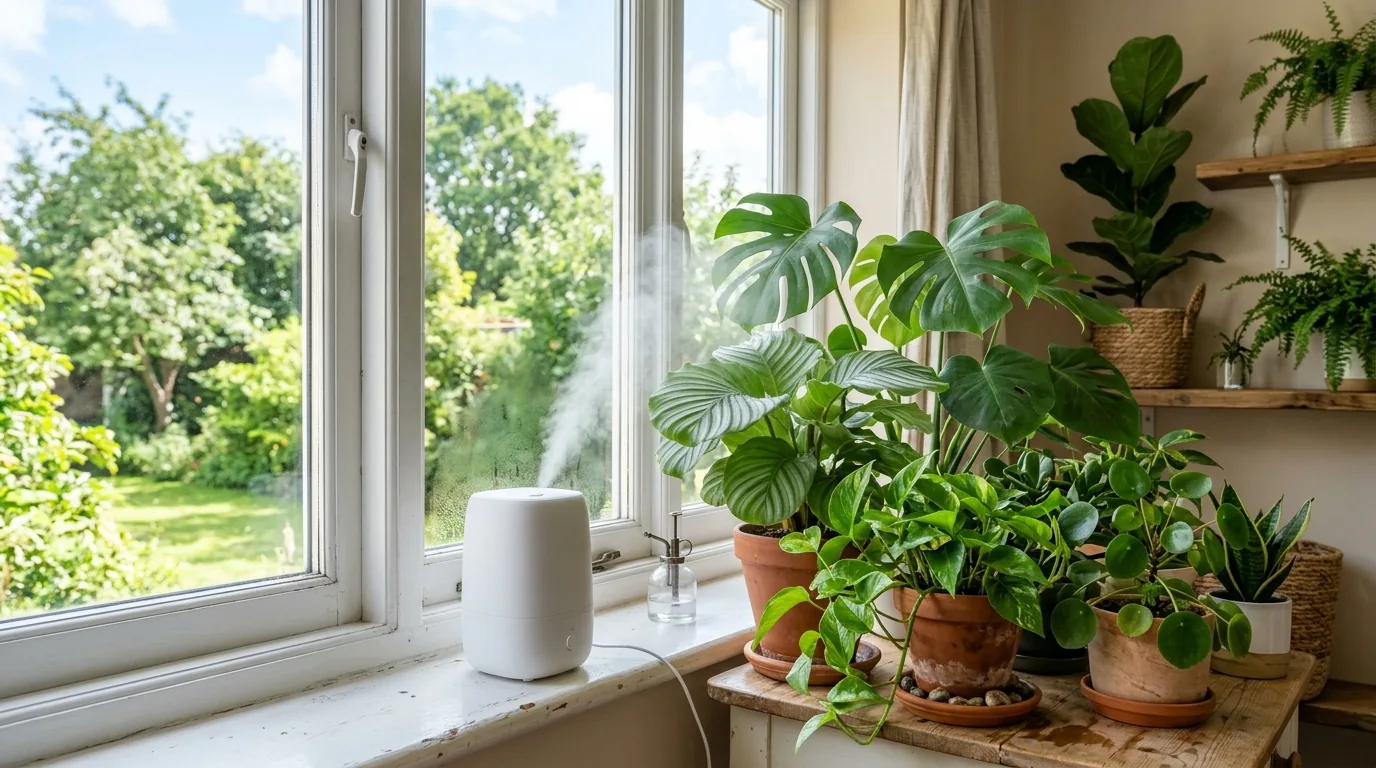
Once the heating comes on, indoor air gets dry, often 10 to 20% relative humidity according to Iowa State, and tropical houseplants show it with brown leaf tips, crispy edges and stalled growth. The usual tips (mist your plants, set them on pebbles) are repeated everywhere, but university extension specialists don’t agree that all of them work. This guide covers how to increase humidity for plants: the ideal humidity for houseplants, which methods actually raise it, how to increase humidity for plants without a humidifier, and how to increase humidity for plants in winter without inviting mold. It follows Iowa State, Penn State, UNH Extension and the EPA.
Ideal Humidity for Houseplants
| Source | What it says |
|---|---|
| Iowa State | Many houseplants prefer 40 to 50% relative humidity; many homes are only 10 to 20% in winter |
| UNH Extension | Aim for about 40 to 50%; many tropical plants prefer more |
| Penn State | ASHRAE recommends 30 to 60% indoors; winter heating can push it below 30%; most houseplants do better than a typical heated home provides, cacti and succulents being exceptions |
| EPA | Keep indoor humidity below 60%, ideally 30 to 50%, to limit mold |
Sources: Iowa State Extension FAQ; UNH Extension (Erler 2020); Penn State Extension (Miklas 2024); EPA, A Brief Guide to Mold, Moisture and Your Home.
Put together, a sensible target for a mixed collection is about 40 to 50%: high enough for most tropical foliage plants, and below the 60% ceiling the EPA sets for mold. Measure before you buy anything. A cheap hygrometer tells you what your room really is; Penn State suggests checking with one before counting on a bathroom, for example.
How to Increase Humidity for Plants: Methods Compared
| Method | How well it works | What the sources say |
|---|---|---|
| Humidifier | Best | “An excellent way” to raise humidity (Iowa State); recommended by UNH; a whole-house unit helps even if it can’t reach ideal levels (Penn State) |
| Terrarium, cloche or cabinet | Very good, for small plants | Glass covers recycle humidity in the plant’s immediate surroundings (Penn State) |
| Grouping plants | Some help | Moisture from soil and leaves raises local humidity (Iowa State, UNH); effect depends on how many plants and room size (Penn State) |
| Pebble tray | Debated | Raises humidity around plants (Iowa State); a practical option (UNH); moisture spreads through the room, so the effect is minimal (Penn State) |
| Cooler room | Some help | Cooler temperatures raise relative humidity somewhat (UNH) |
| Bathroom | Depends | Depends on how often the shower runs; bathrooms often lack light (Penn State) |
| Misting | Little to none | Not effective (Iowa State); even daily misting does nothing for humidity around the plant (Penn State); helps only briefly and can promote fungal problems (UNH) |
Sources: Iowa State Extension FAQ; Penn State Extension, Humidity and Houseplants (2024); UNH Extension (2020).
Humidifiers
Every source we checked puts the humidifier first. Iowa State calls it an excellent way to raise relative humidity in the home, and UNH Extension recommends one for winter, while noting it may not fully offset the dry air from a heat register blowing nearby. Penn State says a whole-house humidifier won’t reach ideal levels for plants but still helps, especially with forced hot-air heating, and that portable units are an option.
- Put it near the plants, not across the room, and group the plants around it.
- Use the hygrometer, not a guess. Run it until the room reads about 40 to 50%, and stay below 60% (EPA).
- Watch the windows. The EPA notes that condensation on windows or walls can be a sign of high humidity; wipe it dry and turn the humidifier down.
- Keep it clean following the maker’s instructions, since standing water in the tank is where problems start.
How to Increase Humidity for Plants Without a Humidifier
No humidifier? These are the options, from most to least useful:
- Put small humidity lovers under glass. A terrarium, a glass cloche or a closed cabinet keeps moisture around the plant (Penn State). This is the best low-cost option for ferns, nerve plants and other small, fussy plants. See our guides on how to make a terrarium and setting up a greenhouse cabinet.
- Group your plants. Water evaporating from the potting mix plus water given off by the leaves raises humidity around the group (Iowa State). The more plants, the better; one or two pots won’t change much (Penn State).
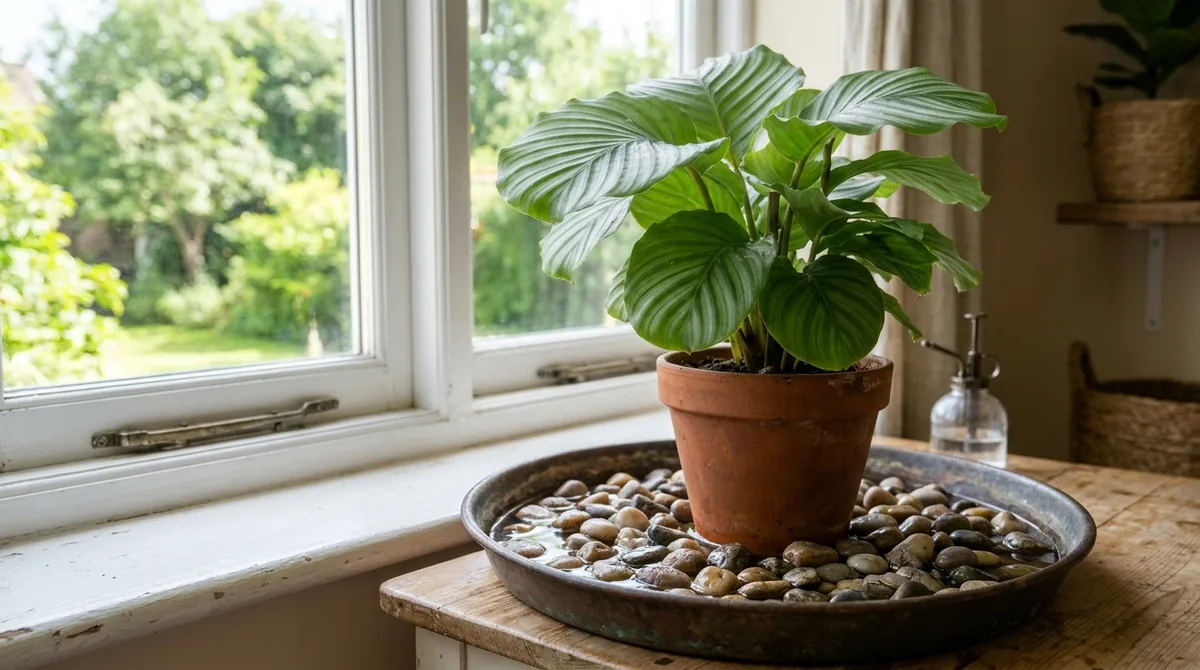
- Try a pebble tray. Fill a tray or saucer with pebbles and water, and keep the water level below the bottom of the pots (Iowa State) so the roots never sit in water. Treat it as a bonus, not a cure: Penn State says the moisture disperses through the room.
- Move plants away from heat. UNH says heat registers blow hot, dry air: keep tropical foliage plants away from them, and leave the spots near heat to succulents.
- Use the right room. A bright bathroom with a regularly used shower can work, but measure it first (Penn State). See our guide to bathroom plants.
Does Misting Work?
Not for humidity. Penn State says the boost lasts only until the water evaporates, often a few minutes, and that “even daily misting does nothing to raise the humidity levels around a plant.” Iowa State adds that you would have to mist several times a day, which is impractical, and UNH warns that misting can promote fungal problems. The exception is air plants (Tillandsia), for which Penn State says misting is an accepted way to water; see our air plant care guide.
How to Increase Humidity for Plants in Winter
Winter is when humidity drops furthest: Iowa State says many homes fall to 10 to 20%, and Penn State notes heating can push humidity below 30%. A winter plan that follows the sources:
- Run a humidifier near the plants and check a hygrometer (Iowa State, UNH).
- Pull tropical plants away from heat registers and radiators (UNH).
- Group plants in the brightest spot you have, since light matters as much as humidity in winter.
- Keep plants a few inches from cold glass (UNH), which also keeps them out of the condensation zone.
- Water less: UNH notes plants need less water at cooler temperatures, so let the top of the mix dry between waterings.
Penn State’s last word is a useful reality check: light and watering are easier to control than humidity, so get those right first. Our guide to winter houseplant care covers the rest, and for the science of humidity and temperature together, see VPD for indoor plants.
Which Plants Need It Most
| Humidity need | Examples | Our guides |
|---|---|---|
| High: struggles in dry rooms | Maidenhair fern, nerve plant, calathea, Boston fern | maidenhair fern, nerve plant, calathea, Boston fern |
| Moderate: most tropical foliage plants | Pothos, philodendron, monstera, dracaena | pothos care, dracaena care |
| Low: fine in dry air | Cacti and succulents (Penn State) | how to grow succulents |
Sources: Penn State Extension (2024) for cacti and succulents; plant groupings follow the sources cited in each of our care guides.
Signs of Too Little (and Too Much) Humidity
| Sign | What it can mean | Source |
|---|---|---|
| Brown leaf tips and edges | Humidity too low (also check watering and salt buildup) | UNH, Clemson HGIC |
| Spider mites appearing | They thrive in hot, dry conditions | UGA |
| Condensation on windows or walls | Humidity too high | EPA |
| Leaf spots after frequent misting | Wet foliage favoring fungal problems | UNH |
Sources: UNH Extension (2020); Clemson HGIC 2251 (2025); UGA Extension B1318 (2022); EPA.
Frequently Asked Questions
How do you increase humidity for plants?
Use a humidifier near your plants; it is the most reliable method according to Iowa State, UNH and Penn State. Grouping plants, glass covers and pebble trays add a little more.
What is the ideal humidity for houseplants?
Many houseplants prefer about 40 to 50% relative humidity (Iowa State, UNH). Keep it below 60% to limit mold (EPA). Cacti and succulents are fine in drier air (Penn State).
How can I increase humidity for plants without a humidifier?
Put small plants under a cloche or in a terrarium, group plants together, keep them away from heat registers, and try a pebble tray with the water below the pot bottoms (Penn State, Iowa State, UNH).
Does misting plants increase humidity?
Barely. Penn State says even daily misting does nothing to raise humidity around a plant, because the water evaporates in minutes, and UNH says it can promote fungal problems.
Do pebble trays work?
The sources disagree. Iowa State says water evaporating from the tray raises humidity around the plants; Penn State says the moisture spreads through the room, so the effect is minimal.
How do you increase humidity for plants in winter?
Run a humidifier near the plants, move tropical plants away from heat registers, group them, and check humidity with a hygrometer. Winter homes can drop to 10 to 20% (Iowa State).
Can humidity be too high for houseplants?
For your home, yes. The EPA recommends staying below 60%, ideally 30 to 50%, to prevent mold, and condensation on windows is a sign humidity is too high.
Sources
- Iowa State Extension FAQ: The air in our home is extremely dry in winter. Should I mist the houseplants?
- Miklas, L. Penn State Extension: Humidity and Houseplants (2024)
- Erler, E. UNH Extension: Houseplant Winter Care Q&A (2020)
- EPA: A Brief Guide to Mold, Moisture and Your Home
- Clemson HGIC 2251: Houseplant Diseases and Disorders (2025)
- Pennisi, B. UGA Extension B1318: Growing Indoor Plants with Success (2022)