
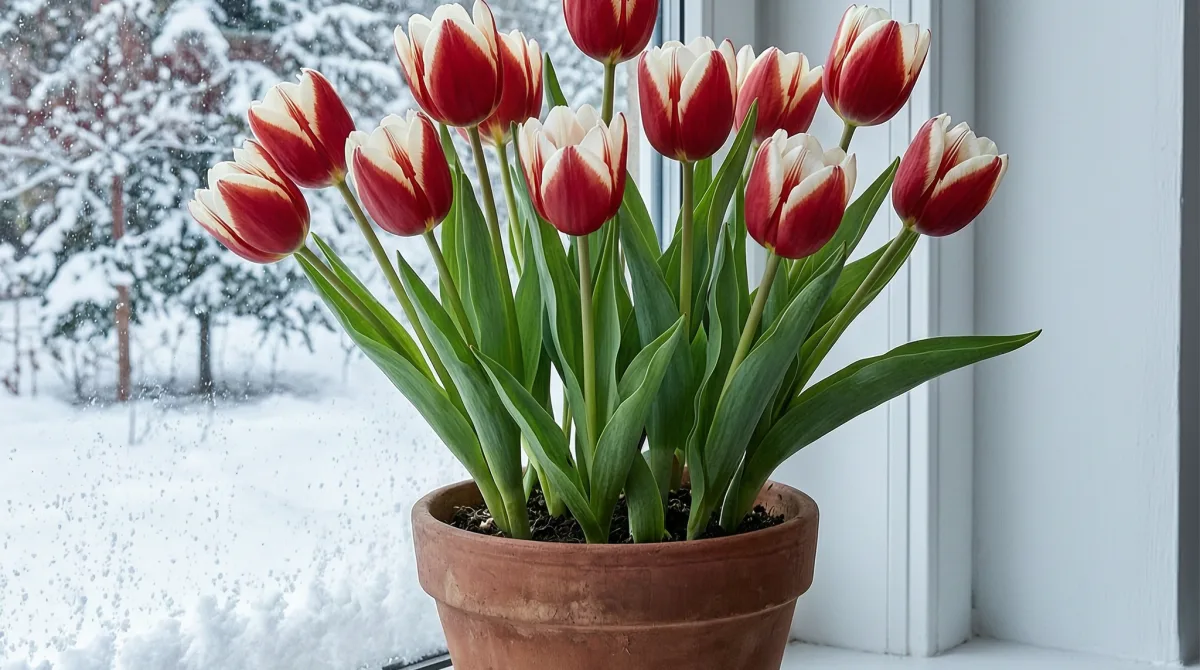
Forcing tulips indoors means giving the bulbs a fake winter, then a warm room. Iowa State University Extension puts the cold period at 40 to 45 °F for 12 to 15 weeks, followed by 2 to 4 weeks to bloom. Count backward 14 to 19 weeks from the date you want flowers, and that is when the pots go into the cold. This guide covers how to force tulips indoors from potting to the last flower.
Forcing Tulips Indoors: The Short Answer
Tulips need a real cold spell before they will bloom, and a refrigerator, a cold garage or an unheated porch can supply it. The bulb is not dormant in the way a seed is; it is waiting for a temperature signal that winter has passed. Skip the cold and the stem stays short, the bud sits low in the leaves, or the bulb simply dries out without flowering.
The schedule is the whole project. Iowa State University Extension gives 12 to 15 weeks at 40 to 45 °F, then 2 to 4 weeks of warmth and light before the flowers open. Add a week of slack for a slow variety or a cold garage that runs a few degrees low, and you are planning 14 to 19 weeks ahead.
| Stage | Temperature | Light | Duration |
|---|---|---|---|
| Cold period | 40 to 45 °F | Complete darkness | 12 to 15 weeks |
| Wake up | 50 to 60 °F | Low to medium | 4 to 5 days, until shoots turn green |
| Growth and bloom | 60 to 65 °F | Bright | 2 to 4 weeks |
Source: Iowa State University Extension and Outreach, How to Force Spring-Flowering Bulbs Indoors.
Count Back From the Date You Want
Pick the date first. For flowers in late January, start the cold period in early October. For flowers at Christmas, start in late August or early September. The count is 12 to 15 weeks of cold plus 2 to 4 weeks of growth, so 14 to 19 weeks in total.
Write the start date on a label and put it in the pot, not on a calendar you might lose. The cold period is long enough that a week of drift is normal, and a label in the pot travels with the bulbs if you move them from a garage to a refrigerator.
Start the pots in that window and check them weekly. A cool garage that holds 42 °F will run toward the long end; a refrigerator set at 45 °F will run toward the short end.
Pots, Soil and Planting Depth
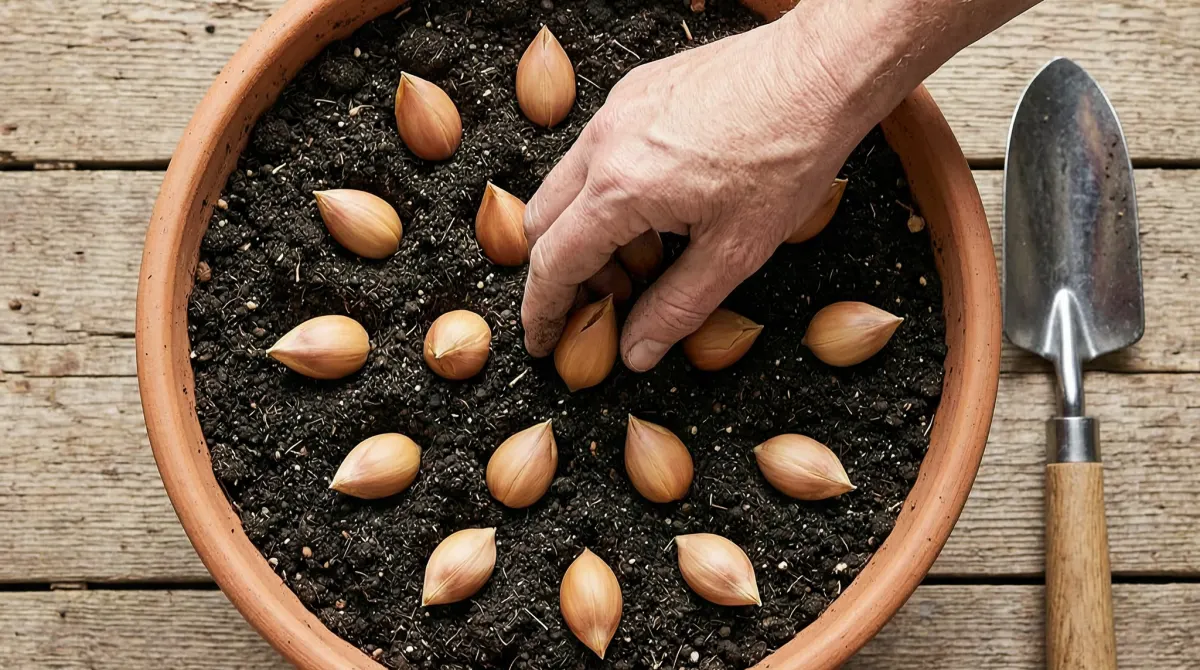
Use a container about twice as deep as the bulbs, with drainage holes. A 6-inch pot takes 5 to 7 tulips, according to Iowa State University Extension. Set the bulbs with the pointed tip up and the flat base down, and space them so they do not touch. The tips should sit at or just below the rim of the pot.
Use a light, well-drained mix rather than garden soil. Fill the pot partway, set the bulbs, then add mix around them and firm it gently. Leave an inch of space below the rim so water does not run straight over the side. Water once after planting and let the pot drain.
The Cold Period
Cold means 40 to 45 °F, and dark means dark. Iowa State University Extension specifies complete darkness during rooting, because light during the cold period can push pale shoots that then burn when they reach the room. A cardboard box over the pots, a black bin, or a dark corner of a cold room all work.
Do not let the pots freeze. A garage that dips below 32 °F will damage the bulbs, and a refrigerator set too cold will do the same. Check the temperature with a thermometer rather than trusting the dial, especially in a garage that swings with the weather.
Keep the mix barely moist. The bulbs are not growing leaves yet, so they use little water, and wet mix in the dark is a recipe for rot. Feel the surface every week or two and water only if it is dry below the top inch.
Keep fruit away
Ripening fruit gives off ethylene, and Iowa State University Extension notes that ethylene inhibits flowering in bulbs. Do not store the pots next to apples, bananas or a bowl of fruit in a refrigerator or garage.
Bringing the Pots Into the Light
When the shoots are up and the pots have had their cold weeks, move them to 50 to 60 °F in low to medium light. Iowa State University Extension gives 4 to 5 days at this stage, until the shoots turn green. This step hardens the growth that formed in the dark and prevents the pale, floppy stems that come from a sudden move into a warm, bright room.
After the shoots green up, move the pots to 60 to 65 °F in bright light. Turn them a quarter turn every day or two so the stems straighten instead of leaning toward the window. A cool room makes the flowers last longer; a warm, sunny room pushes them open fast and then collapses them.
Pro tip: Keep the pots cool at night. The difference between 60 °F and 70 °F is several days of bloom, and a cool spare room or a glassed porch does the job without any equipment.
Water, Temperature and Support
Water when the surface of the mix is dry, and water less than you would for a houseplant in active growth. The bulbs are prone to rot in soggy mix, and the roots are shallow. A pot that feels light is a better guide than a calendar.
Tall varieties may need a thin stake or a ring of twine. The stems are soft from the forced growth, and a heavy flower head can tip a whole pot. Support them early, before the buds open, so you are not pushing a cane into the bulbs later.
Keep the pot away from radiators, heat vents and the direct stream of a hot window. Bright light and cool air are the combination that gives straight stems and a long bloom. If the leaves look pale and the stems stretch, the light is too weak; move the pot closer to the glass.
After the Flowers Fade
Cut the flower stems and keep watering the leaves until they yellow, if you want to try saving the bulbs. Iowa State University Extension notes that tulips are usually discarded after forcing, while daffodils can be saved. The reason is that a forced tulip has spent most of its stored energy on one flower, and the bulb that remains is small.
If you do keep them, let the leaves die back naturally in good light, then lift the bulbs and store them cool and dry until autumn. Do not expect a second forcing to match the first. For most people, the honest plan is to compost the spent tulips and buy fresh bulbs for the next schedule.
Daffodils and hyacinths follow the same cold and warm pattern but with different aftercare. Our guides to growing paperwhites and growing hyacinths cover the bulbs that do not need a cold period and the ones that are forced in water. For a bulb that blooms on a similar schedule with a much shorter cold, see amaryllis care.
Pet Safety
Tulips are toxic to dogs, cats and horses, according to the ASPCA. The toxic principles are tulipalin A and B, and the highest concentration sits in the bulb. Signs listed by the ASPCA include vomiting, depression, diarrhea and hypersalivation.
That matters more for forced bulbs than for a garden bed, because the pots sit on counters and floors where pets can dig. Keep the pots out of reach, and sweep up any bulb scales or broken bulbs before a cat or dog finds them. If you suspect your pet has eaten tulip, contact your veterinarian or the ASPCA Animal Poison Control Center at (888) 426-4435.
Frequently Asked Questions
How long do tulips take to bloom indoors?
About 14 to 19 weeks from potting. Iowa State University Extension gives 12 to 15 weeks of cold at 40 to 45 °F, then 2 to 4 weeks of warmth and light before the flowers open.
When to start forcing tulips?
Count back 14 to 19 weeks from the date you want flowers. For late January bloom, start the cold period in September or early October; for Christmas, start in late August or early September.
Forcing tulips in water: does it work?
Tulips are usually forced in pots of soil, because the bulb needs a cold, dark root run. Hyacinths are the bulb commonly forced in a glass of water, with the bulb held above the water line.
Do forced tulips need darkness?
Yes, during the cold period. Iowa State University Extension specifies complete darkness while the bulbs root. Light at that stage pushes pale shoots that burn when the pot comes into the room.
Can I save forced tulip bulbs for next year?
It is possible but rarely worth it. Iowa State University Extension notes that tulips are usually discarded after forcing, while daffodils can be saved. A forced tulip has spent most of its stored energy on one flower.
Why are my forced tulips short?
Usually too little cold or too warm a cold period. The bulb needs 12 to 15 weeks at 40 to 45 °F. A garage that stayed above 50 °F, or a cold spell cut short, gives short stems and buds that sit low in the leaves.
Are tulips toxic to cats and dogs?
Yes. The ASPCA lists tulips as toxic to dogs, cats and horses, with the highest concentration of tulipalin in the bulb. Keep forced pots out of reach and clean up fallen bulb scales.