
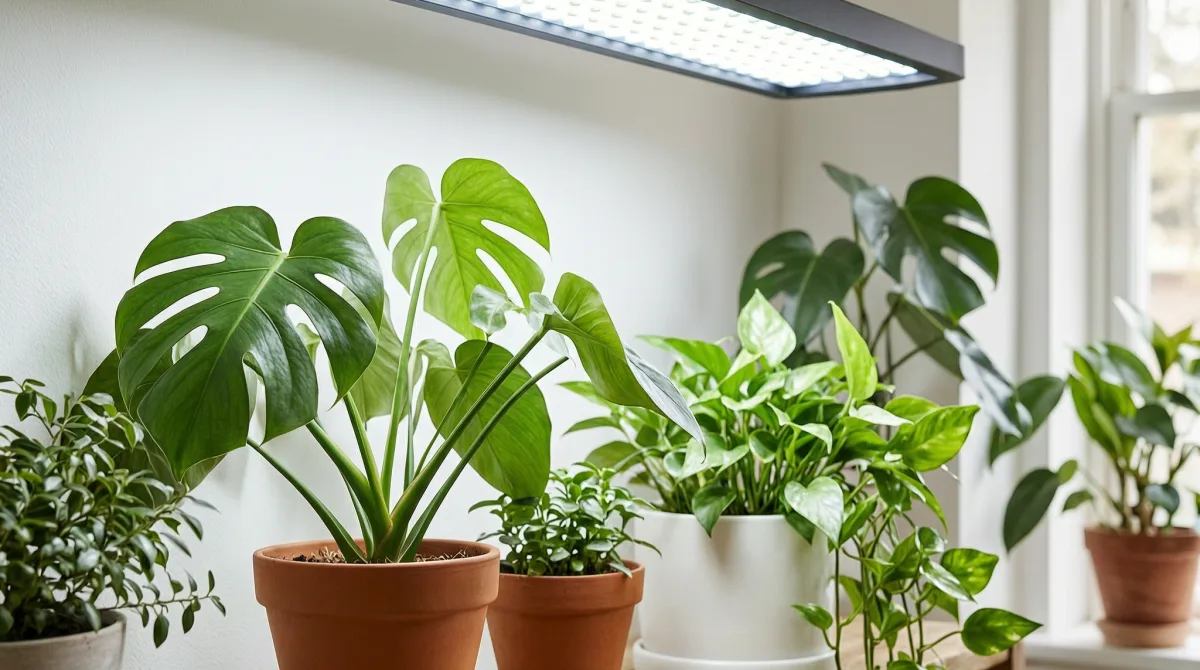
How far should grow lights be from plants? For most foliage houseplants, 12 to 24 inches. Seedlings want 4 to 6 inches, flowering plants 6 to 12 inches, and hydroponic lettuce or herbs 6 to 12 inches, according to the University of Minnesota Extension. Those are starting points, not fixed rules, because the same lamp at 6 inches and at 24 inches delivers very different intensity to the leaf.
How Far Should Grow Lights Be From Plants?
The distance depends on what you are growing and how strong the lamp is. A weak strip light has to sit close to do anything. A high-output LED panel can damage leaves at the same distance. The University of Minnesota Extension sorts the common cases into four groups, and the range for each one is wide enough to cover most home setups.
| What you are growing | Distance from the canopy | Hours of light per day |
|---|---|---|
| Seedlings | 4 to 6 inches | 16 to 18 hours |
| Flowering plants and cuttings | 6 to 12 inches | 14 to 16 hours |
| Hydroponic lettuce and herbs | 6 to 12 inches | 12 to 14 hours |
| Foliage houseplants | 12 to 24 inches | 12 to 14 hours |
Source: University of Minnesota Extension, Lighting for indoor plants and starting seeds.
Two adjustments override the table. First, measure from the top of the plant, not from the pot rim, and remeasure as the plant grows. Second, if the lamp has a dimmer, use it. Turning a strong light down is easier than moving a fixed shelf up, and it keeps the coverage even across several pots.
Why Distance Changes Everything
Light spreads as it leaves the fixture. The same photons that cover a narrow circle at 6 inches cover a much wider circle at 24 inches, so fewer of them land on any one leaf. The University of Minnesota Extension describes this as intensity falling as the distance increases, which is why a lamp that scorches a seedling at 4 inches may do almost nothing for a monstera at 3 feet.
This is also why “close enough” is not a fixed number. A 10-watt strip and a 100-watt panel are not interchangeable, and two lamps sold as “full spectrum” can differ by a factor of five in output. Distance is the control you have after you buy the light, and it is the fastest one to change.
Do not guess from the box
“Equivalent to 100 watts” describes power draw, not light delivered to the leaf. A lamp with a wide beam also loses intensity faster at the edges of a shelf than at the center, so the plants at the ends of a long strip may need a shorter distance than the ones in the middle.
Distance by Plant Type
Seedlings. Four to six inches is the range the University of Minnesota Extension gives for starting seeds. Seedlings are small, the canopy is flat, and a short distance keeps the light even across the tray. The trade is heat: a lamp that is safe at 8 inches may dry the surface of a seed tray at 4 inches, so check the mix daily.
Flowering plants and cuttings. Six to 12 inches. Flowering takes more energy than holding leaves, and cuttings have no roots to buffer a bad week. A rooted cutting in a small pot can sit closer than a flowering plant in a 10-inch pot, because the canopy is smaller and the light does not have to travel as far to reach every leaf.
Hydroponic lettuce and herbs. Six to 12 inches, with 12 to 14 hours of light. Leafy crops are forgiving about distance and unforgiving about heat. If the reservoir warms up, the plants suffer before the light looks wrong, so keep the fixture high enough that the water stays near room temperature.
Foliage houseplants. Twelve to 24 inches, with 12 to 14 hours. Most aroids, ferns and ficus sold as houseplants evolved under a canopy, not in full sun. They want bright light without the leaf temperature that comes from a lamp held too close. This is the group where the wide range matters most, because a slow-growing plant in a dim corner needs the closer end and a variegated plant in a bright room needs the far end.
How Long Should Grow Lights Be On?
Distance and duration work together. A lamp at the far end of the range needs the longer photoperiod to deliver the same daily total, and a lamp at the close end needs the shorter one. The University of Minnesota Extension gives 16 to 18 hours for seedlings, 14 to 16 hours for flowering plants, and 12 to 14 hours for lettuce, herbs and foliage houseplants.
Do not run a grow light 24 hours a day. Plants use the dark period to move sugars and complete processes that light interrupts, and many houseplants are sensitive to day length. A simple timer set once is more reliable than switching the lamp by hand, and it keeps the same schedule on cloudy days.
The upper end of each range is for a weak lamp or a dark room. If you are already at the closest safe distance and the plant still stretches, add an hour before you add a second fixture. If the leaves look bleached, cut an hour and raise the lamp.
PPF, Lumens and Watts: Which Number Matters
Grow light labels use three different numbers, and only one describes the light a plant can use. The University of Minnesota Extension measures light for plants in PPF, the total photosynthetic photon flux a fixture emits, in micromoles per second. The light that actually reaches a leaf is PPFD, the same unit per square meter, written as micromoles per square meter per second.
These are the PPF ranges the University of Minnesota Extension uses to describe low, medium and high light for indoor plants. A fixture’s output is fixed, so the PPFD at the leaf depends on how far the lamp is and how wide the beam spreads.
Lumens are a measure for human vision, not for photosynthesis, and the University of Minnesota Extension notes that they are an unreliable way to compare plant lights. Watts measure energy use rather than intensity, so a 30-watt LED and a 30-watt fluorescent are not the same light. Use watts to estimate running cost and PPF or PPFD to compare fixtures.
Pro tip: If a manufacturer publishes a PPFD map, read the number at the corners, not the center. The center figure is the best case, and a shelf of plants sits across the whole footprint.
Signs the Light Is Too Close or Too Far
Too close
- Leaf edges curl upward or turn brown and crispy
- Bleached or white patches on the side facing the lamp
- Soil dries out in a day or two
- New leaves are smaller than the old ones
Too far
- Stems stretch and the spaces between leaves get longer
- New leaves are smaller and paler
- Variegated plants lose their pattern
- Growth stops even though the lamp is on
Stretching is the clearest signal that a plant wants more light. It happens because the stem extends toward the strongest part of the beam, which is directly under the fixture. Move the lamp 2 to 3 inches closer, wait two weeks, and look at the new growth rather than the old stems, which will not shrink back. Our guide to leggy plants covers what to do with the stretched growth you already have.
Bleaching is the opposite problem. It shows up first on the leaves closest to the lamp and on the side that faces it. Raise the fixture, and do not move the plant into a darker room, because the rest of the plant still needs the light. If only one pot is affected, rotate it to the edge of the footprint instead of changing the height for everything.
Setting the Distance on a Shelf or Tent
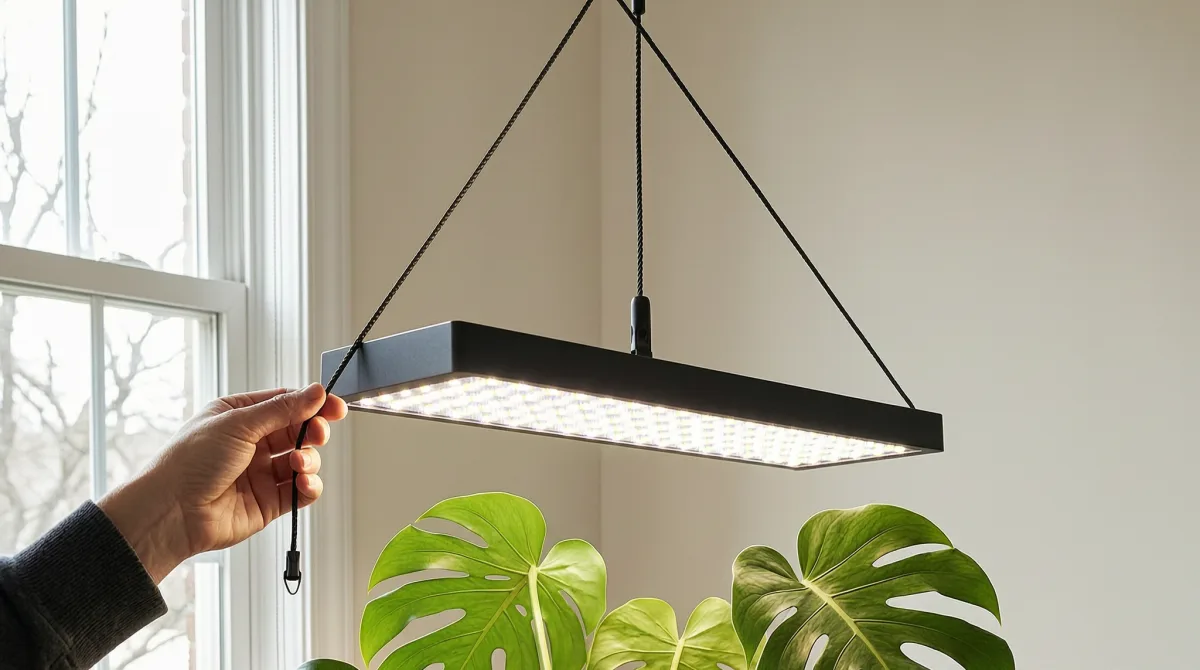
Set the height for the tallest plant and use risers for the short ones. A stack of books under a 4-inch pot is easier to adjust than a shelf bracket, and it keeps the lamp at one height instead of tilting. In a grow tent, hang the fixture from the cross bars with ratchet hangers so you can move it a few inches at a time.
Then measure the actual gap with a tape, not by eye. A 12-inch distance from the top of a plant in a 10-inch pot is not the same as 12 inches from the shelf, and the difference is the whole point. Write the number on a label, and check it again when the plant puts out a new flush of leaves.
For a single plant in a room, a lamp at 12 to 24 inches with a 12-hour timer is enough for most foliage houseplants. For a shelf of seedlings, keep the lamp at 4 to 6 inches and run it 16 to 18 hours. If you are choosing a fixture first, our guide to the best grow lights for indoor plants covers output and coverage, and our monstera light requirements guide shows how one plant’s needs translate into a distance.
Frequently Asked Questions
How far should grow lights be from seedlings?
Four to 6 inches, according to the University of Minnesota Extension. Keep the light 16 to 18 hours a day and check the soil surface daily, because a lamp that is close enough for compact growth can also dry a small tray quickly.
How far should grow lights be from house plants?
Twelve to 24 inches for most foliage houseplants, with 12 to 14 hours of light. A variegated plant or one in a bright room can sit at the far end, while a slow-growing plant in a dim corner needs the closer end.
Can a grow light be too close to a plant?
Yes. Leaf edges curl, brown patches appear on the side facing the lamp, and the soil dries within a day or two. Raise the fixture a few inches and cut the photoperiod by an hour if the damage is recent.
How long should grow lights be on for houseplants?
Twelve to 14 hours a day for foliage houseplants, 14 to 16 hours for flowering plants, and 16 to 18 hours for seedlings. A timer is more consistent than switching the lamp by hand.
How far away should grow lights be?
Use the plant as the reference, not the room. Foliage houseplants sit 12 to 24 inches below the lamp, seedlings 4 to 6 inches, and flowering plants or herbs 6 to 12 inches. Measure from the top leaf, then adjust after two weeks of new growth.
Do grow lights need to be a certain distance from the ceiling?
No. What matters is the gap between the lamp and the top of the plant. A shelf or a hanging kit gives you room to adjust that gap as the plant grows, which is why ratchet hangers and risers are more useful than a fixed bracket.
Is 24 hours of grow light bad for plants?
It is not recommended. Plants use the dark period to move sugars and complete growth processes, and many houseplants respond to day length. Keep to the 12 to 18 hour ranges above and give the plant a dark night.