
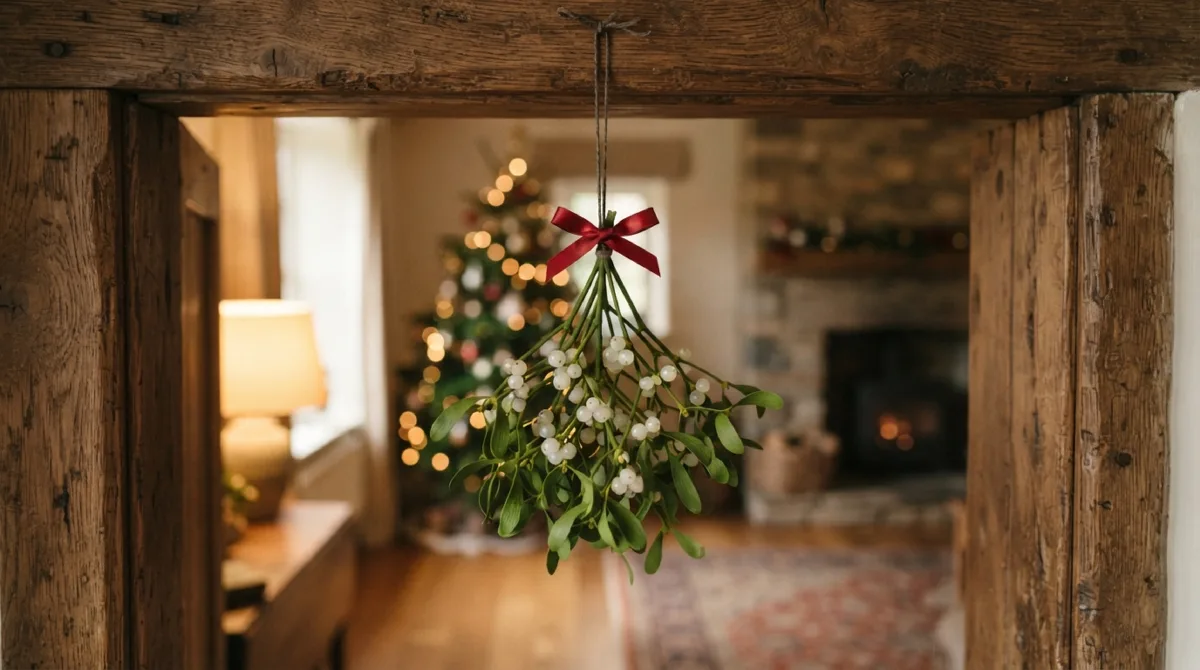
Every December, a sprig of white berries hangs over a doorway and gives people permission to kiss. The mistletoe meaning behind that custom is older and stranger than the decoration suggests. This guide covers the plant, the Norse story that explains the mistletoe meaning kiss, the English custom that turned it into a Christmas game, and the mistletoe christmas meaning people use today. It also covers mistletoe meaning in love and the way the word shows up in song and slang. It follows the RHS, NC State Extension and the medieval sources.
What Mistletoe Means in One Paragraph
Mistletoe means a kiss, a truce and a bit of winter magic, depending on who is telling the story. In the Norse version it is a plant of loss: the one thing that was overlooked when the gods asked everything in the world to spare Baldr. In the English version it is a party game: a bunch hung in the kitchen, a kiss for each berry, and no berries left when the fun is over. In both versions the plant is a boundary object, something that grows between earth and sky, and that is a large part of its hold on the imagination.
The Plant Behind the Tradition
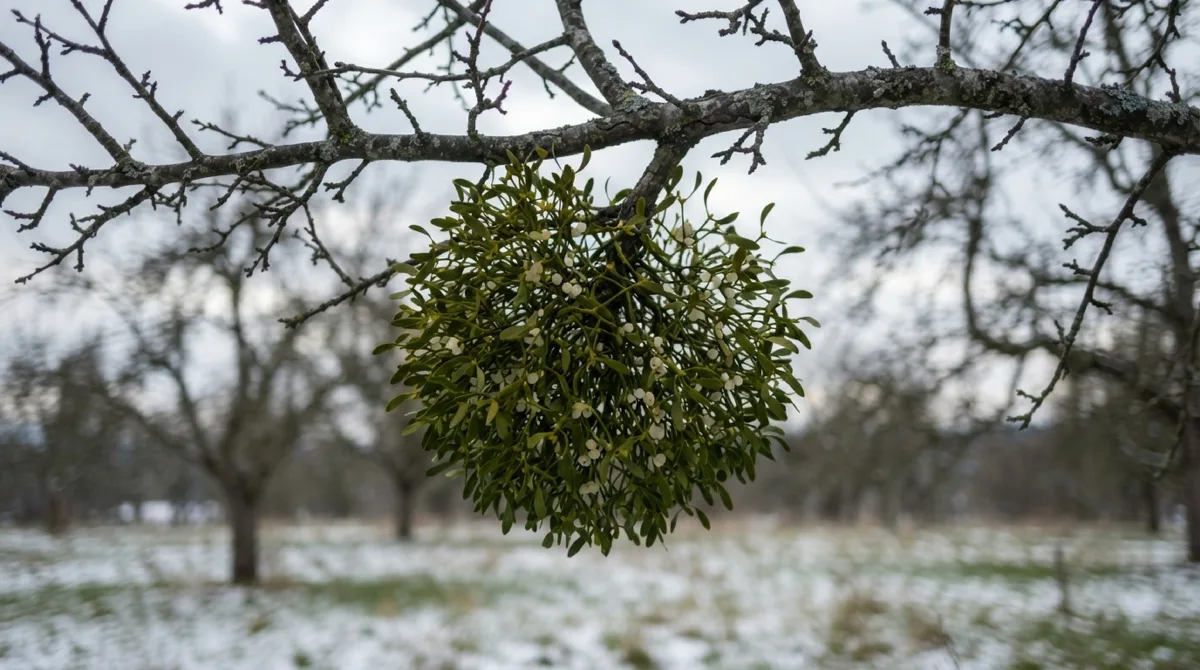
The mistletoe in a British Christmas bunch is usually European mistletoe, Viscum album. The RHS describes it as a plant that grows on the branches of trees rather than in the ground, with apple as its most common host in the UK, followed by lime, hawthorn and poplar. It takes water and nutrients from the host tree but also makes its own food through photosynthesis, which is why it is called a hemiparasite rather than a full parasite.
The American version is Phoradendron leucarpum, native to the central and eastern United States. NC State Extension describes it as an evergreen shrub in the sandalwood family, a hemiparasitic epiphyte that grows on the branches of maple and oak and makes its own food while taking water and nutrients from the tree. It matures to about 3 feet high and wide, with greenish branches and white berries.
Both plants spread the same way. Birds eat the berries, the sticky pulp carries the seed, and the seed sticks to a branch where it can sprout. NC State notes that the pulp is also the method by which the seeds are deposited on trees, which is a polite way of saying that the bird does the planting.
Why We Kiss Under It: Three Layers of the Tradition
There is no single origin story that explains the kiss. Three layers are usually mixed together, and each one adds something.
- The Norse myth. Mistletoe is the plant that kills Baldr, the god who was supposed to be invulnerable. The story survives in the Prose Edda, a 13th-century Icelandic text.
- The English farmhouse custom. A bunch of mistletoe hung in a kitchen or farmhouse at Christmas, with a kiss for each berry plucked. Washington Irving recorded it in The Sketch Book in 1820.
- The Victorian Christmas. The custom moved from the farmhouse to the parlor, the kissing bough became a decoration, and the plant became a standard Christmas image alongside holly and ivy.
The layers are not competing versions of one event. They are a myth, a custom and a fashion, stacked on top of each other until the plant meant a kiss to almost everyone.
Mistletoe in Norse Myth: Baldr and Frigg
The story is in the Prose Edda, in the section called Gylfaginning. Baldr, the son of Odin and Frigg, begins to dream of his own death. Frigg asks every thing in the world to swear an oath not to harm him: fire, water, iron, stones, earth, wood, sickness, animals, birds, worms. The gods then amuse themselves by throwing weapons at Baldr, because nothing can hurt him.
Loki, disguised as a woman, asks Frigg whether anything was left out. She answers that there is a tree-sprout west of Valhalla called mistletoe, and that she thought it too young to ask for an oath. Loki pulls up the mistletoe, goes to the assembly, and finds Hödr, Baldr’s blind brother, standing outside the circle. Loki puts the mistletoe in Hödr’s hand and guides him to throw it at Baldr. The plant pierces Baldr and he dies.
That is the source of the darker half of the meaning. Mistletoe is not a lucky plant in the myth; it is the overlooked thing that ends a golden age. The later association with love and peace is a reinterpretation, not something the medieval text says. It is also why some retellings call mistletoe a plant of peace: the story is about a world that lost something precious and the hope of its return.
The English Kissing Bough
The kiss is not in the Edda. It comes from English custom, and the clearest early description is in Washington Irving’s The Sketch Book, published in 1820. Irving describes an old English Christmas in which the Yule log and Christmas candle were burned and “the mistletoe with its white berries hung up, to the imminent peril of all the pretty housemaids.”
His footnote explains the game: the mistletoe is still hung in farmhouses and kitchens at Christmas, the young men have the privilege of kissing the girls under it, and each kiss costs a berry. When the berries are all plucked, the privilege ends. That is the detail most modern decorations leave out: the berries were a counter, and the bunch was a game with rules.
The kissing bough was a related decoration, a ball of evergreen branches, apples, ribbons and sometimes candles, hung from the ceiling. Over the 19th century it moved into the parlor and became part of the Victorian Christmas, which is the version that spread to the United States and the rest of the English-speaking world.
Mistletoe Meaning in Love, Song and Slang
Today the mistletoe meaning in love is simple: an invitation. “Meet me under the mistletoe” is a way of proposing a kiss without saying so directly, and the plant gives the moment a script. That is why it appears in Christmas songs, cards and films, and why the word itself can stand in for a kiss.
The mistletoe meaning slang is looser. In casual use, “mistletoe” is shorthand for a romantic moment or a kiss, and the word turns up in captions, lyrics and jokes that have little to do with the plant. The best-known modern example is Justin Bieber’s 2011 song “Mistletoe,” which uses the image for exactly that: a winter romance rather than a botany lesson.
There is also a quieter meaning that shows up in older writing: peace and friendship. The plant was said to be a sign of goodwill, and a kiss under it was a truce as much as a flirtation. That reading fits the Norse story, where mistletoe is tied to the loss of Baldr and the hope of his return, but it is a later interpretation rather than a line in the medieval text.
Is Mistletoe Poisonous?
Yes. NC State Extension lists American mistletoe as having medium severity poison characteristics, and notes that the white pulp of the berry is poisonous to humans. The ASPCA lists mistletoe as toxic to cats and dogs. The berries are the part people most often handle, and the sticky pulp is the part that ends up on fingers.
Keep real mistletoe out of reach of children and pets, and wash your hands after handling it. Do not assume that a small amount is harmless because the plant is traditional. If a child or pet eats the berries, call a poison control service or your veterinarian. If you want greenery that is safe around animals, start with our lists of cat safe plants and plants safe for dogs.
How to Use Mistletoe at Christmas
Fresh mistletoe is the traditional choice and lasts for weeks if it is kept cool and dry. Tie a small bunch with ribbon, add a loop, and hang it above a doorway at head height or higher. Keep it away from radiators and direct heat, which dry the leaves and loosen the berries.
If you have pets or small children, use fabric or paper mistletoe, or hang the real bunch well above reach and check it regularly. The same rule applies to other holiday plants: our guide to Christmas plants covers which ones are pet-safe and which are not, and our holly care guide covers the other berry-heavy Christmas plant.
For the tree itself, see our real Christmas tree care guide. For more on the stories behind the plants, see our guide to monstera symbolism.
Frequently Asked Questions
What does mistletoe symbolize?
It symbolizes a kiss, romance and Christmas goodwill, with a darker layer from Norse myth, where mistletoe is the plant that kills the god Baldr. The kissing custom comes from English farmhouse tradition.
Why do people kiss under mistletoe?
The custom is recorded in Washington Irving’s The Sketch Book in 1820: mistletoe was hung in farmhouses and kitchens, a man could kiss a woman under it, and each kiss cost a berry. When the berries were gone, the privilege ended.
Is mistletoe poisonous to humans?
Yes. NC State Extension lists American mistletoe as having medium severity poison characteristics and says the white berry pulp is poisonous to humans. Keep it away from children and wash your hands after handling it.
Is mistletoe poisonous to dogs and cats?
The ASPCA lists mistletoe as toxic to cats and dogs. Keep real sprigs out of reach, pick up any berries that fall, and call your veterinarian if a pet eats the plant.
Is mistletoe a parasite?
It is a hemiparasite. It takes water and nutrients from the host tree but makes its own food through photosynthesis. The RHS describes European mistletoe this way, and NC State describes the American species the same way.
What is the difference between American and European mistletoe?
They are different plants. European mistletoe is Viscum album, common on apple and other trees in the UK. American mistletoe is Phoradendron leucarpum, native to the central and eastern United States and used as a Christmas decoration there.
Does mistletoe mean peace?
It is often described that way, but the peace reading is a later interpretation. The Norse myth is about loss, and the English custom is about a kiss. The peace meaning grew from the plant’s role as a sign of goodwill at Christmas.
Sources
- RHS: Mistletoe, growing guide and plant profile
- NC State Extension Plant Toolbox: Phoradendron leucarpum (American mistletoe)
- ASPCA: Mistletoe is toxic to cats and dogs
- Snorri Sturluson, Prose Edda, Gylfaginning, trans. Arthur Gilchrist Brodeur (1916)
- Washington Irving, The Sketch Book (1820), Project Gutenberg