
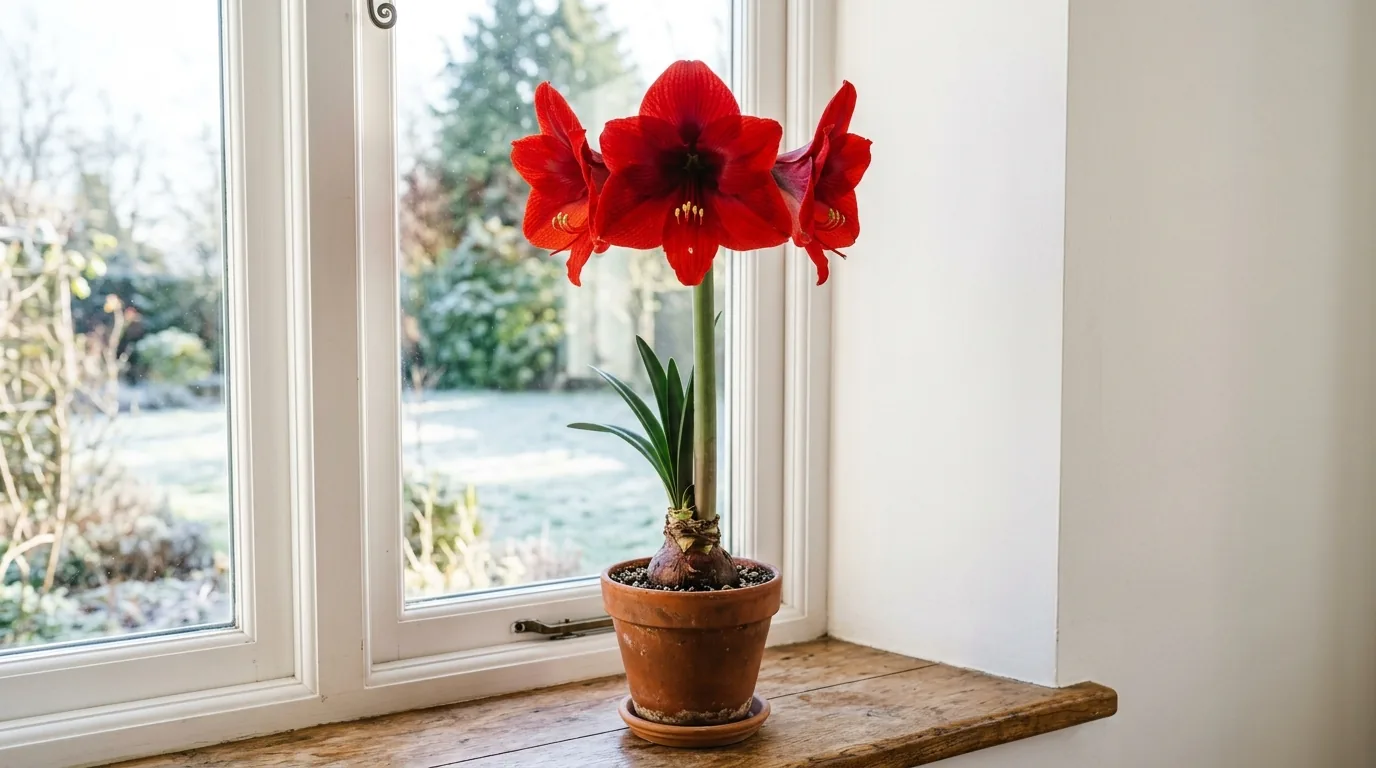
The amaryllis sold for the holidays is a Hippeastrum hybrid from Central and South America, not the African Amaryllis that gave it its name (University of Minnesota Extension). It is one of the easiest bulbs to bring into flower indoors, and with the right amaryllis care the same bulb can bloom again for years. The trick is what you do after the flowers fade. This guide covers planting, care indoors, amaryllis care after blooming, reblooming, waxed bulbs and pet safety, following University of Minnesota Extension, Clemson HGIC, University of Maryland Extension, Iowa State, NC State Extension and the ASPCA.
Amaryllis Care at a Glance
| Need | What the sources say |
|---|---|
| Pot | About 1 inch wider than the widest part of the bulb (UMN, UMD); 1 to 2 inches (Clemson); with drainage holes; heavy pots resist tipping (Clemson) |
| Planting depth | One third to one half of the bulb above the soil (UMN, Clemson) |
| Light | Sunny window; at least four hours of direct sun a day, south window best (Clemson) |
| Water | Sparingly until growth starts, then when the top of the mix dries (UMN: top 2 inches; UMD: top 1/2 inch); never standing in water |
| Temperature | 70 to 75°F while growing; about 65°F once in flower to make blooms last (Clemson) |
| Time to bloom | 4 to 8 weeks from planting (Clemson); about 4 to 6 weeks after a rest (UMN) |
| Feeding | Only once growth is visible; dilute houseplant fertilizer (UMN, Clemson) |
| Rest for winter rebloom | 8 to 12 weeks dry and dark at 50 to 60°F (UMN); 6 to 8 weeks at 40 to 50°F (UMD); 8 to 10 weeks without water (Clemson) |
| Pets | Toxic to dogs, cats and horses (ASPCA) |
Sources: University of Minnesota Extension (reviewed 2026); Clemson HGIC 1551 (2024); University of Maryland Extension (2023); ASPCA.
Choosing a Bulb
University of Minnesota Extension advises buying the largest bulb available for the variety, since larger bulbs produce more stalks and flowers. Bulbs should be firm and dry with no mold, decay or injury; new green growth is normal. Clemson HGIC gives an example: a bulb of 30 to 32 cm in circumference usually produces two stalks with 3 to 4 flowers each, and larger bulbs up to three stalks.
How to Plant Amaryllis Bulbs in Pots
Amaryllis blooms best slightly potbound, in a narrow pot (UMN, UMD). Following University of Minnesota Extension:
- Choose a pot with drainage holes, about 1 inch wider than the widest part of the bulb and twice as tall as the bulb, for root room.
- Fill it about half full with fresh, sterile potting mix rich in organic matter such as peat moss. Clemson suggests equal parts peat and perlite.
- Set the bulb so its roots rest on the mix, then fill in around it, firming the mix, until one third to one half of the bulb is still showing. Clemson notes that keeping the bulb’s “nose” dry helps reduce red blotch disease.
- Water thoroughly and let it drain completely, then set it in a sunny window.
After that first watering, Clemson suggests waiting about a week before watering again and then keeping the mix only slightly moist until leaves or a flower stalk appear. Clemson says plants usually bloom 4 to 8 weeks after planting when planted in early to mid November, which makes early November the time to plant for holiday flowers.
Amaryllis Care Indoors While It Grows and Blooms
- Light: Clemson recommends at least four hours of direct sun a day, ideally a south window. Turn the pot every few days so the stalk grows straight (Clemson, UMD). UMD warns that spindly, floppy leaves are a sign of too little light.
- Water: UMN says to water when the top 2 inches of soil feel dry and let the pot drain each time; UMD suggests letting the top 1/2 inch dry. Never leave the pot standing in water, which encourages bulb and root rot.
- Feeding: start only once growth is visible. UMN suggests fertilizing at half strength each time you water, with a higher-phosphorus houseplant fertilizer to promote blooming; Clemson suggests diluted liquid houseplant fertilizer twice a month. Clemson warns that fertilizing a bulb with no leaves can kill its roots.
- Temperature: Clemson suggests 70 to 75°F while the bulb roots and grows, away from heaters and vents.
- Staking: tall stalks may need a stake and a soft tie; avoid pushing the stake into the bulb (UMD). If a stalk bends too far, Clemson says you can cut it and put it in a vase, where it keeps blooming.
Amaryllis Care After Blooming
University of Minnesota Extension puts it simply: the secret to keeping amaryllis thriving for years is to keep it actively growing after it finishes blooming. The leaves made over spring and summer are what fill the bulb with energy for the next flowers.
- Remove the faded flowers so the plant doesn’t set seed, which drains the bulb (UMN, Clemson).
- Deal with the stalk. UMN says to leave the stalk until it turns yellow, because a green stalk still photosynthesizes. Clemson and UMD say to cut it back after the flowers fade. Either works; the leaves matter more.
- Keep every leaf. Don’t cut the foliage; it feeds the bulb (UMD).
- Give it the sunniest spot indoors, and keep watering and feeding regularly with an all-purpose houseplant fertilizer (UMN).
- Move it outdoors for summer once all danger of frost has passed. Start in shade, then move it gradually into full sun, at least 6 hours a day (UMN). You can sink the whole pot in a garden bed. Keep feeding monthly, and bring it back indoors before the first fall frost, because amaryllis won’t survive frost.
If you are bringing pots back inside in fall, our guide to bringing plants indoors for winter covers checking them for pests first.
How to Get Amaryllis to Bloom Again
University of Minnesota Extension notes that amaryllis does not actually need a rest period: kept growing, it will bloom again on its own schedule. A dry rest is how you time the flowers for winter. The sources give slightly different recipes:
| Source | Rest period | Then |
|---|---|---|
| University of Minnesota Extension | Bring the pot in before frost; store it cool, dry and dark at about 50 to 60°F; no water for 8 to 12 weeks; let the leaves brown and dry before cutting them off | When new growth appears (or after 12 weeks), move it to a sunny window and resume watering and feeding; flowers usually follow in about 4 to 6 weeks |
| University of Maryland Extension | Start in late summer or early fall; cool, dry place at 40 to 50°F, light not important; withhold water until the leaves wither; rest about 6 to 8 weeks | Resume growing when regrowth appears |
| Clemson HGIC | Stop watering and fertilizing for 8 to 10 weeks; the leaves yellow and wither | When the flower bud appears, move to a sunny spot, resume watering, remove dry foliage |
Sources: University of Minnesota Extension; University of Maryland Extension; Clemson HGIC 1551.
Check the stored bulb now and then for mold, and throw it away if it rots (UMN). If the bulb grows leaves but no flower stalk, UMN says it most likely didn’t store enough energy the previous summer: more sun and feeding after the next bloom is the fix. Amaryllis only needs repotting every 3 or 4 years, ideally just after a rest period (UMN).
Holiday cacti are the other classic plant that needs a fall cue to flower; see our guide to a Christmas cactus not blooming.
Amaryllis in Wax: Care and Reblooming
Wax-dipped amaryllis bulbs are sold to bloom with no soil or water. NC State Extension explains that the wax seals in the moisture and nutrients already in the bulb, so amaryllis in wax care while it blooms is mostly a matter of bright light. There is nothing to water.
Saving it afterward is possible but not guaranteed. Iowa State Extension explains that flowering uses up the carbohydrates stored in the bulb, and without soil or water the bulb can’t replace them, so it shrinks inside the wax. If you want to try:
- Carefully remove all the wax, without breaking any small roots embedded in it (Iowa State, NC State).
- Check the bulb: if it has soft, sunken, dark or mushy spots or a bad smell, discard it.
- Pot it like a normal bulb, in well-drained potting mix in a pot 1 to 2 inches wider than the bulb, with the upper half (Iowa State) or top third (NC State) above the soil.
- Give it plenty of light and fertilizer through spring and summer, then the same rest as any amaryllis.
Iowa State notes that some waxed bulbs never recover, and others grow healthy leaves but skip a year of flowering while they rebuild.
Problems, Pests and Diseases
| Problem | Likely cause | What to do |
|---|---|---|
| Leaves but no flower stalk | Bulb didn’t store enough energy after the last bloom (UMN) | Full sun, regular feeding and a summer outdoors after flowering |
| Spindly, floppy leaves or stalk | Too little light (UMD) | Sunniest window; turn the pot often |
| Soft, rotting bulb | Overly wet soil or bruised bulbs (Clemson) | Discard diseased bulbs; use fresh mix and water less |
| Red spots or streaks on bulb, leaves or stalk | Red blotch, a fungal disease (UMN, Clemson); usually not fatal (UMN) | Buy clean bulbs; keep the bulb’s nose above the mix; clean tools with alcohol |
| Yellow streaks, stunted growth | Mosaic virus; no cure (Clemson) | Discard the bulb |
| Wilting, distorted leaves after a summer outdoors; bulb rotten inside | Narcissus bulb fly larvae (UMN) | Destroy infested bulbs; UMN says insecticides are generally ineffective |
| Small flies around the pot | Fungus gnats from constantly wet mix (UMN) | Let the top of the mix dry between waterings; never leave the pot in water |
Sources: University of Minnesota Extension; Clemson HGIC 1551; University of Maryland Extension.
Clemson also lists scale, mites, thrips and mealybugs among amaryllis pests; see our guides to mealybugs and thrips.
Is Amaryllis Toxic to Cats and Dogs?
Yes. The ASPCA lists amaryllis as toxic to dogs, cats and horses, with lycorine among the toxic principles. Signs include vomiting, depression, diarrhea, abdominal pain, drooling, loss of appetite and tremors. Clemson notes that all parts are poisonous if eaten in quantity and the bulb is the most toxic part, so keep bulbs, including waxed ones, away from pets. If you think a pet has eaten some, call your veterinarian or the ASPCA Animal Poison Control Center at (888) 426-4435. For safer winter flowers, see our cat-safe plants list.
For more holiday plants, see our guides to Thanksgiving vs Christmas cactus, cyclamen and paperwhites.
Frequently Asked Questions
What do you do with an amaryllis after it blooms?
Cut off the faded flowers, keep the leaves, and grow the plant in the sunniest spot you have, watering and feeding regularly. Move it outdoors after frost danger has passed and bring it in before the first fall frost (UMN).
How do you get an amaryllis to bloom again?
Keep it growing and feeding all summer, then give it a dry rest: University of Minnesota Extension suggests 8 to 12 weeks without water in a cool, dark place at about 50 to 60°F, then a sunny window and regular watering. Flowers usually follow in 4 to 6 weeks.
How long does it take an amaryllis bulb to bloom?
Usually 4 to 8 weeks after planting (Clemson), or about 4 to 6 weeks after a rest period (UMN).
Should I cut the leaves off my amaryllis?
Not while they are green. The leaves feed the bulb for next year’s flowers (UMD). Remove them only once they have browned and dried during the rest period (UMN).
Can you save a waxed amaryllis bulb?
Sometimes. Remove all the wax carefully, discard the bulb if it is soft or rotting, and pot it in well-drained mix with the upper half above the soil (Iowa State). It needs plenty of light and fertilizer through spring and summer, and may skip a year of flowering.
How often should I water an amaryllis?
Sparingly until growth starts, then when the top of the mix feels dry: the top 2 inches according to UMN, the top 1/2 inch according to UMD. Always let it drain and never leave it in water.
Is amaryllis poisonous to cats?
Yes. The ASPCA lists amaryllis as toxic to cats, dogs and horses; the bulb is the most toxic part (Clemson).
Sources
- Weisenhorn, J. and Meyer, M. Growing and caring for amaryllis. University of Minnesota Extension (reviewed 2026)
- Clemson HGIC 1551: Amaryllis (revised 2024)
- University of Maryland Extension: Amaryllis care (updated 2023)
- Steil, A. Can I get my waxed amaryllis bulb to rebloom? Iowa State University Extension (2025)
- de Souza, G. (2026). What to do with your wax-dipped amaryllis after the holidays. NC State Extension, New Hanover County
- ASPCA: Amaryllis