
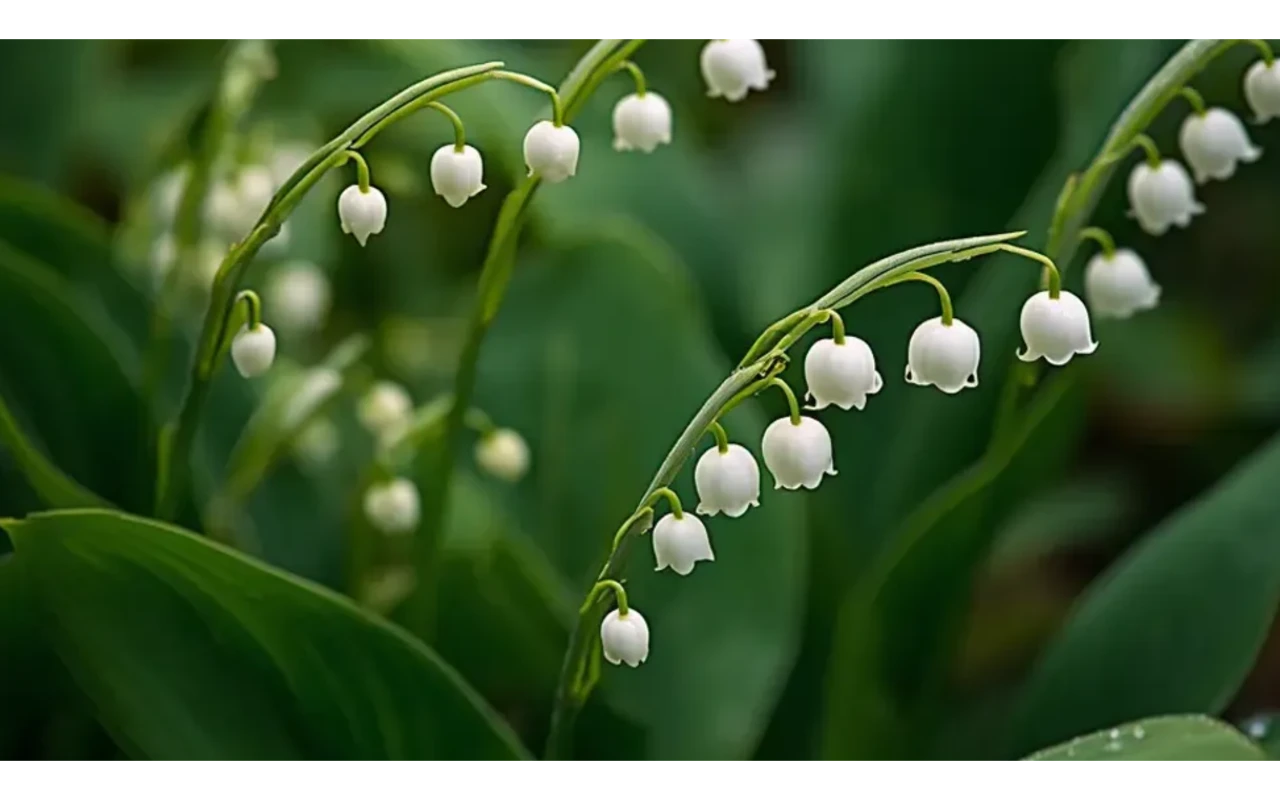
Lily of the valley (Convallaria majalis) is a shade-loving perennial with tiny, sweetly scented white bells in late spring, and lily of the valley care is easy in the right spot: shade, moist soil rich in organic matter, and a cold winter. The harder parts are keeping it from spreading where you don’t want it and handling it safely, because every part of the plant is poisonous if eaten. The Royal Horticultural Society describes it as a fragrant perennial that forms “extensive colonies,” lists it as poisonous if eaten and toxic to pets, and recommends wearing gloves when handling it.
Lily of the Valley Care at a Glance
| Need | What the sources say |
|---|---|
| Light | Full or partial shade (RHS); dappled to deep shade (NC State) |
| Soil | Fertile, humus-rich and moist (RHS); acid, neutral or alkaline all suit it (RHS) |
| Hardiness | USDA zones 3 to 7 (NC State); the RHS gives its top hardiness rating, H7 |
| Size | About 10 inches (25 cm) tall, spreading by rhizomes (NC State; RHS) |
| Flowers | 6 to 16 fragrant white bells per stem, late spring to early summer, for about three weeks (NC State) |
| Feeding | Top-dress with leaf mould in autumn (RHS) |
| Propagation | Division in autumn, or seed (RHS; NC State) |
| Toxicity | All parts poisonous if eaten; toxic to dogs, cats and horses (ASPCA; NC State) |
Sources: RHS; NC State Extension Plant Toolbox; ASPCA.
What Kind of Plant Is Lily of the Valley?
Lily of the valley (Convallaria majalis) is a spring-flowering perennial native to Eurasia. Despite the name, it is not a true lily: NC State Extension places it in the asparagus family, Asparagaceae. It grows from creeping underground rhizomes and sends up pairs of broad leaves. NC State describes one-sided clusters of 6 to 16 small, nodding, fragrant, bell-shaped white flowers in late spring to early summer, lasting about three weeks, and notes that the plant is used in perfume and in the pharmaceutical industry. Red berries can follow in summer, but NC State says they seldom form, because cross-pollination needs genetically different plants nearby. The RHS gives it its Award of Garden Merit.
Pink lily of the valley: the RHS lists Convallaria majalis var. rosea, the rosy lily of the valley, a spreading form to about 20 cm with fragrant, pale mauve-pink bells in late spring. It needs the same shade and moist, humus-rich soil, and it is just as toxic.
Gardeners usually buy it as “pips”: short sections of rhizome with a pointed bud, which is how the plant is planted, divided and forced indoors.
Lily of the Valley Meaning
In the Victorian language of flowers, Kate Greenaway’s Language of Flowers (1884) gives lily of the valley the meaning “Return of happiness.” That fits its season: the white bells appear in late spring, after winter. If you give it as a pot or a bouquet, mention that it is poisonous if eaten, so it stays out of reach of children and pets.
Is Lily of the Valley Poisonous to Touch?
This is the most searched question about the plant, and the short answer is that touching it is not the main danger. Lily of the valley poisoning, as described by MedlinePlus (U.S. National Library of Medicine), the ASPCA and NC State Extension, comes from eating the plant. Its toxins are heart-affecting compounds called cardiac glycosides, which act once swallowed.
What’s fine
Brushing against the plant, smelling the flowers, or briefly handling stems. Wash your hands afterward, especially before eating or touching your eyes and mouth.
Take precautions
Wear gloves when dividing pips, pulling plants or cutting lots of stems; the RHS recommends gloves when handling it. Some people get skin irritation from plant sap, and gloves keep residue off your hands.
So, can you touch lily of the valley? Yes, with common sense: gloves for garden work, hand washing, and keeping the plant out of reach of young children and pets, who are the ones likely to put leaves, flowers or berries in their mouths. As a precaution, place vases of cut flowers where pets and children can’t reach them or drink the water.
Toxicity: People, Dogs and Cats
All parts are poisonous if eaten
MedlinePlus lists convallarin, convallamarin and convallatoxin as the poisonous ingredients and says the flowers, fruit and leaves are poisonous. Symptoms can include an irregular or slow heartbeat, collapse, nausea, vomiting, diarrhea, stomach pain, blurred vision, confusion, drowsiness, rash and hives. It advises seeking immediate medical help and not making the person vomit unless told to by poison control. In the U.S., call Poison Help at 1-800-222-1222, or 911 in an emergency.
MedlinePlus says recovery depends on how much was swallowed and how fast treatment starts, that symptoms usually last 1 to 3 days and may need a hospital stay, and that death is unlikely. NC State Extension rates the severity as low and notes it is toxic mainly when larger amounts are eaten, but lists every part of the plant, including the berries, as poisonous. Treat any ingestion seriously, especially by a child.
Pets: The ASPCA lists lily of the valley as toxic to dogs, cats and horses, naming cardenolides (convallarin and others) and signs including vomiting, irregular heartbeat, low blood pressure, disorientation, coma and seizures. If your pet eats any part of it, call your veterinarian or the ASPCA Animal Poison Control Center at (888) 426-4435 right away. For pet-friendly choices, see our list of cat safe plants.
Lily of the Valley vs Wild Garlic
In Europe, foragers sometimes mistake lily of the valley leaves for wild garlic (ramsons). Swiss poison centre Tox Info Suisse lists it among wild garlic’s toxic lookalikes and gives the differences:
| Feature | Lily of the valley | Wild garlic |
|---|---|---|
| Smell when crushed | No garlic odour | Strong garlic smell |
| Leaves | Two to three leaves attached to and wrapped around the same stem, glossy underside | Each leaf on its own distinct stalk |
Source: Tox Info Suisse, “Do you know the toxic doppelgängers of wild garlic?”
Tox Info Suisse advises identifying leaves where they grow and checking each one, because picked leaves look more alike. It names nausea, vomiting and diarrhoea and a slow or irregular pulse as the critical signs after eating several leaves. If you have any doubt, don’t eat it.
How to Grow Lily of the Valley
Light and site
The RHS recommends full or partial shade on a west, east or north-facing site, and NC State lists dappled sun through to deep shade. That makes it useful under deciduous trees and shrubs, along shaded foundations and on the north side of buildings, where many plants struggle.
Soil and water
Grow it in fertile, humus-rich, moist soil (RHS). NC State describes it as preferring moist, organically rich soil while tolerating heavy clay and occasional dryness. The RHS accepts acid, neutral or alkaline soil, so there’s no need to adjust pH. Water during dry spells so the soil doesn’t dry out completely, but avoid ground that stays waterlogged.
Feeding
It needs little feeding. The RHS recommends a top-dressing of leaf mould in autumn; well-rotted compost does the same job. See our guide to composting at home to make your own.
Climate and blooming
This is a cold-climate plant. NC State lists it for USDA zones 3 to 7, and forced pips need a long cold period before they flower (see below). In warm-winter regions it often grows leaves but few flowers. Older, crowded colonies can also bloom less; dividing them in autumn gives the pips room.
Pro tip: For deep shade with fewer safety and spreading worries, pair or replace it with a clump-forming plant such as the cast iron plant, which works in shady corners indoors and, in mild climates, outdoors.
Controlling the Spread
The rhizomes that make lily of the valley such a good ground cover are also why it gets out of hand. NC State Extension says it naturalizes easily, can crowd out other plants, may become weedy and aggressive in regions with moist, cool winters, and is reported as invasive in Wisconsin and Arkansas; it recommends considering native alternatives.
- Plant it where it can spread, such as under trees or in a bed bordered by paving or lawn, not next to a perennial border.
- Use a root barrier. Edging or a bottomless container sunk into the soil around the planting helps keep rhizomes in place.
- Remove unwanted patches early. Dig out rhizomes while the patch is small, wearing gloves, and go back for regrowth.
- Don’t compost the rhizomes. Pieces of rhizome can regrow where compost is spread; bag them for the trash instead.
Forcing Pips Indoors
Lily of the valley can be brought into flower indoors for its fragrance, but it isn’t a long-term houseplant. University of Wisconsin-Madison Extension’s forcing guide lists 14 to 15 weeks of cold for lily of the valley and says a home refrigerator, typically 35 to 45°F, works for the cold period.
- Start with chilled pips. Pips sold for forcing are often pre-chilled; check the label. Otherwise give them the full cold period in the refrigerator, away from fruit.
- Pot them close together in moist potting mix with the tips at or just above the surface.
- Bring them into a bright, cool room out of direct hot sun and keep the mix evenly moist. UW-Madison notes that most forced bulbs bloom about three to four weeks after leaving the cold.
- Plant them outside afterward in a shady bed if you have one; forced pips are spent for that season.
For another fragrant plant you can force in winter, see our guide to growing and forcing hyacinths.
Dividing and Propagating
The RHS recommends dividing clumps in autumn, or sowing seed (with the berry flesh removed) in containers in a cold frame as soon as it ripens. Division is the quicker way to new flowering plants:
- Wearing gloves, lift a section of the colony with a garden fork after the foliage dies back.
- Pull the rhizomes apart into pieces, each with at least one pointed bud.
- Replant them shallowly in humus-rich soil in shade, water them in, and top-dress with leaf mould.
The RHS lists few problems: swift moth caterpillars, grey mould and leaf spots. NC State adds that deer and rabbits tend to leave it alone.
For more garden flowers, see our guides to forget-me-nots and ranunculus.
Frequently Asked Questions
Is lily of the valley poisonous to touch?
Touching it is not how people are poisoned; MedlinePlus, the ASPCA and NC State describe poisoning from eating the plant. The RHS still recommends gloves when handling it, and you should wash your hands afterward and keep it away from children and pets.
Is lily of the valley poisonous?
Yes. Every part of the plant is poisonous if eaten, including the leaves, flowers and red berries (RHS; NC State). Its toxins are cardiac glycosides, heart-affecting compounds that act once swallowed, and the ASPCA lists it as toxic to dogs, cats and horses. If a person eats any part of it, call Poison Control (1-800-222-1222 in the US) or a doctor right away; for a pet, call your veterinarian.
Is lily of the valley a true lily?
No. NC State Extension places Convallaria majalis in the asparagus family, Asparagaceae. True lilies belong to a different family, Liliaceae.
Is lily of the valley toxic to dogs and cats?
Yes. The ASPCA lists it as toxic to dogs, cats and horses, with signs including vomiting, irregular heartbeat, low blood pressure, disorientation, coma and seizures. Call your vet or ASPCA Animal Poison Control right away if your pet eats any part.
What does lily of the valley mean?
In Kate Greenaway’s Victorian Language of Flowers (1884), lily of the valley means “Return of happiness.”
Is there a pink lily of the valley?
Yes. The RHS lists Convallaria majalis var. rosea, the rosy lily of the valley, with pale mauve-pink, fragrant bells in late spring. It needs the same care and is equally toxic.
Can lily of the valley be mistaken for wild garlic?
Yes. Tox Info Suisse says lily of the valley leaves have no garlic smell and grow two or three to one stem, while wild garlic smells strongly of garlic and each leaf has its own stalk.
Are lily of the valley berries poisonous?
Yes. NC State Extension lists the fruit among the poisonous parts, and MedlinePlus says the fruit, flowers and leaves are poisonous. NC State notes the berries seldom form, but remove any that do if children or pets use the garden.
Why is my lily of the valley not blooming?
Common reasons are winters that are too mild (NC State lists zones 3 to 7), crowded old clumps, and too little moisture or organic matter. Divide crowded colonies in autumn and top-dress with leaf mould.
Does lily of the valley spread?
Yes, by rhizomes. The RHS says it forms extensive colonies, and NC State reports it as invasive in Wisconsin and Arkansas. Plant it where it has room or contain it with a root barrier.
Sources
- Royal Horticultural Society: Convallaria majalis
- NC State Extension Plant Toolbox: Convallaria majalis
- MedlinePlus: Lily of the valley poisoning (reviewed 2025)
- ASPCA Animal Poison Control: Lily of the Valley
- University of Wisconsin-Madison Extension: Forcing Bulbs
- RHS: Convallaria majalis var. rosea
- Tox Info Suisse: Toxic lookalikes of wild garlic
- Greenaway, K. (1884). Language of Flowers. Project Gutenberg