
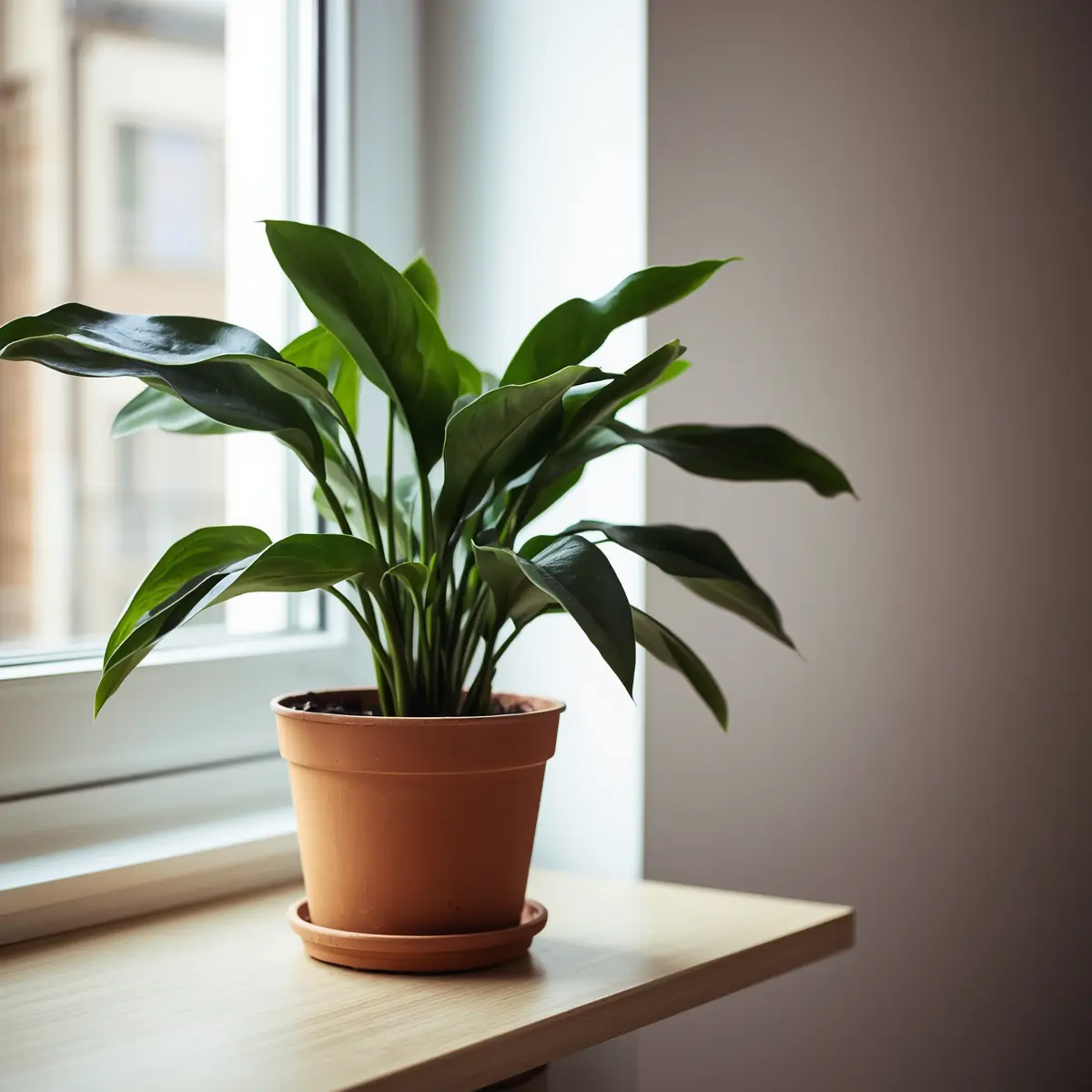
The ZZ plant (Zamioculcas zamiifolia) earns its reputation as one of the toughest houseplants: it tolerates low light, dry air and missed waterings, thanks to thick underground rhizomes that store water. ZZ plant care is mostly about restraint. The plant is far more likely to die from too much water than too little. This guide follows NC State Extension, the UConn Home and Garden Education Center and the ASPCA.
ZZ Plant Care at a Glance
| Need | What the sources say |
|---|---|
| Light | Best in bright indirect light; tolerates deep shade and fluorescent light; direct sun scalds (NC State, UConn) |
| Water | Let the soil dry out completely; about twice a month in summer, once a month in winter (NC State) |
| Soil | Well-drained potting soil (NC State) |
| Temperature | 55 to 80°F (UConn); bring outdoor pots in below 60°F (NC State) |
| Feeding | Once or twice in the growing season, balanced fertilizer at half strength (UConn) |
| Size | Slow-growing, 2 to 4 feet tall and wide (NC State) |
| Propagation | Division or leaf cuttings (NC State, UConn) |
| Pets | Contains insoluble calcium oxalate (ASPCA); medium toxicity (NC State) |
Sources: NC State Extension Gardener Plant Toolbox; UConn Home and Garden Education Center (2019); ASPCA (2025).
What Is a ZZ Plant?
The ZZ plant is an aroid, a member of the arum family (Araceae) along with philodendrons and peace lilies. NC State lists it as native to tropical eastern and southern Africa, from Kenya and Tanzania to Mozambique, Zimbabwe and KwaZulu-Natal. Above ground it makes stiff, arching stems lined with about 25 glossy leaflets each; below ground, fat rhizomes store water, which is why it handles drought so well. It is slow-growing and reaches 2 to 4 feet tall and wide (NC State).
Light
The ZZ plant is sold as a low-light plant, and that is only half the story. NC State says it tolerates deep shade and very low light, including fluorescent light, but does best in bright, indirect light. The UConn Home and Garden Education Center notes it can grow in a windowless office under fluorescent lights for several hours a day.
- Best spot: near a bright window, out of direct sun.
- Too much sun: UConn says direct light causes scalding: leaves whiten, curl, yellow and then brown.
- Too little light: growth slows to a crawl and stems stretch and lean. Move it closer to a window or add a grow light; see our grow light guide.
Watering
Watering is where most ZZ plants are won or lost. NC State says to let the soil dry out between waterings because the plant does not tolerate wet feet, and suggests watering about twice a month in summer, only if the soil has dried completely, and about once a month in winter. UConn says to water sparingly and to err on the dry side when in doubt.
- Check the soil with a finger or a wooden skewer. If any moisture remains, wait.
- When it is completely dry, water thoroughly until water runs from the drainage holes.
- Empty the saucer so the pot doesn’t sit in water.
- In low light and in winter, the soil dries much more slowly, so expect to water less often.
Soil, Pots and Repotting
NC State recommends a well-drained potting soil for containers. A standard houseplant mix with some perlite added drains well; see our vermiculite vs perlite guide. Always use a pot with drainage holes. Terracotta dries out faster than plastic, which suits a plant that dislikes wet soil.
Because it grows slowly, a ZZ plant needs repotting only when the rhizomes crowd the pot or start to bulge or crack a plastic one. Move up one pot size in spring or summer and plant at the same depth. Wear gloves: like other aroids, the sap contains calcium oxalate crystals (UConn).
Temperature and Feeding
UConn says to keep ZZ plants between 55 and 80°F, with warmer temperatures speeding growth. NC State lists it as hardy outdoors only in USDA zones 9a to 10b; elsewhere, a pot can spend summer outdoors in shade and come back in once temperatures fall below 60°F. Keep it away from cold drafts and heaters. Average household humidity is fine.
For feeding, UConn recommends fertilizing once or twice during the growing season with a balanced houseplant fertilizer at half strength (or at full strength once every six months). Don’t feed in winter.
ZZ Plant Yellow Leaves and Other Problems
| Symptom | Likely cause | What to do |
|---|---|---|
| Yellow leaves, soft stems, rotting rhizomes | Overwatering (UConn) | Stop watering; unpot, cut away soft brown rhizomes and roots, repot in fresh dry mix |
| Leaves whitened, curling, yellowing then browning | Too much direct light (UConn) | Move out of direct sun |
| Stems leaning toward or away from a window | Uneven or too strong light (UConn) | Adjust placement; turn the pot |
| Single old leaflet yellowing, rest healthy | Normal aging | Remove it |
| Bumps on stems and leaves | Scale insects (NC State) | See our scale guide |
| Very slow or no new growth | Low light or winter | Normal for ZZ; more light speeds it up |
Sources: UConn Home and Garden Education Center; NC State Extension.
ZZ plant yellow leaves are almost always a watering problem. If the soil is damp and leaves are yellowing, let it dry out completely and check the rhizomes: firm and pale is healthy, soft and brown is rot. Our overwatered vs underwatered guide and root rot guide walk through rescue.
ZZ Plant Propagation
NC State lists division and leaf cuttings. Both are easy but slow.
Division
At repotting, separate the clump into sections, each with at least one rhizome and some roots, and pot them up separately. This gives you sizeable plants straight away.
Leaf cuttings
- Cut leaflets or a section of stem, and let the cut ends dry for a few hours (UConn).
- Insert the cut end partway into moist soilless mix and keep it in indirect light (UConn).
- Wait. UConn says rhizomes form in about a month in greenhouse conditions, but indoors it may take up to 9 months before new shoots appear.
Stem cuttings can also be rooted in water, but they still need to form a rhizome before new growth appears. If water cuttings turn soft, see our guide to cuttings rotting in water.
Is the ZZ Plant Toxic to Cats and Dogs?
Yes, it should be kept away from pets. The ASPCA lists the ZZ plant (Zamioculcas spp.) among houseplants that contain insoluble calcium oxalate crystals. NC State rates its poison severity as medium, including for cats and dogs, with vomiting and diarrhea if leaves are eaten in quantity. UConn notes that calcium oxalate crystals in aroids can be extremely painful to the mouth and throat and advises keeping plants away from children and pets.
If your pet chews a ZZ plant, call your veterinarian or the ASPCA Animal Poison Control Center at (888) 426-4435. For pet-safe alternatives, see our cat-safe plants list.
Does a ZZ Plant Clean the Air?
ZZ plants are often marketed as “NASA air-purifying plants,” but the ZZ plant was not among the plants tested in the 1989 NASA Clean Air Study, which used small sealed chambers. UConn says ZZ plants are known to remove certain volatile compounds, but a review by Cummings and Waring (Drexel University, 2020) concluded that potted plants remove volatile compounds far more slowly than normal building ventilation does. Grow it for its looks and toughness.
ZZ Plant Varieties
| Variety | Description |
|---|---|
| Raven (‘Dowon’) | Lime-green new growth that ages to purple-black (NC State) |
| ‘Chameleon’ | New leaves golden-yellow, turning dark green (NC State) |
| ‘Lucky’ | Wide green leaflets with rounded tips (NC State) |
| ‘Zenzi’ | Compact plant with tightly packed, curled leaflets |
Source: NC State Extension (Raven, Chameleon, Lucky).
Care is the same for all of them. For other tough, low-fuss plants, see our snake plant care guide and money tree care guide.
For more easy houseplants, see our guides to pilea, and our list of the 10 best low-maintenance indoor plants.
Frequently Asked Questions
How often should I water a ZZ plant?
Only when the soil has dried out completely. NC State suggests about twice a month in summer and once a month in winter, but check the soil rather than the calendar, especially in low light.
Why does my ZZ plant have yellow leaves?
Usually overwatering, which UConn says causes yellow leaves and rotting rhizomes. Too much direct sun can also bleach and yellow the leaves. A single old leaflet yellowing now and then is normal.
Is the ZZ plant toxic to cats?
Yes. The ASPCA lists it among plants containing insoluble calcium oxalate, which irritates the mouth, and NC State rates its toxicity as medium for cats and dogs. Keep it out of reach.
Can a ZZ plant live in a windowless room?
UConn says it can grow under fluorescent office lights for several hours a day. It will grow slowly, so a brighter spot or a grow light gives better results.
How long does ZZ plant propagation take?
Division gives new plants immediately. Leaf cuttings form rhizomes in about a month in a greenhouse, but UConn says it may take up to 9 months indoors.
Do ZZ plants need fertilizer?
Very little. UConn suggests a balanced fertilizer at half strength once or twice during the growing season.
Sources
- NC State Extension Gardener Plant Toolbox: Zamioculcas zamiifolia
- UConn Home and Garden Education Center (2019). ZZ Plant
- ASPCA (2025). These Houseplants Can Cause Trouble for Your Pets
- Cummings, B.E. and Waring, M.S. (2020). Potted plants do not improve indoor air quality: a review and analysis of reported VOC removal efficiencies. Journal of Exposure Science and Environmental Epidemiology 30: 253-261
- Wolverton, B.C., Johnson, A. and Bounds, K. (1989). Interior Landscape Plants for Indoor Air Pollution Abatement. NASA