
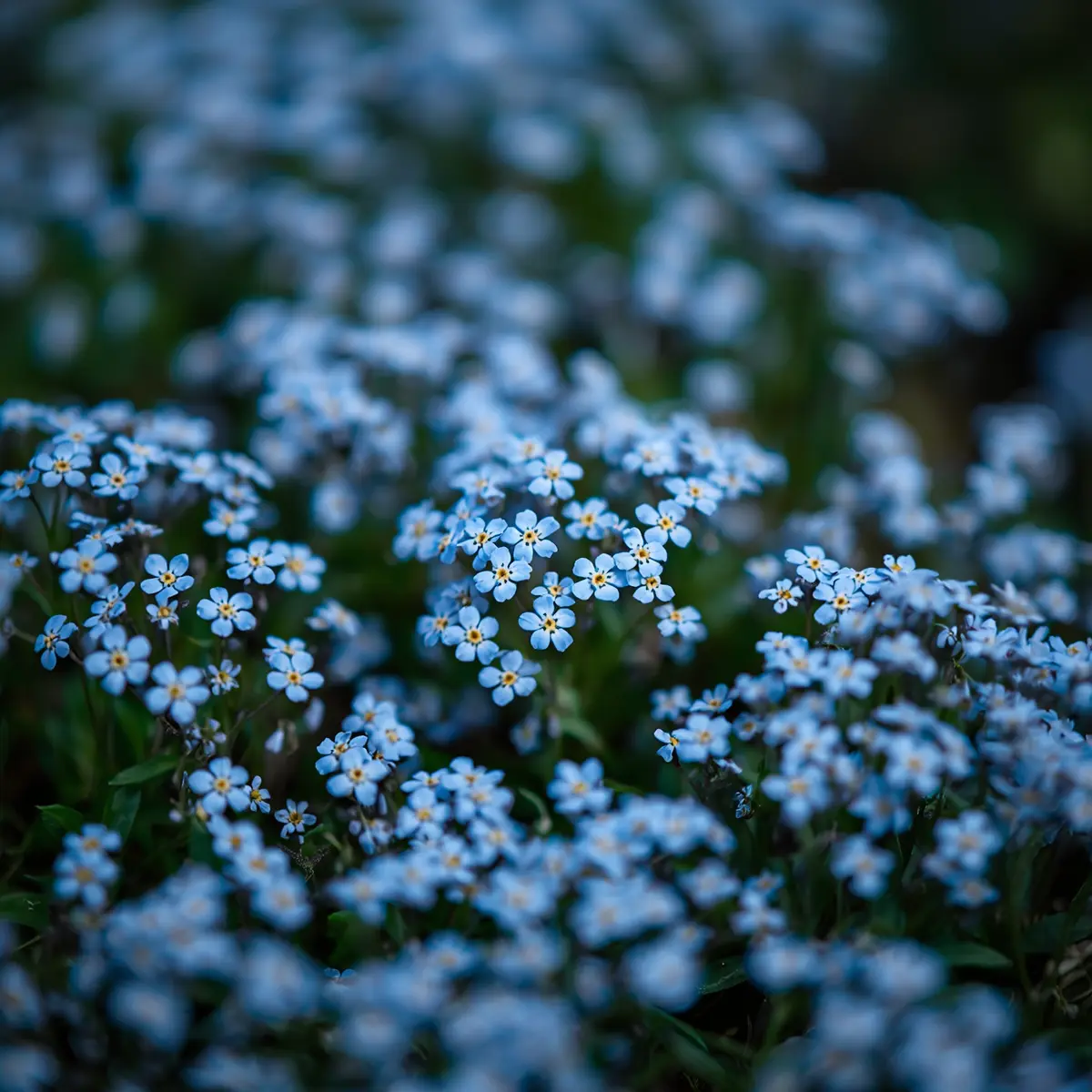
Forget-me-nots might be the easiest flower you will ever grow and the hardest one to get rid of. Sow a pinch of seed in summer and you get a sheet of sky-blue flowers the next spring, and very often the spring after that, and the one after that, whether you asked for it or not. Good forget-me-not care is less about keeping the plant alive and more about timing: sowing at the right moment, watering through dry spells, and deciding how far you want it to spread. This guide covers how to care for forget-me-nots through a full year, how often to water forget-me-nots in beds and pots, whether forget-me-nots come back every year, where they are regulated as invasive, and how to tell the six plants called “forget-me-not” apart, following NC State Extension, the Royal Horticultural Society, the Wisconsin DNR, Illinois and Iowa State Extension, and the ASPCA.
Forget-Me-Not Care at a Glance
The short answer: forget-me-nots want what a cool, damp woodland edge offers, meaning steady moisture, rich soil and a break from hot afternoon sun. Here is the garden forget-me-not in one table.
| Factor | What garden forget-me-nots want | Source |
|---|---|---|
| Light | Full sun to partial shade (2 to 6 hours of direct sun); afternoon shade in hot summers | NC State |
| Soil | Organically rich, consistently moist, well-drained; chalk, clay or loam; any pH | NC State, RHS |
| Water | Consistent moisture; tolerates occasionally wet soil | NC State |
| Hardiness | USDA zones 3 to 8 (M. sylvatica); 5 to 9 for water forget-me-not | NC State |
| Size | 6 to 12 inches tall, 6 to 10 inches wide | NC State |
| Bloom | April and May, with sporadic summer flowers; flowers about 3/8 inch across | NC State |
| Life cycle | Short-lived perennial grown as an annual or biennial; self-seeds freely | NC State, RHS |
| Problems | Powdery mildew, rust; can be weedy | NC State, RHS |
| Wildlife | Deer and rabbit resistant; visited by small butterflies | NC State |
| Pets | No ASPCA entry (see the pet section) | ASPCA |
Sources: NC State Extension Plant Toolbox (Myosotis sylvatica, M. scorpioides); Royal Horticultural Society; ASPCA plant lists.
Forget-Me-Not Care Calendar: Month by Month
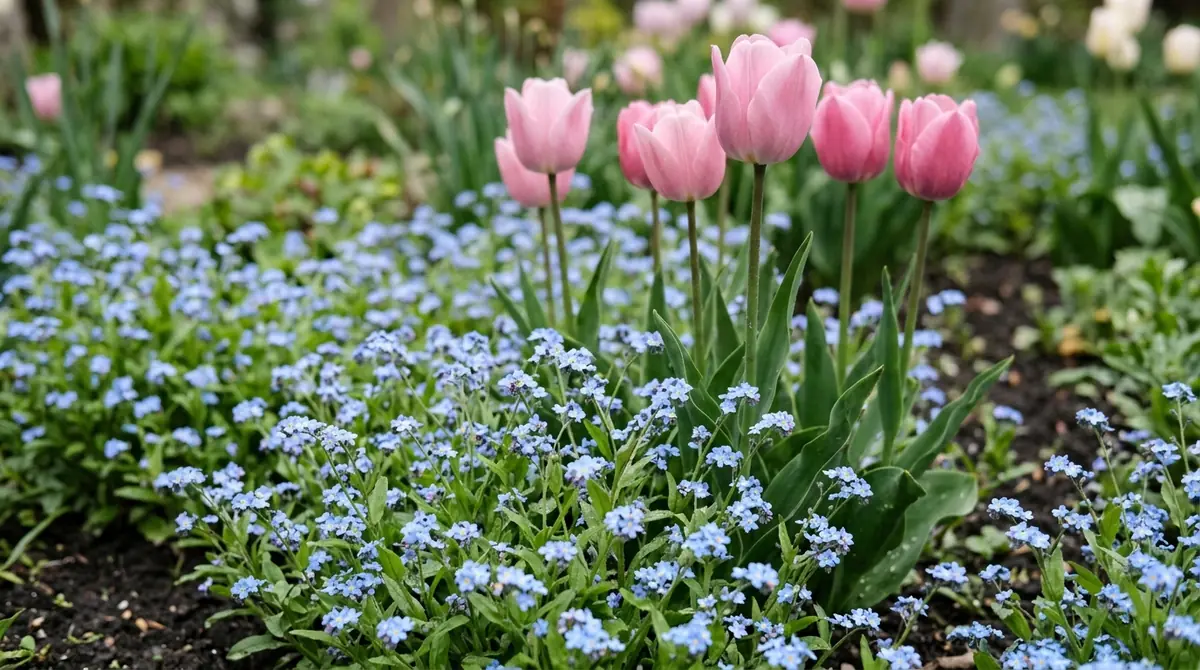
Forget-me-nots run on a two-season rhythm: you sow in summer, the seedlings sit through winter as low leafy rosettes, and they flower the following spring. NC State describes this biennial timing (sow in mid-summer for bloom the following year), and the RHS describes the garden forget-me-not as usually grown as a biennial. This calendar is for a typical temperate garden; shift it a few weeks earlier in warm climates and later in cold ones.
| When | What to do | Why |
|---|---|---|
| Early to mid-summer | Sow seed outdoors where you want flowers next spring | NC State’s biennial timing for next year’s bloom |
| Late summer to early fall | Thin seedlings to about 6 to 10 inches apart; move extras to new spots | Spacing matches the plant’s width (NC State) and helps air reach the leaves, which limits mildew |
| Fall | Leave the leafy rosettes alone; water in dry spells | These are next spring’s flowering plants |
| Winter | Little to do; plants are hardy to zone 3 (NC State) | Rosettes overwinter in the ground |
| Early spring | Water if spring is dry; plant out nursery plants or indoor-raised seedlings | Growth and flower buds form now |
| April to May | Enjoy the bloom; pair with tulips and other spring bulbs | Main flowering period (NC State) |
| After flowering | Pull up spent plants, or leave a few to drop seed for next year | The RHS suggests pulling the Sylva series up once flowers fade to avoid self-seeding |
Sources: NC State Extension; Royal Horticultural Society. Calendar timing adapted to a temperate garden.
Which Forget-Me-Not Do You Have?
Six different plants are sold or found under the name “forget-me-not,” and they do not all need the same care. Two of them are not even in the genus Myosotis. Use this table before you follow any care guide.
| Plant | How to recognize it | Where it grows | Care difference |
|---|---|---|---|
| Garden or woodland forget-me-not (Myosotis sylvatica) | 6 to 12 in tall; sky-blue flowers about 3/8 in across with a yellow or white eye; spreading, hooked hairs on the sepals | Garden beds, shady borders; escapes into woods | The standard care in this guide |
| Water or true forget-me-not (M. scorpioides, formerly M. palustris) | Light blue flowers about 1/4 in across in coiled clusters; angled stems; flat, tight hairs on the sepals | Pond edges, stream banks, wet ground; up to 3 in of standing water | Needs wet soil; restricted or regulated in several states |
| Alpine forget-me-not (M. alpestris; Alaska’s plant is often listed as M. asiatica) | Compact, about 8 in tall; sky-blue flowers with yellow centers | Rock gardens, mountains, containers | Wants well-drained, poor to moderately fertile soil and dislikes winter wet (RHS) |
| Early or spring forget-me-not (M. verna) | Tiny white flowers about 1/8 in across with no yellow eye; densely hairy leaves | Native wildflower of dry, sandy or rocky open ground | A native wild plant, not a garden flower |
| Chinese forget-me-not (Cynoglossum amabile) | Taller, 1 to 2 ft; blue sprays of 1/4 in flowers from late spring to frost; seeds cling to animals | Annual flower beds, zones 6 to 9 | Grown as a cool-weather annual; full sun to part shade |
| False forget-me-not (Brunnera macrophylla) | Large, heart-shaped, hairy leaves up to 6 in across; small blue flowers in early to mid-spring | Shade gardens, zones 3 to 8 | A long-lived perennial for part to full shade; dislikes hot, humid summers |
Sources: NC State Extension (M. sylvatica, M. scorpioides, Cynoglossum amabile, Brunnera macrophylla); Wisconsin DNR (sepal hairs); RHS (M. alpestris); Minnesota Wildflowers (M. verna); EPPO (M. asiatica).
Early forget-me-not leaves: how to recognize them
If you found a small, fuzzy weed with tiny white flowers in a dry, sunny spot in spring, it may be early forget-me-not (Myosotis verna). Minnesota Wildflowers describes its leaves as alternate, toothless, up to 2 inches long and about 1/3 inch wide, densely covered on both sides with spreading and flattened hairs, with the lower leaves often stalked and broadest above the middle and the lowest ones withering by flowering time. The plant is 3 to 15 inches tall, blooms from April to July, and has white flowers only about 1/8 inch across, without the yellow eye of garden forget-me-nots. It is a native annual or biennial, so it is a wildflower rather than an invasive weed; let it be if it is not in the way.
Sun or Shade: Where to Plant Forget-Me-Nots
The best place to plant forget-me-nots is a spot with morning sun and afternoon shade in moist soil, such as a woodland edge, the shady side of a border, or under deciduous shrubs. NC State Extension lists full sun to partial shade, or 2 to 6 hours of direct sun, and says the plants appreciate afternoon shade in hot summer climates. The Fairfax County Master Gardeners add that in the north they can take full sun, but the more sun they get, the more water they need.
Their low height and spring timing make them a classic carpet under tulips and daffodils. For other shade-tolerant spring flowers, see our guides to lily of the valley and hyacinths.
How Often to Water Forget-Me-Nots
Water forget-me-nots whenever the top inch of soil starts to dry, which in a garden bed works out to about 1 inch of water a week from rain plus watering. NC State says the garden forget-me-not needs consistently moist soil and tolerates occasionally wet ground, so the goal is soil that never fully dries out, not a fixed schedule.
| Situation | How often | Source |
|---|---|---|
| Established plants in beds | About 1 inch of water per week, rain included; water deeply rather than lightly every day | Illinois Extension; Purdue Extension |
| Hot weather | More water: 1 to 1.5 inches a week for annual flowers | Clemson HGIC |
| New seedlings and transplants | Keep the surface evenly moist until they are growing well | UMass Extension (about 2 weeks of consistent moisture to establish) |
| Pots | Check daily in summer; water when the mix is dry 1 to 2 inches down. Small pots in hot, windy weather can need water once or twice a day | Iowa State Extension |
| Water forget-me-not (M. scorpioides) | Keep wet; it grows in up to 3 inches of standing water | NC State |
Sources: Illinois Extension (2020); Purdue Extension; Clemson HGIC; UMass Extension; Iowa State Extension; NC State Extension.
The Fairfax Master Gardeners suggest a soaker hose or drip line, which keeps water off the leaves and helps against mildew. A layer of mulch keeps the soil cool and moist between waterings.
Soil and Feeding
Forget-me-nots grow best in organically rich, consistently moist, well-drained soil, and NC State says they adapt to loam or clay loam if it stays moist. The RHS lists chalk, clay or loam and acid, neutral or alkaline pH, so soil testing is not needed. Dig in compost before sowing; the Fairfax Master Gardeners mention a slow-release fertilizer, but in reasonable garden soil compost is usually enough. Rich feeding mostly grows leaves.
How to Grow Forget-Me-Nots From Seed
Will forget-me-nots bloom the first year? It depends on when you sow. NC State gives two routes:
- Biennial route (traditional): sow outdoors in mid-summer; plants flower the following spring.
- Annual route: start seed indoors 8 to 10 weeks before your last spring frost for flowers the same year.
- Prepare the bed. Loosen the soil, mix in compost and rake it smooth (Fairfax Master Gardeners).
- Sow thinly. Scatter the small seed and cover it only lightly, then press it in.
- Keep it moist. Water gently and often enough that the surface never dries until seedlings are up.
- Thin. Space plants about 6 to 10 inches apart, their mature width (NC State), so air moves between them.
- Indoors: sow in trays under a bright window or a grow light, harden off, and plant out after the last frost.
Forget-Me-Nots in Pots
Forget-me-nots do well in containers, and the Fairfax Master Gardeners suggest them for pots on porches and patios. The RHS lists the alpine forget-me-not for containers too. Use a pot with drainage holes and a moisture-retentive potting mix, and remember that pots dry out much faster than beds: Iowa State advises checking containers daily in summer. Forget-me-nots are cool-season garden plants, not long-term houseplants, so grow them outdoors and start seed indoors only to get a head start.
Do Forget-Me-Nots Come Back Every Year?
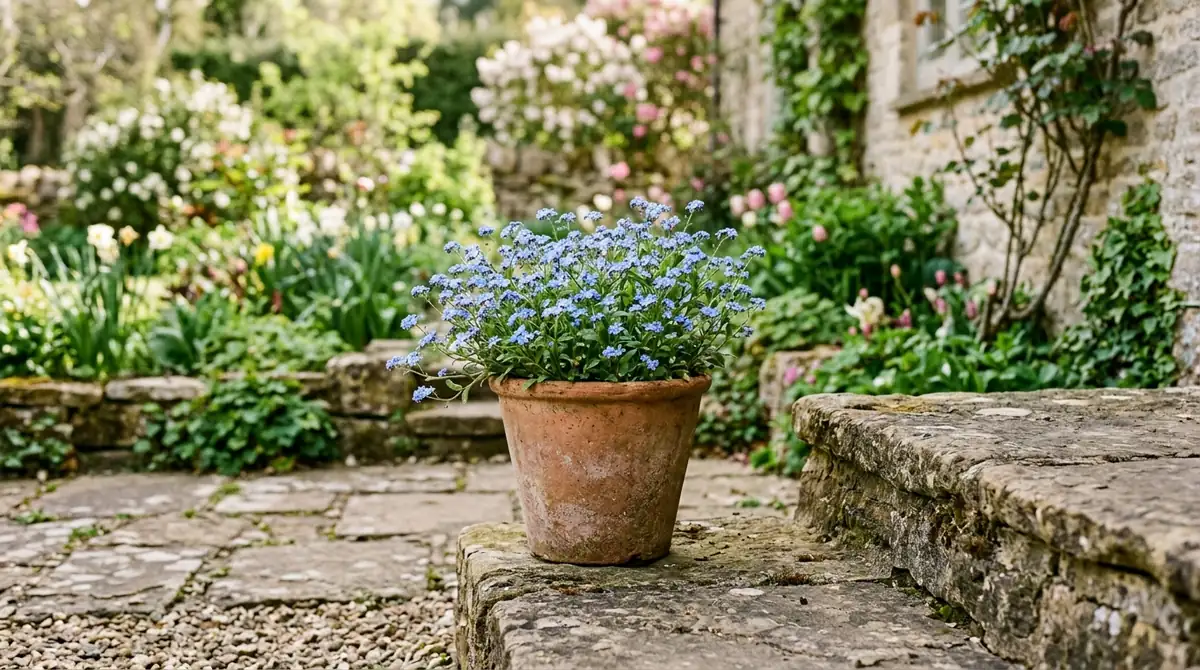
Yes, but usually as new plants rather than the same ones. NC State calls the garden forget-me-not a short-lived perennial best grown as an annual, and the RHS says it is usually grown as a biennial. Each plant flowers, sets seed and fades, and the seed it drops grows into next spring’s display. That is why a patch seems to “come back every year” while the individual plants come and go. In pots, the same thing happens only if seed falls into the mix and you leave it undisturbed.
Should You Cut Back Forget-Me-Nots in Fall?
No. The low leafy rosettes you see in fall are the plants that will flower next spring, so leave them. The time to cut back or pull forget-me-nots is right after they flower: the RHS suggests pulling the Sylva series up once the flowers fade to avoid self-seeding, and advises cutting the alpine forget-me-not back after flowering if seed is not wanted. NC State adds that deadheading right after flowering limits excessive self-seeding. If you want next year’s plants, leave a few to drop their seed first.
Are Forget-Me-Nots Invasive? A State-by-State Look
In some places, yes. NC State says the garden forget-me-not self-seeds freely, can form colonies with creeping stems, and is listed as a noxious weed in one or more Midwestern states. Here is what the official sources we checked say:
| State | Status | Source |
|---|---|---|
| Wisconsin | Water forget-me-not (M. scorpioides) and woodland forget-me-not (M. sylvatica) are both listed as Restricted | Wisconsin DNR |
| Connecticut, Massachusetts, New Hampshire | Water forget-me-not listed as noxious or regulated | Wisconsin DNR literature review (2012) |
| Michigan, Minnesota, Washington | Water forget-me-not not regulated at the time of the review, though widespread in the Great Lakes States and the Pacific Northwest | Wisconsin DNR literature review (2012) |
Lists change: check your state’s current invasive species list before planting near woods, streams or ponds.
The Wisconsin DNR says water forget-me-not can escape water gardens and ponds into wetlands, forests and stream banks, and the woodland forget-me-not page warns it can form large monocultures that crowd out native herbs, including spring ephemerals. Its literature review notes that water forget-me-not spreads by seed, by stolons and by fragments carried in water. To keep forget-me-nots in check:
- Pull or deadhead plants right after flowering, before seed ripens (NC State, RHS).
- When removing a patch, dig out the whole root system and watch for resprouts (Wisconsin DNR).
- Don’t plant water forget-me-not in ponds that connect to streams or wetlands. For pond plants, see our guide to water lilies and lotus.
Common Problems and Fixes
| Symptom | Likely cause | Fix |
|---|---|---|
| White powdery coating on leaves | Powdery mildew (RHS, NC State), often late in the season | Thin plants, water at the soil line, pull badly affected plants after flowering |
| Grayish fuzz under leaves (Sylva types) | Downy mildew (RHS) | Improve air flow, avoid wetting the leaves |
| Orange-brown spots | Rust (NC State) | Remove affected leaves, keep foliage dry |
| Plants yellow and die after blooming | Normal for a short-lived plant that has set seed | Pull them; seedlings replace them |
| Wilting in warm weather | Dry soil or too much afternoon sun | Water deeply, mulch, give afternoon shade (NC State) |
| Leggy, floppy plants | Crowding or deep shade | Thin to 6 to 10 inches apart and give more light |
| Forget-me-nots everywhere | Self-seeding (NC State) | Pull after flowering, before seed sets (RHS) |
NC State lists no known insect pests, and deer and rabbits leave the plant alone.
The Forget-Me-Not as Alaska’s State Flower
The forget-me-not is Alaska’s state flower, and it held the title long before statehood. A 1917 territorial law, Chapter 10 of the 1917 Session Laws of Alaska, designated the forget-me-not as the territorial and floral emblem of Alaska, praising a wild flower that grows on every hill and in every valley. The plant is usually given as the alpine forget-me-not, Myosotis alpestris, but the EPPO database lists the Alaskan plant as Myosotis asiatica, noting that the state flower was designated under the name M. alpestris, which strictly refers to a closely related European plant. In gardens, alpine forget-me-not wants sharp drainage and protection from winter wet (RHS).
The flower’s wider symbolism is about remembrance and faithful love; the Fairfax Master Gardeners retell the legend of a knight who, swept away by a river, threw his lady a bunch of blue flowers and cried “Forget me not.” See our September flower meaning guide for more birth-month flowers.
Are Forget-Me-Nots Safe for Pets?
The honest answer is that there is no official verdict. The ASPCA’s plant lists have no entry for forget-me-not (Myosotis), and none for Chinese forget-me-not or Brunnera either, so none of them is ASPCA-listed as safe or toxic. Two cautions do exist. The Wisconsin DNR’s review notes that water forget-me-not contains pyrrolizidine alkaloids, which are toxic to mammals, and NC State lists pyrrolizidine alkaloids in Chinese forget-me-not, with liver disease in horses that eat large amounts or graze it over a long time. Don’t let pets or livestock graze forget-me-nots, and call your vet if a pet eats a lot. For plants that are on the ASPCA non-toxic list, see our guides to cat-safe plants and plants safe for dogs.
Frequently Asked Questions
Do forget-me-nots come back every year?
Yes, mostly from seed. The garden forget-me-not is a short-lived perennial usually grown as an annual or biennial, and it self-seeds freely, so new plants replace the old ones each year (NC State, RHS).
How often should I water forget-me-nots?
Keep the soil evenly moist. In beds that means about 1 inch of water a week including rain (Illinois Extension); in pots, check daily in summer and water when the mix is dry 1 to 2 inches down (Iowa State).
Will forget-me-nots bloom the first year?
Only if you start them early. Seed started indoors 8 to 10 weeks before the last frost can bloom the same year; seed sown outdoors in mid-summer blooms the following spring (NC State).
Do you cut back forget-me-nots in the fall?
No. The fall rosettes are next spring’s flowering plants. Cut back or pull plants right after they flower, before they set seed (RHS, NC State).
Where is the best place to plant forget-me-nots?
In moist, rich soil with morning sun and afternoon shade, such as a woodland edge or a shady border. NC State lists full sun to partial shade, with afternoon shade in hot climates.
Are forget-me-nots invasive?
In some states. Wisconsin lists both water and woodland forget-me-not as Restricted, and water forget-me-not is regulated in Connecticut, Massachusetts and New Hampshire (Wisconsin DNR). NC State notes the garden forget-me-not is a noxious weed in one or more Midwestern states.
What is early forget-me-not?
Early or spring forget-me-not (Myosotis verna) is a small native wildflower with densely hairy leaves and tiny white flowers about 1/8 inch across, found on dry, sandy or rocky ground (Minnesota Wildflowers).
Is the forget-me-not a state flower?
Yes. A 1917 territorial law made the forget-me-not the floral emblem of Alaska, and it remains Alaska’s state flower. It is usually given as Myosotis alpestris; EPPO lists the Alaskan plant as M. asiatica.
Sources
- NC State Extension Plant Toolbox: Myosotis sylvatica
- NC State Extension Plant Toolbox: Myosotis scorpioides
- NC State Extension Plant Toolbox: Cynoglossum amabile (Chinese forget-me-not)
- NC State Extension Plant Toolbox: Brunnera macrophylla (false forget-me-not)
- Royal Horticultural Society: Myosotis sylvatica
- Royal Horticultural Society: Myosotis alpestris
- Royal Horticultural Society: Myosotis sylvatica Sylva Series
- Wisconsin DNR: Aquatic forget-me-not
- Wisconsin DNR: Woodland forget-me-not
- Wisconsin DNR: Aquatic Invasive Species Literature Review, Myosotis scorpioides (2012)
- Minnesota Wildflowers: Myosotis verna (Spring Forget-me-not)
- Alaska Legislature: Session Laws of Alaska 1917, Chapter 10
- EPPO Global Database: Myosotis asiatica
- Fairfax County Master Gardeners: Forget-Me-Nots
- Illinois Extension: How much water does your garden need? (2020)
- Purdue Extension: Watering 101
- Clemson HGIC: Growing Annuals
- UMass Extension: Drought Tolerant Annuals and Perennials
- Iowa State Extension: Care of Plants Growing in Containers
- ASPCA: Toxic and Non-Toxic Plant List, Cats
- ASPCA: Toxic and Non-Toxic Plant List, Dogs