
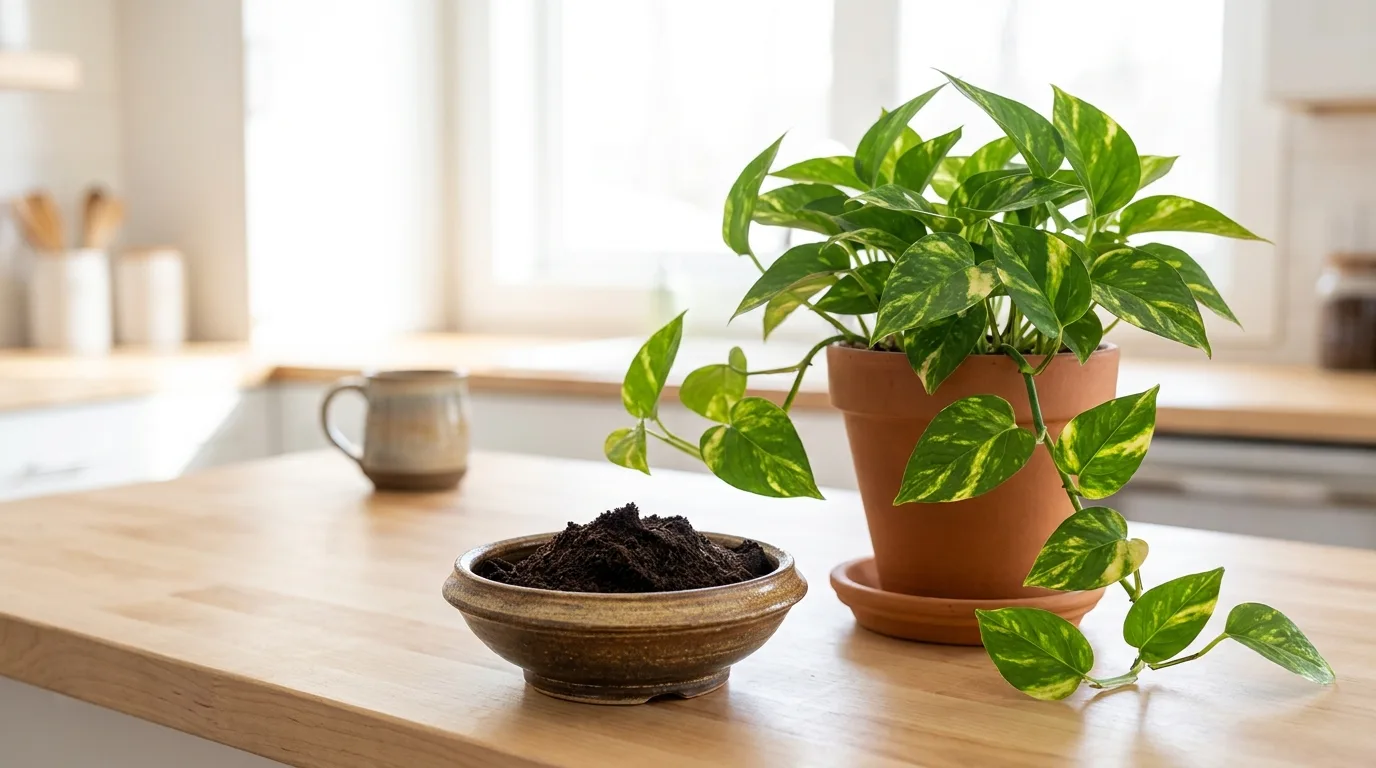
Used coffee grounds for houseplants are not a good fertilizer when you add them straight to the pot. Researchers at the University of Melbourne found that applying spent grounds directly to soil made all five test plants grow poorly, regardless of soil type or fertilizer (Hardgrove and Livesley, 2016). Oregon State University Extension adds that brewed grounds are close to neutral (pH 6.5 to 6.8), not acidic, and contain only 1 to 2% nitrogen. The safe way to use them is in compost, not on top of your plants.
Coffee grounds are a widely shared houseplant “hack”, and it’s easy to see why: they’re free, they look like rich soil, and they smell like something good is happening. The research on coffee grounds for plants tells a different story. This guide checks each popular claim against university and peer-reviewed sources, then shows what to do with your grounds instead.
Coffee Grounds for Houseplants: 5 Claims, Checked
| Claim | What the sources say | Verdict |
|---|---|---|
| “Coffee grounds make soil acidic” | After brewing, grounds are close to neutral, around pH 6.5 to 6.8; the acid goes into your cup (Oregon State Extension) | Myth |
| “They’re a great free fertilizer” | They contain 1 to 2% nitrogen and small amounts of micronutrients but “aren’t a major source of plant nutrition” (Oregon State Extension) | Overstated |
| “They make plants grow faster” | Applied directly, they reduced growth of all five plants tested, in every soil type (Hardgrove and Livesley, 2016) | Myth |
| “They’re safe to mix straight into soil” | Uncomposted grounds can temporarily tie up nitrogen and may slow growth because of caffeine residues (Oregon State Extension) | Risky |
| “They’re great in compost” | Yes, as part of the mix: Oregon State recommends no more than 20% of the pile’s volume | True |
Sources: Oregon State University Extension (Linda Brewer, 2025); Hardgrove and Livesley, Urban Forestry and Urban Greening (2016).
What the Research Actually Found
- Plants tested: broccoli, leek, radish, viola and sunflower
- Soils: sandy, sandy clay loam and loam, with and without fertilizer
- Field rates: 0, 2.5, 5, 10 and 25% spent coffee grounds
- Result: all plants grew poorly with grounds, regardless of soil type or fertilizer, and more grounds meant less growth
- Why: not explained by soil pH or nitrogen; the authors point to likely toxic effects on plants
So, are coffee grounds good for plants when applied raw? Not according to this study. Oregon State University Extension reaches a similar conclusion from a gardening angle: excess uncomposted grounds can tie up nitrogen and may inhibit seed germination or slow growth because of caffeine residues. A University of California master gardener article, “Should You Share a Cup of Coffee with Your Plants?”, summarizes the same study and recommends combining grounds with compost rather than applying them directly.
An honest limit
We found no controlled study testing coffee grounds on common houseplants in pots. The evidence above comes from garden plants and soils. Given that every source we checked advises against applying raw grounds directly, there is no evidence-based reason to expect pots to do better.
Why Pots Are the Worst Place for Grounds
A pot is a small, closed system. Anything you add stays close to the roots, and moisture lingers longer than in a garden bed. Two practical problems follow:
Fungus gnats
Oregon State Extension says fungus gnat larvae live in the top half inch or so of potting soil and need moisture. A damp layer of organic grounds sitting on the surface keeps exactly that zone wet. If you already have gnats, see our diatomaceous earth guide and fungus gnat control guide.
Slower growth
The reduced growth seen in the garden study came from grounds mixed into open soil; in a small container there is even less soil to dilute them. Oregon State also warns that a surface layer can dry out and repel water unless it’s covered.
The Right Way to Use Coffee Grounds
- Compost them. Oregon State Extension suggests mixing three parts leaves to one part fresh grass clippings to one part coffee grounds by volume.
- Keep them under 20% of the pile. Oregon State warns that higher amounts can be toxic to plants.
- Use the finished compost, not the grounds. Once composted, a little finished compost can go into potting mix like any other organic ingredient. Our guide to composting at home walks through the process.
- Outdoors only, if used raw. For garden beds, Oregon State suggests working about half an inch of grounds into the top 4 inches of soil, or covering a thin layer with leaves or bark mulch so it doesn’t dry out and repel water.
Pro tip: If you make a lot of coffee, keep a lidded container for grounds next to your compost bin rather than next to your plants. It removes the temptation to “top up” a pot.
Better Ways to Feed Houseplants
A potted plant only has the nutrients in its small volume of mix plus what you add, so a fertilizer with a known, balanced formula does the job that coffee grounds can’t. Use it at the label rate or weaker during the growing season. To compare options, see our guide to synthetic vs organic fertilizer.
Coffee grounds aren’t the only kitchen “fertilizer” that disappoints in a pot. Our evidence check on banana peel fertilizer comes to a similar conclusion. If your plants show yellowing that looks like a nutrient problem, the cause may be the soil itself; see our guide to pH lockout in houseplants.
Coffee Grounds and Pets
Keep grounds away from dogs and cats
The ASPCA warns that coffee and caffeine contain methylxanthines, which in pets can cause vomiting and diarrhea, panting, excessive thirst and urination, hyperactivity, abnormal heart rhythm, tremors, seizures and even death, and that higher caffeine content means greater risk. A pot topped with grounds is one more reason not to use them where pets dig or chew. If you suspect your pet has eaten coffee grounds, contact your veterinarian or the ASPCA Animal Poison Control Center at (888) 426-4435.
Frequently Asked Questions
Are coffee grounds good for house plants?
Not when added directly to the pot. A 2016 University of Melbourne study found spent coffee grounds applied straight to soil made all five test plants grow poorly. The safer way to use coffee grounds for houseplants is to compost them first and feed with a balanced fertilizer.
Do coffee grounds make soil acidic?
No. Oregon State University Extension says brewed grounds are close to neutral, around pH 6.5 to 6.8, because the acid dissolves into the coffee you drink.
Which houseplants like coffee grounds?
None need them. The usual advice to give grounds to “acid-loving” plants rests on the idea that grounds are acidic, but used grounds are close to neutral, according to Oregon State University Extension.
Do coffee grounds attract fungus gnats?
They can make conditions better for them. Fungus gnat larvae live in the top half inch of potting soil and need moisture, according to Oregon State University Extension, and a damp layer of grounds keeps that zone wet.
Are coffee grounds good for compost?
Yes, in moderation. Oregon State Extension recommends keeping them under 20% of the pile’s total volume, mixed with leaves and grass clippings. Use the finished compost rather than raw grounds, and in outdoor beds work a thin layer into the soil or cover it with mulch.
Are coffee grounds dangerous for dogs and cats?
They can be. The ASPCA warns that caffeine causes symptoms in pets ranging from vomiting and hyperactivity to tremors and seizures, with higher caffeine content meaning greater risk. Keep grounds out of pots pets can reach.
Sources
- Oregon State University Extension: Coffee grounds boost soil health (Linda Brewer, 2025)
- Hardgrove and Livesley (2016), Applying spent coffee grounds directly to urban agriculture soils greatly reduces plant growth, Urban Forestry and Urban Greening
- University of California ANR: Should You Share a Cup of Coffee with Your Plants? (2019)
- Oregon State University Extension: I have fungus gnats everywhere
- ASPCA: People Foods to Avoid Feeding Your Pets