
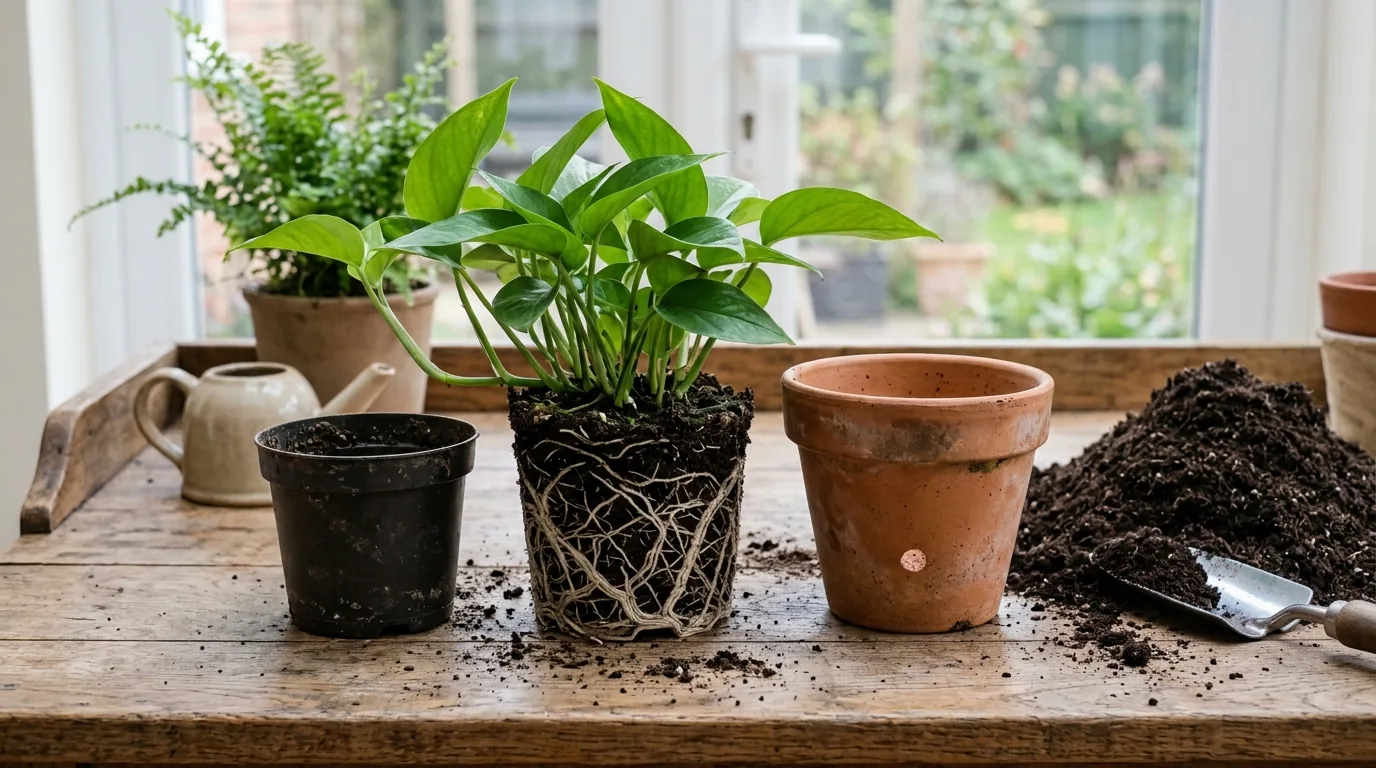
Repotting is one of the few houseplant jobs that can make a struggling plant grow again almost immediately, and one of the easiest ways to drown one if you choose a pot that is too big. The good news is that university extension services agree on almost every step: repot in spring, move up only one pot size, loosen circling roots, keep the plant at the same depth, and water it well. This guide explains how to repot a plant step by step, when to do it, how to choose the pot and mix, and how to repot without killing it, using Clemson, Penn State, NC State and University of Wisconsin Extension.
Does Your Plant Need Repotting?
| Sign | What it means | Source |
|---|---|---|
| Roots growing out of the drainage holes or on the soil surface | The pot is full | Penn State, Wisconsin, Clemson, NC State |
| Soil dries out much faster than it used to | Roots have replaced most of the soil | Penn State, Wisconsin, Clemson |
| Plant wilts soon after watering | Pot too small for the root system | Clemson, NC State |
| Growth stalls in spring and summer despite feeding | Outgrowing the pot | Penn State, NC State |
| Yellowing and stunting on a long-neglected plant | Nutrient shortage in an old, root-packed pot | Wisconsin |
Sources: Clemson HGIC 1458; Penn State Extension (2026); University of Wisconsin Extension XHT1033 (2024); NC State Extension Gardener Handbook, ch. 18.
Check the roots to be sure. Slide the plant out of its pot. Wisconsin Extension says that if loose soil falls away, the plant does not need repotting yet; a rootball with little loose soil and lots of roots circling the outside does. Penn State adds that little visible potting mix in the bottom third of the rootball is another sign.
Not every plant wants more room. Clemson Extension notes that some plants, such as amaryllis, thrive when pot-bound, and our guides explain that Christmas cactus and African violets bloom best slightly root-bound too.
When to Repot a Plant
- Season: spring, as the plant starts its seasonal growth (Penn State, Wisconsin). Clemson says to repot only as needed in spring and summer while the plant is growing, and NC State says early spring. Roots then have the whole growing season to settle in.
- How often: Clemson says fast-growing plants may need repotting every year and slow growers every 2 to 3 years. NC State suggests repotting healthy, well-grown plants annually with fresh mix.
- When not to: Clemson advises against repotting ailing or dormant plants or those beginning to flower. The exception is an emergency such as root rot in soggy soil; see root rot treatment.
Choosing the New Pot
| Current pot | New pot | Source |
|---|---|---|
| Up to 8 inches wide | 1 to 2 inches wider than the current root ball | NC State |
| 10 inches or wider | 2 to 3 inches wider than the root ball | NC State |
| Any | 1 or 2 inches larger in diameter than the current pot | Clemson |
| Any | One pot size larger; two sizes only for vigorous growers | Wisconsin, NC State |
Sources: NC State Extension Gardener Handbook, ch. 18; Clemson HGIC 1458; University of Wisconsin Extension XHT1033 (2024).
- Drainage holes are essential (Penn State, Wisconsin). A decorative pot without holes can be used as a cachepot around a draining pot; empty any water that collects in it (Penn State). See also our self-watering pot problems guide.
- Clay or plastic: porous clay pots lose moisture faster, so Penn State says plants in clay need watering more often than plants in plastic; NC State notes heavy plastic pots hold moisture well. Clay suits plants that like to dry out, such as succulents and cacti.
- Clean reused pots. Penn State suggests one part bleach to nine parts water; NC State suggests a non-bleach household disinfectant and scrubbing salt crust off clay with a wire brush.
Choosing the Potting Mix
Use a good-quality soilless potting mix made for containers, not garden soil (Penn State). Wisconsin warns that mixes containing soil may drain poorly and harbor root-rot organisms. Most houseplants do well in a general mix, while orchids, cacti and succulents, and African violets have specialty mixes (Penn State, Wisconsin). Penn State also says to moisten the potting mix before you repot. For aroids such as monstera and philodendron, see our best aroid soil mix, and for drainage additives, vermiculite vs perlite.
How to Repot a Plant Into a Bigger Pot: 8 Steps
- Water the plant first. Penn State suggests watering it in its old pot and letting it rest for about an hour, so the rootball holds together and slides out more easily.
- Prepare the new pot. Cover the drainage hole with a small square of screen (Penn State) or a piece of broken pot (Clemson) so mix does not wash out. Do not add a layer of gravel or rocks: Clemson says it slows water movement, and NC State says never to put one under the mix.
- Add a base of moist mix so the top of the rootball will sit about 1 inch below the rim (Clemson, Penn State).
- Remove the plant. Turn the pot on its side or upside down with your hand over the soil and the stems between your fingers, and knock the rim against a solid edge (Clemson). If it sticks, run a straight knife between the rootball and the pot wall (NC State).
- Loosen the roots. Gently tease apart roots that are matted or circling (Penn State, NC State). If they are too tight, score the rootball with a knife (Clemson) or cut vertically down the sides (NC State) to encourage new roots to grow outward.
- Set the plant at the same depth. Clemson says not to add soil above the original level on the rootball.
- Fill around the sides with mix, firming it gently with your fingers. Do not pack it hard (Clemson), because compacted mix restricts water and air (Penn State). Leave about 1 inch between the mix and the rim for watering.
- Water thoroughly until water runs out of the drainage holes, and let it drain (Clemson, Penn State). Clemson says to repeat several times, especially with peat-based mixes, which can be hard to wet.
Repotting in the Same Pot
To keep a plant the same size, Penn State describes how to repot a plant in the same pot: trim back the outer roots, return the rootball to the same container with fresh potting mix, and cut back some of the top growth to balance the smaller root system. This refreshes worn-out mix, which breaks down over time and holds too much water.
Aftercare: How to Repot a Plant Without Killing It
- Put it back in its usual spot once it has drained (Penn State).
- Water by need, not by habit. A slightly larger pot holds more water, so check the top of the mix before watering again; see our overwatered vs underwatered guide. Plants in a new clay pot will dry faster (Penn State).
- Go easy on fertilizer. Many fresh potting mixes already contain fertilizer (Penn State lists fertilizers among common mix ingredients), so check the bag before feeding a newly repotted plant.
- Expect a short pause. Roots that were disturbed need time to grow into the new mix, so a short pause in growth is common; drooping in dry mix means it needs water, while drooping in wet mix points to overwatering.
Common Repotting Mistakes
| Mistake | Why it causes problems |
|---|---|
| Pot far too big | Extra soil stays wet and favors root rot (Wisconsin) |
| Gravel or rocks in the bottom | Slows drainage instead of improving it (Clemson, NC State) |
| Planting deeper than before | Clemson says never to add soil above the original level on the rootball |
| Packing the mix hard | Restricts water and air to the roots (Penn State, Clemson) |
| Using garden soil | Drains poorly and may carry root-rot organisms (Wisconsin, Penn State) |
| Repotting a flowering, dormant or sick plant | Adds stress at the wrong time (Clemson) |
| Pot without drainage holes | Water collects at the bottom (Penn State) |
Sources: Clemson HGIC 1458; Penn State Extension (2026); University of Wisconsin Extension XHT1033 (2024); NC State Extension Gardener Handbook, ch. 18.
If you find tiny flies or white cottony bugs while repotting, see our guides to getting rid of fungus gnats and getting rid of mealybugs.
Frequently Asked Questions
When should you repot a plant?
In spring, when it starts growing, and only when it needs it: roots out of the drainage holes, roots circling the rootball, or soil that dries out very quickly (Penn State, Wisconsin, Clemson). Fast growers may need it yearly, slow growers every 2 to 3 years (Clemson).
How much bigger should the new pot be?
Usually 1 to 2 inches wider. Clemson suggests 1 or 2 inches larger in diameter, and NC State gives 1 to 2 inches wider than the root ball for pots up to 8 inches and 2 to 3 inches for pots 10 inches or wider.
Should I water a plant before or after repotting?
Both. Penn State suggests watering the plant in its old pot about an hour before repotting, moistening the new mix beforehand, and watering thoroughly after repotting until water drains out.
Should you break up roots when repotting?
Gently, yes, if they are circling or matted. Penn State and NC State say to tease them apart; Clemson says to score a very tight rootball with a knife so new roots grow outward.
Should I put rocks in the bottom of the pot?
No. Clemson says a layer of rocks or clay pieces slows water movement through the pot, and NC State says never to put gravel under the potting mix. Use a pot with drainage holes instead.
Why is my plant drooping after repotting?
Some droop is normal while disturbed roots recover. Check the mix: if it is dry, water thoroughly; if it is wet, let it dry, because a bigger pot holds more water and can lead to root rot (Wisconsin).
Can I repot a plant in winter?
It is better to wait. Penn State, Wisconsin and NC State all recommend spring, and Clemson advises against repotting dormant plants. Repot in winter only for emergencies such as root rot or a broken pot.
Sources
- Shaughnessy, D. and Pertuit, A. Indoor Plants: Transplanting and Repotting. Clemson Cooperative Extension HGIC 1458
- Concklin, M. and Marquesen, S. (2026). Repotting Houseplants. Penn State Extension
- Gibbs, A. and Hudelson, B. (2024). Houseplant Care, XHT1033. University of Wisconsin-Madison Extension
- NC State Extension Gardener Handbook, Chapter 18: Plants Grown in Containers