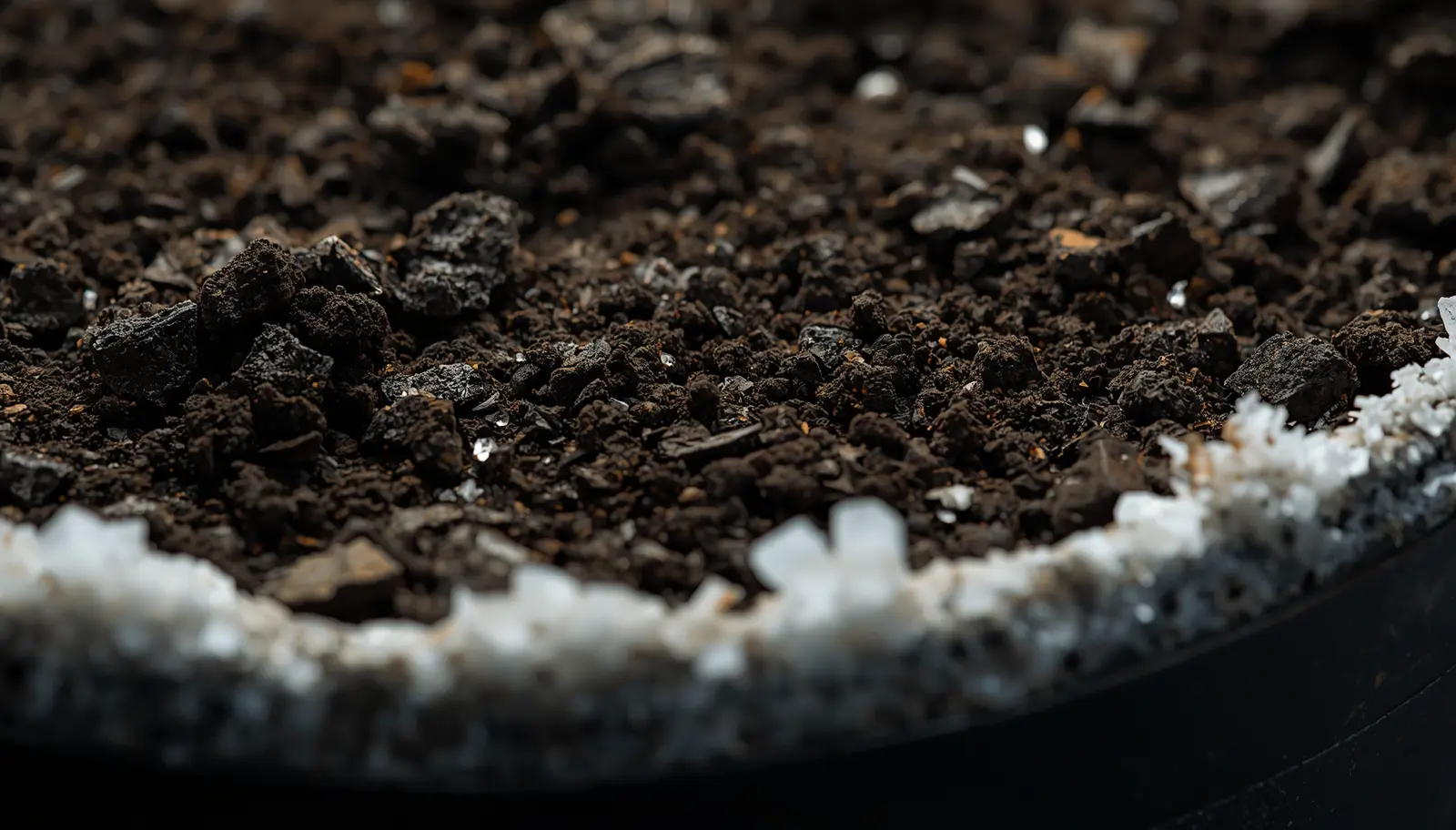
A hard white crust on houseplant soil, sometimes called a white mineral crust, is almost always a build-up of salts: minerals from hard tap water, leftover fertilizer, or both, left behind as water evaporates. University of Maryland Extension describes these deposits as white crystallized coatings on leaves or a white crust on the growing media or pot, and recommends flushing the soil from the top with at least 3 times the pot’s volume of fresh water, letting it drain completely. In small pots, or if the crust is heavy, repotting into fresh mix is simpler.
| Sign | Likely cause | What to do |
|---|---|---|
| Hard white or yellowish crust on the soil surface or pot rim | Hard-water minerals or fertilizer salts (UMD) | Scrape off, flush with about 3 pot volumes of water |
| Crust plus brown leaf tips and edges, slow growth | High soluble salts (UMD) | Flush; in small pots, repot in fresh mix |
| White crust on the outside of a clay pot | Salts wicking through the clay | Clean or replace the pot (UMD) |
| Fuzzy, cottony white growth that wipes away | Mold or fungus on damp soil | Let the soil dry more between waterings; see our fungus in houseplant soil guide |
Source: University of Maryland Extension.
What Causes White Crust on Houseplant Soil?
UMD Extension separates two sources:
- Mineral deposits come from hard water, which carries dissolved substances such as calcium carbonate, sodium and iron.
- Fertilizer deposits (fertilizer salt) are the result of the various components of soluble fertilizers.
Water leaves the pot through the leaves and by evaporating from the soil surface, but the dissolved salts stay behind and concentrate at the top of the mix and on the pot rim. Pots without drainage holes and bottom watering make it worse, because water never runs through the soil to carry salts out. UMD’s fertilizer toxicity page adds that high soluble salt levels are caused by excessive use of fertilizers, frequent applications, and incorrect use of fertilizer concentrates.
How Salt Build-Up Harms Plants
Salts in the soil compete with the roots for water, which UMD describes as competing for the available moisture and causing desiccation or “burning” of tissues; they can also affect the pH of the mix and block the uptake of nutrients. Its page on fertilizer toxicity lists the typical symptoms:
- Browning or dieback of leaf tips and margins.
- Reduced growth, lower leaf drop, dead root tips and wilting.
- Sometimes yellowing or stunting, root dieback and decay, and stem collapse at the soil line.
- A white crust on the potting mix and salt deposits on the outside of pots.
Brown tips have other causes too, including dry air and overwatering, so look at the whole picture; our guide to yellow and brown leaves helps narrow it down.
Is It Salt or Mold?
Salt crust is hard, crunchy or chalky, often off-white or slightly yellow, and collects on the surface and the pot rim; it does not wipe away like a powder. Mold is soft, fuzzy or cottony and usually appears on soil that stays damp. Some plants also leave mineral spots on their own leaf tips after dripping water overnight; see our guttation guide.
Growers who want numbers can measure soluble salts with an inexpensive EC (electrical conductivity) meter using the pour-through method. Rutgers Cooperative Extension fact sheet FS848 describes it: water as normal, wait until the pot stops draining, then pour enough water on the surface to collect about 50 ml of runoff and measure that. Its guideline range for nursery plants in pine-bark media is 0.6 to 2.0 dS/m (the same as mS/cm), but Rutgers cautions these guidelines come from a limited number of species. For most houseplant owners, the crust and the leaf symptoms are enough to act on.
How to Flush Salts Out of Houseplant Soil
- Scrape off the crust and the top layer of discolored mix with a spoon, and top up with fresh potting mix if needed.
- Take the plant to a sink, tub or outdoors in its pot, which must have drainage holes.
- Water slowly from the top with at least 3 times the volume of the pot, letting it drain completely (UMD). If your tap water is hard, use rainwater, distilled or other low-mineral water, as UMD advises using a water source low in dissolved minerals.
- Let it drain fully before putting it back in a cachepot or saucer; never leave it standing in the runoff.
- For a bad case, repeat the next day. Rutgers notes that leaching with one container volume of good quality water removes most soluble salts, and that a second leaching 24 hours later removes salts that have re-entered the solution.
When to repot instead
UMD recommends replacing the mix in small pots with high salts, and repotting into fresh media for severe cases. If the pot itself is crusted, replace it or clean it before reuse. Flushing a plant whose roots are already rotting adds more water to a problem; check the roots first if the plant is wilting in wet soil.
Do You Need Special Flushing Products?
No. The extension advice from UMD and Rutgers is plain, good-quality water, in volume. Products sold as “flushing agents” and homemade acid rinses are not part of that guidance, and acids can harm roots if misused. If your problem is hard water, changing the water you use is the real fix.
Feeding Again After a Flush
Flushing washes out nutrients along with salts, so start feeding again with your next regular feeding rather than immediately, and use the rate on the label. UMD’s advice for preventing salt build-up is to use the proper fertilizer analysis at the correct rate and frequency, and to wash off any fertilizer spills on plant surfaces. Rutgers also warns against applying fertilizer or concentrated nutrient solutions to dry mix; water first. For choosing products, see our synthetic vs organic fertilizer guide.
How Often to Flush
UMD suggests leaching houseplant soil with fresh water every 4 to 6 months as routine maintenance, and sooner whenever you see crust or salt symptoms. Plants that get more salts need it more often: those fed frequently, watered with hard water, or grown in self-watering pots and mineral substrates where water rarely runs through. In self-watering planters, water from the top with plain water now and then; see our self-watering pot problems and Lechuza PON guides.
Is the Crust Harmful to Pets?
There is no specific data on pets licking soil salt crust, but fertilizer residues are not something pets should eat, so scrape the crust off and keep pets away from pots they like to dig or lick. The bigger risk is usually the plant: many common houseplants, such as Monstera and pothos, are toxic to cats and dogs. See our cat-safe plants guide.
For more on repotting and potting mix, see our guides to how to repot a plant.
Frequently Asked Questions
Is salt build up in plants and soil bad for my plant?
It can be. UMD notes salt deposits compete with roots for water and can cause desiccation or “burning” of tissues, often showing as brown leaf tips and edges.
How do I get rid of white crust on houseplant soil?
Scrape it off, then flush the soil from the top with at least 3 times the pot’s volume of fresh water and let it drain completely (UMD). Repot small pots in fresh mix.
Is the white stuff on my soil mold or salt?
Salt is hard and crusty and builds up on the surface and pot rim; mold is soft and fuzzy and appears on soil that stays damp.
Does bottom watering cause salt build-up?
It can contribute, because water never flushes through the pot. UMD advises avoiding bottom watering and pots without drain holes, and flushing the mix from the top with pure water.
Can I use tap water to flush?
If your tap water is soft, yes. If it is hard, UMD advises using a water source low in dissolved minerals, such as rainwater or distilled water.
How often should I flush houseplant soil?
UMD suggests every 4 to 6 months, and sooner if you see crust or brown leaf tips.
Sources
- University of Maryland Extension: Mineral and fertilizer salt deposits on indoor plants
- University of Maryland Extension: Fertilizer toxicity or high soluble salts on indoor plants
- Rutgers NJAES Fact Sheet FS848: Monitoring and managing soluble salts in ornamental plant production (Johnson and Cabrera, 2014)