
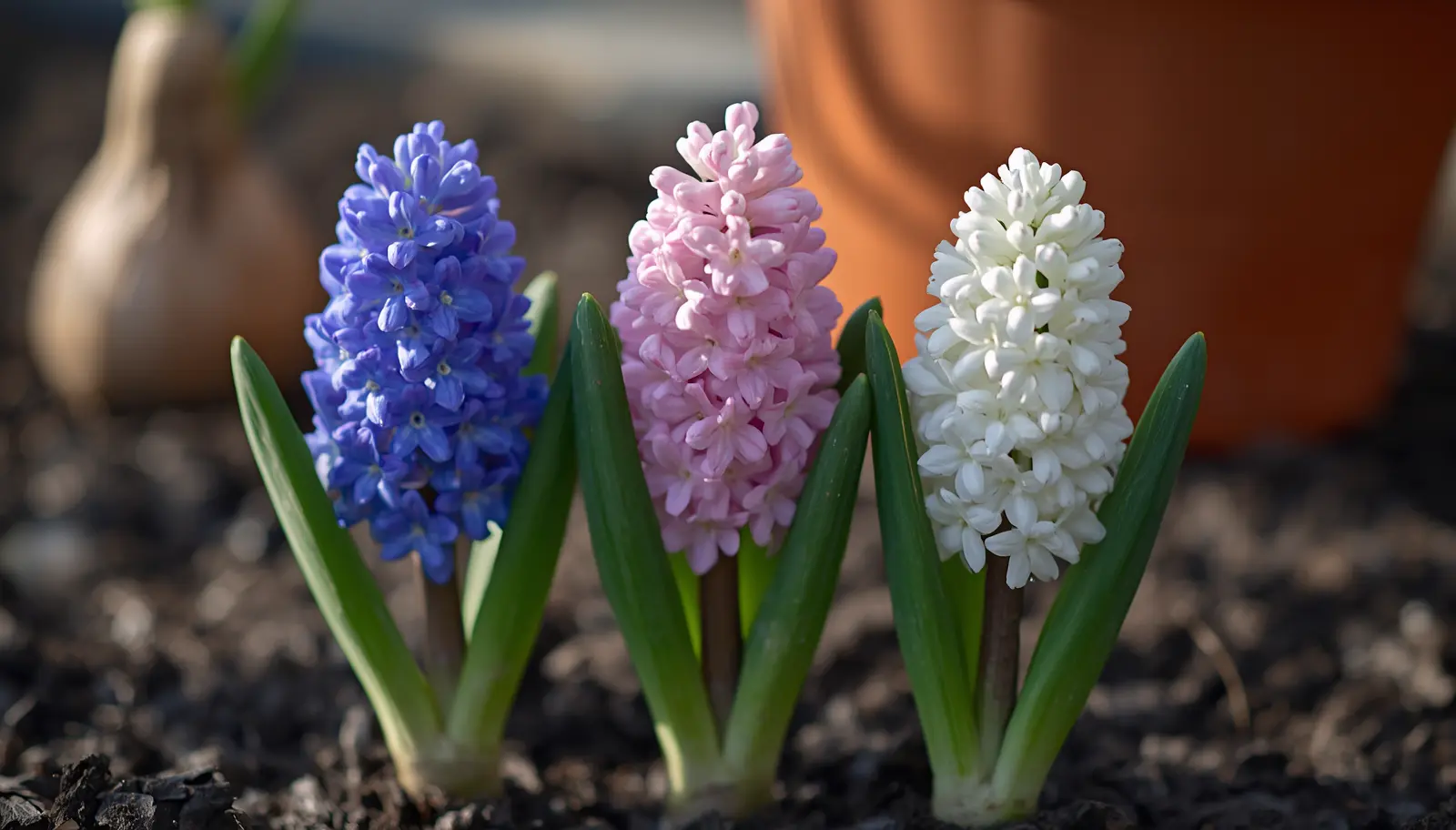
Hyacinths (Hyacinthus orientalis) are spring bulbs grown for their dense, intensely fragrant flower spikes. They are easy to grow in the garden and are one of the classic bulbs for flowering indoors in winter, in a pot or in a glass of water. This guide explains how to grow hyacinths both ways: planting bulbs outdoors in autumn, and forcing them indoors after a cold period. It follows the RHS, Iowa State University Extension, NC State Extension and the ASPCA.
Hyacinths at a Glance
| Need | What the sources say |
|---|---|
| Planting time | Early autumn for March to April flowers; prepared bulbs in September for Christmas (RHS) |
| Depth and spacing | 10 cm (4 in) deep, at least 7.5 cm (3 in) apart (RHS) |
| Light | Full sun; part shade works for one season (RHS); full sun to part shade (NC State) |
| Soil | Well-drained, moderately fertile (RHS); bulbs rot in poorly drained soil (NC State) |
| Hardiness | USDA zones 4a to 8b (NC State) |
| Forcing chill | 40 to 45°F for 12 to 15 weeks, in the dark (Iowa State) |
| Bloom | Mid-spring for 2 to 3 weeks outdoors (NC State); 2 to 4 weeks after chilling indoors (Iowa State) |
| Pets | Toxic to dogs, cats and horses (ASPCA) |
Sources: RHS hyacinth growing guide; Iowa State Extension (Jauron and Steil, reviewed 2023); NC State Extension; ASPCA.
Planting Hyacinths Outdoors
The RHS says to plant hyacinth bulbs in early autumn for flowers in March and April, pointed end up, about 10 cm (4 in) deep with at least 7.5 cm (3 in) between bulbs. They prefer well-drained, moderately fertile soil and full sun; partial shade is fine for a one-off display, but the RHS notes that flowering declines in later years in shade. NC State lists organically rich, well-drained soil and USDA zones 4a to 8b, and warns that bulbs can rot in poorly drained soil.
- Choose firm, healthy bulbs and a sunny, well-drained spot.
- Wear gloves: NC State says contact with the sap can cause dermatitis and advises gloves when planting.
- Plant pointed end up, 10 cm deep and at least 7.5 cm apart (RHS).
- Water after planting to settle the soil.
- Protect bulbs with wire mesh if squirrels dig them up, and watch for slugs in mild weather (RHS).
How to Grow Hyacinths in Pots
For outdoor containers, the RHS suggests a mix of two parts John Innes No. 2 compost to one part grit, which drains well. Plant at the same depth and spacing, or a little closer for a fuller pot. The RHS recommends a liquid high-potassium feed, such as tomato fertilizer, from early spring until six weeks after flowering for bulbs in containers.
For pots you plan to bring indoors in winter, follow the forcing steps below instead.
How to Grow Hyacinths Indoors (Forcing)
Forcing gives the bulbs an artificial winter so they flower early indoors. Iowa State University Extension gives these steps:
- Pot the bulbs: use a pot with drainage holes, about twice as deep as the bulbs are tall. Set the bulbs close together with their tips sticking above the potting mix, and water well.
- Chill them: keep the pots at 40 to 45°F for 12 to 15 weeks in complete darkness, watering as needed and never letting them freeze. A refrigerator, cool cellar or outdoor trench works.
- Keep fruit away: ripening fruit such as apples gives off ethylene gas, which can inhibit flower development, so don’t chill bulbs where fruit is stored.
- Bring them out gradually: move the pots to a 50 to 60°F spot in low to medium light until the shoots turn green (usually 4 to 5 days), then to a bright 60 to 65°F spot.
- Enjoy the flowers: they typically open 2 to 4 weeks after leaving cold storage. Bring out a few pots every 1 to 2 weeks for a longer display.
Prepared bulbs: bulbs sold as “prepared” or “for Christmas” have been heat-treated to flower early. The RHS says to plant them in September; they need 10 to 12 weeks for good root and shoot growth.
How to Grow Hyacinths in Water
Hyacinths can flower in just water using an hourglass-shaped forcing vase, often called a hyacinth glass (Iowa State).
- Fill the vase so the water sits just below the bulb’s base without touching it. Iowa State and the RHS both warn that the bulb rots if it sits in water.
- Keep it in a dark, cool place until the vase is full of roots (RHS), using the same cold treatment as for potted bulbs, or use prepared bulbs.
- Replace the water once or twice a week, or whenever it turns cloudy (Iowa State).
- Move it to bright, cool light once the shoot develops, and rotate the vase so the stem grows straight.
Bulbs grown in water need no feeding (RHS), and Iowa State suggests discarding them after flowering. Iowa State also gives a simpler method for a hyacinth in a jar: chill the bulb in a paper bag at 40 to 45°F for 12 to 15 weeks first, checking it for drying or rot, then set it on the glass.
After Flowering
The RHS says to cut off the flower stalk at the base when the flowers fade. Leave the leaves until they die down naturally. Move container bulbs to a sheltered spot and feed them, or plant them out in a sunny spot in the garden.
Expect smaller flowers in later years. The RHS says bulb performance and flower quality usually decline after the first year, and NC State says outdoor hyacinths produce smaller, more widely spaced flowers each year. For the best display, the RHS suggests replacing bulbs each year or adding a few new ones each autumn.
Common Problems
| Problem | Likely cause | Source |
|---|---|---|
| Soft, rotting bulbs | Poorly drained soil; bulb sitting in water | NC State, Iowa State |
| Flowers open down in the leaves | Room too warm while forcing | RHS |
| Poor flowering after forcing | Ripening fruit stored near the chilling bulbs (ethylene) | Iowa State |
| Smaller, sparser spikes | Normal decline after the first year; shade | RHS, NC State |
| Damaged bulbs or leaves | Squirrels, slugs, bulb mites, narcissus bulb fly | RHS, NC State |
Sources: RHS; Iowa State Extension; NC State Extension.
Are Hyacinths Poisonous?
Yes, to pets and people. The ASPCA lists hyacinths as toxic to dogs, cats and horses, with intense vomiting, diarrhea (occasionally with blood), depression and tremors; it gives the toxic principles as possibly narcissus-like alkaloids. NC State says the bulbs contain the highest concentration of toxins, that eating large amounts causes stomach cramps, salivation, vomiting and diarrhea, and that the sap can cause dermatitis.
Grape hyacinth (Muscari) is a different plant; NC State tags Muscari armeniacum as non-toxic for cats, dogs and horses. For another toxic spring flower, see our lily of the valley guide, and for safer choices our cat-safe plants list.
Hyacinth Meaning and Myth
The name comes from Greek myth. In Ovid’s Metamorphoses, Hyacinthus, a youth loved by Apollo, is killed by a thrown discus, and Apollo makes a flower grow from his blood. In the Victorian language of flowers, Kate Greenaway’s Language of Flowers (1884) gives the hyacinth as “sport, game, play” and the white hyacinth as “unobtrusive loveliness.” Other color meanings found online, such as purple for sorrow or blue for sincerity, come from later and less consistent sources.
For more garden flowers, see our guides to snapdragons and monkshood. For more bulbs you can bring into bloom indoors, see our guides to paperwhites. Forget-me-nots are a classic carpet under spring bulbs; see our guide to forget-me-not care.
Frequently Asked Questions
When should I plant hyacinth bulbs?
In early autumn for flowers in March and April, or September for prepared bulbs meant to flower at Christmas (RHS).
How deep do you plant hyacinth bulbs?
About 10 cm (4 in) deep, pointed end up, with at least 7.5 cm (3 in) between bulbs (RHS).
How do you grow hyacinths indoors?
Pot them with the tips showing, chill them at 40 to 45°F for 12 to 15 weeks in the dark, then move them to a cool, bright room. They flower 2 to 4 weeks later (Iowa State).
How do you grow hyacinths in water?
Use a hyacinth glass with the water just below the bulb’s base, keep it cool and dark until the roots fill the glass, then move it into bright, cool light. Change the water once or twice a week (Iowa State, RHS).
Do hyacinths come back every year?
Yes outdoors, but the RHS and NC State both say the flowers get smaller and sparser after the first year. Forced bulbs grown in water are usually discarded (Iowa State).
Are hyacinths poisonous to cats and dogs?
Yes. The ASPCA lists them as toxic to dogs, cats and horses, and NC State says the bulbs hold the most toxin.
Sources
- RHS: How to grow hyacinths
- Jauron, R. and Steil, A. How to force spring-flowering bulbs indoors. Iowa State University Extension (reviewed 2023)
- NC State Extension Gardener Plant Toolbox: Hyacinthus orientalis
- NC State Extension Gardener Plant Toolbox: Muscari armeniacum
- ASPCA: Hyacinth
- Greenaway, K. (1884). Language of Flowers. Project Gutenberg