
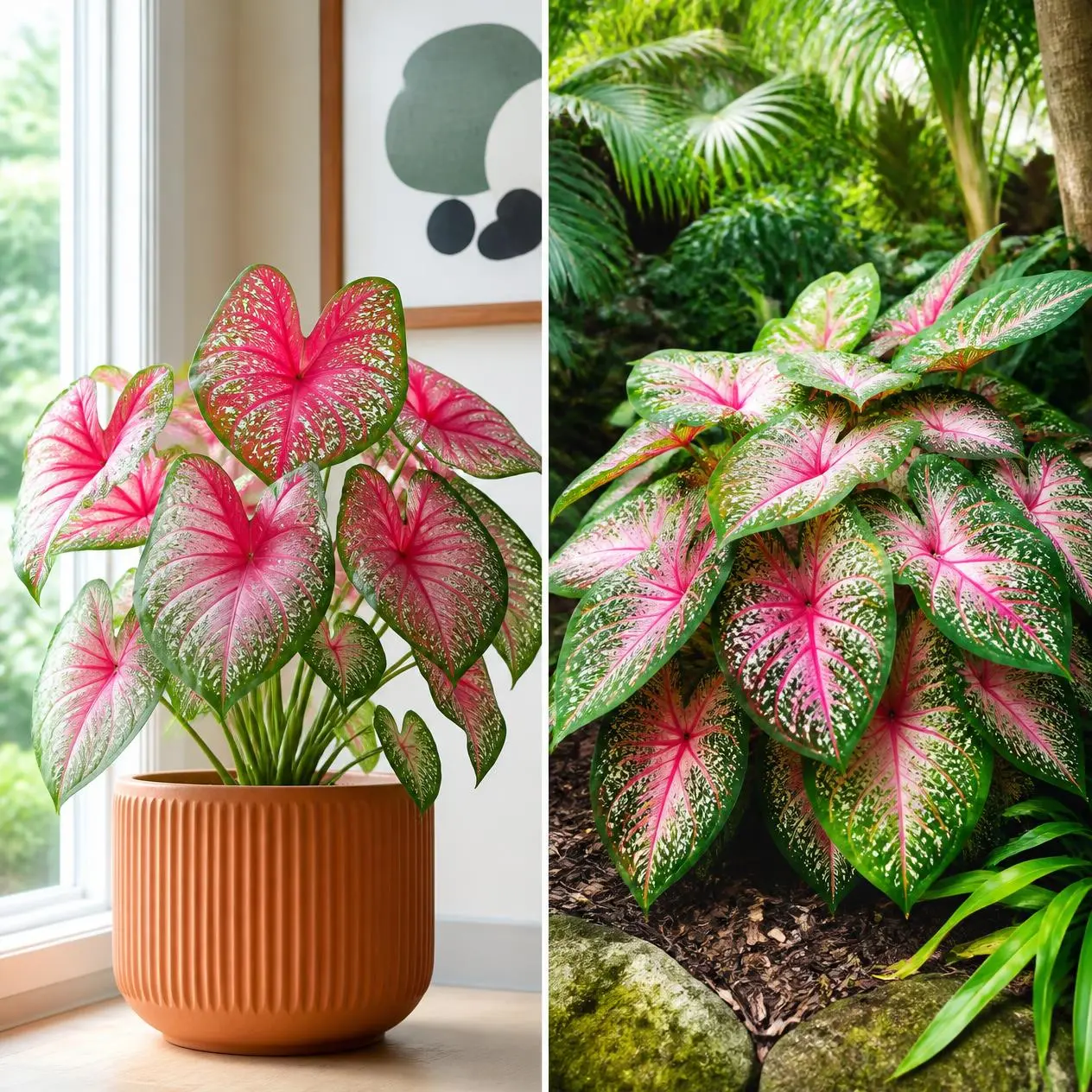
Caladiums are grown for their paper-thin, heart-shaped leaves splashed with white, pink, red and green. They grow from tubers, love warmth and moisture, and go dormant every autumn, which is when many people throw them out by mistake. Good caladium care means planting the tubers in warm soil, giving them shade or filtered light, keeping the soil evenly moist, and then storing the tubers somewhere warm and dry over winter. This guide follows UF/IFAS, NC State, Penn State and Clemson Extension.
Caladium Care at a Glance
| Need | What the sources say |
|---|---|
| Light | Partial shade; most need only 2 to 4 hours of direct sun, ideally morning (UF/IFAS); avoid hot afternoon sun (Clemson, Penn State) |
| Water | Soil moist to the touch, never dry and never saturated (UF/IFAS); a “water guzzler” in summer (NC State) |
| Soil | Fertile, acidic (below pH 6.0), rich in organic matter, well-drained (NC State) |
| Planting | Eye side up, about 2 in deep, 8 to 12 in apart, in soil at least 60 to 70°F (UF/IFAS) |
| Feeding | Light, slow-release, low in phosphorus (UF/IFAS); high nitrogen can turn leaves green (Penn State) |
| Hardiness | Can stay in the ground in USDA zones 8b to 11 (UF/IFAS); dig elsewhere |
| Size | 1 to 2 ft tall, 1 to 2.5 ft wide (NC State) |
| Pets | Toxic to dogs, cats and horses (ASPCA) |
Sources: UF/IFAS Gardening Solutions and EDIS FP083; NC State Extension; Penn State Extension (2026); Clemson HGIC (2019); ASPCA.
Caladium (Caladium bicolor, also sold as C. x hortulanum) is an aroid native to Central and South America (NC State). Its leaves rise on long stalks straight from an underground tuber. Clemson notes there are more than 1,000 named cultivars, in fancy-leaf and lance-leaf types.
Light, Water, Soil and Feeding
Light
UF/IFAS Gardening Solutions says most caladiums thrive in partial shade and need only two to four hours of direct sun a day, ideally morning sun followed by shade, and that leaf colors are usually brighter in shade than in full sun. Clemson warns that intense sun bleaches and burns thinner-leaved cultivars, and Penn State says to avoid strong midday and late afternoon sun.
Water
UF/IFAS says the tubers should never sit in dry soil or in saturated soil, but in soil that is moist to the touch, which may mean frequent watering in summer. Mulch after the leaves emerge to hold moisture. NC State calls caladium a water guzzler during growth. Clemson adds that tubers kept too wet develop root rot, so drainage matters as much as water.
Soil
NC State lists fertile, acidic soil (pH below 6.0), high in organic matter and well-drained. In pots, use a good peat-free or peat-based potting mix with some perlite or bark for drainage, in a pot with drainage holes.
Feeding
UF/IFAS says that for the best foliage color, choose a slow-release fertilizer that is low in phosphorus, that sandy soils usually need only one or two light feedings a season, and that too much fertilizer makes the leaves greener and washes out the reds and whites. Penn State suggests a balanced slow-release fertilizer at planting or a diluted liquid feed monthly during active growth, and warns that a high-nitrogen fertilizer can produce green leaves instead of bright ones.
Caladium Bulbs: How to Plant
Here is how to plant caladium bulbs (botanically tubers) outdoors or in pots:
- Wait for warm soil. UF/IFAS says to plant in soil that is at least 60 to 70°F, because cooler soil can cause tuber rot and slow growth. Penn State is stricter: soil at least 68°F, with air temperatures well over 70°F. In cold climates, Penn State suggests starting tubers indoors in pots as spring approaches.
- Find the top. Plant eye side up: the puckered, knobby side (UF/IFAS).
- Set the depth. UF/IFAS Gardening Solutions suggests about 2 inches deep; the UF/IFAS EDIS fact sheet gives 3 to 5 inches in loose soil. Pots and heavier soils suit the shallower end.
- Space them 8 to 12 inches apart (UF/IFAS).
- Water in and keep the soil moist but not soggy until shoots appear.
Caladium bulbs can take a few weeks to sprout, and cool soil slows them down. If nothing appears after several weeks of warm weather, gently dig one up: a firm tuber is alive, a soft, smelly one has rotted.
Caladium Care Indoors
Caladiums grow well as summer houseplants in bright, indirect light, such as near an east window. Keep the potting mix evenly moist and the room warm, and raise humidity with a pebble tray if the air is dry. NC State notes that caladiums are hard to keep growing indoors through winter: like outdoor plants, indoor caladiums usually go dormant in autumn. That’s normal and doesn’t mean the plant has died (see winter care below).
Annual or Perennial?
Caladium is a tender perennial grown from a tuber. The UF/IFAS EDIS fact sheet says tubers can stay in the ground in USDA zones 8b to 11, and that even there they seem to perform better when dug and protected from wet winter soil. Elsewhere, tubers must be dug and stored before frost each year, so many gardeners treat caladiums as annuals. Clemson describes them as frost-sensitive tropical plants.
Caladium Care in Winter
In autumn the leaves yellow and collapse as the tuber goes dormant. UF/IFAS says to water less and less as the leaves yellow to help the tubers go dormant.
Lifting and storing tubers
- Dig before frost, after the leaves yellow (UF/IFAS, Penn State).
- Brush off the soil and cure them. UF/IFAS EDIS says to dry them in semi-shade for about 10 days; Penn State says 1 to 2 weeks in a warm, dry spot, which dries the outer layer and reduces rot in storage.
- Pack them dry in peat moss, vermiculite or pine shavings, in mesh bags or shallow boxes (UF/IFAS, Penn State, NC State).
- Keep them warm enough. See the table below.
- Check them during winter and discard any that turn soft.
| Source | Storage temperature |
|---|---|
| Penn State Extension | Never below 60°F; cold can kill the tubers |
| UF/IFAS Gardening Solutions | 60°F or above until spring |
| UF/IFAS EDIS FP083 | 50 to 60°F, in dry peat moss or vermiculite |
| NC State Extension | 45°F or warmer, dry, in wood shavings or peat |
Sources: Penn State Extension (2026); UF/IFAS Gardening Solutions; UF/IFAS EDIS FP083; NC State Extension.
Because the sources disagree, the safe choice is a dry spot that stays at about 60°F, such as an indoor closet, not a cold garage or a refrigerator.
Potted caladiums
For caladiums in pots, you can let the leaves die back, stop watering, and keep the whole pot dry indoors in the same warm range, then start watering again in spring once it warms up.
Caladiums: Sun or Shade Varieties
Caladiums: sun or shade? Most caladiums are shade plants, but Clemson notes that some newer cultivars tolerate sun, naming ‘Red Flash’, ‘Red Frill’ and ‘Celebration’, and UF/IFAS says some new cultivars have been bred to grow in direct sun. Even sun-tolerant types usually look best with morning sun and afternoon shade in hot climates (UF/IFAS). Classic white types such as ‘Candidum’ are best kept in shade, since thin leaves bleach and burn in intense sun (Clemson).
Dark “black caladium” plants in garden centers are sometimes not caladiums at all but dark-leaved elephant ears (Colocasia), so check the botanical name on the label.
Drooping, Fading or Green Leaves
| Symptom | Likely cause | What to do |
|---|---|---|
| Drooping leaves, dry soil | Underwatering | Water thoroughly; keep soil evenly moist (UF/IFAS) |
| Drooping or yellowing, wet soil, soft tuber | Root or tuber rot from soil kept too wet (Clemson) | Improve drainage; let the surface dry a little |
| Bleached, scorched patches | Too much sun (Clemson, Penn State) | Move to shade or morning sun only |
| New leaves greener, colors washed out | Too much fertilizer, especially nitrogen (UF/IFAS, Penn State) | Feed less; use a low-phosphorus, slow-release product |
| Leaves yellowing in autumn | Normal dormancy | Water less; store the tubers |
| Holes in leaves | Slugs and snails, caterpillars (NC State, UF/IFAS) | Handpick; protect young leaves |
| Torn leaves | Wind or hail (NC State) | Plant in a sheltered spot |
Sources: UF/IFAS; Clemson HGIC; Penn State Extension; NC State Extension.
For general yellowing problems, see our yellow leaves guide and overwatered vs underwatered guide.
Are Caladiums Toxic?
Yes. The ASPCA lists caladium as toxic to dogs, cats and horses because of insoluble calcium oxalates, with oral irritation, pain and swelling of the mouth, tongue and lips, drooling, vomiting and difficulty swallowing. NC State rates its toxicity as medium, notes that the sap can irritate skin, and says ingestion by livestock or pets may be fatal. Keep caladiums away from pets and children, wear gloves when handling tubers, and call your veterinarian or the ASPCA Animal Poison Control Center at (888) 426-4435 if a pet chews one. See our cat-safe plants list for alternatives.
For more garden flowers, see our guides to snapdragons and lavender. For overwintering tips, see our guides to bringing plants indoors for winter and winter houseplant care.
Frequently Asked Questions
Do caladiums like sun or shade?
Mostly shade. UF/IFAS says most need only two to four hours of direct sun, ideally in the morning. Sun-tolerant cultivars such as ‘Red Flash’ and ‘Celebration’ handle more (Clemson), but afternoon sun bleaches thin-leaved types.
How do you plant caladium bulbs?
Plant them eye side up (the knobby side), about 2 inches deep and 8 to 12 inches apart, once the soil is at least 60 to 70°F (UF/IFAS). Penn State recommends waiting for 68°F soil, or starting them indoors in pots.
How do you care for caladiums in winter?
Water less as the leaves yellow, then dig the tubers before frost, cure them for about 10 days to 2 weeks, and store them dry in peat, vermiculite or shavings. Keep them at about 60°F; Penn State warns that colder storage can kill them.
Do caladiums come back every year?
In USDA zones 8b to 11 they can stay in the ground (UF/IFAS). In colder areas, the tubers come back only if you dig and store them before frost.
Why is my caladium turning green?
Usually too much fertilizer, especially nitrogen, which UF/IFAS and Penn State say makes leaves greener and washes out the colors. Very low light can also reduce color.
Are caladiums poisonous to cats and dogs?
Yes. The ASPCA lists caladium as toxic to dogs, cats and horses because of insoluble calcium oxalates, causing mouth pain, drooling, vomiting and difficulty swallowing.
Sources
- UF/IFAS Gardening Solutions: Caladiums
- Gilman, E.F., Klein, R.W. and Hansen, G. Caladium x hortulanum. UF/IFAS EDIS FPS83/FP083
- NC State Extension Gardener Plant Toolbox: Caladium bicolor
- Gibson, M.J.R. (2026). Caladiums for the Home Garden. Penn State Extension
- Smith, B.H. (2019). Caladiums for Summer Color. Clemson HGIC
- ASPCA: Caladium
I have been growing caladiums for over 5 year and have been successful wiht beautiful displays of my christmas tree caladiums. I’m in southern CA -zone 9 and end up purchasing new tubers every 2 years. I want larger displays!!
My problem is getting viable tubers, I get tubers that are or quickly become mushy beige custard instead of shoots and roots. The vendors are not very helpful in ssending replacements.
Any recommendations for sources to purchase tubers?
Thanks for sharing, Bill, those Christmas tree caladiums sound beautiful! Most caladium tubers sold in the US are grown around Lake Placid, Florida, so buying directly from a grower there early in the season usually gets you firmer, larger tubers than general retailers. Mushy, custard-like tubers are often rotting from cool, wet soil, so check that they’re firm when they arrive and wait until the soil is at least 65 to 70°F before planting.
I just split two pots into 5 and hope you can suggest how to support help them thrive from this trauma.
Any and all suggestions are greatly appreciated.
Divided caladiums usually bounce back well. Keep them in bright, indirect light out of hot afternoon sun, water when the top inch of soil starts to dry rather than keeping it soggy, and skip fertilizer for a few weeks while new roots form. A few droopy or yellow leaves at first is normal transplant stress, and fresh leaves from the tubers will tell you they’ve settled in.