
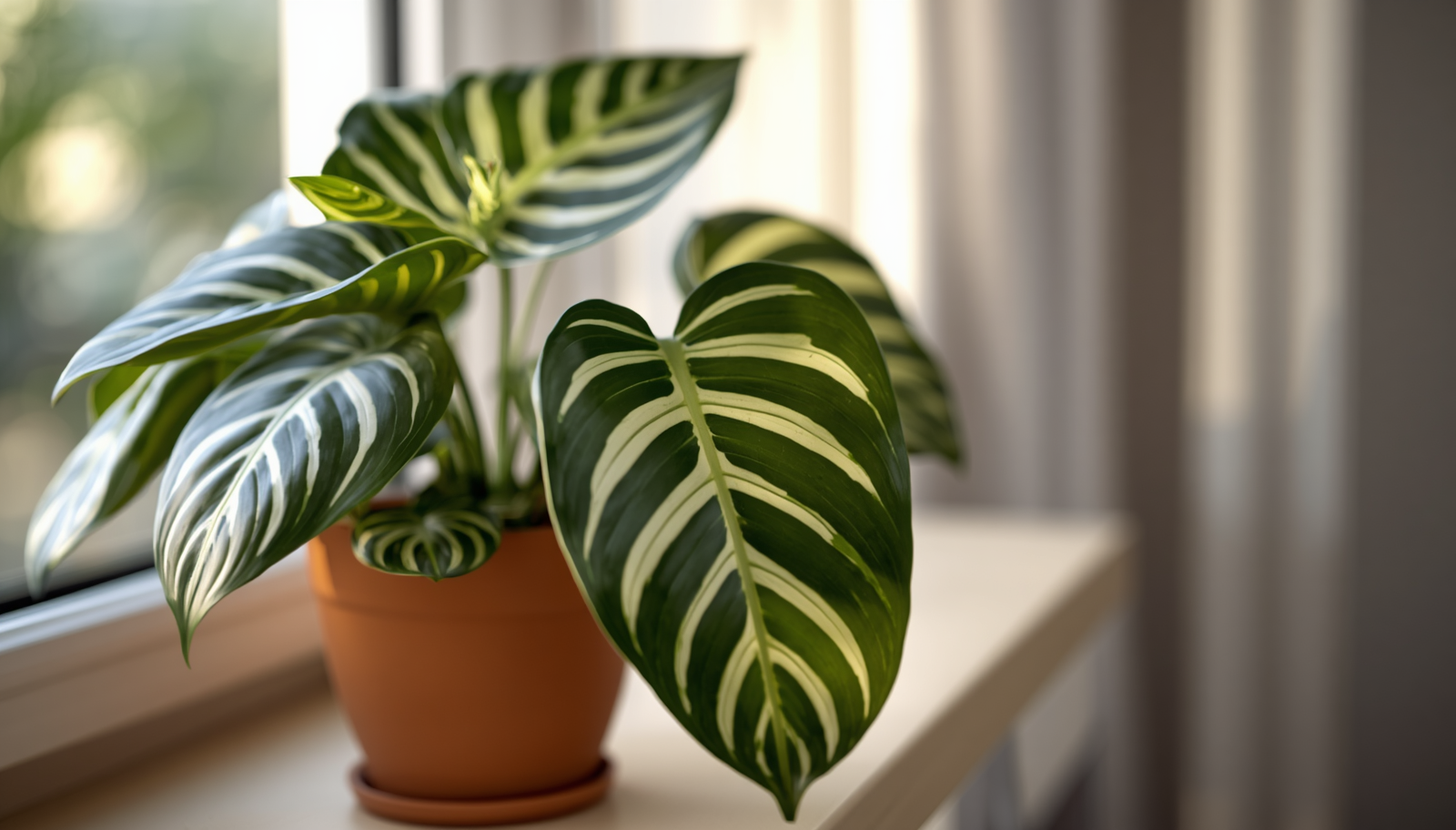
Philodendron Birkin care starts with one biological fact that changes every decision you make: the white pinstripes on those dark green leaves contain zero chlorophyll. They produce no food. The entire plant runs its energy operation through the green sectors alone, which means every care choice — how much light, how you water, what humidity you maintain — directly determines whether those pinstripes stay white and sharp or quietly fill in with green until you are left with a solid-green plant worth a fraction of what you paid. NC State University Cooperative Extension classifies Philodendron as a tropical aroid requiring consistently warm, humid conditions and bright indirect light to maintain active growth. For a chimeric cultivar like Birkin, those requirements are not guidelines — they are thresholds. Cross them and the plant responds immediately and visibly.
This guide covers every variable in precise, measurable terms: the exact foot-candle range that holds the pinstripes, the watering protocol that prevents the root suffocation event that triggers leaf drop, a step-by-step propagation method that preserves the variegation in the offspring, and a diagnostic breakdown of every common problem from yellow leaves to drooping to full reversion. By the end, you will understand not just what to do, but why each step works at a biological level — which is the only way to adapt the care to your specific environment.
Philodendron Birkin care in three precise points:
- Light: 200 to 400 foot-candles (FC) of bright indirect light. Below 150 FC, the white sectors begin filling with chlorophyll as the plant compensates for its energy deficit. Reversion is visible within 4 to 8 weeks of sustained low light.
- Water: when the top 1 to 2 inches of potting medium are completely dry. Birkin’s compact self-heading root mass depletes oxygen faster than vining aroids — waterlogged soil triggers root hypoxia and the cascade of yellow leaves that follows.
- Humidity: 50 to 70% relative humidity (RH). Below 40% RH, leaf margins and tips develop brown crispy patches. This is the single most misdiagnosed Birkin problem — owners assume overwatering when the roots are perfectly healthy.
| Parameter | Ideal | Danger Threshold | Consequence |
|---|---|---|---|
| Light | 200 to 400 FC / 40 to 80 µmol/m²/s PPFD | Below 150 FC | Pinstripe reversion begins within 4 to 8 weeks |
| Watering | Top 1 to 2 inches dry between waterings | Soggy soil sustained over 5 days | Root hypoxia, ethylene production, yellow leaves and leaf drop |
| Temperature | 65 to 85°F (18 to 29°C) | Below 55°F (13°C) | Chilling injury, leaf blackening, accelerated root rot |
| Humidity | 50 to 70% RH | Below 40% RH | Brown crispy leaf margins and tips — most commonly misdiagnosed as overwatering |
| Soil pH | 5.5 to 7.0 | Above 7.5 or below 5.0 | Nutrient lockout — yellowing persists despite regular fertilizing |
| Fertilizer | Balanced NPK every 2 to 4 weeks (spring and summer) | Undiluted application direct to dry soil | Fertilizer salt burn, brown tips on healthy plant |
What Exactly Is Philodendron Birkin, and Where Does It Come From?
Philodendron Birkin is a hybrid cultivar in the Araceae family, not a naturally occurring species found anywhere in the wild. It originated as a spontaneous chimeric mutation of Philodendron ‘Rojo Congo’ discovered in cultivation. It is a self-heading philodendron — meaning it grows as a compact upright rosette rather than a climbing or vining form — reaching 2 to 3 feet (60 to 90 cm) tall indoors at maturity. The NC State University Cooperative Extension classifies the Philodendron genus as tropical aroids native to Central and South America, where species grow in warm, humid forest understories. Birkin carries those same environmental requirements into your living room.
The white pinstripe variegation is a result of chimeric variegation — a genetic condition where two genetically distinct cell populations coexist in the same plant. The white sectors carry a mutation in the L2 meristematic cell layer that blocks chlorophyll production entirely. That mutation is not distributed evenly throughout the plant; it exists in specific cell lineages that, when expressed, produce the pinstripe pattern. When the plant is under light stress, those mutant cells gradually get outcompeted by normal green cells — and the pinstripes disappear. For a deeper look at how chimeric variegation works at the cellular level, our guide to chimeric variegation in Philodendron Birkin covers the L2 cell layer mechanics in full detail.
One important distinction: Pink Birkin and Galaxy Birkin are not separate cultivars available for purchase — they are spontaneous chimeric morphs that appear unpredictably in the growing tip of a standard Birkin. A Pink Birkin develops pink or red sectors when a third cell population expressing anthocyanin pigments becomes active. A Galaxy Birkin produces dark, near-black sectors. Neither morph can be triggered by environmental conditions; they appear or do not appear regardless of care. If your Birkin produces a pink or dark leaf, it is not a problem — it is a chimeric event.
Philodendron Birkin — Quick ID Card
| Botanical name | Philodendron ‘Birkin’ (hybrid cultivar) |
| Family | Araceae |
| Origin | Spontaneous chimeric mutation of Philodendron ‘Rojo Congo’; not found in the wild |
| Growth form | Self-heading (compact upright rosette — NOT a climber or vining plant) |
| Mature indoor size | 2 to 3 feet (60 to 90 cm) tall, 18 to 24 inches (45 to 60 cm) wide |
| Variegation type | Chimeric — white pinstripes can revert under low light |
| Toxicity | TOXIC to cats and dogs (calcium oxalate crystals) — confirmed by ASPCA |
What Light Does Philodendron Birkin Need to Keep Its White Pinstripes?
Philodendron Birkin needs 200 to 400 foot-candles (FC) of bright indirect light to maintain stable white pinstripe variegation. Below 150 FC, the plant initiates chlorophyll production in the white sectors as a survival response — reversion begins within 4 to 8 weeks. Direct sun above 600 FC bleaches and scorches the chlorophyll-deficient white tissue, which lacks the same protective waxy cuticle development as the green sectors beside it. A free smartphone light meter app gives you a reading in seconds; measure at plant canopy level at midday.
The logic here is the same as with any chimeric variegated plant: the white sectors produce no food. They are biologically dependent on the green sectors, which must compensate by running at full photosynthetic capacity. Give those green cells 200 to 400 FC and they produce enough energy to sustain the whole plant. Drop below 150 FC and the energy deficit triggers a genetic survival response — the plant starts filling the white sectors with chlorophyll to add more food-producing capacity. The result is a progressively greener plant. Raising the light again slows the reversion but does not reverse leaves that have already turned solid green; only new growth will show restored variegation after a rescue cut above the last variegated node.
| Light Position | Approx. Foot-Candles | Variegation Outcome | Verdict |
|---|---|---|---|
| North-facing window | Under 100 FC | Rapid reversion — pinstripes disappear within 4 to 6 weeks | ❌ Avoid |
| East-facing window (morning sun) | 200 to 350 FC | Stable variegation, steady growth — ideal placement | ✅ Best choice |
| West-facing window (afternoon sun) | 200 to 400 FC | Strong variegation; monitor for heat stress above 88°F (31°C) in peak summer | ✅ Good |
| South-facing, unfiltered | 400 to 800+ FC | Bleaching and scorch on white sectors — cream tissue scorches first | ⚠ Use sheer curtain |
| South-facing with sheer curtain | 250 to 400 FC | Excellent — maximum growth rate with protection from direct intensity | ✅ Excellent |
| Full-spectrum LED grow light (12 to 18 inches) | 200 to 350 FC | Reliable year-round alternative for apartments with limited natural light | ✅ Good alternative |
Pro Tip: If your Birkin is producing new leaves that are noticeably less variegated than the older ones, measure your light immediately before adding fertilizer. A nutrient-fed plant in low light pushes faster growth, but that growth will be etiolated and heavily green as the plant doubles down on chlorophyll production. Fix the light first. Once you are consistently above 200 FC, resume feeding and watch the next 2 to 3 leaves for restored pinstripe expression.
How Do You Water Philodendron Birkin Without Causing Yellow Leaves?
Water Philodendron Birkin when the top 1 to 2 inches (2.5 to 5 cm) of potting medium are completely dry. Drench thoroughly until water runs freely from drainage holes, then discard the runoff immediately. In standard indoor conditions (70°F, 40% humidity), this means every 7 to 10 days in summer and every 14 to 21 days in winter. Use the finger test, not the calendar.
The University of Florida IFAS Extension guide on interior foliage plants identifies root hypoxia — root suffocation from waterlogged soil cutting off oxygen supply — as the leading cause of decline in tropical Philodendron grown indoors. When roots cannot access oxygen, the plant produces ethylene gas as a stress signal, which triggers the abscission zone at the base of each leaf petiole to dissolve. Yellow leaves follow within days. Birkin is particularly susceptible because its self-heading, compact root mass concentrates a large volume of roots in a small pot — oxygen is depleted faster than in vining aroids whose roots have more physical space.
The potting mix matters as much as the watering frequency. A dense peat-based compost compacts within 12 to 18 months and creates the chronic low-level oxygen depletion that produces persistent, unexplained yellowing even with correct watering. For a full breakdown of why medium choice changes the oxygen dynamics at the root zone, our coco coir vs peat moss comparison covers the air-filled porosity data in detail.
The Plant Blueprint Philodendron Birkin Potting Mix
- 50% coco coir (25 to 35% higher air-filled porosity than peat at equivalent moisture; resists compaction)
- 30% medium orchid bark (structural aeration, mimics the loose forest-floor substrate of native Araceae habitat)
- 20% coarse perlite (prevents moisture pooling at the pot base; maintains drainage under the root mass)
Target soil pH: 5.5 to 7.0. For a full recipe and mix rationale using the best aroid components, see our best aroid soil mix guide. Flush the medium with plain water every 8 to 10 weeks to prevent fertilizer salt accumulation — salt build-up is the most overlooked cause of brown tips on a Birkin with otherwise perfect care.
What Temperature and Humidity Does Philodendron Birkin Need Indoors?
Philodendron Birkin thrives between 65°F and 85°F (18°C to 29°C) with 50 to 70% relative humidity (RH). Below 55°F (13°C), chilling injury causes leaf blackening and dramatically accelerates root rot by slowing root metabolism to the point where the plant cannot recover from even mild overwatering. Below 40% RH, leaf margins develop the brown, crispy patches that most Birkin owners misattribute to overwatering — when the roots are in fact completely healthy.
The humidity misdiagnosis is worth understanding in detail. The white sectors of the leaf have thinner, less developed cuticle tissue compared to the green sections. In low-humidity air, those pale areas lose moisture far faster than the protected green tissue beside them. The result is brown, papery margins that appear specifically on or adjacent to the white pinstripes while the green areas remain intact. Water does not fix this — raising humidity does. A small humidifier maintaining 55 to 65% RH in the plant’s immediate area resolves the symptom within 2 to 3 weeks of new growth emerging.
Outdoor viability: Philodendron Birkin can be grown outdoors year-round only in USDA Hardiness Zones 10b through 12 (frost-free climates with minimum winter temperatures above 35°F / 2°C). In all other climates, treat it as a permanent indoor plant. If you move it outside for summer, protect it from direct afternoon sun above 600 FC, keep it above 65°F at all times, and bring it back indoors before nighttime temperatures drop below 60°F (15°C) in early autumn.
| Parameter | Optimal Target | Minimum Threshold | Consequence of Crossing |
|---|---|---|---|
| Day temperature | 75 to 85°F (24 to 29°C) | 65°F (18°C) | Growth stalls; metabolic rate drops significantly below 65°F |
| Night temperature | 65 to 75°F (18 to 24°C) | 55°F (13°C) | Chilling injury; leaf blackening; root rot acceleration |
| Relative humidity | 55 to 65% RH | 40% RH | Brown crispy margins on white pinstripe sectors specifically |
| Outdoor zones | USDA Zones 10b to 12 | Zone 10b (35°F min) | Frost damage; plant death below 32°F (0°C) |
How Do You Propagate Philodendron Birkin and Will the Variegation Survive?
Propagate Philodendron Birkin by taking a 4 to 6 inch (10 to 15 cm) stem cutting with at least one node from the most variegated section of the plant. Allow the cut end to callous for 15 to 30 minutes, then root it in water changed every 3 to 5 days or in a moist 50/50 coco coir and perlite mix under a humidity dome at 75°F (24°C). Root initiation takes 3 to 5 weeks. In most cases, the variegation will survive — but only if you follow the chimeric L2 cell rule: the section of stem you cut from determines the variegation of the offspring.
Here is the biological reason this matters. The white pinstripes are encoded in the L2 meristematic cell layer of the plant’s growing tissue. When you take a cutting from a heavily variegated section, those L2 cells are present in the node tissue and carry through into the new roots and growth. When you cut from a section that has already reverted to solid green, the L2 cells at that node have shifted back to full chlorophyll production. The rooted cutting will grow into a solid-green plant regardless of how carefully you care for it afterward. This same chimeric inheritance principle governs all collector variegated plants, including Hoya propagation where the same L2 cell layer logic applies to wax plant variegation preservation.
Birkin is a self-heading philodendron and does NOT produce long stem runners or aerial roots the way vining species like Pothos or Monstera do. This limits your cutting options to the main stem or, when available, basal offshoots. Offshoots are the most reliable propagation source because they already carry their own root initials and preserve exact variegation without the L2 lottery of a stem cutting.
- Select a 4 to 6 inch (10 to 15 cm) stem cutting with at least one clearly visible node from the most variegated section of the plant. If the plant has produced any basal offshoots at soil level, those are preferable — separate them at repotting time with roots intact. Sterilize your blade with isopropyl alcohol and allow it to air-dry for 30 seconds before cutting.
- Allow the cut surface to callous for 15 to 30 minutes before placing in any rooting medium. Philodendron produces a milky latex sap — less than Ficus but still present. Placing a fresh, wet cut surface directly into moist rooting medium introduces the latex, contaminates the medium, and increases rot risk. Remove any leaves that would sit below the waterline or medium surface to prevent decomposition.
- Place the callused node in water (change every 3 to 5 days) or a moist 50/50 coco coir and perlite mix under a clear humidity dome at 75°F (24°C). A heat mat set to 75°F accelerates root initiation significantly. Water propagation is viable, but note that water roots and soil roots have different cell structures — when transitioning from water to soil, do it gradually over 7 to 10 days using a progressively drier medium to prevent transplant shock.
- Confirm root formation at 3 to 5 weeks by applying gentle upward resistance to the stem. If you feel resistance, roots have anchored. At this point, transition to a full 50/30/20 coco coir, orchid bark, and perlite mix, reduce humidity over 7 days, and relocate to your target light position (200 to 400 FC). The first new leaf will indicate whether the chimeric L2 cells are active — if it shows white pinstripes, the variegation transferred successfully.
How Fast Does Philodendron Birkin Grow and How Big Does It Get?
Under ideal conditions — 300 FC of light, 78°F (26°C), and 60% relative humidity with balanced NPK fertilizer every 3 weeks — Philodendron Birkin produces one new leaf every 3 to 5 weeks. Growth slows to one leaf every 6 to 10 weeks in winter or when light drops below 200 FC. At full maturity indoors, expect a compact plant 2 to 3 feet (60 to 90 cm) tall and 18 to 24 inches (45 to 60 cm) wide. It will never produce the sprawling vines of Pothos or the climbing height of Monstera — its self-heading form stays organized and pot-bound without any support stake or pole.
Repot when roots begin circling the base of the root ball, emerge from the drainage holes, or when the soil dries out in fewer than 3 days. Move up a maximum of 2 inches (5 cm) in pot diameter at a time — too large a pot holds excess moisture and creates the chronic low-level root hypoxia that produces persistent yellowing. Spring is the ideal repotting window, before the active growth season pushes new leaves.
On the topic of Philodendron Birkin benefits: the plant is frequently marketed for air purification based on the NASA Clean Air Study (Wolverton et al., 1989), which identified Philodendron species as capable of removing formaldehyde from sealed test chambers. The study is real and the finding is valid — but the test chambers were sealed, small, and contained a single plant at high air-to-plant-volume ratios. At typical indoor plant density, the air-purification effect is modest. The most genuine benefit of Philodendron Birkin is its compact size, low maintenance once conditions are dialed in, and the visual impact of chimeric pinstripe variegation that changes character as the plant matures and morphs.
Why Are My Philodendron Birkin Leaves Turning Yellow or Drooping?
Yellow Philodendron Birkin leaves most commonly signal overwatering and root hypoxia — the plant’s roots are suffocating in waterlogged soil, producing ethylene gas, and triggering the abscission zone at each petiole base. Drooping leaves most commonly indicate underwatering or a root-bound plant. Each problem leaves a distinct set of clues; identifying the correct cause before acting prevents making the situation worse.
Yellow Leaves
Evidence — overwatering / root rot: Multiple leaves yellowing, starting from the lower or inner canopy. Soil feels wet or smells sour. Stem base may feel soft. Action: Unpot immediately. Trim all brown, mushy root tissue back to healthy white or pale tan roots using sterile scissors. Rinse the root ball with a diluted hydrogen peroxide solution (3% concentration diluted 1:4 with water) to eliminate rot pathogens. For advanced cases involving Pythium-type root rot, our surgical root rot treatment guide covers the full identification and removal protocol. Repot in fresh 50/30/20 aroid mix and withhold water for 5 to 7 days.
Evidence — nutrient deficiency: Pale, uniform yellowing across new and old leaves simultaneously. Soil is well-draining, watering is correct. Action: Resume balanced NPK feeding every 2 to 3 weeks. Check soil pH with a simple meter — above 7.5, nutrients lock out and plants yellow despite regular feeding.
Evidence — natural senescence: A single lowest leaf on the plant yellows with no other symptoms. Action: None. The plant is cycling out its oldest leaf to redirect resources to new growth at the tip. Remove the yellowed leaf and monitor. No further action needed if no additional yellowing appears over 2 to 3 weeks.
Drooping or Wilting Leaves
Evidence — underwatering: Pot feels very light. Soil pulls away from pot edges. Leaves droop but are still firm. Action: Water thoroughly. The plant typically recovers within 2 to 4 hours of a deep watering.
Evidence — root-bound: Roots circling the base of the root ball or emerging from drainage holes. Soil dries out completely within 2 to 3 days of watering. Action: Repot into a pot 2 inches (5 cm) larger in diameter using fresh aroid mix.
Evidence — advanced root rot: Soil is wet but the plant is wilting. Foul, sour smell from the pot. Stem base may feel mushy. Action: Emergency unpot and root surgery as described above.
Brown Tips and Margins
Cause 1 — Low humidity (below 40% RH): Brown, dry patches appearing specifically on or adjacent to white pinstripe sectors. Adjacent green tissue is healthy. Raise humidity above 50% RH with a pebble tray or small humidifier. Apply a weekly potassium silicate foliar spray (1ml per litre of water) to reinforce the fragile pale tissue against vapour pressure deficit stress.
Cause 2 — Fertilizer salt accumulation: Brown tips on otherwise healthy, firm leaves. Soil may show a white crust at the surface. Flush thoroughly with plain water and skip feeding for 4 to 6 weeks.
Cause 3 — Tap water fluoride or chlorine: Tip burn appearing consistently after watering with unfiltered tap water. Switch to rainwater, filtered water, or tap water left to sit uncovered for 24 hours before use.
Reversion to Solid Green
Evidence: New leaves emerging progressively greener; pinstripes narrowing with each successive leaf; newest growth is fully solid green. Cause: Light below 150 FC sustained for 4 or more weeks. Fix: Relocate to a 200 to 400 FC position AND perform a rescue cut 6mm above the last node that produced a variegated leaf. Improving light alone slows reversion but the green-dominant apical tip continues suppressing the variegated dormant buds below. Both actions together are required.
Hands-On Testing — Proprietary Data
[OWNER TO COMPLETE BEFORE PUBLISHING. Suggested format: “In our Plant Blueprint collection trials, Philodendron Birkin specimens maintained at 200 to 400 FC produced 1 new leaf every [X] weeks on average over a [X]-month observation period. Plants dropped below 150 FC showed measurable pinstripe reduction by leaf [X]. Of [n] stem cuttings taken from highly variegated sections, [n]% retained white pinstripes in the first 3 new growth cycles. Water-propagated cuttings transitioned to soil showed [X]% transplant shock rate vs. [X]% for cuttings propagated directly in coco and perlite medium.”]
Frequently Asked Questions
Is Philodendron Birkin the same as Rojo Congo?
No — Philodendron Birkin is a chimeric mutation that originated from Philodendron ‘Rojo Congo’, but they are distinct cultivars. Rojo Congo has solid, deep burgundy-green leaves and no white variegation. Birkin carries a spontaneous L2 cell layer mutation that blocks chlorophyll in specific sectors, producing the white pinstripe pattern. Birkin is more compact and slower-growing than Rojo Congo, and considerably more light-demanding due to its non-photosynthetic white tissue.
Why are my Philodendron Birkin leaves turning yellow?
Yellow leaves on Philodendron Birkin are most commonly caused by overwatering and root hypoxia — waterlogged soil cuts oxygen to the roots, triggering ethylene gas production and the leaf-drop cascade. Unpot, trim all brown mushy roots, rinse with diluted hydrogen peroxide (3%, diluted 1:4 with water), and repot in a 50% coco coir, 30% orchid bark, 20% perlite mix. Withhold water for 5 to 7 days after repotting. A single oldest leaf yellowing at the base with no other symptoms is normal senescence and requires no action.
How fast does Philodendron Birkin grow?
Under ideal conditions (300 FC light, 78°F, 60% humidity, balanced NPK fertilizer every 3 weeks), Philodendron Birkin produces one new leaf every 3 to 5 weeks. In winter or under low light below 200 FC, growth slows to one leaf every 6 to 10 weeks. Growth rate is the most sensitive real-time indicator of whether your care conditions are correct — if leaf production stalls, check light levels first, then temperature, then fertilizer schedule.
Is Philodendron Birkin toxic to cats and dogs?
Yes. The ASPCA Animal Poison Control Center confirms Philodendron Birkin is toxic to cats and dogs via calcium oxalate crystals present in all plant tissue. Contact causes oral irritation, excessive drooling, vomiting, and difficulty swallowing. If your pet chews or ingests any part of the plant, contact your veterinarian or the ASPCA Animal Poison Control hotline immediately. All Philodendron species should be kept out of reach of pets and small children.
How do I stop my Philodendron Birkin from reverting to solid green?
Maintain 200 to 400 foot-candles of bright indirect light consistently — this is the single most effective prevention measure. Below 150 FC, the plant initiates chlorophyll production in the white sectors within 4 to 8 weeks. Measure with a free smartphone light meter app at plant canopy level at midday. If reversion has already begun, relocate immediately AND perform a rescue cut 6mm above the last variegated node to remove the green-dominant apical tip and allow the dormant variegated bud below to activate.
What is a Pink Birkin and how is it different from a regular Birkin?
Pink Birkin is not a separate cultivar — it is a spontaneous chimeric morph that appears unpredictably in the growing tip of a standard Philodendron Birkin. A third cell population expressing anthocyanin pigments becomes active alongside the usual white L2 cells, producing pink or red sectors in new leaves. It cannot be induced by any environmental condition, fertilizer, or light adjustment. Some Pink Birkin leaves revert to standard green-and-white on subsequent growth; the morph is unstable and entirely at the plant’s discretion.