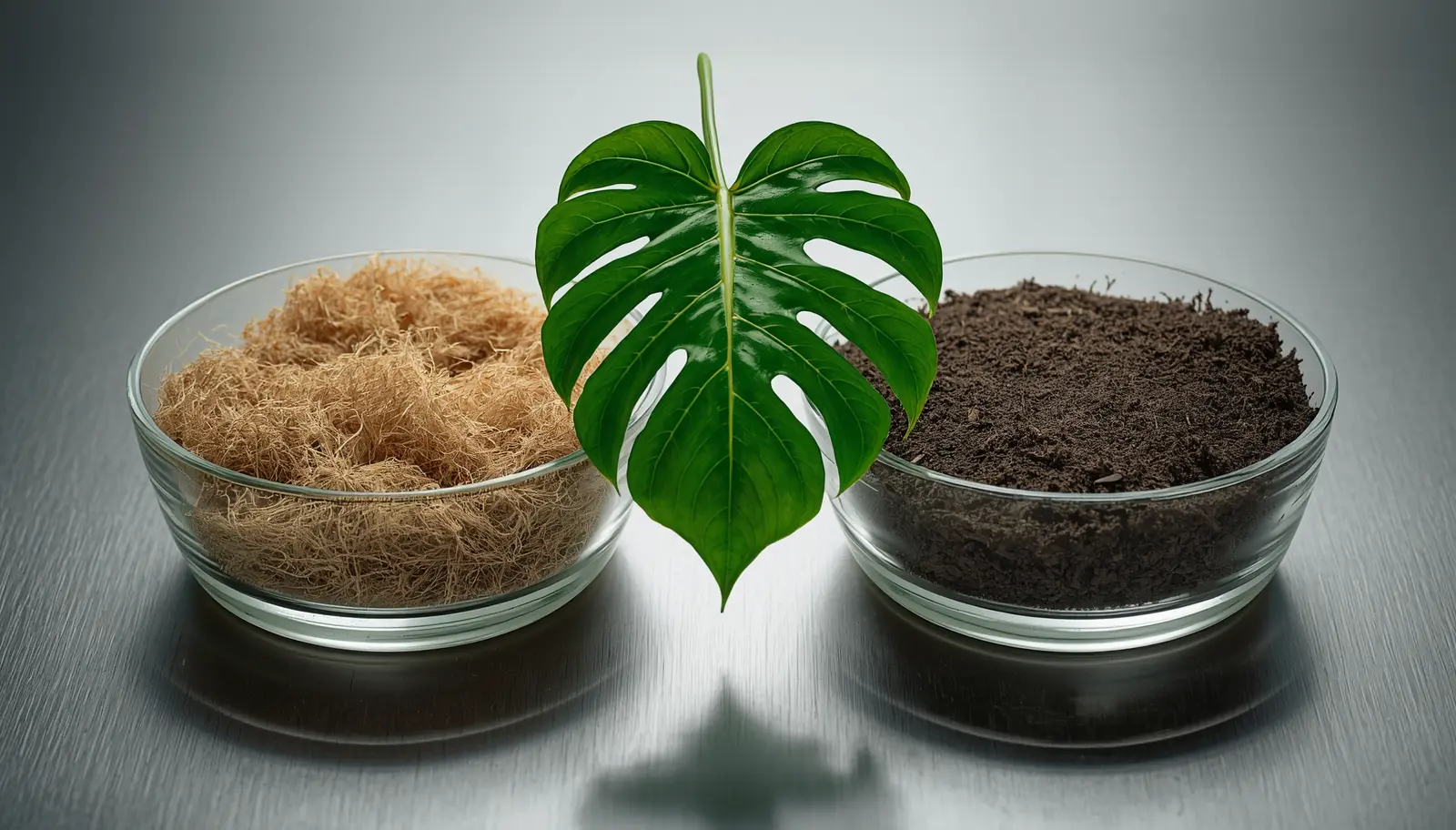
Most bagged potting mixes are built on one of two bases: sphagnum peat moss or coconut coir. Both hold water and air well, but they behave differently once they are in a pot. In the coco coir vs peat moss debate, coir wins on rewetting, pH and sustainability, while peat wins on nutrient-holding capacity and consistency, and either can grow healthy houseplants if you adjust your watering and feeding to match.
Coco Coir vs Peat Moss at a Glance
| Property | Coco coir | Sphagnum peat moss |
|---|---|---|
| pH | 5.6 to 6.9 (most commercial sources 5.8 to 6.5); lime not needed | Very acidic; lime needed for most plants |
| Rewetting | Absorbs water readily; no wetting agent needed | Hard to rewet when dry; usually needs a wetting agent |
| Structure over time | Slow to break down (high lignin); resists shrinking and compaction | Breaks down and settles over time |
| Nutrient-holding (CEC) | Lower than peat | Higher |
| Salts and nutrients | Can be high in salts in lower-grade batches; high potassium, low calcium | Low in salts and nutrients |
| Consistency | Varies by supplier | Fairly consistent |
| Sustainability | Byproduct of the coconut industry | Harvested from peat bogs that form very slowly |
Sources: Newman (2007), UC Cooperative Extension, in Greenhouse Management and Production; Holman, Bugbee and Chard (2005), Utah State University; RHS.
What Are Coir and Peat?
Coir comes from the fibrous husk of the coconut. In a 2007 Greenhouse Management and Production column, Julie Newman of University of California Cooperative Extension explains that husks are shredded and screened into long fibers and pith (cocopeat or coco dust), and that processing involves washing, composting, screening and grading. “Coco peat” or “coir pith” is the fine material; “coir fiber” and “coir chips” are coarser.
Sphagnum peat moss is partly decomposed sphagnum moss harvested from peat bogs. It has been the standard base of potting mixes for decades.
Water, Air and Rewetting
Both bases hold plenty of water, but they differ in how they behave as they dry and age:
- Rewetting. Newman notes that coir readily absorbs water and does not need a wetting agent, as sphagnum peat does. Dry peat sheds water, so a peat mix that dries out completely can be hard to rewet; see our bottom watering guide.
- Structure. Newman says coir is more than 45 percent lignin and decomposes slowly, with limited shrinkage and compaction, giving an open structure that air can penetrate. Coarser coir lasts longer than fine coir.
- Watering habits. Newman warns that growers switching from peat to coir need to adjust their irrigation, because coir wets differently. Coir can look dry on top while holding water below, so check deeper before watering.
For aroids and other plants that need air at the roots, the base matters less than what you mix into it: bark, perlite or pumice keep any mix open. Our aroid soil mix guide and vermiculite vs perlite guide cover the amendments.
pH, Salts and Nutrients
pH. Newman reports a coir pH range of 5.6 to 6.9, with most commercial sources between 5.8 and 6.5, and notes that adding lime is not necessary with coir as it is with sphagnum peat. The Utah State review by Holman, Bugbee and Chard (2005) cites work showing coir’s pH is already close to 6, so liming would push it too high. For acid-loving plants, peat’s acidity is an advantage.
Salts. The most common problem with coir, according to Newman, is high salt content in lower-grade supplies, usually because husks were washed in salt water instead of fresh water. Salty coir needs to be leached before use, and buying from a reputable supplier avoids the problem.
Potassium and calcium. The Utah State review cites reports of very high potassium and low calcium in coir products, with coir-based media needing an added calcium source. This is what “buffered” coir addresses: the coir is treated (commonly with a calcium solution) and rinsed so it doesn’t hold onto calcium and magnesium at the plant’s expense.
Nutrient-holding capacity. Newman notes coir’s cation-exchange capacity is lower than that of sphagnum peat, so growers switching to coir need to change their fertilization practices.
Plant growth. Results in research are mixed. The Utah State review summarizes studies in which coir caused no harm for some crops and reduced growth for others, sometimes linked to high proportions of coir, nitrogen tie-up or fresh, unprocessed material. In practice, good-quality, properly processed coir used as part of a mix performs well.
Sustainability
The RHS urges gardeners to avoid peat: it notes that peatlands store over twice as much carbon as all the world’s forests combined, that it takes 100 years to form just 10 cm of peat, and that extraction destroys habitats for rare species. Coir is a byproduct of the coconut industry, although Newman notes the coir fiber industry has contributed to water pollution and coir is shipped long distances. On balance, many gardeners and the RHS favor peat-free mixes, and many of those are coir- or bark-based.
Which Should You Use?
| If you grow… | Good choice |
|---|---|
| Most tropical houseplants and aroids | Buffered coir or a peat-free mix, with bark and perlite |
| Plants that need acidic soil (azaleas, blueberries, some carnivorous plants) | Peat-based or ericaceous peat-free mixes |
| Plants you sometimes let dry out | Coir, which rewets more easily |
| Seedlings and cuttings | Either; fine coir or a seed mix; see our sphagnum moss propagation guide for live moss |
Mixing the two is also common. Newman notes that blending coir with peat lets the mix take up water more readily without a wetting agent, while peat improves coir’s consistency.
Tips for Growing in Coir
- Buy washed or buffered coir from a reputable supplier. If the label says neither, rinse it thoroughly before use.
- Use a complete fertilizer with calcium and magnesium, since coir is low in calcium and holds fewer nutrients than peat. A fertilizer slightly lower in potassium suits it.
- Check moisture below the surface before watering.
- Add structure with bark or perlite for plants that need air at the roots.
- Flush occasionally to prevent salt buildup; see our white crust guide. If leaves yellow between the veins, check for nutrient problems with our pH lockout guide.
Frequently Asked Questions
Is coco coir better than peat moss for houseplants?
For most houseplants, good-quality buffered coir works as well as or better than peat: it rewets easily, needs no lime and is more sustainable. Peat holds more nutrients and suits acid-loving plants. Either works if you adjust watering and feeding.
What is the disadvantage of coco coir?
Lower-grade coir can be high in salts, and coir in general is high in potassium, low in calcium, and holds fewer nutrients than peat, according to UC Cooperative Extension’s Julie Newman and the Utah State review. Buy washed or buffered coir and use a complete fertilizer.
What does buffered coir mean?
Coir that has been treated, usually with a calcium solution, and rinsed so it holds less potassium and sodium and does not tie up calcium and magnesium. Unbuffered coir may need rinsing before use.
What are the downsides of peat moss?
It is very acidic and needs lime for most plants, it is hard to rewet once dry, and the RHS warns that harvesting it releases carbon from peatlands and destroys habitats.
Is coco peat the same as coco coir?
Coco peat (coir pith or coco dust) is the fine part of processed coconut husk. Coir fiber and coir chips are coarser forms. All come from the same husk.
Do I need to change how I water if I switch to coir?
Yes. Newman notes that growers switching from peat to coir need to modify their irrigation, because coir wets more easily. Check moisture below the surface before watering.
Sources
- Newman, J. (2007). Core facts about coir. Greenhouse Management and Production 27(2): 57 (UC Cooperative Extension)
- Holman, J., Bugbee, B. and Chard, J.K. (2005). A Comparison of Coconut Coir and Sphagnum Peat as Soil-less Media Components for Plant Growth. Utah State University
- RHS: Peat-free advice for gardeners