
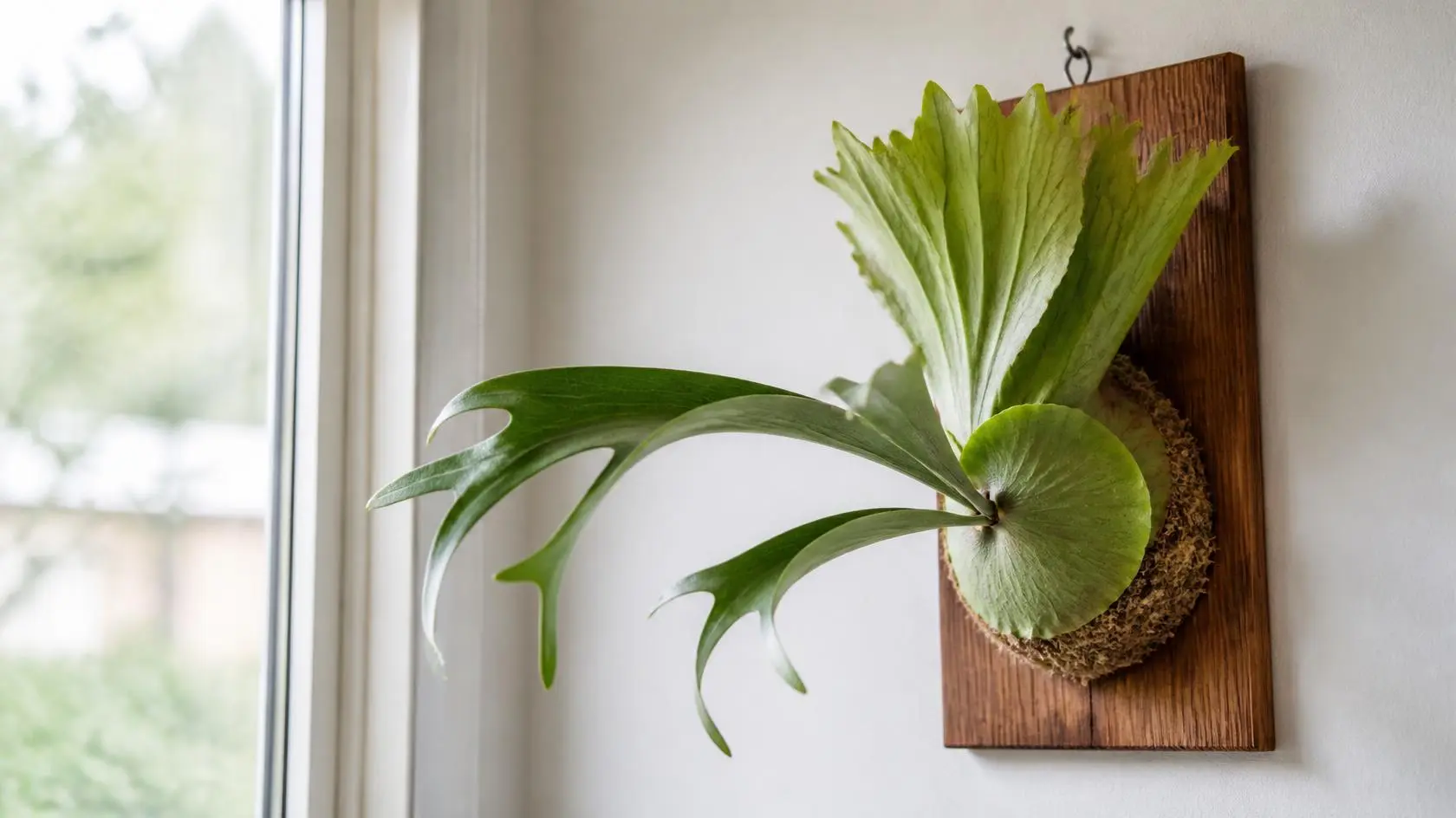
Staghorn ferns (Platycerium) grow on tree trunks and branches in the wild, not in soil, which is why they are usually sold mounted on a board or in a wire basket. Good staghorn fern care copies that life: bright indirect light, a mount or loose medium that drains instantly, a thorough watering that is allowed to dry a little before the next, and warmth. This guide follows UF/IFAS, the University of Wisconsin-Madison, the New York Botanical Garden and the ASPCA.
Staghorn Fern Care at a Glance
| Need | What the sources say |
|---|---|
| Light | Bright or strong indirect light (UW-Madison, NYBG); shade or partial shade outdoors (UF/IFAS) |
| Water | Let it dry slightly; water when fronds just start to wilt, about weekly in warm dry weather (UF/IFAS) |
| Growing medium | Mounted on wood, bark or tree fern fiber, or in a wire basket with sphagnum moss (UF/IFAS, UW-Madison) |
| Temperature | Above 55°F for most species (UF/IFAS, UW-Madison, NYBG) |
| Humidity | Moderate; mist when the air is dry (UW-Madison, NYBG) |
| Fertilizer | 1:1:1 ratio; young ferns monthly in warm months, mature ferns once or twice a year (UF/IFAS) |
| Propagation | Division of pups (UF/IFAS, UW-Madison) |
| Pets | Non-toxic to dogs, cats and horses (ASPCA) |
Sources: UF/IFAS Gardening Solutions; UW-Madison Extension (2026); NYBG; ASPCA.
What Is a Staghorn Fern?
Staghorn ferns are epiphytes: they attach to trees and collect water and nutrients from rain, air and debris. UW-Madison Extension says the genus has about 18 species, native mainly to Africa, Australia and Southeast Asia, and that the common staghorn fern, Platycerium bifurcatum, comes from the rainforests of Java, New Guinea and southeastern Australia.
Each plant makes two kinds of fronds (UW-Madison):
- Basal (shield) fronds: rounded, overlapping fronds that hug the mount and protect the roots. They turn brown and papery with age, which is normal; leave them in place until they fall off naturally.
- Fertile fronds: the brighter green, forked “antlers”. Their undersides carry brown, felt-like spore patches near the tips.
UF/IFAS names P. bifurcatum and P. veitchii as the easiest and most cold-tolerant species, with P. alcicorne and P. hillii also easy to grow.
Staghorn Fern Light Requirements
UW-Madison says staghorn ferns need bright, indirect light, and can tolerate more direct sun when humidity and temperatures are high. The New York Botanical Garden recommends strong, indirect light. Outdoors in Florida, UF/IFAS says they thrive in shade or partial shade, and warns that very low light encourages disease and pests.
- Indoors: near an east window, or a few feet back from a south or west window, out of hot direct sun.
- Too dark: slow, weak growth and more problems. Add a grow light if needed; see our grow light guide.
- Too much sun: bleached or scorched fronds.
Watering
Overwatering kills more staghorns than anything else. UF/IFAS says an overwatered fern will rot and die, and that it is best to wait until the fern wilts slightly before watering, roughly once a week in warm, dry weather and less often when it is cool or cloudy. UW-Madison advises letting the growing medium dry somewhat between waterings, notes that established plants are fairly drought tolerant, and says rainwater is best if available. NYBG says to keep the plant evenly moist but not waterlogged during the growing season and to water less in winter.
- Check the mount. Feel the moss behind the shield fronds and lift the board: a light board and dry moss mean it is time.
- Soak it. NYBG suggests soaking when the shield fronds cover the growing medium. Submerge the root ball and moss in a sink or tub until saturated.
- Drain completely before rehanging, so water doesn’t run down the wall.
- Water less in winter, when the plant absorbs water more slowly (NYBG).
Staghorn Fern Care Mounted: How to Mount One
UF/IFAS recommends mounting staghorns on wood, tree fern fiber or rock, with the basal fronds touching the medium, or in a wire basket. Its DIY mounting guide uses an old piece of untreated wood, sphagnum moss and old stockings.
- Soak sphagnum moss for a couple of hours (UF/IFAS).
- Make a mound of moist moss on the board, roughly the size of the root ball.
- Set the fern on the moss with the basal fronds against it.
- Tie it down. UF/IFAS prefers nylon stockings because they eventually rot away and won’t cut into the plant; it also lists plastic strips or wire, as long as it is not copper. UW-Madison mentions fishing line, wire and plastic mesh, and warns never to tie over the soft green fronds.
- Hang it in bright, indirect light and water by soaking.
Use untreated wood: chemically treated lumber is not a good match for a plant that absorbs water through its mount. For a basket, UF/IFAS suggests a wire hanging basket turned sideways and packed with an organic medium such as sphagnum. For working with sphagnum moss, see our sphagnum moss guide.
Can you grow one in a pot? A pot of loose, bark-based orchid or epiphyte mix that drains instantly can work for a small plant, but regular potting soil holds too much water around the roots. A mount or basket suits the plant’s habit better.
Fertilizer
UF/IFAS recommends a fertilizer with a 1:1:1 ratio, used at label rates: young ferns monthly in warm months and every other month in cooler months, mature ferns only once or twice a year. UW-Madison suggests a balanced, diluted liquid fertilizer or slow-release pellets in the growing medium. NYBG says to feed occasionally during active growth, and for bark-mounted plants to soak the bark in diluted fertilizer. Too much fertilizer burns roots and fronds, so when in doubt, use less.
Temperature and Humidity
UF/IFAS says most species can’t tolerate temperatures below 55°F, though P. bifurcatum and P. veitchii can withstand brief dips as low as 30°F. UW-Madison says staghorns do best above 55°F, can survive brief freezes down to the mid-20s°F, and should be moved indoors before night temperatures drop into the 40s°F in fall. NYBG recommends a minimum of 55°F and nights about ten degrees cooler than days.
For humidity, UW-Madison says moderate humidity is enough but that frequent misting may be needed when the air is dry, and NYBG says plants in warm rooms need daily misting and like an airy, well-ventilated room. Good air movement helps the mount dry evenly between soaks.
Staghorn Fern Care Indoors
Indoors, a staghorn fern does best on a wall or hanging near a bright window, away from hot direct sun and blasts from heaters. Because heated homes are dry in winter, mist more often but soak less, since the plant uses water more slowly in winter (NYBG). Bathrooms with a bright window are a good spot. If you move an outdoor staghorn inside for winter, bring it in before nights fall into the 40s°F (UW-Madison), and check for pests first.
Propagation (Pups)
UF/IFAS and UW-Madison both say staghorns are propagated by removing pups, the small plants that appear around the main plant or through the back and sides of a basket.
- Wait until the pup has its own small shield frond and some roots.
- Cut it away carefully with a sharp, clean knife (UW-Madison), keeping its roots and some of the medium attached.
- Mount it on a small board or in a small basket with moist sphagnum, as above.
- Keep it in bright, indirect light and water carefully while it attaches.
The brown patches on the frond tips are spore-bearing structures (UF/IFAS). Growing staghorns from spores is possible but slow and specialized; division is the practical route at home.
Brown Fronds and Other Problems
| What you see | Likely cause | What to do |
|---|---|---|
| Brown, papery shield fronds | Normal aging (UW-Madison, NYBG) | Leave them; they protect the roots |
| Brown felt-like patches on green frond tips | Spore patches (UF/IFAS) | Normal; leave them |
| Whitish-grey fuzz on green fronds | Natural hairs on the fronds | Don’t wipe them off (UW-Madison) |
| Black or soft base, fronds collapsing | Rot from overwatering (UF/IFAS, UW-Madison) | Let it dry more between soaks; improve air flow |
| Fronds limp or curling, mount light and dry | Underwatering | Soak the mount thoroughly |
| Bumps under fronds, sticky residue, cottony spots | Scale or mealybugs (UW-Madison, NYBG) | Pick off carefully; treat with care to avoid damaging the frond hairs |
| Weak growth, frequent problems | Too little light (UF/IFAS) | Move to brighter, indirect light |
Sources: UF/IFAS Gardening Solutions; UW-Madison Extension; NYBG.
Withered fertile fronds can be pruned off (UW-Madison). For more on rot, see our overwatered vs underwatered guide.
Is It Safe for Pets?
Yes. The ASPCA lists the common staghorn fern (Platycerium bifurcatum) as non-toxic to dogs, cats and horses. Mounting it on a wall also keeps it out of reach. See our cat-safe plants list for more options.
Remounting and Dividing
UF/IFAS says to remount or divide when the basal fronds have grown to the sides of the mount. You can attach the old board to a larger one rather than tearing the plant off, or divide a large plant: the UF/IFAS mounting guide describes cutting a mature fern into separate plants and trimming old roots to fit the new mount. Soak the plant first so the moss and roots are pliable, and keep each division with its own shield fronds and roots.
UW-Madison notes that P. bifurcatum has naturalized in Florida and Hawaii, and UF/IFAS advises planting staghorn fern with caution and managing its growth to prevent escape, so in warm climates don’t let pups spread into natural areas.
Frequently Asked Questions
How often should I water a staghorn fern?
When the moss feels dry and the mount is light, or as UF/IFAS puts it, when the fern just starts to wilt. That is roughly weekly in warm, dry weather and less often in cool or cloudy conditions and in winter.
What are staghorn fern light requirements indoors?
Bright, indirect light, such as near an east window or set back from a sunny one (UW-Madison, NYBG). Very low light encourages disease and pests (UF/IFAS).
Can staghorn ferns grow in soil?
Not in regular potting soil, which stays too wet. Mount them on wood or bark or grow them in a basket with sphagnum moss (UF/IFAS, UW-Madison); a very loose bark mix can work for small plants.
Why are the bottom fronds of my staghorn fern brown?
Those are the shield (basal) fronds. They naturally turn brown and papery and protect the roots, so leave them in place (UW-Madison, NYBG).
What temperature is too cold for a staghorn fern?
Most species can’t tolerate temperatures below 55°F (UF/IFAS). The common staghorn can survive brief dips toward freezing, but UW-Madison advises bringing it indoors before nights drop into the 40s°F.
Are staghorn ferns safe for cats?
Yes. The ASPCA lists the common staghorn fern as non-toxic to dogs, cats and horses.