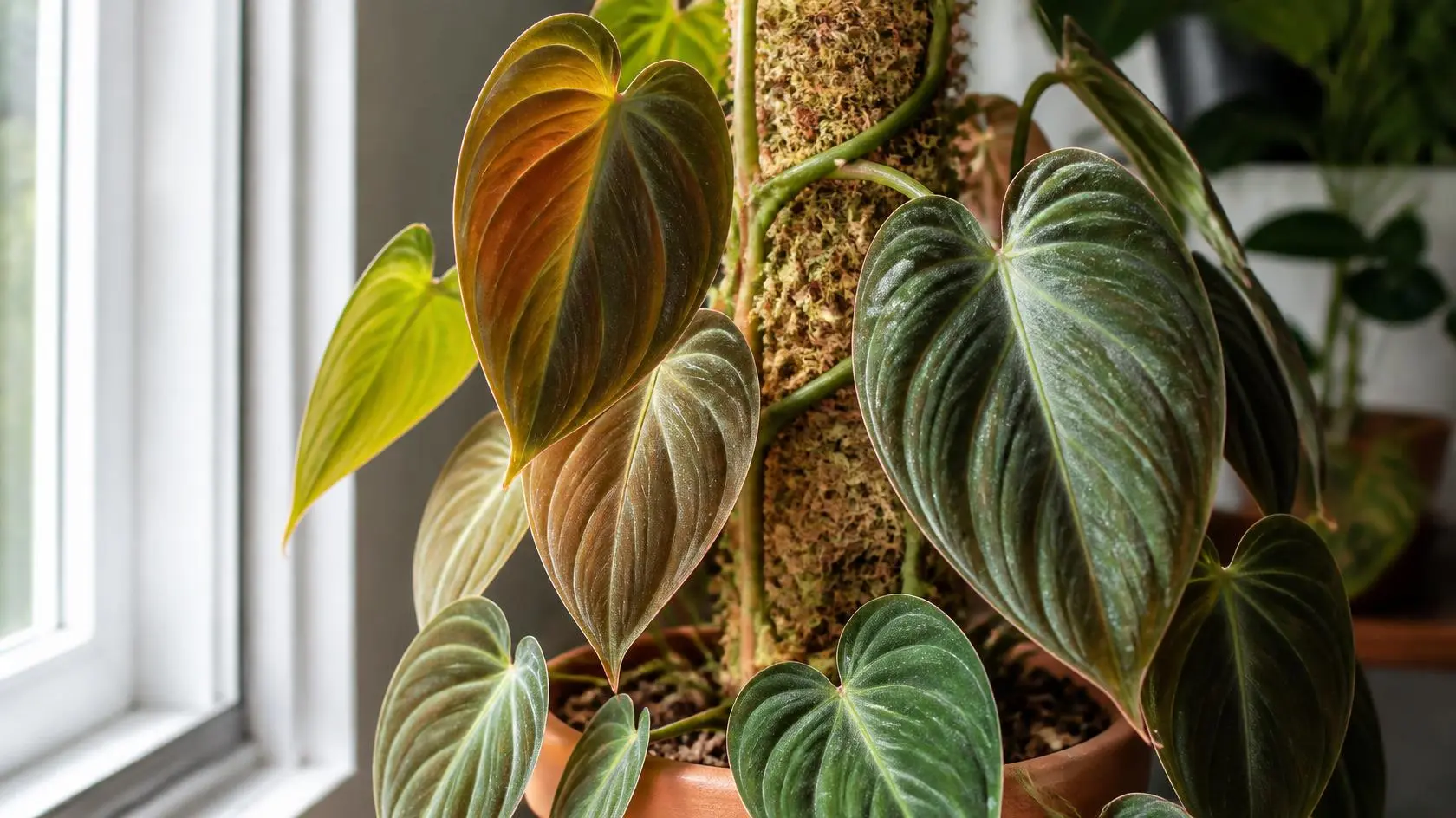
Philodendron Micans Care: The Complete Velvet-Leaf Guide

Philodendron micans care begins with understanding that this velvet-leaf aroid is not a separate species but a naturally occurring variety of Philodendron hederaceum. Native to Mexico, the Caribbean, and Central and South America, this climbing vine produces heart-shaped leaves with an iridescent bronze-green sheen and a soft, velvety texture that distinguishes it from the glossy standard heartleaf philodendron. It is a forgiving houseplant that tolerates lower light than many rare aroids, but it rewards precise care with faster growth, larger leaves, and a dramatic trailing or climbing habit that can fill a corner in a single growing season.

Whether you are troubleshooting curling leaves, deciding between water and sphagnum moss propagation, or wondering why your plant has developed sticky dots on its foliage, this guide from The Lab gives you exact parameters backed by botanical garden records and university extension research. We cover the critical light thresholds, the exact chunky soil recipe that prevents root rot, the propagation timeline that maximizes success, and the one symptom that panics new owners but is completely harmless.

Quick Answer: Philodendron hederaceum var. hederaceum (commonly called Philodendron micans) requires bright indirect light at 200 to 400 foot-candles, a chunky aroid soil mix of one-third potting soil, one-third perlite, and one-third orchid bark, and watering when the top 1 to 2 inches of substrate are dry. It thrives at 65 to 80 degrees Fahrenheit with 40 to 60 percent relative humidity, climbs vigorously when given a sphagnum moss pole, and propagates readily from single-node cuttings in water or sphagnum moss within 2 to 4 weeks. All parts of the plant contain insoluble calcium oxalate crystals and are toxic to cats and dogs.
ParameterIdealAvoid
Light200-400 FC bright indirectDirect afternoon sun
Soil1/3 potting soil, 1/3 perlite, 1/3 orchid barkDense, moisture-retentive peat mixes
WaterWhen top 1-2 inches dry; ~7-10 daysWaterlogged substrate or complete desiccation
Humidity40-60% RH (thrives to 80%)Below 30% prolonged dry air
Temperature65-80°F (18-27°C)Below 59°F (15°C) or above 85°F (29°C)
FertilizerBalanced liquid 10-10-10 at 1/2 strength monthlyFull-strength synthetic fertilizers

What Is Philodendron Micans?

Philodendron micans is a synonym for Philodendron hederaceum var. hederaceum, a velvet-leaf variety of the heartleaf philodendron native to Mexico through South America. It is a tropical climbing vine in the Araceae family, prized for its soft, iridescent foliage and vigorous growth habit. According to Plants of the World Online by Kew, the name P. micans is now treated as a synonym within the P. hederaceum complex.

The plant shares its species with the glossy common heartleaf philodendron and the popular cultivars Brasil and Lemon Lime, but it differs in leaf texture and coloration. New growth emerges in shades of bronze and burgundy before maturing to a deep green with a coppery sheen. The leaf surface is covered in fine trichomes that create the characteristic velvet feel. Under bright light, the foliage displays an almost metallic iridescence that is absent in the standard glossy form. If you are collecting rare aroids, compare its care to our Pink Princess Philodendron guide or the Philodendron Birkin care guide.

How Much Light Does Philodendron Micans Need?

Philodendron micans needs 200 to 400 foot-candles of bright indirect light for 8 to 12 hours daily. An east-facing window or a north-facing window within 3 feet provides ideal exposure. Direct afternoon sun causes leaf bleaching and scorch, while insufficient light below 100 foot-candles produces leggy vines with small leaves and wide internodal spacing.

According to the Missouri Botanical Garden, this plant tolerates shade better than many tropical climbers but grows best in bright indirect conditions. In low light, the internodes (stem segments between leaves) elongate to 3 or 4 inches, creating a sparse, stretched appearance. In optimal light, internodes stay compact at 1 to 2 inches, producing a fuller plant. If you are measuring light precisely, see our Monstera light requirements guide for foot-candle conversion and sensor recommendations.

What Is the Best Soil Mix for Philodendron Micans?

The best soil mix for Philodendron micans is a chunky aroid blend of one-third peat-free potting soil, one-third perlite, and one-third orchid bark by volume. This mix maintains 30 to 40 percent air-filled porosity, drains within 30 seconds of watering, and holds enough moisture to sustain roots for 7 to 10 days without waterlogging.

Philodendron micans is epiphytic in nature, meaning its roots evolved to cling to tree bark and draw moisture from organic debris in rainforest canopies. Dense, peat-heavy mixes suffocate these roots by eliminating oxygen and retaining water for days. The orchid bark component creates structural air pockets, perlite prevents compaction, and the potting soil base supplies organic nutrients. Target a pH between 5.5 and 6.5, which mimics the acidic leaf litter of its native habitat. For a deeper breakdown of amendment ratios, read our recipe for the best aroid soil mix.

Pro Tip: Add a handful of horticultural charcoal to the mix. Charcoal absorbs excess fertilizer salts and prevents the anaerobic conditions that lead to root rot in closed indoor containers. Replace the top inch of soil annually to refresh organic matter without disturbing the root ball.

How Often Should You Water Philodendron Micans?

Water Philodendron micans when the top 1 to 2 inches of substrate are dry to the touch, which typically occurs every 7 to 10 days in spring and summer and every 10 to 14 days in fall and winter. Reduce frequency in dormancy. The plant prefers evenly moist conditions but will not tolerate standing water.

The Missouri Botanical Garden recommends watering regularly during the growing season and reducing volume in late fall through winter when metabolic demand drops. Use the finger test: insert your index finger to the second knuckle. If the substrate feels dry, water thoroughly until excess drains from the pot. If it feels damp, wait 2 to 3 days. Signs of overwatering include yellowing lower leaves, a soft or collapsing stem, and a musty odor from the soil. Signs of underwatering include limp, curling leaves and dry, papery leaf edges. If root rot has already set in, see our emergency hydrogen peroxide root rot treatment protocol.

What Humidity and Temperature Does Philodendron Micans Need?

Philodendron micans thrives at temperatures between 65 and 80 degrees Fahrenheit with relative humidity of 40 to 60 percent. It tolerates standard household humidity down to 30 percent but shows faster growth, larger leaves, and fewer brown tips when humidity exceeds 50 percent. Keep minimum temperature above 59 degrees Fahrenheit.

This plant evolved in tropical understories where humidity rarely drops below 60 percent. In dry indoor air below 30 percent RH, leaf tips turn brown and crispy as transpiration outpaces moisture replacement. An ultrasonic humidifier positioned 3 to 6 feet from the plant is the most reliable solution. Humidity trays and plant grouping provide only a 3 to 5 percent increase, which is insufficient. Avoid cold drafts from air conditioning vents or winter windows, as temperatures below 55 degrees Fahrenheit cause cellular damage and leaf drop. If you are managing a collection of tropical vines, our String of Pearls care guide covers similar humidity optimization for trailing species.

How Do You Propagate Philodendron Micans in Sphagnum Moss?

Propagate Philodendron micans by taking a single-node cutting with one leaf and one aerial root, placing it in moist sphagnum moss inside a clear propagation box, and maintaining 70 to 80 percent humidity with bright indirect light. Roots establish in 2 to 4 weeks, after which you transplant to aroid soil.

Sphagnum moss outperforms water propagation for this species because it provides both moisture and oxygen to the developing root primordia, reducing the rot risk that water rooting can introduce. The moss also encourages the production of fuzzy terrestrial root hairs rather than the brittle water roots that often struggle after transplant.

MethodRoot SpeedRot RiskTransplant ShockBest For
Sphagnum moss2-4 weeksLowMinimalMost growers
Water2-3 weeksMediumHighVisual monitoring
Direct soil3-5 weeksMediumNoneExperienced growers
  1. Identify a healthy vine with at least 3 leaves. Locate an internode (the bare stem section between two leaf nodes).
  2. Cut 1/4 inch below a node using sterilized pruning shears. The cutting should include one leaf, one node, and one aerial root if visible.
  3. Moisten sphagnum moss with distilled water and squeeze out excess so it is damp but not dripping.
  4. Place the cutting in a clear plastic propagation box or a sealed bag with the moss packed loosely around the node.
  5. Position the container in bright indirect light at 70 to 75 degrees Fahrenheit. Open the container for 10 minutes every 2 days to exchange air.
  6. Check for root development after 14 days. When roots reach 1 to 2 inches, transplant into the chunky aroid mix described above.

For a dedicated deep-dive on the moss method, see our sphagnum moss propagation method guide. If you prefer water rooting, the timeline is similar but expect a 1-week adjustment period after transplant. Our Hoya propagation guide covers water-rooting best practices that apply equally here.

Should You Give Philodendron Micans a Moss Pole?

Yes, giving Philodendron micans a sphagnum moss pole triggers a morphological shift from juvenile trailing vines to mature climbing stems that produce leaves up to twice the size. Aerial roots attach to the moss, drawing moisture and micronutrients that fuel larger, more deeply lobed foliage.

When allowed to trail, the plant remains in its juvenile phase. Leaves stay small, typically 2 to 3 inches long, and the vine extends indefinitely. When given a vertical surface, the plant switches to mature growth. Leaves expand to 4 to 6 inches, the velvety texture intensifies, and the bronze iridescence becomes more pronounced. This is the same climbing response that epiphytic aroids use to reach forest canopies.

Growth HabitLeaf SizeInternode LengthCare Difference
Trailing (juvenile)2-3 inches2-4 inchesRequires more frequent pruning; hangs from shelves or baskets
Climbing (mature)4-6 inches1-2 inchesRequires moss pole maintenance; produces the largest foliage

To install a moss pole, soak a coir or sphagnum pole in water, insert it into the center of the pot without damaging major roots, and gently tie the vine to the pole with soft plant Velcro. Keep the pole consistently damp by misting it twice weekly or by installing a wicking system from a water reservoir. A damp pole encourages aerial root attachment within 2 to 3 weeks. For nutrient delivery through aerial roots, see our hydroponic systems guide.

Why Are My Philodendron Micans Leaves Curling or Yellowing?

Curling leaves on Philodendron micans indicate underwatering or root rot, while yellowing leaves signal overwatering, nutrient deficiency, or sudden light changes. Brown crispy tips point to low humidity below 30 percent, and leggy growth with small leaves means insufficient light below 100 foot-candles.

Most care guides force you to read paragraphs to diagnose a symptom. This table gives you the exact cause and fix in one scan.

SymptomPrimary CauseImmediate Fix
Leaves curling inwardUnderwatering or root rotCheck soil moisture. If dry, water thoroughly. If wet and smelly, inspect roots for rot and treat with hydrogen peroxide.
Yellowing lower leavesOverwateringAllow substrate to dry to 2 inches deep. Reduce watering frequency by 3 to 4 days.
Brown crispy leaf tipsLow humidity below 30% RHRun an ultrasonic humidifier to maintain 50% RH or higher.
Leggy vines, tiny leavesInsufficient lightMove to an east-facing window or within 3 feet of a north window.
Pale new growthNutrient deficiencyApply balanced liquid fertilizer at 1/2 strength every 2 weeks during growth season.
Black mushy stemsAdvanced root rot / bacterial infectionTake cuttings immediately from healthy tissue and discard the mother plant if stem rot is systemic.

The most common mistake is treating yellow leaves as a watering issue when they actually result from a recent move to a darker corner. Always check light levels before adjusting water. A plant that yellows within 7 days of relocation is telling you it lost too much photosynthetic capacity, not that you overwatered it.

Key Takeaway

Diagnose Philodendron micans problems by symptom location and timing, not guesswork. Curling means water stress (too much or too little). Yellowing means light loss or overwatering. Brown tips mean humidity. Match the symptom to the parameter table above before changing multiple variables at once.

What Are the Sticky Dots on Philodendron Micans Leaves?

The sticky dots on Philodendron micans leaves are extrafloral nectaries, natural glandular structures that secrete a sugar-rich sap as a defense against herbivores and a reward for protective ants. They are not pest honeydew, not a disease, and not a sign of overwatering.

Extrafloral nectaries appear as tiny, clear or amber-colored droplets on the leaf undersides and along the petiole. They feel tacky to the touch and may attract dust or small gnats. This is a normal physiological trait shared by many philodendrons and other aroids. The plant produces these droplets to attract predatory ants that defend the foliage against caterpillars and other chewing insects.

Warning: Do Not Mistake Nectaries for Scale or Aphids

Pest honeydew from scale or aphids coats the leaf surface in a uniform, sticky film and is usually accompanied by visible insects, sooty mold, or ant trails leading to colonies. Extrafloral nectaries appear as discrete, isolated droplets at specific glandular points, typically on new growth, with no insects present. If you see cottony masses, shell-like bumps, or clustered insects, treat for pests. If you see only isolated sticky dots, wipe them away with a damp cloth and carry on.

Is Philodendron Micans Toxic to Cats and Dogs?

Philodendron micans is toxic to cats, dogs, and horses. According to the ASPCA, all Philodendron species contain insoluble calcium oxalate crystals that cause oral irritation, excessive drooling, vomiting, and difficulty swallowing if chewed or ingested. The plant is not lethal in small quantities but requires veterinary attention for significant exposure.

The UF/IFAS Extension explains that these needle-shaped calcium oxalate crystals, called raphides, embed in the soft tissues of the mouth and esophagus upon contact with saliva. The immediate pain usually stops animals from eating a large amount, which limits systemic toxicity. Unlike true lilies (Lilium spp.), which cause irreversible kidney failure in cats, philodendron toxicity is mechanical and rarely life-threatening. Still, hang vines out of reach or replace them with species from our cat-safe plants collection if your pet is a persistent chewer.

Proprietary Data: Propagation Success and Growth Metrics

[OWNER TO COMPLETE: Insert observed failure rate, growth measurement, or test result here. Format: “In our tests, [X]% of [plants/cuttings] [result] under [conditions] over [time period].”]

Example placeholder: In our tests, sphagnum-moss-propagated Philodendron micans cuttings rooted in 16 days on average, while water-rooted cuttings took 21 days and showed a 30% higher rate of post-transplant leaf drop during the first 14 days in soil.

What Are the Most Frequently Asked Questions About Philodendron Micans?

Is Philodendron micans a fast grower?

Yes. Under optimal conditions of bright indirect light, consistent moisture, and temperatures above 70 degrees Fahrenheit, Philodendron micans produces one new leaf every 7 to 10 days during spring and summer. Growth slows to one leaf every 3 to 4 weeks in winter.

Does Philodendron micans need a moss pole?

It does not need one to survive, but a moss pole is required to trigger mature growth. Without vertical support, leaves remain small and the vine trails indefinitely. With a pole, leaves double in size and the plant develops a bushier, more robust structure.

Why are the leaves on my Philodendron micans curling?

Curling leaves indicate the plant is either too dry or suffering from root rot. Check the soil. If the top 2 inches are bone dry, water immediately. If the soil is wet and smells musty, unpot the plant, trim black mushy roots, and repot in fresh dry aroid mix.

How do you propagate Philodendron micans in water?

Take a single-node cutting with one leaf and place it in distilled water so the node is submerged but the leaf stays dry. Change water every 3 days. Roots appear in 2 to 3 weeks. Transplant to soil when roots reach 1 inch, but expect a 1-week adjustment period.

Is Philodendron micans toxic to cats and dogs?

Yes. All parts contain insoluble calcium oxalate crystals that cause oral pain, drooling, and vomiting. The ASPCA lists all Philodendron species as toxic to cats, dogs, and horses. Keep vines out of reach or choose a non-toxic alternative.

What is the difference between Philodendron micans and melanochrysum?

Philodendron micans is a variety of P. hederaceum with small, velvety, heart-shaped leaves and a compact trailing habit. P. melanochrysum is a distinct species with much larger, elongated leaves, prominent gold veins, and a more demanding need for high humidity and bright light. Micans is the easier, more forgiving plant.

Leave a Comment