
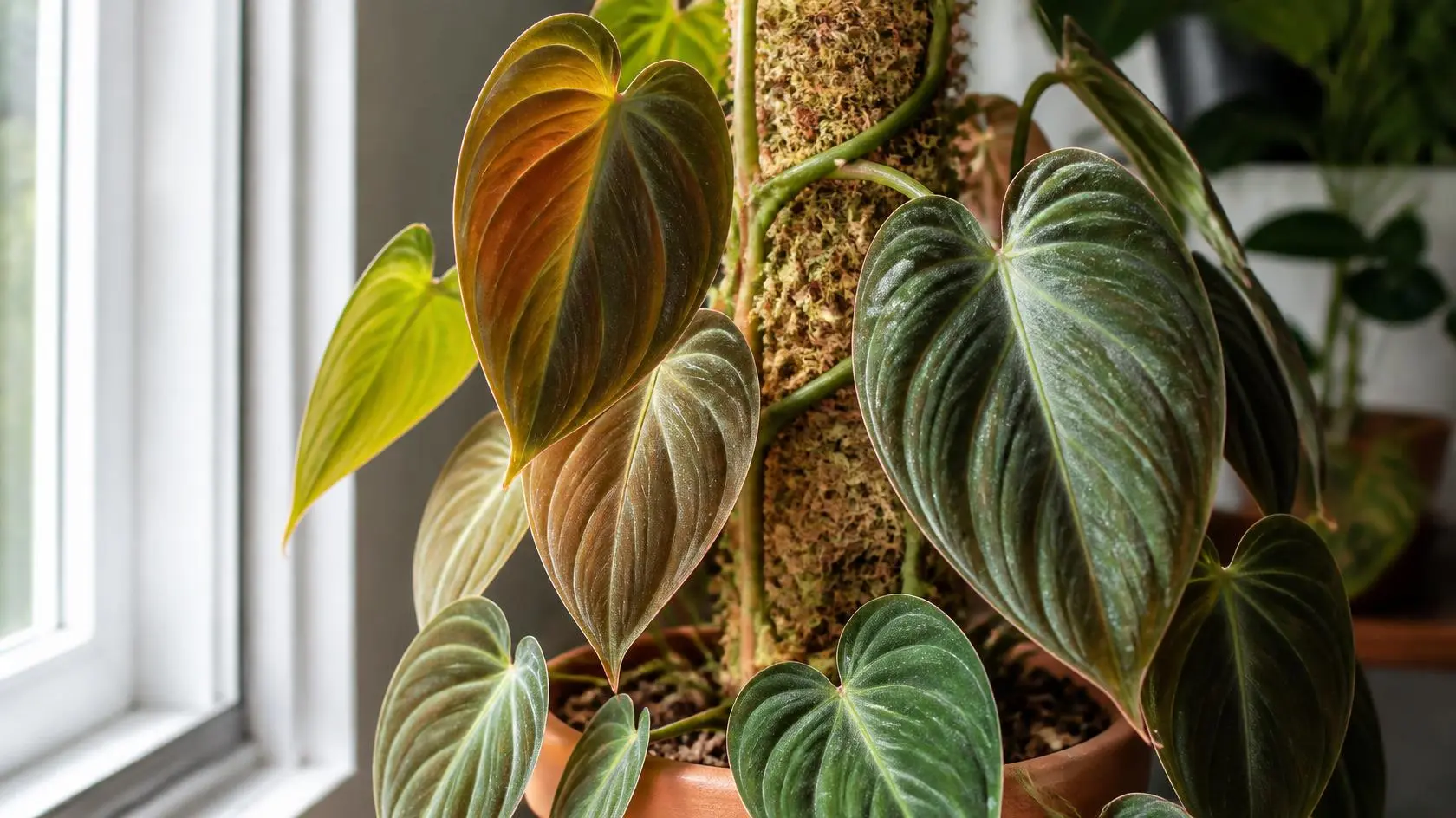
Philodendron micans is the velvet-leaved form of the heartleaf philodendron: the same easy trailing vine, but with soft, bronze-green leaves that shimmer in good light and new growth that often opens pinkish or reddish. Philodendron micans care is almost identical to heartleaf care: bright indirect light, watering when the top of the soil dries, a loose, well-drained mix and warmth. This guide covers what is specific to micans; for the full background, see our heartleaf philodendron care guide.
What Is Philodendron Micans?
NC State Extension lists Philodendron micans (and P. scandens f. micans) as former names of Philodendron hederaceum, the heartleaf philodendron, which is native from Mexico to tropical America. In other words, “micans” is not a separate species but the velvet-leaved form of the heartleaf philodendron, still sold under its old name. It is sometimes labelled Philodendron hederaceum ‘Micans’ or var. hederaceum.
What sets it apart is the leaf surface: soft and velvety rather than glossy, often bronze or purplish-green, with new leaves that may open in shades of pink or red. Growth habit and care are the same as for the glossy heartleaf.
| Need | What the sources say for heartleaf philodendron |
|---|---|
| Light | Bright, diffuse light; tolerates shade; no direct sun (UF/IFAS) |
| Water | When the top inch of soil is dry (UF/IFAS); less in winter (NC State) |
| Soil | Lightweight, well-drained (UF/IFAS); loose, slightly acidic, pH 5 to 6 (RHS) |
| Temperature | 65 to 80°F (Iowa State); below 50°F too cool (UF/IFAS) |
| Humidity | Prefers high, tolerates normal home air (UF/IFAS, Iowa State) |
| Pets | Toxic to dogs, cats and horses (ASPCA) |
Sources: UF/IFAS Gardening Solutions; Iowa State University Extension (2025); NC State Extension; RHS; ASPCA. These apply to P. hederaceum, including the micans form.
Light
UF/IFAS says the heartleaf philodendron prefers bright, diffuse light, tolerates shade, and burns in direct sun. The RHS notes that too little light makes philodendrons leggy, with fewer, smaller leaves. With micans, light also affects the look of the leaves: the velvet sheen and the bronze and pink new growth show best in bright, indirect light, while plants in dim corners make smaller, plainer leaves on long, bare stems. An east window, or a spot set back from a brighter window, works well.
Watering
UF/IFAS says to water when the top inch of soil becomes dry to the touch. Iowa State says to keep the soil evenly moist but not soggy and never to let the pot stand in water. NC State says to water less in winter and warns that overly wet soil causes root rot. Water thoroughly, let it drain, and check again with a finger before the next watering.
Soil and Feeding
UF/IFAS recommends a lightweight, well-drained potting medium. The RHS suggests a loose, free-draining, slightly acidic mix (pH 5 to 6), for example two parts orchid compost to one part peat-free ericaceous compost. A houseplant mix with some bark and perlite added works well; see our aroid soil mix guide.
For feeding, Iowa State suggests a balanced all-purpose fertilizer once or twice a month in spring and summer, and UF/IFAS warns that too much fertilizer browns and curls leaf tips. Feed lightly and stop in winter.
Humidity and Temperature
Iowa State gives typical home temperatures of 65 to 80°F, UF/IFAS says below 50°F is too cool, and the RHS suggests a minimum of 15°C (59°F), away from drafts and radiators. UF/IFAS and Iowa State both say heartleaf philodendrons prefer high humidity but handle normal household air. Micans grows fine in most homes; extra humidity mainly helps new leaves open cleanly.
Philodendron Micans Propagation
Iowa State says trailing philodendrons root easily from 3- to 6-inch stem sections with the lower leaves removed, in water or in perlite or potting soil, and that sections with aerial roots root more reliably. The RHS describes a 10 cm cutting cut just below a leaf joint and rooted in water for a couple of weeks.
- Cut a stem section with at least one node (leaf joint), ideally with an aerial root.
- Remove the leaf at the bottom node so no leaf sits underwater or in the mix.
- Root it in water, damp sphagnum moss or perlite in bright, indirect light.
- Pot it up once the roots are a few centimeters long, or plant several cuttings back into the parent pot to make it fuller.
Our sphagnum moss propagation guide covers rooting in moss, and our guide to cuttings rotting in water helps if they turn soft.
Philodendron Micans Moss Pole or Hanging Pot?
Both work. Iowa State says climbing philodendrons do well on a trellis, moss pole or in a hanging basket, and the RHS says climbing types root into a moss pole if it is kept moist. UF/IFAS notes that heartleaf philodendrons climbing tall supports can make much larger leaves than trailing plants, which usually stay at 2 to 4 inches. If you want bigger micans leaves, train the stems up a moist moss pole and fix the aerial roots against it; if you prefer a cascading look, a hanging pot is simpler.
Curling, Yellowing and Small Leaves
| Symptom | Likely cause | What to do |
|---|---|---|
| Small leaves, long bare stems | Too little light (RHS) | Move to brighter, indirect light; prune and replant cuttings |
| Yellowing leaves, wet soil | Overwatering or poor drainage, root rot (RHS, NC State) | Let the top dry; check drainage and roots |
| Curling, limp leaves, dry soil | Underwatering | Water thoroughly; check more often |
| Brown, curled tips | Too much fertilizer (UF/IFAS); dry air | Feed less; flush the soil; raise humidity |
| Bleached, scorched patches | Direct sun (UF/IFAS) | Move out of direct sun |
| Webbing, cottony spots, bumps | Spider mites, mealybugs, scale, aphids (UF/IFAS, NC State) | Isolate and treat |
Sources: RHS; UF/IFAS; NC State Extension.
For root problems, see our root rot and hydrogen peroxide guide and overwatered vs underwatered guide.
Sticky Droplets on the Leaves
Owners of micans and other philodendrons often notice small, clear or amber sticky droplets on leaf stalks, stems or new leaves. These are commonly attributed to extrafloral nectaries: glands outside the flowers that release a little sugary nectar, which in many plants attracts ants. We did not find an extension source that covers this in philodendrons specifically, so check carefully before deciding it is harmless:
- Likely nectar: separate droplets that appear in the same spots, often on new growth, with no insects around.
- Likely pests: a sticky film spreading over leaves and surfaces below, black sooty mould, tiny insects, cottony tufts or bumps on stems. Mealybugs and scale produce honeydew (UF/IFAS lists both on heartleaf philodendron).
Wipe droplets off with a damp cloth if they bother you. If you find insects, see our mealybug guide and scale guide.
Is Philodendron Micans Toxic to Cats?
Yes. The ASPCA lists Philodendron hederaceum as toxic to dogs, cats and horses because of insoluble calcium oxalates, with oral irritation, pain and swelling of the mouth, tongue and lips, drooling, vomiting and difficulty swallowing. NC State notes the sap can cause skin irritation. Keep it out of reach and call your veterinarian or the ASPCA Animal Poison Control Center at (888) 426-4435 if a pet chews it. See our cat-safe plants list for alternatives.
Frequently Asked Questions
Is philodendron micans a different species from heartleaf philodendron?
No. NC State lists P. micans as a former name of Philodendron hederaceum, the heartleaf philodendron. Micans is its velvet-leaved form, with the same care.
How often should I water a philodendron micans?
When the top inch of soil is dry (UF/IFAS), less often in winter (NC State). Never let it stand in water.
How do you do philodendron micans propagation?
Take a stem cutting with at least one node, remove the bottom leaf, and root it in water, moss or perlite (Iowa State, RHS). Roots usually form within a few weeks.
Does philodendron micans need a moss pole?
No, but it helps. Climbing heartleaf philodendrons make larger leaves on a support (UF/IFAS); in a hanging pot it trails with smaller leaves.
Why are my philodendron micans leaves small?
Usually too little light, which the RHS says makes philodendrons leggy with smaller leaves. Move it somewhere brighter, out of direct sun.
Is philodendron micans toxic to cats?
Yes. The ASPCA lists Philodendron hederaceum as toxic to dogs, cats and horses because of insoluble calcium oxalates.