
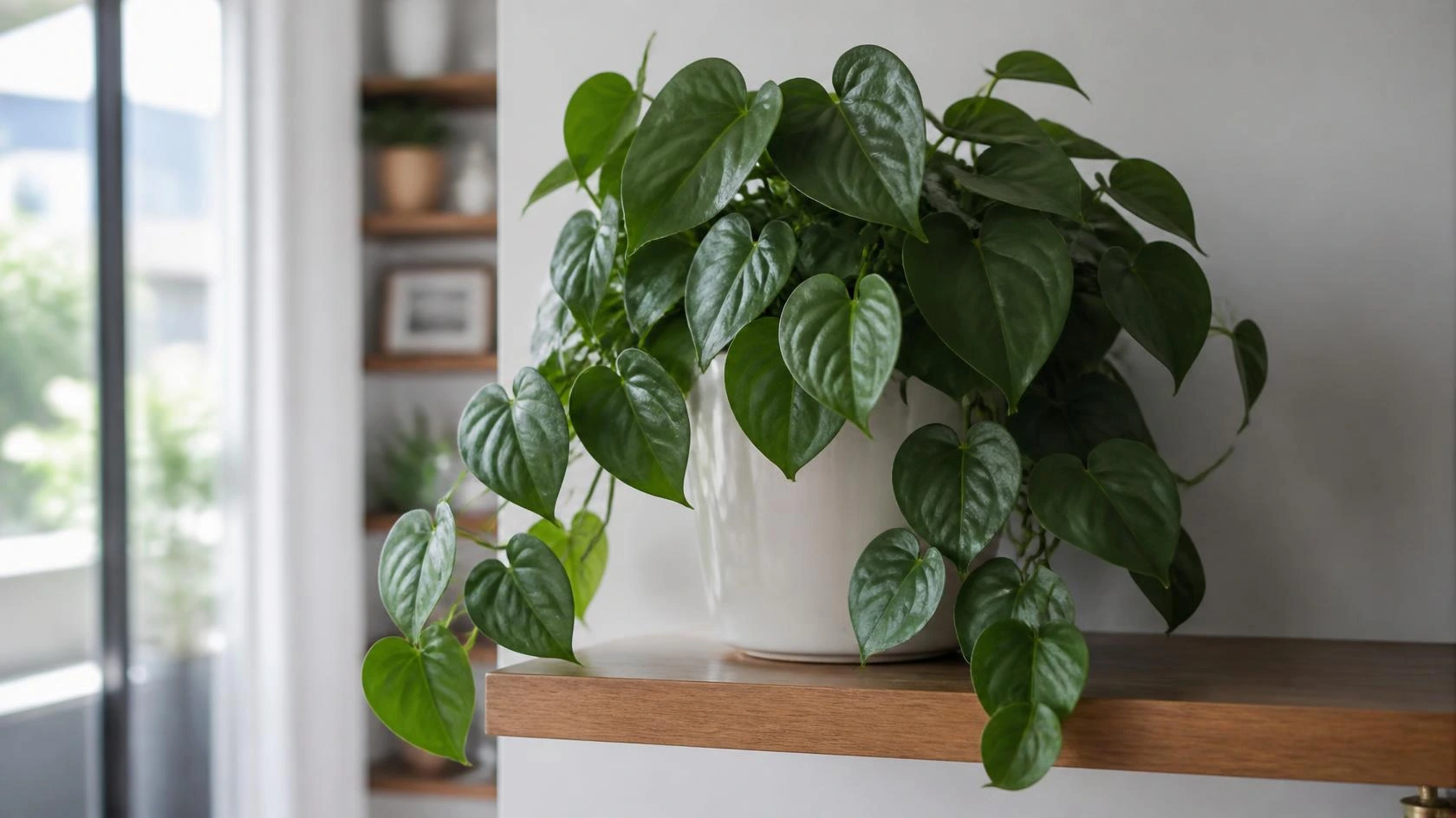
The heartleaf philodendron (Philodendron hederaceum) is one of the easiest houseplants there is: a fast trailing or climbing vine with glossy, heart-shaped leaves that tolerates low light and dry air. Heartleaf philodendron care comes down to indirect light, watering when the top of the soil dries, a well-drained mix, warmth above 50°F, and the occasional trim to keep it full. This guide follows UF/IFAS, Iowa State, NC State, the RHS and the ASPCA.
What Is a Heartleaf Philodendron?
NC State lists Philodendron hederaceum as native from Mexico to tropical America and gives several former names, including P. scandens, P. oxycardium and P. micans. It is an aroid that climbs trees with aerial roots in the wild; indoors it trails from a shelf or climbs a support. NC State describes its growth as rapid, with stems that can reach 4 feet or more, and lists cultivars including ‘Brasil’ (green with unstable yellow variegation), ‘Lemon Lime’ (chartreuse leaves), ‘Cream Splash’, ‘Rio’ and ‘Silver Stripe’.
| Need | What the sources say |
|---|---|
| Light | Bright, diffuse light; tolerates shade; no direct sun (UF/IFAS); tolerates very low light (Iowa State) |
| Water | When the top inch of soil is dry (UF/IFAS); evenly moist, not soggy (Iowa State) |
| Soil | Lightweight, well-drained potting medium (UF/IFAS); all-purpose potting soil (Iowa State) |
| Temperature | 65 to 80°F (Iowa State); below 50°F too cool (UF/IFAS) |
| Humidity | Prefers high, tolerates normal home air (UF/IFAS, Iowa State) |
| Feeding | Light, once or twice a month in spring and summer (Iowa State); every 3 to 4 months (UF/IFAS) |
| Pets | Toxic to dogs, cats and horses (ASPCA) |
Sources: UF/IFAS Gardening Solutions; Iowa State University Extension (2025); NC State Extension; ASPCA.
Light
UF/IFAS says the heartleaf philodendron prefers bright, diffuse light but tolerates shade, and that direct sun can burn the leaves. Iowa State notes that philodendrons come from tropical forest understories, that heartleaf types tolerate very low light, and that brightly colored varieties such as ‘Lemon Lime’ and ‘Brasil’ need more. The RHS adds that too little light makes philodendrons leggy, with fewer, smaller leaves.
- Best spot: near an east window, or a few feet back from a south or west window.
- Low light: it survives, but expect long gaps between leaves and smaller leaves.
- Direct sun: scorched, bleached patches (UF/IFAS, RHS).
Watering
UF/IFAS says to water when the top inch of soil becomes dry to the touch. Iowa State says to keep the soil evenly moist but not soggy, watering when the top of the soil is dry and never leaving the pot standing in water. The RHS suggests room-temperature water, ideally rainwater or filtered water. NC State says to reduce watering in winter and warns that overly wet soil causes root rot.
Check with a finger rather than watering on a schedule: plants in bright, warm rooms dry out much faster than those in dim corners. If you’re unsure whether yellow leaves mean too much or too little water, see our overwatered vs underwatered guide.
Soil and Repotting
UF/IFAS recommends a lightweight, well-drained potting medium, and Iowa State says an all-purpose potting soil works. The RHS suggests a loose, free-draining, slightly acidic mix (pH 5 to 6), for example two parts orchid compost to one part peat-free ericaceous compost. Any good houseplant mix with some added bark or perlite drains well.
Iowa State says philodendrons tolerate being slightly root-bound and should be repotted one size larger when crowded or when the soil dries out too fast. The RHS suggests repotting in spring, roughly every couple of years, into a pot only a few centimeters larger than the root ball.
Temperature and Humidity
Iowa State says typical home temperatures of 65 to 80°F suit philodendrons. UF/IFAS says temperatures below 50°F are too cool for the heartleaf philodendron, and the RHS suggests a minimum of 15°C (59°F), away from hot radiators and cold drafts. For humidity, UF/IFAS and Iowa State both say it prefers high humidity but handles normal household air, including dry winter air.
Feeding
Iowa State suggests feeding lightly once or twice a month in spring and summer with a balanced all-purpose fertilizer. UF/IFAS suggests feeding every 3 to 4 months and warns that too much fertilizer browns and curls the leaf tips. The RHS says to feed from April to September with a general houseplant fertilizer. In practice: a balanced liquid feed at label strength or weaker, during the growing season only.
Making It Bushy
Heartleaf philodendrons naturally grow long, trailing stems with bare sections, especially in lower light. To keep one full:
- Give it more light, which shortens the gaps between leaves (RHS).
- Trim long stems just above a leaf. Pruning encourages new shoots further back on the stem.
- Root the cuttings and replant them in the same pot to thicken the top (see propagation below).
- Cut back aerial roots if you like. Iowa State says they can be cut near the main stem without harming the plant, or guided into the soil.
Our pothos pruning guide uses the same technique.
Hanging Basket or Moss Pole?
Both work. Iowa State says climbing philodendrons do well on a trellis, moss pole or in a hanging basket, and that aerial roots help them climb. The RHS says climbing types need a moss pole or similar, which they root into if it is kept moist, while trailing types suit high shelves or hanging baskets. UF/IFAS notes that heartleaf leaves are usually 2 to 4 inches long indoors, but that plants climbing tall supports outdoors can make leaves 12 inches or more, so a pole tends to produce bigger leaves than a basket.
Heartleaf Philodendron Propagation in Water
This is one of the easiest plants to propagate. Iowa State says trailing types root easily from 3- to 6-inch stem sections with the lower leaves removed, in water or in perlite or potting soil, and that sections with aerial roots root more reliably. The RHS describes a 10 cm cutting taken just below a leaf joint and rooted in water for a couple of weeks.
- Cut a 3- to 6-inch stem section just below a leaf joint (node), ideally with an aerial root.
- Remove the lower leaves so no leaves sit underwater.
- Stand it in a glass of water in bright, indirect light, and change the water every few days.
- Pot it up once the roots are a few centimeters long.
If cuttings turn soft, see our guide to cuttings rotting in water; for rooting in moss, see our sphagnum moss propagation guide.
Small, Pale or Yellow Leaves
| Symptom | Likely cause | What to do |
|---|---|---|
| Small leaves, long bare stems | Too little light (RHS) | Move to brighter, indirect light; prune |
| Yellowing leaves, wet soil, collapse | Overwatering or poor drainage leading to root rot (RHS, NC State) | Let the top dry; check drainage and roots |
| Brown, curled leaf tips | Too much fertilizer (UF/IFAS) | Feed less; flush the soil |
| Bleached or scorched patches | Direct sun (UF/IFAS) | Move out of direct sun |
| Sticky leaves, webbing, cottony spots | Aphids, spider mites, mealybugs, scale (UF/IFAS, NC State) | Isolate and treat |
Sources: RHS; UF/IFAS; NC State Extension.
For more on yellowing, see our yellow leaves guide.
Is Heartleaf Philodendron Toxic to Cats?
Yes. The ASPCA lists heartleaf philodendron as toxic to dogs, cats and horses because of insoluble calcium oxalates, with oral irritation, pain and swelling of the mouth, tongue and lips, drooling, vomiting and difficulty swallowing. NC State rates its severity as low and notes the sap can cause contact dermatitis. Keep it out of reach, and call your veterinarian or the ASPCA Animal Poison Control Center at (888) 426-4435 if a pet chews it. For alternatives, see our cat-safe plants list.
Heartleaf Philodendron vs Pothos
The two are often mixed up in garden centers. Iowa State notes they are different genera, heartleaf philodendron (Philodendron hederaceum) and pothos (Epipremnum aureum), with similar growth habits and care needs, and that heartleaf tolerates very low light. The extension sources don’t give an identification key, but growers commonly use these features:
| Feature | Heartleaf philodendron | Pothos |
|---|---|---|
| Leaf | Thinner, softer, more heart-shaped, with a narrower pointed tip | Thicker, slightly waxy, more spade-shaped |
| New leaves | Often emerge from a thin sheath (cataphyll) that dries and falls | Emerge without a separate sheath |
| Petiole | Round | Grooved on top |
| Aerial roots | Several thin roots per node | Usually one thicker root per node |
Grower identification features, not from an extension source. The cataphyll and petiole are the most reliable checks.
Care is so similar that most advice works for both. For more on pothos, see our golden pothos vs marble queen guide and N-Joy vs Pearls and Jade guide.
Frequently Asked Questions
How often should I water a heartleaf philodendron?
When the top inch of soil is dry (UF/IFAS). That may be weekly in a bright, warm room and much less often in a dim one or in winter, when NC State says to water less.
Is heartleaf philodendron toxic to cats?
Yes. The ASPCA lists it as toxic to dogs, cats and horses because of insoluble calcium oxalates, which cause mouth pain, drooling, vomiting and difficulty swallowing.
How do you do heartleaf philodendron propagation in water?
Cut a 3- to 6-inch stem section below a node, remove the lower leaves and stand it in water (Iowa State). Roots usually form in a couple of weeks (RHS); pot it up once they are a few centimeters long.
What is the difference between heartleaf philodendron vs pothos?
They are different genera with similar care (Iowa State). Philodendron leaves are thinner and more heart-shaped, new leaves often emerge from a papery sheath, and the leaf stalks are round rather than grooved.
Why is my heartleaf philodendron leggy?
Usually too little light, which the RHS says makes philodendrons leggy with fewer, smaller leaves. Move it somewhere brighter, trim the long stems and replant the rooted cuttings in the same pot.
Can heartleaf philodendron grow in low light?
Yes. Iowa State says heartleaf types tolerate very low light, though growth will be slower and sparser than in bright, indirect light.