
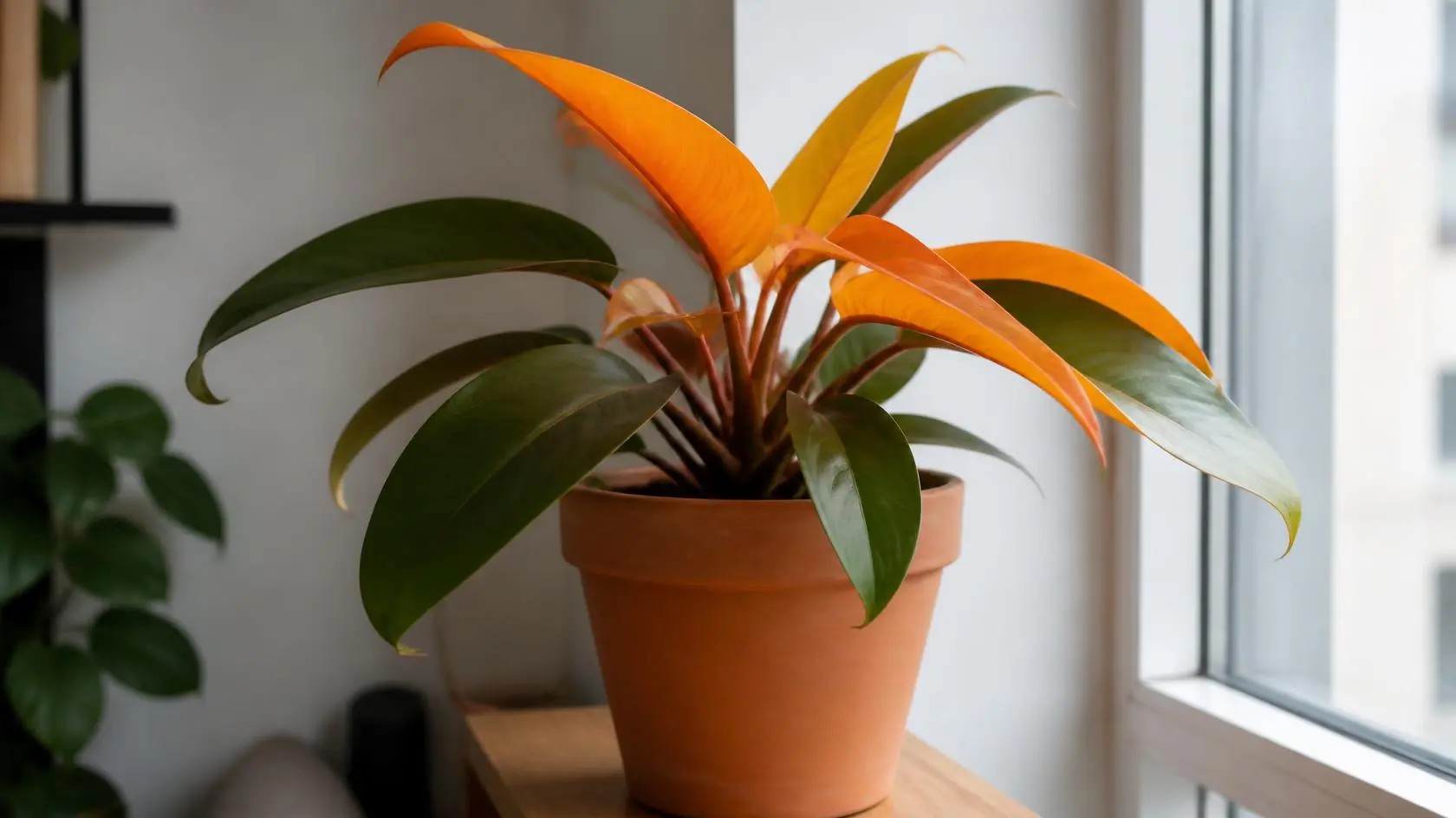
Philodendron Prince of Orange care indoors is straightforward when you know the exact thresholds. This self-heading hybrid thrives at 65 to 85 degrees Fahrenheit, 150 or more foot-candles of bright indirect light, and a well-draining peat-based potting mix. Water when the top 1 to 2 inches of soil dry out. New leaves emerge bright copper-orange and mature to deep green naturally.
It is a patented hybrid of Philodendron erubescens developed by Howard N. Miller in 1989. Unlike vining philodendrons, it grows as a compact upright rosette reaching 24 to 35 inches tall. It is often confused with climbing varieties at garden centers. This guide gives you precise numbers for light, water, soil, and fertilizer to keep the foliage vibrant. For more indoor plant care guides, explore our complete collection.
Master Philodendron Prince of Orange care indoors by maintaining 150 to 800 foot-candles of bright indirect light, temperatures between 65 and 85 degrees Fahrenheit, and a watering schedule based on soil dryness. Feed with a 3:1:2 NPK fertilizer at half strength every two weeks during spring and summer. New leaves naturally shift from orange to green as they mature. Keep away from pets; it is toxic to cats and dogs.
Table of Contents
- What Is a Philodendron Prince of Orange?
- How Much Light Does a Philodendron Prince of Orange Need Indoors?
- What Is the Best Soil Mix for a Philodendron Prince of Orange?
- How Often Should You Water a Philodendron Prince of Orange?
- What Temperature and Humidity Does a Philodendron Prince of Orange Need?
- How Do You Fertilize a Philodendron Prince of Orange for Best Growth?
- Why Are My Prince of Orange Leaves Turning Green Instead of Orange?
- Is Philodendron Prince of Orange a Climbing or Self-Heading Plant?
- How Do You Propagate a Philodendron Prince of Orange at Home?
- How Do You Prune a Philodendron Prince of Orange?
- Is Philodendron Prince of Orange Toxic to Cats and Dogs?
- How Do You Repot a Philodendron Prince of Orange?
- Frequently Asked Questions
| Parameter | Ideal | Avoid |
|---|---|---|
| Light | 150-800 fc bright indirect | Direct afternoon sun, below 75 fc |
| Temperature | 65-85 degrees F (18-29 degrees C) | Below 50 degrees F (10 degrees C), cold drafts |
| Water | When top 1-2 in dry | Soggy soil, cold water |
| Humidity | 40-60% | Below 30% for long periods |
| Soil | Peat-based, pH 6.0-7.0 | Heavy garden soil, no drainage |
| Fertilizer | 3:1:2 NPK, half strength | Full strength, winter feeding |
What Is a Philodendron Prince of Orange?
Philodendron Prince of Orange is a patented hybrid cultivar of Philodendron erubescens. It produces self-heading, non-clumping rosettes of large leaves that emerge bright copper-orange and mature to deep green. It reaches 24 to 35 inches tall indoors. U.S. Plant Patent PP6,797 was granted to Howard N. Miller in 1989 and expired in 2008.
The species belongs to the Araceae family. It was bred for its striking ontogenic color change, in which each new leaf unfurls in a vivid orange-salmon hue before transitioning through bronze and yellow tones and finally settling into a glossy deep green. According to the UF/IFAS Gardening Solutions program, this hybrid does well in low light and maintains its orange color in all levels of light, though optimal conditions produce the most intense coloration. It is not a trailing vine. It is a self-heading hybrid that grows from a central base. Many buyers mistakenly expect it to climb like a heartleaf philodendron. You can read about the differences in our guide to heartleaf philodendron care indoors.
How Much Light Does a Philodendron Prince of Orange Need Indoors?
It needs 150 to 800 foot-candles of bright, indirect light to maintain optimal leaf size and color intensity. It tolerates as low as 75 foot-candles, but growth slows and orange coloration fades. Direct afternoon sun scorches foliage. An east-facing window or 3 to 5 feet from a south window provides ideal indoor light.
According to UF/IFAS Ask IFAS, commercial philodendron production requires 150 or more foot-candles to maintain color and leaf size. The UF/IFAS Gardening Solutions program notes that Prince of Orange maintains its orange color in all light levels, but low light produces smaller leaves and less vivid new growth. Direct south-facing sun causes bleached patches and brown scorch marks. If you only have a south-facing window, place the plant 3 to 5 feet back or filter the light with a sheer curtain. North-facing windows provide gentle light that works in summer but may be too dim in winter. If your space lacks natural light, LED grow lights set 12 to 18 inches above the canopy can sustain the plant. Leaves that turn uniformly pale green often signal light levels have dropped below the 75 foot-candle minimum.
What Is the Best Soil Mix for a Philodendron Prince of Orange?
Use a well-draining peat-based potting mix with a pH between 6.0 and 7.0. A standard indoor mix amended with 20 to 30 percent perlite or orchid bark improves drainage. Heavy, water-retentive soils cause root rot. The self-heading root system needs oxygen, so avoid pure garden soil or mixes without aeration amendments.
UF/IFAS Ask IFAS pegs commercial production at pH 6.0 to 6.5, while the K-State Extension sheet just calls for “well-draining potting mix” without getting more specific. Because Prince of Orange grows as a single dense rosette rather than a spreading vine, its roots stay concentrated in one tight mass under the crown, so aeration right at that root ball matters more than it would for a trailing philodendron with roots spread along a pole. Two parts peat-based potting soil to one part perlite and one part orchid bark works well: the bark holds air pockets open even as the peat compresses over time, and the perlite adds drainage without robbing the mix of moisture. Skip plain garden soil: it packs down hard around a dense rosette root ball and starves it of oxygen faster than it would a more spread-out vining root system. Watch the pH too: push it much above 7.0 and iron becomes unavailable to the roots, which shows up first as yellowing between the veins on new leaves. Because the compact root mass fills a pot faster than a vine’s roots would, plan on refreshing the mix every two to three years at repotting time: wait longer and the peat breaks down into a compacted, airless base that undoes whatever the bark and perlite were doing for it.
How Often Should You Water a Philodendron Prince of Orange?
Water when the top 1 to 2 inches of soil feel dry to the touch. In most indoor conditions this means once every 7 to 10 days in spring and summer, and every 10 to 14 days in fall and winter. Always use room-temperature water. Cold water below 60 degrees Fahrenheit can shock tropical roots.
Skip the calendar and check the soil directly: push a finger in to the second knuckle, and if it comes out dry, water until it runs from the drainage holes; if there’s still moisture on your fingertip, wait another two or three days and test again. The K-State Extension sheet simplifies that to “water once the top inch has dried,” which lines up closely enough with the finger test to use as a quick gut-check. More Prince of Oranges are lost to overwatering than to anything else: soggy mix chokes off oxygen at the roots and opens the door to fungal rot, so don’t let the saucer sit full; tip it out within half an hour. Growth slows on its own once light and temperature drop in winter, and the plant simply isn’t pulling as much moisture from the soil during that stretch, so a longer interval between waterings then is matching the plant’s demand, not neglecting it. One more detail: if your tap water runs heavily chlorinated, let it sit out overnight before using it, or switch to filtered water: sensitive new roots on a freshly potted specimen handle it better without the chlorine. More on this in our guide to best water for calathea.
Stick to water between 65 and 75 degrees Fahrenheit. Anything colder than 60 degrees risks shocking the tropical root system and can trigger leaf drop.
What Temperature and Humidity Does a Philodendron Prince of Orange Need?
The ideal temperature range is 65 to 85 degrees Fahrenheit. Temperatures below 50 degrees Fahrenheit cause permanent tissue damage. Average household humidity between 40 and 60 percent is sufficient, though the plant prefers 50 to 70 percent. Keep it away from cold drafts, air conditioning vents, and heating registers.
UF/IFAS Ask IFAS narrows the commercial sweet spot to 70 to 80 degrees Fahrenheit, while the K-State Extension guidance is more of a hard floor: don’t let it drop under 50. In practice that floor rules out an unheated porch or a drafty windowsill through a cold winter: a single cold night can leave permanent damage on the leaves even if the plant otherwise survives. Humidity affects appearance more than survival: once relative humidity drops under 30 percent, expect tips to brown and crisp even with otherwise correct watering. Clustering a few pots together raises the local humidity around all of them, a pebble tray under the pot does something similar without wetting the roots, and a small humidifier handles it more consistently than either. Misting looks like it helps but the effect fades within minutes, so treat it as a nice-to-have, not a fix. And keep the plant off the radiator and away from forced-air vents: the dry heat pulls moisture out of the leaves faster than the roots can resupply it, and that shows up as crisping no matter how well you’re watering.
How Do You Fertilize a Philodendron Prince of Orange for Best Growth?
Feed with a 3:1:2 or 3:1:3 NPK liquid fertilizer at half strength every two weeks during spring and summer. Stop feeding in fall and winter when growth slows. Over-fertilizing causes salt buildup, leaf tip burn, and root damage. Always apply to damp soil, never to dry roots.
The 3:1:2 or 3:1:3 NPK ratio that UF/IFAS Ask IFAS uses commercially translates well enough to a home schedule: a standard liquid houseplant feed diluted to half strength gets you close. K-State’s extension sheet takes a looser approach, recommending any balanced liquid fertilizer on a 4-to-6-week cycle through the growing season, which works fine if you’d rather not chase down an exact ratio. Whatever you use, feed only into already-damp soil, never dry roots: fertilizer hitting dry soil concentrates around the roots instead of dispersing. Every couple of months, flush the pot with a deep watering that runs well past what the plant needs; this carries out mineral salts that plain feeding leaves behind, which otherwise build up at the root tips and cause burn. A white, crusty ring on the soil surface is the tell that salts have accumulated: flush right away and ease off the concentration for a while.
Why Are My Prince of Orange Leaves Turning Green Instead of Orange?
New leaves naturally emerge bright orange, transition through bronze and salmon, and mature to deep green. This is normal ontogenic color change, not a health problem. The orange color is temporary and lasts only on the newest one to three leaves at any time. Older leaves turning green is expected biology.
This is the single most common worry among new owners. When a new leaf unfurls, it displays a vivid copper-orange or salmon-pink hue. Over the next two to four weeks, that same leaf will shift through yellow-bronze tones and finally settle into a glossy deep green. The plant always has a crown of colorful new foliage above a base of green mature leaves. If the newest leaves emerge already green or pale, the plant likely needs more light or fertilizer. Move it to a brighter location and feed with a half-strength 3:1:2 NPK formula. If only the oldest bottom leaves are yellowing, that is natural senescence. Remove them to keep the plant tidy. For more help diagnosing houseplant problems, visit our troubleshooting hub.
Is Philodendron Prince of Orange a Climbing or Self-Heading Plant?
It is a self-heading, non-climbing, non-vining plant. It grows as a compact upright rosette from a central stem base. It does not produce long trailing vines and does not need a moss pole. This distinguishes it sharply from vining philodendrons like heartleaf philodendron.
According to Iowa State University Extension, Prince of Orange is classified as a compact, non-climbing variety of P. erubescens. The self-heading habit means all leaves emerge from a central base rather than along an elongating vine. It will never climb your bookshelf or drape from a hanging basket. It stays bushy and upright, making it ideal for tabletops, desks, and floor stands in small apartments.
| Feature | Self-Heading (Prince of Orange) | Climbing/Vining (Heartleaf) |
|---|---|---|
| Growth pattern | Upright rosette from central base | Trailing or climbing vine |
| Maximum height | 24-35 in tall, compact | Up to 13 ft long |
| Support needed | None | Moss pole, trellis, or basket |
| Space needs | Small footprint, tabletop | Vertical or horizontal spread |
| Leaf size | Large, up to 8 in | Small to medium, 2-4 in |
| New leaf color | Bright orange to green | Green (variegated forms excepted) |
How Do You Propagate a Philodendron Prince of Orange at Home?
Propagate from stem cuttings with at least one node and one leaf, placed in room-temperature water or moist potting mix. Root initials appear in 7 to 14 days. Transplant when roots reach 2 to 3 inches. Home propagation for personal use is legal; the U.S. Plant Patent PP6,797 expired in 2008.
Iowa State University Extension‘s guidance on philodendron propagation comes down to one non-negotiable: every cutting needs a node, the small raised bump where roots and leaves originate: cut a section without one and it simply will not root, however healthy the attached leaf looks. With clean, sharp scissors, cut at roughly 45 degrees just below a node, then strip the lowest leaf so nothing but bare stem and node sit below the waterline; a submerged leaf rots and can foul the water before roots even form. Room-temperature water in a clear jar lets you watch the roots develop, and swapping that water every three to five days keeps bacteria from building up around the cut. Bright, indirect light is enough to support the process; direct sun is not needed and can overheat a jar of water. Once the new roots reach 2 to 3 inches, the cutting is ready for a small pot of moist mix. Sphagnum moss works as an alternative rooting medium too, if you would rather skip the water stage: our guide on how to propagate in sphagnum moss covers that method in detail.
| Stage | What to Look For | Typical Timeline |
|---|---|---|
| Root initials | Small white bumps at the node | Day 7-10 |
| Side roots | One-quarter inch white root hairs | Day 10-14 |
| Primary roots | Two to three inches long, branching | Day 14-21 |
| Soil transition | Roots anchored, new leaf unfurling | Day 21-28 |
- Pick a stem section with one mature leaf and a clearly visible node.
- Make a 45-degree cut just below that node with clean, sharp scissors.
- Strip the lowest leaf so only bare stem and node will sit underwater.
- Submerge the node in a clear jar of room-temperature water.
- Keep it in bright, indirect light, never direct sun.
- Swap the water every 3 to 5 days to keep algae and bacteria down.
- Once roots reach 2 to 3 inches, pot it up in moist mix.
How Do You Prune a Philodendron Prince of Orange?
Prune to remove dead or yellowing leaves and to control height. Use clean, sharp scissors. Cut spent leaves at the base where they meet the stem. Remove lower leaves as they naturally age. Pruning is minimal because the self-heading habit keeps a naturally compact shape.
The plant does not require aggressive shaping. Its self-heading rosette form stays naturally bushy. The main pruning task is removing old leaves that have turned completely yellow or brown. Snip them at the petiole base where they attach to the main stem. Do not tear them by hand; this can damage the stem tissue and invite infection. If the plant becomes too tall for your space, you can remove the tallest leaf stalks at the base. This encourages the plant to push new growth from the center. Always sterilize your blades with rubbing alcohol or a 10 percent bleach solution between cuts. This prevents spreading bacterial or fungal pathogens from one plant to another.
Pro Tip: Rotate for Even ColorRotate the pot one-quarter turn every time you water. This ensures all sides receive equal light and prevents lopsided orange coloration on one side of the rosette.
Is Philodendron Prince of Orange Toxic to Cats and Dogs?
Yes: Philodendron Prince of Orange is toxic to cats, dogs, and horses, carrying the insoluble calcium oxalate crystals typical of the genus. Chewed leaves release needle-shaped crystals into the mouth and throat, and the reaction is fast: pain, swelling, drooling, vomiting, and trouble swallowing can all follow within minutes. Treat it as a plant to keep well out of reach of both pets and small children.
Every philodendron on the ASPCA‘s list carries the same warning, and Prince of Orange is no exception: it contains the identical insoluble calcium oxalate crystals found throughout the genus. A pet that bites into a leaf usually shows symptoms within minutes: pawing at the mouth, heavy drooling, refusing food, and in worse cases enough swelling to affect breathing. If that happens, rinse your pet’s mouth with water right away and get your vet or the ASPCA Animal Poison Control Center on the phone. Do not try to induce vomiting yourself unless a professional tells you to: with oxalate crystals, that can do more damage on the way back up. If you want pet-safe alternatives, browse our guide to cat-safe plants.
How Do You Repot a Philodendron Prince of Orange?
Repot every two to three years in spring, or when roots grow through drainage holes. Choose a pot only one size larger, 1 to 2 inches wider in diameter. Use fresh peat-based potting mix. The self-heading root system tolerates being slightly pot-bound and may bloom more readily when roots are snug, though blooming is rare indoors.
Iowa State University Extension notes that philodendrons actually do better slightly root-bound, so hold off repotting until roots are visibly filling, or circling, the container rather than working to a fixed schedule. Water the day before you repot: a moist root ball holds together far better coming out of the pot than a dry one, which tends to crumble apart. Once it is out, gently work loose any roots that have started circling the bottom, then set the plant into fresh mix at the same depth it was growing before and backfill around the sides, pressing just enough to close large air gaps without compacting the whole thing. Water it in well and return it to its usual spot. Hold off on fertilizer for four to six weeks afterward: the fresh mix already has what the plant needs, and roots that were just disturbed need that window to recover before they are ready to take up nutrients again.
Philodendron Prince of Orange is a self-heading hybrid that thrives indoors at 65 to 85 degrees Fahrenheit, 150 or more foot-candles of bright indirect light, and a 3:1:2 NPK fertilizer during active growth. Water when the top 1 to 2 inches of soil dry. New leaves naturally turn from orange to green as they mature. It is toxic to pets.
Frequently Asked Questions
How fast does a Philodendron Prince of Orange grow indoors?
In optimal conditions, it produces one to two new leaves per month during spring and summer. Growth slows in fall and winter when light and temperature drop. It is slower than vining philodendrons because it invests energy in large individual leaves rather than stem elongation.
Can Philodendron Prince of Orange grow in low light?
Yes, it tolerates low light down to approximately 75 foot-candles, but new leaves will be smaller and less vividly orange. For best color intensity and leaf size, provide 150 foot-candles or more.
Why are the leaves on my Prince of Orange turning yellow?
Yellow leaves usually indicate overwatering, but can also signal underwatering, nutrient deficiency, or natural old-age senescence. Check soil moisture first. If the soil is wet and roots smell sour, reduce watering. If dry, water thoroughly. If only the oldest bottom leaves are yellowing, remove them.
Do I need a moss pole for Philodendron Prince of Orange?
No. It is a self-heading plant that grows as an upright rosette. It does not climb and does not need a moss pole, trellis, or basket. It is ideal for tabletops and floor stands without any support structure.
Can I propagate Philodendron Prince of Orange legally?
Yes. Home propagation for personal use is legal. U.S. Plant Patent PP6,797 expired in 2008 after its 20-year term. You may take stem cuttings for your own collection. Commercial propagation and sale may still involve trademark considerations for the cultivar name.
How long do Prince of Orange cuttings take to root in water?
Root initials appear in 7 to 10 days. Roots reach transplantable length of 2 to 3 inches in 14 to 21 days. Change the water every 3 to 5 days for fastest results.