
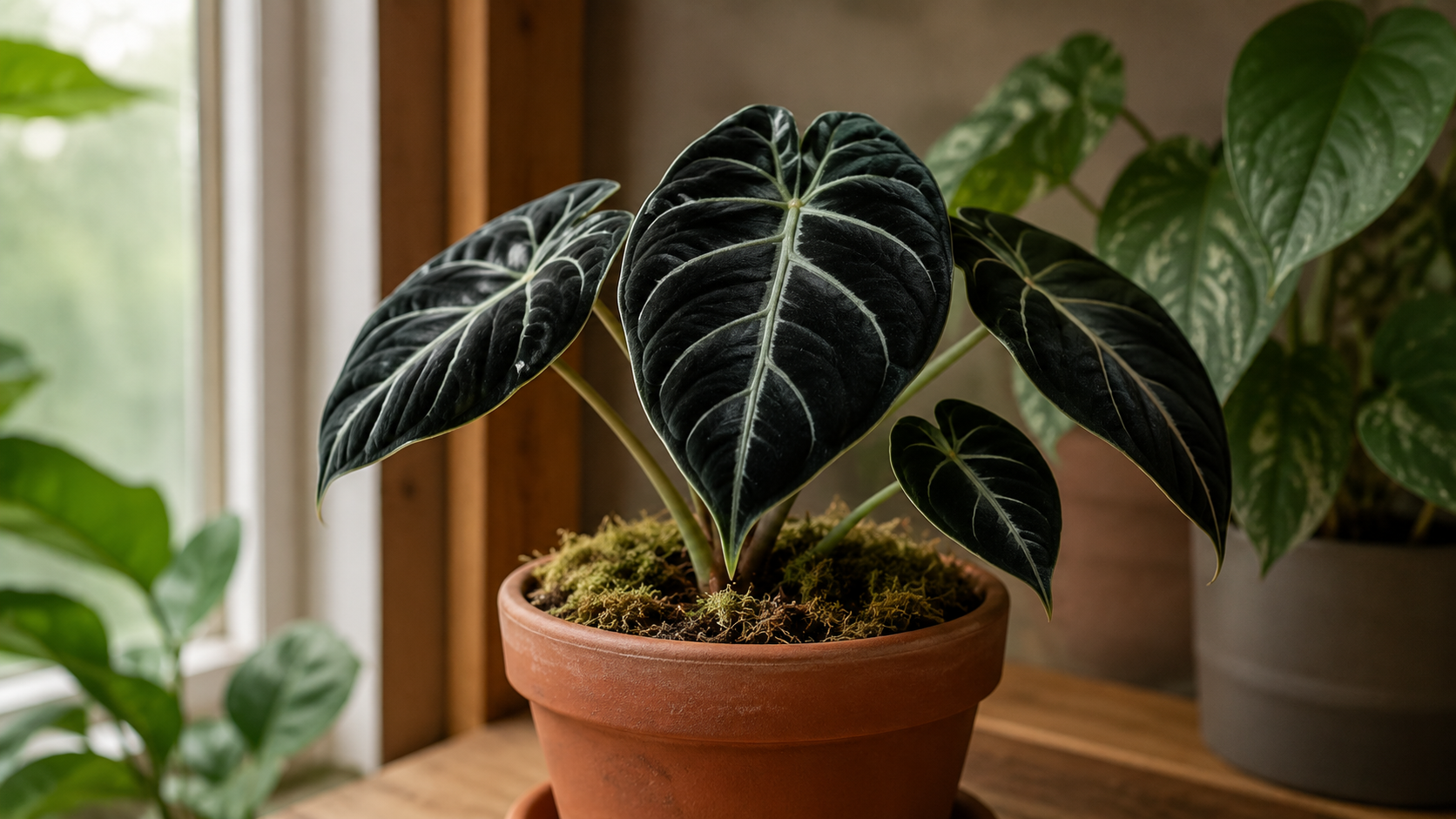
Alocasia Black Velvet (Alocasia reginula) needs bright, indirect light, a free-draining houseplant compost, high humidity and temperatures that stay above 15°C (59°F), according to the Royal Horticultural Society (RHS). Water freely from spring to autumn, cut watering to a minimum in winter, and never let the pot stand in water. It is slow-growing, compact and toxic to pets.
Black Velvet is one of the smaller “jewel” alocasias, prized for its near-black leaves and silver veins. Because it grows slowly, it uses water slowly too, so winter watering deserves extra care. This guide uses the RHS, the University of Arkansas Extension and NC State Extension, and notes where they differ.
Black Velvet Care at a Glance
| Need | What to give it | Source |
|---|---|---|
| Light | Bright, indirect light; east, west or north window, no direct sun | RHS; University of Arkansas |
| Water | Water freely spring to autumn; minimal in winter; never standing water | RHS; University of Arkansas |
| Soil | Peat-free houseplant compost with horticultural grit; moist but well-drained, acid to neutral | RHS |
| Temperature | Above 15°C (59°F) year-round | RHS |
| Humidity | High; use a tray of moist gravel | RHS |
| Feeding | Light; RHS suggests liquid feed every 2 to 3 weeks spring to autumn, Arkansas warns it is not a heavy feeder | RHS; University of Arkansas |
| Size | Usually under 1 foot tall, up to 18 inches wide; slow, 2 to 5 years to mature | University of Arkansas; RHS |
| Pets | Toxic to dogs, cats and horses | ASPCA |
What Is Alocasia Black Velvet?
Black Velvet is Alocasia reginula, a species first published by botanist A. Hay in 1998. Plants of the World Online (Kew) gives its native range as likely Borneo, growing mainly in the wet tropical biome, and the University of Arkansas Extension notes it probably comes from the jungles of Borneo.
The University of Arkansas describes the leaves as heart-shaped ovals about the size of a saucer, with a velvety black blade offset by platinum-colored veins. It grows from a branched, rhizomatous stem and usually stays under a foot tall while spreading up to 18 inches wide. NC State Extension lists it at up to 1.5 feet tall with thick-textured, dark green to black leaves. The RHS calls it slow-growing, taking 2 to 5 years to reach full size.
If you are deciding between jewel alocasias, see how it compares with the faster-growing Alocasia Polly, or read our Polly vs Bambino comparison.
How Much Light Does It Need?
The RHS recommends bright, indirect light in partial shade with an east- or west-facing aspect. The University of Arkansas Extension describes the ideal as bright conditions without direct sun, and suggests a north or east window. Keep direct sun off the leaves; a sheer curtain helps at a west-facing window.
If your windows are dim, especially in winter, a grow light can make up the difference. Our guide to the best grow lights for indoor plants explains how far to hang one and how many hours to run it.
How to Water Alocasia Black Velvet
Spring to autumn
- Water freely while the plant is growing (RHS)
- Let excess water drain away completely
- Check the soil before each watering instead of following a calendar
Winter and always
- Reduce watering to a minimum in winter (RHS)
- Never let the plant sit in standing water (University of Arkansas)
- Empty the saucer after watering
Because the plant grows slowly and its pot should be small, wet soil lingers longer than you might expect, especially in cool winter rooms. If you prefer watering from the bottom, see our guide to bottom watering, and always let the pot drain afterward.
Soil and Pot Size
The RHS recommends a peat-free houseplant compost with added horticultural grit, kept moist but well-drained, at an acid to neutral pH. NC State Extension describes the genus as preferring slightly acidic, moist, well-drained, humus-rich soil. For an aroid mix built around those goals, see our best aroid soil mix guide.
Pro tip: Keep the pot small. The University of Arkansas Extension suggests repotting about once a year but keeping the pot size as small as possible. A large pot holds more wet soil around a small root system.
Temperature and Humidity
The RHS rates Black Velvet H1A, meaning it must be grown indoors year-round and kept above 15°C (59°F). NC State Extension gives typical daytime temperatures of 68 to 77°F for the genus. Keep it away from cold windows, exterior doors and air-conditioning vents.
For humidity, the RHS recommends standing the pot on a tray of moist gravel or pebbles, with the base of the pot above the waterline. A room humidifier nearby is another option during dry winter heating.
How Much to Fertilize
The sources differ here. The RHS suggests a general liquid fertilizer every 2 to 3 weeks from spring to autumn. The University of Arkansas Extension warns that Black Velvet is not a heavy feeder and that you should avoid trying to force fast growth with extra fertilizer.
Our practical takeaway
Feed only while the plant is putting out new leaves, use a diluted liquid fertilizer, and lean toward the lighter end. Stop feeding in winter when growth slows.
Propagation
The RHS lists division in spring or summer as the home method, along with stem cuttings in spring and seed. The University of Arkansas Extension notes that tissue culture methods make commercial propagation possible. Divide only a healthy, actively growing plant, making sure each piece has its own roots.
Yellow Leaves, Pests and Other Problems
The RHS lists glasshouse red spider mite and mealybugs as the main pests. NC State Extension adds that the genus is prone to spider mites, and susceptible to aphids, mealybugs, root rot and leaf spots from overwatering.
| What you see | Likely cause | What to do |
|---|---|---|
| Yellowing leaves with wet soil, soft stems | Overwatering or root rot (NC State) | Let the soil dry more; check the roots; water minimally in winter |
| Spots on leaves after frequent watering | Leaf spot from overwatering (NC State) | Water the soil, not the leaves; improve airflow |
| Fine webbing, pale speckling | Spider mites (RHS, NC State) | Isolate, raise humidity and treat early; see our neem oil guide |
| White cottony clumps at leaf bases | Mealybugs (RHS, NC State) | Remove by hand and monitor weekly |
| Faded, stretched growth | Too little light | Move closer to a bright window or add a grow light |
For other causes of yellowing, work through our yellow leaves guide.
Is It Toxic to Pets?
Yes, keep it away from pets
The ASPCA lists Alocasia as toxic to dogs, cats and horses because of insoluble calcium oxalates, causing oral irritation, pain and swelling of the mouth, drooling, vomiting and difficulty swallowing. The RHS adds that it is a skin and eye irritant, so wear gloves when handling it. If you suspect your pet has eaten part of the plant, contact your veterinarian or the ASPCA Animal Poison Control Center at (888) 426-4435.
For pet-friendly choices, see our cat-safe plants guide.
Frequently Asked Questions
How big does Alocasia Black Velvet get?
Small. The University of Arkansas Extension says it is usually under a foot tall and up to 18 inches wide, and NC State Extension lists it at up to 1.5 feet. The RHS notes it is slow-growing, taking 2 to 5 years to reach full size.
How often should I water Alocasia Black Velvet?
Water freely from spring to autumn and reduce to a minimum in winter, according to the RHS. Check the soil before watering, let the pot drain fully, and never leave it standing in water.
What light does Alocasia Black Velvet need?
Bright, indirect light without direct sun. The RHS suggests an east- or west-facing position, and the University of Arkansas Extension suggests a north or east window.
What is the minimum temperature for Black Velvet?
Keep it above 15°C (59°F) all year, according to the RHS, which rates it as needing indoor protection year-round. NC State Extension gives 68 to 77°F as typical daytime temperatures for the genus.
Is Alocasia Black Velvet the same as Alocasia reginula?
Yes. Black Velvet is the common name for Alocasia reginula, a species first published by A. Hay in 1998, according to Plants of the World Online (Kew).
Is Alocasia Black Velvet toxic to cats?
Yes. The ASPCA lists Alocasia as toxic to dogs, cats and horses because of insoluble calcium oxalates, which cause mouth irritation, drooling, vomiting and difficulty swallowing.