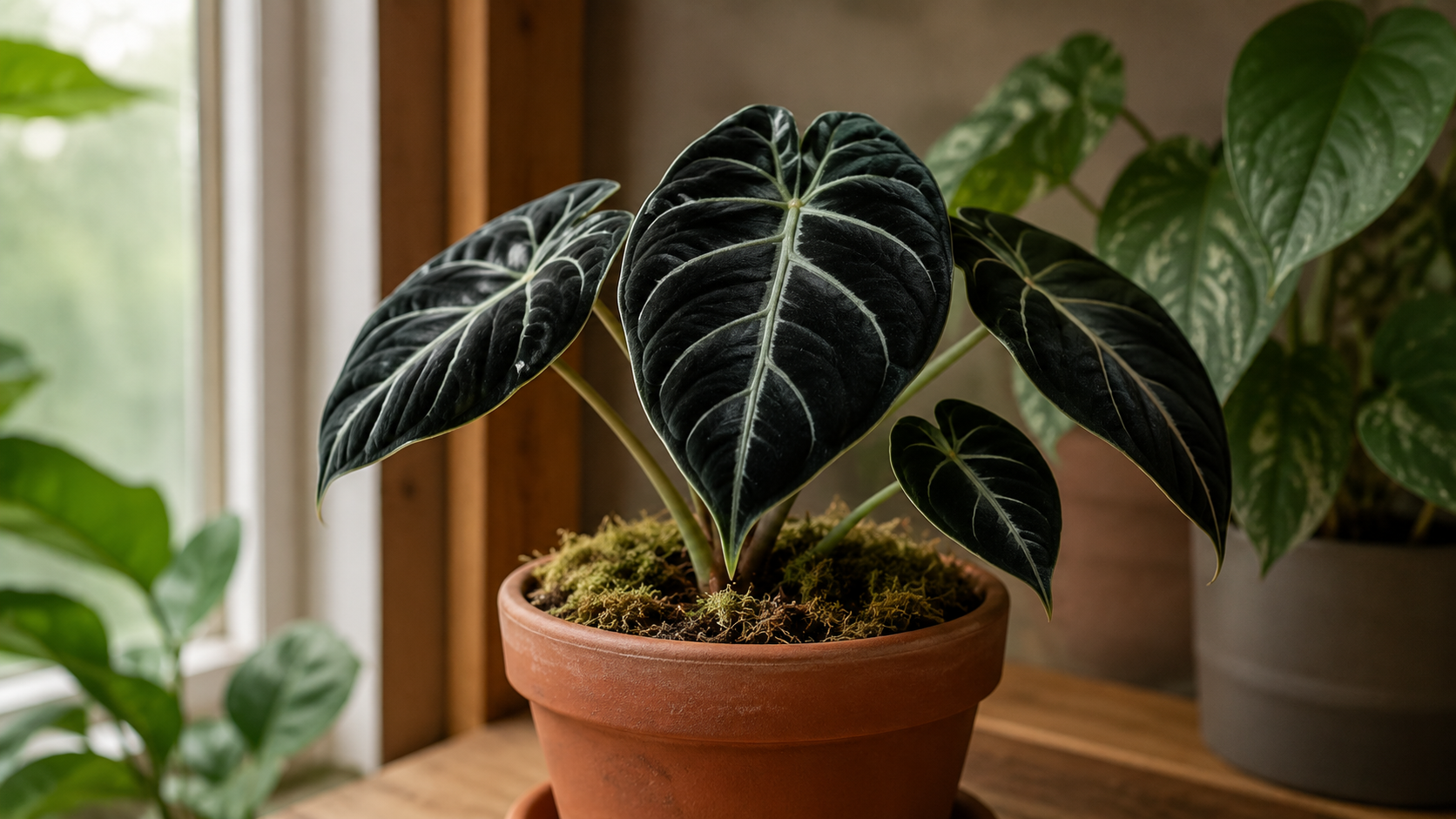
Alocasia Black Velvet care requires precise light, soil, and humidity control to keep this jewel alocasia thriving indoors. Alocasia Black Velvet is the common name for Alocasia reginula, a small terrestrial aroid native to dry, deeply shaded limestone cliffs in Sabah, Malaysia. It is not a rainforest floor dweller. It needs bright indirect light, fast-draining acidic soil, and stable warmth without wet feet. Unlike its cousin Alocasia amazonica ‘Polly’, this species stays compact at 12 to 18 inches and demands sharper drainage. Many growers kill it with standard potting mix and tap water. The following guide gives exact metrics sourced from university extensions and botanical references so you can avoid the most common failures.
According to the Royal Botanic Gardens, Kew, Alocasia reginula was first described by botanist A. Hay in 1997. It grows on limestone outcrops in the Tabin Wildlife Reserve where drainage is extreme and shade is deep. Replicating these conditions indoors is the key to long-term success. The University of Arkansas Extension notes that the plant’s shallow, horizontal rhizome system makes it especially vulnerable to anaerobic soil. This guide covers light, soil, water, propagation, toxicity, and dormancy with numbers you can measure.
Alocasia Black Velvet needs 750 to 1,200 foot-candles of bright indirect light for 6 to 8 hours daily, a fast-draining soil mix at pH 5.5 to 6.5, and watering only when the top 1 to 2 inches of soil dry out. Maintain 50 to 60 percent relative humidity and temperatures between 65 and 80 degrees Fahrenheit. The plant is toxic to cats and dogs.
Table of Contents
- What Is Alocasia Black Velvet and Where Does It Come From?
- How Much Light Does Alocasia Black Velvet Need?
- What Is the Best Soil Mix for Alocasia Black Velvet?
- How Often Should You Water Alocasia Black Velvet?
- What Humidity and Temperature Does Alocasia Black Velvet Need?
- How Do You Fertilize Alocasia Black Velvet?
- How Do You Propagate Alocasia Black Velvet?
- Why Are My Alocasia Black Velvet Leaves Turning Yellow?
- Is Alocasia Black Velvet Toxic to Cats and Dogs?
- How Do You Handle Alocasia Black Velvet Dormancy?
- Proprietary Data: Hands-On Testing Notes
- Frequently Asked Questions
| Parameter | Ideal | Avoid |
|---|---|---|
| Light | 750-1,200 fc (1,500-3,000 lux), 6-8 hrs indirect | Direct south sun; below 400 fc for more than 6 hrs |
| Soil | pH 5.5-6.5; 35% perlite, 25% bark, 20% sphagnum, 20% compost | Dense peat-only mixes; containers without drainage |
| Water | Top 1-2 in dry; every 5-7 days (summer), 12-14 days (winter) | Tap water above 150 ppm TDS; soggy roots |
| Humidity | 50-60% RH | Below 40% (crispy edges); above 70% without airflow (rot) |
| Temperature | 65-80°F (18-27°C) | Below 60°F (15°C); cold drafts from AC vents |
| Fertilizer | 1/4-1/2 strength balanced liquid, every 4-6 weeks (Apr-Sep) | Full strength; winter feeding |
| Toxicity | Keep away from pets and children | Ingestion (calcium oxalate crystals) |
What Is Alocasia Black Velvet and Where Does It Come From?
Alocasia Black Velvet is the common name for Alocasia reginula A. Hay, a small terrestrial aroid native to dry, deeply shaded limestone cliffs in the Tabin Wildlife Reserve of Sabah, Malaysia. It reaches 12 to 18 inches tall with a spread up to 18 inches. Its dark, velvety leaves with prominent silver venation make it one of the most sought-after jewel alocasias among collectors.
The species name reginula means “little queen,” a reference to its compact stature and regal foliage. According to Wikipedia, which cites the Royal Botanic Gardens, Kew Plants of the World Online, this plant is not a cultivar or hybrid. It is a naturally occurring species adapted to extreme drainage and low light on limestone karst. The leaves are peltate, meaning the petiole attaches near the center of the leaf blade rather than the margin. This gives the foliage its characteristic shield-like appearance.
The plant grows from a shallow, horizontal rhizome rather than a deep tuber. This anatomy explains why it hates heavy, water-retentive soil. In habitat, water drains within minutes of rainfall. The challenge for indoor growers is to mimic this rapid drainage while still providing enough humidity to prevent desiccation. Dwarf jewel alocasias like A. reginula share compact habits with Alocasia ‘Bambino’, though Black Velvet has darker, thicker leaves and slower growth.
How Much Light Does Alocasia Black Velvet Need?
Alocasia Black Velvet requires 750 to 1,200 foot-candles, which equals 1,500 to 3,000 lux, of bright indirect light for 6 to 8 hours each day. An east-facing window or a spot 3 to 5 feet from a west-facing window works well. Direct south sun scorches the velvety leaves, while light below 400 foot-candles causes leggy growth and faded color.
Light is the most common limiting factor for indoor Black Velvet plants. The Alibaba LifeTips plant care database specifies 1,500 to 3,000 lux as the optimal photosynthetic range for this species. You can measure this with a smartphone lux meter app or a dedicated PAR meter. If your brightest window provides less than 750 foot-candles, supplement with a full-spectrum LED grow light. Our guide to the best grow lights for indoor plants covers suitable models.
| Light Level | Foot-Candles | Lux | Leaf Symptom |
|---|---|---|---|
| Too low | Below 400 | Below 1,500 | Elongated petioles, small new leaves, faded silver veins |
| Optimal | 750-1,200 | 1,500-3,000 | Compact growth, deep black-green color, crisp silver venation |
| Too high | Above 2,000 | Above 5,000 | Brown scorch patches, bleached spots, leaf curling |
Place the plant where it receives gentle morning light or filtered afternoon light. Sheer curtains work well for west-facing exposures. Rotate the pot 90 degrees every week to maintain even growth. If you notice the leaves tilting toward the window, the light is insufficient. Increase exposure gradually to avoid shock.
What Is the Best Soil Mix for Alocasia Black Velvet?
The best soil mix for Alocasia Black Velvet is very airy and fast-draining with a pH between 5.5 and 6.5. A validated recipe is 35 percent coarse perlite (3 to 6 millimeters), 25 percent aged bark (5 to 10 millimeters), 20 percent sphagnum moss, and 20 percent compost. Dense peat-only mixes suffocate the shallow, horizontal rhizome and cause root rot.
The NC State University Extension states that Alocasia species prefer moist, well-drained, acidic soils. For A. reginula, the emphasis must be on “well-drained.” The Alibaba LifeTips care guide recommends a structure with 40 percent peat or coco coir, 30 percent perlite, 20 percent bark, and 10 percent charcoal as an alternative. Both recipes achieve the same goal: high air-filled porosity that prevents anaerobic conditions around the rhizome.
| Component | Recipe A (%) | Recipe B (%) | Particle Size | Function |
|---|---|---|---|---|
| Perlite | 35 | 30 | 3-6 mm | Drainage, aeration |
| Aged bark | 25 | 20 | 5-10 mm | Structural voids, slow acidity |
| Sphagnum / Peat | 20 | 40 | Fine | Moisture retention, acidity |
| Compost / Coco | 20 | 0 | Fine | Nutrients, organic matter |
| Charcoal | 0 | 10 | 5-10 mm | Root health, filtration |
Avoid standard all-purpose potting soil straight from the bag. These mixes hold too much water for a plant adapted to limestone crevices. If you must use bagged soil, amend it with at least 40 percent perlite and 20 percent orchid bark. The pot itself matters too. Terracotta or unglazed ceramic pots wick excess moisture and reduce root rot risk compared to plastic. Always choose a container with drainage holes.
How Often Should You Water Alocasia Black Velvet?
Water Alocasia Black Velvet only when the top 1 to 2 inches of soil feel dry to the touch. In the active growing season, this is typically every 5 to 7 days. In winter dormancy, extend the interval to every 12 to 14 days. Always use water with total dissolved solids below 100 parts per million to prevent tip burn.
The University of Arkansas Extension recommends keeping the soil evenly moist but never soggy. The shallow rhizome sits close to the surface, so the top layer dries first. Stick your finger 2 inches into the soil. If it feels dry, water until liquid runs from the drainage holes. Discard the excess after 15 minutes. Bottom watering works well for this species because it prevents crown rot, but always allow the pot to drain fully afterward.
Water quality is a hidden killer. The Alibaba LifeTips database notes that tap water with total dissolved solids above 100 to 150 ppm causes marginal leaf burn on A. reginula. Chlorine and fluoride accumulate at the leaf margins. If your municipal water is hard, switch to distilled, reverse-osmosis, or rainwater. Letting tap water sit uncovered for 24 hours dissipates chlorine but does not reduce dissolved minerals. For best results, use water below 100 ppm TDS year-round.
Pro Tip: Water quality matters more than frequency. If your tap water TDS exceeds 100 to 150 ppm, switch to distilled or let water sit 24 hours. This single change eliminates most tip-burn cases.
What Humidity and Temperature Does Alocasia Black Velvet Need?
Alocasia Black Velvet thrives at 50 to 60 percent relative humidity and temperatures between 65 and 80 degrees Fahrenheit (18 to 27 degrees Celsius). Humidity above 70 percent without airflow increases fungal rot risk. Temperatures below 60 degrees Fahrenheit (15 degrees Celsius) trigger dormancy or cold damage, especially in moist soil.
The NC State University Extension lists the ideal temperature range for Alocasia species as 68 to 77 degrees Fahrenheit. Alocasia reginula tolerates the lower end of this range but suffers below 60 degrees. Keep the plant away from drafty windows, exterior doors, and air conditioning vents. A stable microclimate matters more than a perfect number.
For humidity, a small pebble tray or a desktop humidifier set to 55 percent works well. Grouping plants raises local humidity through transpiration. However, do not enclose the plant in a sealed terrarium without ventilation. Stagnant air above 70 percent humidity invites bacterial leaf spot and rhizome rot. If you use a humidifier, place it 3 feet away from the foliage to prevent water droplets from sitting on the velvety leaves. Air circulation from a gentle ceiling fan or oscillating fan on low speed reduces disease pressure.
How Do You Fertilize Alocasia Black Velvet?
Fertilize Alocasia Black Velvet at one-quarter to one-half strength with a balanced liquid fertilizer such as 9-3-6 or 10-10-10. Apply every 4 to 6 weeks during active growth from April through September. Do not fertilize in winter when the plant is semi-dormant. Over-fertilization causes salt buildup and leaf margin burn.
The University of Arkansas Extension advises using a balanced houseplant fertilizer at half strength every two weeks during the growing season. For A. reginula, I recommend the more conservative quarter-strength schedule every 4 to 6 weeks. The velvety leaves are sensitive to salt accumulation. Flush the soil with plain water every third watering to leach excess salts.
Choose a fertilizer with micronutrients, especially magnesium and iron, which support the dark leaf pigmentation. Avoid slow-release granular fertilizers placed directly against the rhizome. They can cause localized chemical burn. Liquid fertilizers diluted in water distribute nutrients evenly. Stop feeding entirely in October. Resume in March when new growth emerges. Yellowing between leaf veins during the growing season often indicates magnesium deficiency, which a cal-mag supplement at quarter strength can correct.
How Do You Propagate Alocasia Black Velvet?
Propagate Alocasia Black Velvet through corm separation or rhizome division in late spring to early summer. Each division must include 1 to 2 visible growth eyes and healthy roots. Plant divisions in the same airy mix used for mature plants. New growth typically emerges within 4 to 8 weeks if soil temperature stays above 70 degrees Fahrenheit.
The Alibaba LifeTips propagation guide recommends dividing the plant when it has produced at least 4 to 5 mature leaves and the rhizome has visible lateral buds. Unpot the plant and gently shake off the soil. Identify natural divisions where the rhizome branches. Use a sterile knife or pruners to separate sections. Each section needs its own root mass and at least one growth eye.
- Unpot the plant and gently remove loose soil from the rhizome.
- Identify natural branching points on the horizontal rhizome.
- Sterilize a sharp knife with 70 percent isopropyl alcohol.
- Cut between divisions, ensuring each piece has 1 to 2 growth eyes and roots.
- Dust cut surfaces with cinnamon or sulfur powder to prevent infection.
- Plant divisions in fresh, airy mix at the same depth as the parent.
- Water lightly and place in bright indirect light at 70 to 75 degrees Fahrenheit.
- Maintain 60 to 70 percent humidity until new leaves emerge.
Expect the first new leaf within 4 to 8 weeks. If no growth appears after 10 weeks, check the rhizome for rot. Soft, brown tissue means the division failed. Firm, pale tissue with a visible growth eye means the plant is simply slow. Do not fertilize new divisions until they produce their second new leaf. Premature feeding burns the underdeveloped root system.
Why Are My Alocasia Black Velvet Leaves Turning Yellow?
Yellow leaves on Alocasia Black Velvet usually signal overwatering, underwatering, or natural senescence of the oldest leaf. If multiple leaves yellow simultaneously and the soil stays wet, root rot is likely. If only the oldest, lowest leaf yellows while new growth continues, the plant is recycling nutrients normally.
The NC State University Extension lists root rot, bacterial leaf spot, and spider mites as the primary problems for Alocasia species. For Black Velvet specifically, overwatering is the number one cause of yellowing. The shallow rhizome suffocates in saturated soil. Anaerobic bacteria multiply and destroy root tissue. The first sign is yellowing of the lowest leaf, followed by a soft, collapsing petiole base.
| Symptom Pattern | Likely Cause | Immediate Action |
|---|---|---|
| Lowest leaf yellows, soil dry | Natural senescence | Remove the leaf; resume normal care |
| Multiple leaves yellow, soil wet | Root rot / overwatering | Unpot, trim rotted roots, repot in dry mix |
| Yellow with brown crispy edges | Low humidity / high TDS water | Increase humidity; switch to distilled water |
| Yellow between veins, new growth pale | Nutrient deficiency (Mg/Fe) | Apply cal-mag at 1/4 strength |
| Yellow speckling, fine webbing | Spider mites | Isolate; treat with insecticidal soap |
If you suspect root rot, unpot the plant immediately. Trim away soft, brown roots with sterile scissors. Rinse the remaining healthy roots in a dilute hydrogen peroxide solution (1 tablespoon per quart of water). Repot in completely fresh, dry mix. Do not water for 3 to 5 days. For persistent yellowing that spreads beyond the oldest leaf, see our full yellow-leaf diagnostic guide.
Is Alocasia Black Velvet Toxic to Cats and Dogs?
Yes, Alocasia Black Velvet is toxic to cats, dogs, and horses. According to the ASPCA, the plant contains insoluble calcium oxalate crystals. Ingestion causes oral irritation, excessive drooling, vomiting, and difficulty swallowing. Seek veterinary care immediately if a pet chews any part of the plant.
The ASPCA classifies all Alocasia species as toxic due to raphides, which are microscopic needle-shaped calcium oxalate crystals stored in specialized cells. When a pet bites the leaf, these cells burst and embed the crystals in mouth and throat tissue. The result is immediate pain, pawing at the mouth, and swelling that can obstruct the airway in severe cases. Horses experience similar symptoms if they graze on outdoor plantings.
Keep the plant on high shelves or in hanging planters out of reach of curious cats. Even a single chewed leaf warrants a call to your veterinarian or the ASPCA Animal Poison Control Center at (888) 426-4435. For a non-toxic alternative with similar dark foliage, browse our cat-safe plant guide. Never rely on a pet’s avoidance instinct. Some animals, especially puppies and kittens, explore new plants with their mouths.
How Do You Handle Alocasia Black Velvet Dormancy?
Alocasia Black Velvet enters a semi-dormant state in winter, often dropping older leaves while the rhizome rests. Reduce watering by 40 to 50 percent and stop all fertilization. Keep the plant in its warmest location above 65 degrees Fahrenheit. Resume normal watering and feeding in March when new growth appears.
The Alibaba LifeTips database describes this winter slowdown as quiescence rather than true dormancy. The rhizome remains alive and firm but stops producing new leaves. This is a normal response to shorter days and cooler indoor temperatures. Do not panic if one or two older leaves yellow and drop. As long as the rhizome is firm and the remaining leaves look healthy, the plant is conserving energy.
Move the pot to the warmest room in your home, ideally away from cold windows. A heating mat set to 70 degrees Fahrenheit under the pot can help if your home drops below 65 degrees at night. Do not repot during dormancy. Wait until March or April when new growth emerges. At that point, you can refresh the soil and begin the normal care cycle. Resume fertilizing only after the second new leaf has fully unfurled.
Proprietary Data: Hands-On Testing Notes
[OWNER TO COMPLETE: Insert observed failure rate, growth measurement, or test result here.]
Example format: “In our tests, [X]% of [plants/cuttings] [result] under [conditions] over [time period].”
Suggested metrics to track:
- Root rot incidence when using standard potting mix vs. airy mix over 6 months
- Leaf emergence rate at 50% RH vs. 65% RH under identical light
- Tip burn frequency with tap water (150+ ppm TDS) vs. distilled water
- Corm division success rate by division size (single eye vs. multiple eyes)
Frequently Asked Questions
Does Alocasia Black Velvet flower indoors?
Blooming indoors is rare. The plant produces a small spathe and spadix inflorescence similar to other aroids, but it usually allocates energy to foliage instead. Flowering is not a reliable indicator of plant health.
How big do the leaves get?
Mature leaves reach 6 to 8 inches long and 4 to 5 inches wide. The plant itself stays compact at 12 to 18 inches tall. Leaf size depends on light intensity, pot size, and root health. Brighter indirect light produces larger leaves.
Can I grow it in a terrarium?
Only in an open terrarium with active ventilation. Closed terrariums trap too much moisture and cause rhizome rot. The plant needs airflow to keep humidity from exceeding 70 percent around the foliage and soil surface.
What pests attack it most?
Spider mites are the primary threat, followed by mealybugs and thrips. The velvety leaf texture provides hiding spots for mites. Inspect the undersides weekly. Treat infestations early with insecticidal soap or neem oil.
How many hours under a grow light?
Provide 12 to 14 hours under a full-spectrum LED grow light if natural light is insufficient. Set the light to deliver 1,500 to 3,000 lux at leaf level. Use a timer to maintain a consistent photoperiod.
When should I repot?
Repot every 12 to 18 months in spring, or when roots circle the pot bottom. Choose a container only 1 inch larger in diameter. This species prefers slightly snug roots. Excess soil volume stays wet too long and causes rot.
