
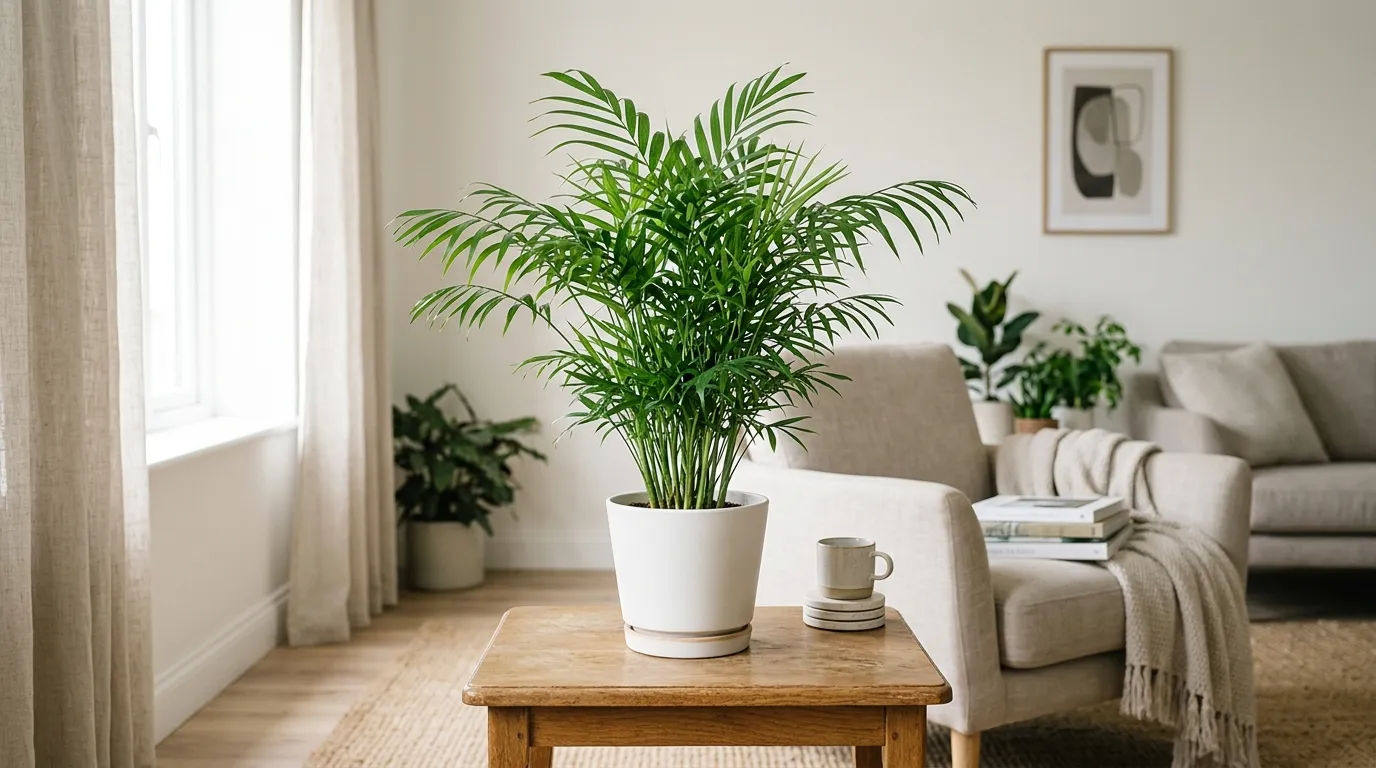
The parlor palm (Chamaedorea elegans) is one of the best palms for indoors: small, slow-growing, tolerant of lower light, and safe for pets. It usually comes as several seedlings in one pot, which gives it a bushy look. Parlor palm care indoors comes down to bright, indirect light, watering when the surface of the mix dries, protection from cold drafts, and humid enough air to keep the frond tips green. This guide follows the RHS, Clemson HGIC, Penn State, NC State and the ASPCA.
Parlor Palm Care at a Glance
| Need | What the sources say |
|---|---|
| Light | Bright, indirect; avoid direct summer sun (RHS); tolerates low light (NC State, Clemson) |
| Water | When the surface of the compost is dry; less in winter; never standing in water (RHS) |
| Temperature | 10 to 27°C (50 to 80°F) (RHS); winter minimum 60°F (Clemson); avoid cold drafts (NC State) |
| Humidity | Not essential but helps prevent brown tips (RHS); low to medium (NC State); high to moderate (Clemson) |
| Soil | Light, fast-draining, peat-free ericaceous mix (RHS); humus-rich, well-drained (NC State) |
| Feeding | Balanced liquid feed monthly, spring to autumn (RHS) |
| Size | Usually 30 to 60 cm, slowly to about 120 cm (RHS); 2 to 3 ft indoors (Penn State) |
| Pets | Non-toxic to dogs and cats (ASPCA) |
Sources: RHS chamaedorea growing guide; Clemson HGIC Indoor Palms; Penn State Extension (2023); NC State Extension; ASPCA.
NC State says the parlor palm is native to southern Mexico and northern Central America and grows slowly. Penn State notes it is often sold as several plants in one container for fullness and stays compact indoors at about 2 to 3 feet.
Light (and Parlor Palm Care in Low Light)
The RHS says bright, indirect light is best and direct sun, especially in summer, scorches the leaves. NC State suggests a north- or east-facing window and says the plant tolerates low-light conditions, and Clemson HGIC agrees that it tolerates lower light well. That makes it one of the better palms for a room away from the window, but expect slower, sparser growth there; the RHS lists low light among the causes of poor growth.
Watering
The RHS says to water when the surface of the compost is dry, preferably with room-temperature rainwater, never to leave the plant sitting in water, and to water less in winter after checking with a finger. NC State says to water when the soil has dried slightly, warns that overwatering can be a problem, and notes that the palm handles short dry spells but grows more lushly in moist soil. Penn State says to keep palms moist but not wet, never waterlogged, and to empty the saucer after watering.
The RHS also advises against regular hard tap water. If yours is hard, rainwater is the better choice.
Temperature and Humidity
| Source | Temperature advice |
|---|---|
| RHS | 10 to 27°C (50 to 80°F); best growth at 20 to 27°C from March to October; tolerates cooler winters |
| Clemson HGIC | Minimum winter temperature of 60°F |
| Penn State | Reddish-brown dead areas suggest cold damage, around 45°F or below |
| NC State | Protect from cold drafts near windows, doors and vents |
Sources: RHS; Clemson HGIC; Penn State Extension; NC State Extension.
For humidity, the RHS says high humidity isn’t essential but regular misting helps prevent brown leaf tips. Clemson suggests a gravel tray, a humidifier or weekly misting if humidity is below 50 percent, and Penn State suggests a humidifier in the room, noting that frond tips brown in low humidity, particularly in dry winter air. See our guide to dry indoor air.
Soil, Pots and Repotting
The RHS recommends a light, fast-draining, peat-free ericaceous (acidic) mix, for example three parts ericaceous compost to one part perlite or grit. NC State suggests a humus-rich, well-drained houseplant mix, and Clemson a porous mix with plenty of organic matter, warning that root rot usually comes from poor drainage or watering too often.
Penn State says palms like to be slightly root-bound and advises not to change the container unless necessary, repotting every 2 to 3 years mainly to refresh the mix. Clemson adds that palm roots are fragile, so handle them carefully. The RHS suggests repotting in spring when roots are crowded, into a pot only about 2 cm (1 in) wider, and warns that overpotting can cause root rot.
Feeding
The RHS suggests a balanced liquid feed monthly from spring to autumn. Clemson suggests a slow-release palm fertilizer with micronutrients two to three times a year in spring and summer, and warns that too much can brown the tips of lower leaves. Penn State also says to feed only two or three times a season. Don’t feed in winter.
Parlor Palm Brown Tips
| Cause | Source | Fix |
|---|---|---|
| Dry air | Penn State, RHS, Clemson | Humidifier, pebble tray, misting, grouping plants |
| Over- or underwatering | RHS | Water when the surface is dry; never leave it in water |
| Hard water | RHS | Use rainwater |
| Too much fertilizer (lower leaves) | Clemson | Feed less; flush the pot with plain water |
| Direct sun | RHS | Move out of direct sun |
| Cold (reddish-brown dead areas) | Penn State | Keep away from cold glass and drafts |
Sources: Penn State Extension; RHS; Clemson HGIC.
Penn State says browning frond tips usually point to low humidity, browning across the whole plant to too little humidity and water, and browning on the lowest leaves is typically normal aging. Brown tips won’t turn green; trim them with clean scissors, following the leaf’s shape, and fix the cause.
Yellow Leaves and Other Problems
- Yellowing lower fronds: some yellowing of the oldest fronds is normal aging (Penn State). Widespread yellowing with wet soil points to overwatering or poor drainage (NC State, Clemson). See our overwatered vs underwatered guide.
- Speckled leaves and webbing: spider mites, which Clemson says are common indoors in low humidity and warm conditions, and which the RHS and NC State also list. Wipe or rinse the fronds and raise the humidity; see our spider mite guide.
- Cottony spots, bumps: mealybugs and scale (NC State, RHS). See our mealybug guide.
- Slow, poor growth: low light, overwatering or crowded roots (RHS).
Penn State also advises against leaf-shine products, which can damage fronds; dust them with a damp cloth instead.
Pruning and Propagation
The RHS says no pruning is needed beyond removing old, dying fronds at the base. Clemson notes that palms can’t be cut back to reduce their height, because new growth comes from a single central point, so never cut off the growing tip.
For propagation, the RHS says a multi-stemmed clump can be divided into smaller plants, and that plants can be grown from seed in warmth, though you need both male and female plants for seed. Since most pots contain several seedlings, careful division in spring is the easiest option at home; handle the roots gently (Clemson).
Looking for a bigger palm? See our areca palm care guide.
Is the Parlor Palm Pet-Safe?
Yes. The ASPCA lists the parlor palm as non-toxic to dogs and cats. NC State also tags it non-toxic for pets but notes that the pulp of its fruit contains crystals that can irritate sensitive skin, which matters only on the rare plants that fruit indoors. See our cat-safe plants list.
For other indoor trees and shrubs, see our guides to Ficus Shivereana Moonshine and bird of paradise. It is also on our list of plants safe for dogs. For other indoor trees and shrubs, see our guides to croton care. For other compact, pet-safe houseplants, see our guides to bromeliad care and peperomia care. It is one of our picks in our guide to bathroom plants.
Frequently Asked Questions
Why does my parlor palm have brown tips?
Usually low humidity (Penn State), over- or underwatering, hard water or direct sun (RHS), or too much fertilizer on the lower leaves (Clemson). Raise the humidity and switch to rainwater first.
How often should I water a parlor palm?
When the surface of the compost is dry, and less often in winter (RHS). Never leave it standing in water.
Can a parlor palm live in low light?
Yes. NC State and Clemson say it tolerates low light, though the RHS lists low light as a cause of poor growth. Bright, indirect light gives the fullest plant.
Why are my parlor palm leaves turning yellow?
A few yellowing lower fronds are normal aging (Penn State). Widespread yellowing with soggy soil points to overwatering or poor drainage (NC State, Clemson).
Is a parlor palm safe for cats?
Yes. The ASPCA lists the parlor palm as non-toxic to dogs and cats.
How big does a parlor palm get?
Usually 30 to 60 cm (1 to 2 ft), slowly reaching about 120 cm (4 ft) over time (RHS); Penn State gives 2 to 3 ft indoors.