
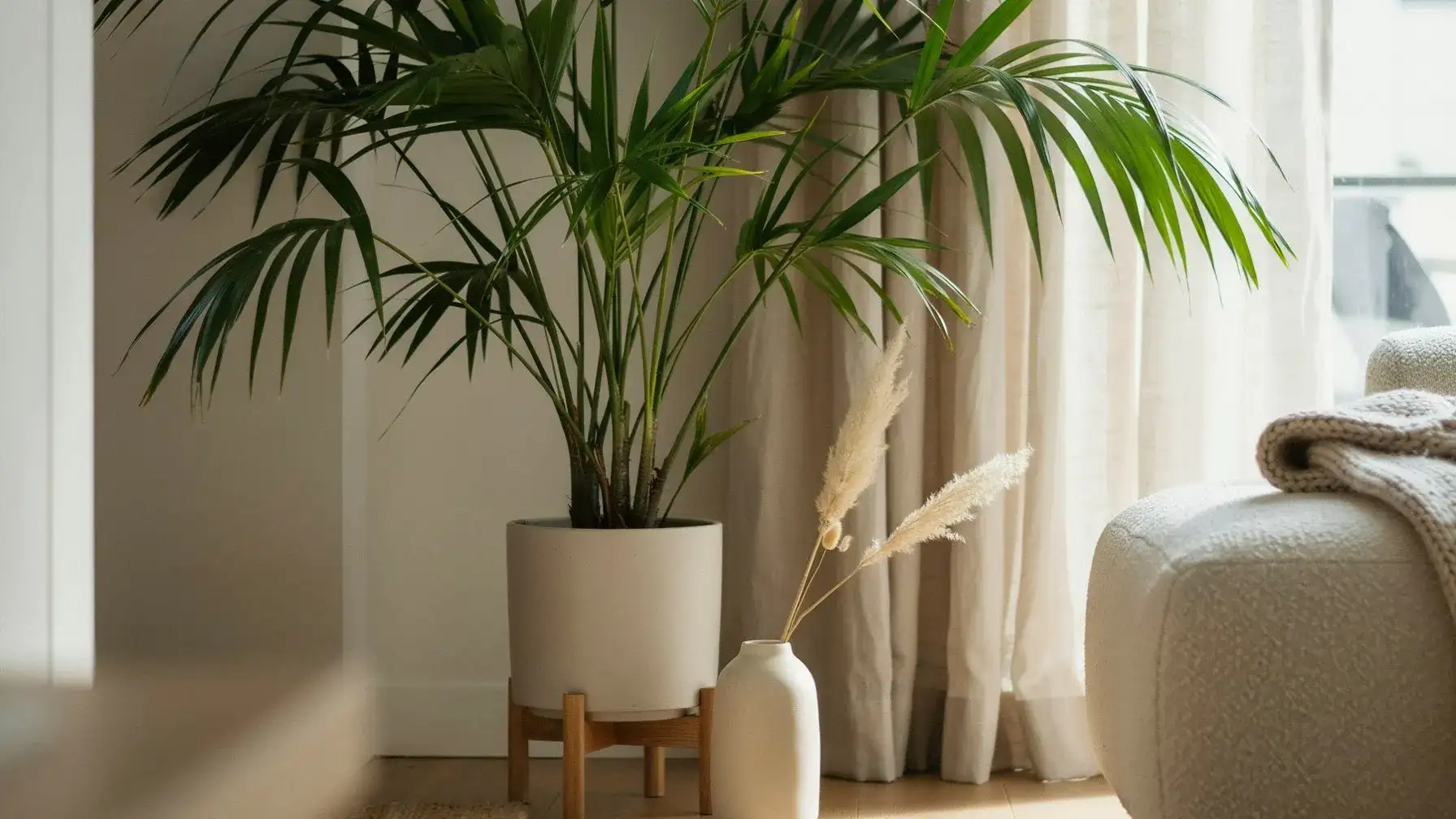
Areca palm (Dypsis lutescens) grows best indoors in bright indirect light near an east, west or south window, in soil that stays evenly moist but never stands in water, at 65 to 70°F at night and 75 to 85°F during the day, with a slow-release palm fertilizer two to three times a year, according to Clemson Cooperative Extension. The ASPCA lists it as non-toxic to cats, dogs and horses. Its famous air-purifying power, though, is far weaker in a real home than most care guides claim.
Most areca palm trouble comes from three things: too little light, soil that swings between bone-dry and waterlogged, and missing potassium. This guide covers each one with numbers from university extension services, then looks at what the research really says about the plant’s benefits.
Areca Palm Care at a Glance
| Need | What to give it | Source |
|---|---|---|
| Light | Bright indirect light near an east, west or south window | Clemson Extension |
| Water | Water thoroughly when the soil surface dries; never let it dry out or stand in water | Clemson Extension |
| Temperature | 65 to 70°F at night, 75 to 85°F during the day | Clemson Extension |
| Humidity | Add a gravel tray, humidifier or weekly misting below 50% | Clemson Extension |
| Fertilizer | Slow-release palm fertilizer (12-4-12 or 8-2-12 with micronutrients), 2 to 3 times in spring and summer | Clemson Extension |
| Growth | 6 to 10 inches a year, up to 6 to 7 feet indoors | Clemson Extension |
| Pets | Non-toxic to cats, dogs and horses | ASPCA |
What Is an Areca Palm?
Areca palm is Dypsis lutescens, a clumping, multi-stemmed palm with arching, feathery fronds and golden-yellow stems. You may also see the older name Chrysalidocarpus lutescens on plant tags. The ASPCA lists its other common names as golden butterfly palm, cane palm, golden feather palm and yellow palm.
According to the University of Florida IFAS, it is endemic to eastern Madagascar, where it is endangered because of habitat loss, and it typically reaches 20 to 35 feet outdoors. Indoors it stays far smaller: Clemson Extension puts it at 6 to 7 feet, growing 6 to 10 inches a year.
Check the label: “bamboo palm” is not one plant
Areca palm is sometimes sold as “bamboo palm” because of its cane-like stems, but the same name is used for other palms. The ASPCA’s “bamboo palm” entry, for example, is Chamaedorea elegans (parlor palm). Buy by the botanical name, Dypsis lutescens, so you know which care guide applies.
How Much Light Does an Areca Palm Need?
Clemson Extension says areca palms do best in bright indirect sunlight and recommends placing them near an east-, west- or south-facing window. In practice, that means close to the window but out of harsh direct rays hitting the fronds.
When any houseplant gets too little light, University of Minnesota Extension lists the typical signs: pale or yellowing leaves, stretched growth, and older leaves dropping. If your brightest window can’t provide that, a grow light can fill the gap; our guide to the best grow lights for indoor plants explains how to choose and position one.
Pro tip: Areca palm clumps grow toward the light. Turning the pot a quarter turn each time you water keeps the fronds growing evenly instead of leaning toward the window.
How to Water an Areca Palm
Clemson Extension’s rule for indoor palms is simple: keep them moist. They should never dry out completely and should never stand in water. Water thoroughly when the surface of the soil dries, let the pot drain, and empty the saucer.
Do
- Check the soil surface before watering
- Water until it drains from the bottom
- Empty the saucer after the pot drains
- Use a pot with drainage holes
Avoid
- Letting the root ball dry out completely
- Leaving the pot standing in water
- Watering on a fixed calendar without checking the soil
Light, pot size and season change how fast the soil dries, so let the soil surface, not the calendar, tell you when to water. If you prefer watering from below, see our guide to bottom watering, and always let the pot drain afterward.
Temperature and Humidity
Clemson Extension gives ideal temperatures of 65 to 70°F at night and 75 to 85°F during the day. That makes areca palm a warm-room plant: keep it away from cold drafts, exterior doors and air-conditioning vents.
For humidity, the same fact sheet recommends action when indoor humidity falls below 50%: fill the saucer with gravel and water (keeping the pot above the waterline), run a room humidifier, or mist the plant weekly. Winter heating is the usual culprit.
Fertilizer and Potassium Deficiency
Clemson Extension recommends a slow-release palm fertilizer with an analysis like 12-4-12 or 8-2-12, including micronutrients, applied only two to three times a year during spring and summer. The high potassium in those formulas matters, because potassium deficiency is one of the most common palm problems.
According to Timothy Broschat of the University of Florida IFAS, potassium deficiency symptoms always appear first on the oldest fronds, because the plant moves potassium from old leaves to new ones. Look for:
- Translucent yellow-orange spotting
- Dead (brown) leaf margins and tips
- Withered, “frizzled” leaflets on the oldest fronds
Pruning and Repotting
Don’t cut yellowing fronds early
Broschat’s University of Florida IFAS publication warns that regularly removing discolored, potassium-deficient older leaves has been shown to speed up the palm’s decline. Those fronds are still feeding potassium to new growth. Wait until a frond is completely brown, then cut it at the base.
Also note that palms can’t be pruned to control height, as Clemson Extension points out, because all new growth comes from the center of each stem. If your palm outgrows its space, the answer is a bigger spot, not a trim.
Clemson Extension suggests repotting about every two to three years, when the roots fill the pot, using a container with drainage holes.
Pests and Common Problems
Clemson Extension names scale insects, mealybugs and spider mites as the main indoor palm pests, and notes that areca palms are very susceptible to spider mites. Check the undersides of the fronds every time you water.
| What you see | Likely cause | What to do |
|---|---|---|
| Fine webbing and pale stippling on fronds | Spider mites (Clemson) | Isolate the plant, rinse the fronds and raise humidity; treat early |
| White cottony clumps where fronds join stems | Mealybugs (Clemson) | Remove them by hand; see our rubbing alcohol method |
| Small brown bumps on stems and fronds | Scale insects (Clemson) | Scrape off and monitor weekly |
| Yellow-orange spots and brown tips on the oldest fronds only | Potassium deficiency (UF/IFAS) | Switch to a palm fertilizer such as 8-2-12; leave the fronds on |
| General yellowing of many fronds | Several possible causes | Work through our yellow leaves guide |
Does Areca Palm Really Purify the Air?
This is the benefit most people buy areca palm for, and the evidence is weaker than the marketing. Here is what the research shows.
The NASA study
NASA tested plants in sealed laboratory chambers while looking for ways to clean air on space stations, and found they could remove some chemicals. As Drexel University researchers later noted, those chambers bear little resemblance to a home with air flowing in and out.
The 30-year review
Drexel University’s Michael Waring and Bryan Cummings reviewed a dozen studies spanning 30 years. In their published analysis (Journal of Exposure Science and Environmental Epidemiology), the median single plant cleaned only 0.023 cubic meters of air per hour, so it would take 10 to 1,000 plants per square meter of floor space to match the air exchange a typical building already gets.
An areca palm field study
Researchers in Palampur, India placed 3, 6 and then 9 areca palms in four naturally ventilated rooms and reported large drops in volatile organic compounds, carbon dioxide and carbon monoxide (Environmental Science and Pollution Research). It is one small study at a single institute.
Verdict
Enjoy areca palm for how it looks and how it makes a room feel, not as an air purifier. For cleaner indoor air, ventilation does far more than any number of houseplants you could realistically fit in a room.
Other Benefits: Pet Safety, Looks and Vastu
Safe for pets
The ASPCA lists areca palm as non-toxic to cats, dogs and horses, which makes it one of the few large, dramatic palms that is safe in a pet household. For more options, see our cat-safe plants guide.
Don’t confuse it with sago palm
Sago palm (Cycas revoluta) looks palm-like but is toxic to dogs, cats and horses. The ASPCA lists signs including vomiting, liver damage, liver failure and death. If you suspect your pet has eaten a sago palm, contact your veterinarian or the ASPCA Animal Poison Control Center at (888) 426-4435.
A large plant for a bright room
Because it grows as a clump of stems reaching 6 to 7 feet indoors, areca palm works as a living room divider or a soft screen in a bright corner.
Areca palm in Vastu Shastra
In Vastu Shastra, the traditional Indian system of architecture and placement, areca palm is commonly recommended as an auspicious plant, often placed in the east, north or northeast of a room. This is a cultural tradition rather than a horticultural rule, so if you follow it, choose the spot that also gives the plant bright indirect light.
Can Areca Palm Grow Outdoors?
Yes, in frost-free climates. The University of Florida IFAS says it survives best where the average annual low temperature is 35 to 40°F, tolerates full sun to partial shade, and reaches 20 to 35 feet tall. In colder areas, keep it in a container and bring it inside before nights turn cold, staying within the 65 to 70°F night range Clemson Extension recommends indoors.
For other indoor trees and shrubs, see our guides to dracaena brown tips and Norfolk Island pine. It is also on our list of plants safe for dogs.
Frequently Asked Questions
How fast does areca palm grow indoors?
Clemson Extension puts indoor growth at 6 to 10 inches a year, with plants eventually reaching 6 to 7 feet. Bright indirect light, steady moisture and regular palm fertilizer support the fastest healthy growth.
Why are my areca palm leaves turning brown?
Brown tips and margins limited to the oldest fronds often point to potassium deficiency, according to the University of Florida IFAS. Dry winter air is another common cause; Clemson Extension recommends raising humidity when it falls below 50%.
Should I cut yellow leaves off my areca palm?
Not until they are completely brown. University of Florida IFAS research found that regularly removing yellowing, potassium-deficient older fronds speeds up the palm’s decline, because those fronds still supply potassium to new growth.
Is areca palm safe for cats and dogs?
Yes. The ASPCA lists areca palm (Dypsis lutescens) as non-toxic to cats, dogs and horses. Don’t confuse it with sago palm, which the ASPCA lists as toxic to all three.
Does areca palm purify air at night?
No plant meaningfully cleans the air in a ventilated home, day or night. A Drexel University review (Cummings and Waring) found it would take 10 to 1,000 plants per square meter of floor space to match normal building air exchange.
How often should I repot an areca palm?
About every two to three years, when the roots fill the pot, according to Clemson Extension. Use a container with drainage holes so water never sits around the roots.
Sources
- Clemson Cooperative Extension, HGIC 1508: Indoor Palms
- University of Florida IFAS, FR309: Dypsis lutescens, Areca Palm
- University of Florida IFAS, EP269: Potassium Deficiency in Palms (Broschat)
- ASPCA: Areca Palm and Sago Palm
- Drexel University: Potted plants do not improve indoor air quality (2019)
- Bhargava et al., Mitigation of indoor air pollutants using Areca palm potted plants in real-life settings (2021)
- University of Minnesota Extension: Lighting for indoor plants