
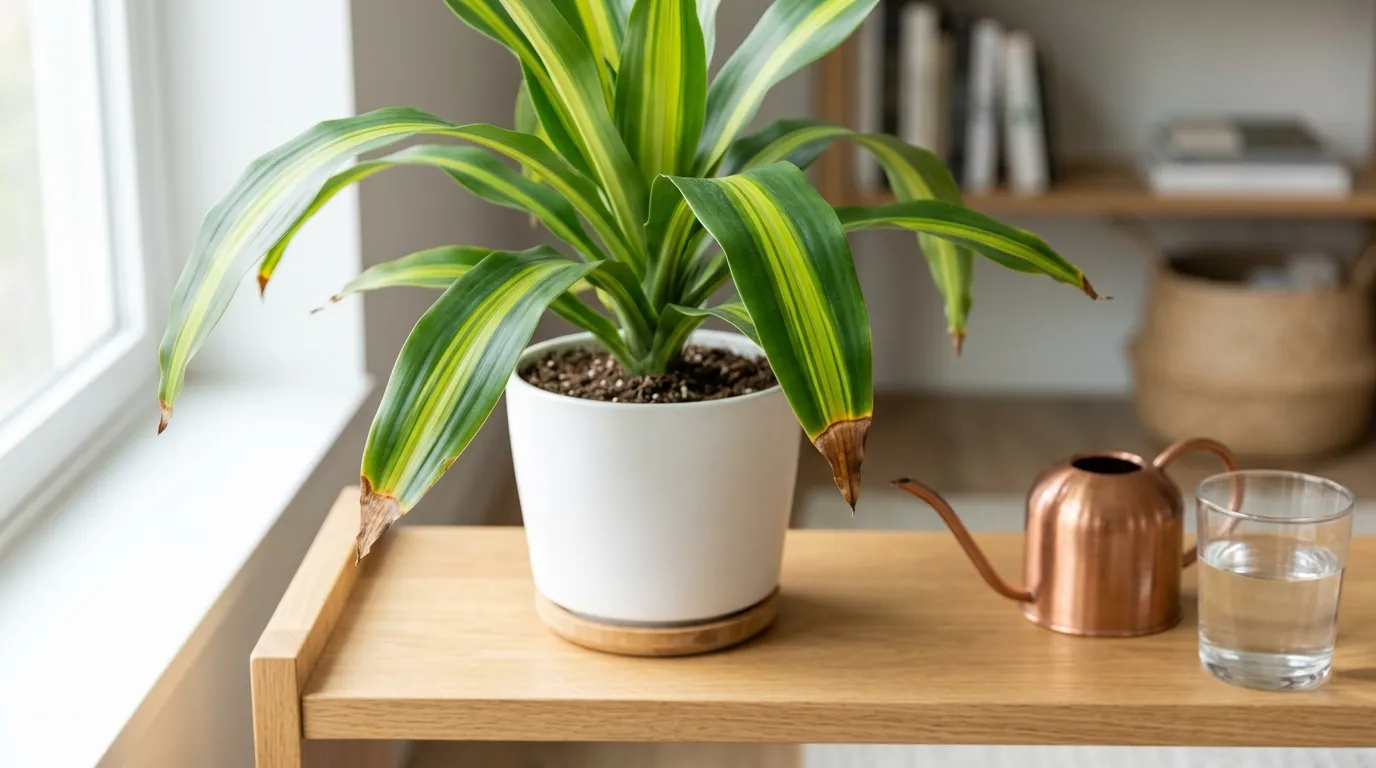
Brown, crispy leaf tips are the most common complaint about dracaenas: the corn plant (Dracaena fragrans), the dragon tree (D. marginata), ‘Janet Craig’ and their relatives. The good news is that the causes are well known. Dracaena brown tips usually come from fluoride or salts in the water, too much fertilizer, dry air or uneven watering, and dracaenas are especially sensitive to the first one. This guide follows Clemson HGIC, the RHS, the University of Missouri, Iowa State and NC State.
What Causes Dracaena Brown Tips?
| Cause | Clues | Fix |
|---|---|---|
| Fluoride in water or mix | Tips and edges die with little or no yellow band between green and brown (Missouri) | Rainwater or filtered water; avoid high-perlite mixes and superphosphate (Clemson, RHS) |
| Too much fertilizer | Brown tips and margins; white crust on the soil (Missouri, Clemson) | Feed less; flush the pot with plenty of plain water |
| Softened water | Same pattern as fertilizer burn (Missouri) | Don’t use water from a softener |
| Low humidity | Dry, papery tips and edges, worse in winter (Clemson, Iowa State) | Pebble tray, humidifier, grouping plants |
| Uneven watering | Browning after the mix dried out for too long (Iowa State); or soggy mix and yellowing (NC State) | Water when the top of the mix is dry; never leave it soggy |
| Too much sun | Round dry patches rather than tips (Clemson) | Move out of direct sun |
Sources: University of Missouri IPM (2019, 2021); Clemson HGIC 1504; RHS; Iowa State (2026); NC State Extension.
Iowa State calls low humidity the most likely cause of brown tips on houseplants in general, but for dracaenas fluoride deserves special attention.
Fluoride: The Dracaena Weak Spot
University of Missouri Extension says dracaenas, like most members of the lily family, are especially sensitive to fluorine, and names fluoride in water as a common cause of dead leaf edges and tips. Its leaf tipburn article explains that fluoride sensitive plants get tipburn even with otherwise good watering and feeding, because trace fluoride in many public water supplies builds up over time. Clemson HGIC describes fluoride injury on dracaena as yellowing or scorched tips and margins.
How to tell it apart from disease: Missouri Extension notes that with environmental damage like fluoride or salt burn, the yellow transition zone between healthy and dead tissue is greatly reduced or absent, whereas disease usually moves from green to yellow to brown.
Where the fluoride comes from
- Tap water in fluoridated areas (Missouri, RHS, NC State). Letting water stand removes chlorine but not fluoride.
- Perlite, which Missouri says contains fluorides; Clemson advises avoiding mixes with a high percentage of perlite.
- Superphosphate fertilizers, which Clemson says often contain high levels of fluorine.
What to do
- Water with rainwater, distilled water or filtered water (RHS, NC State). Ordinary jug filters remove chlorine but many do not remove fluoride, so check what yours removes.
- Keep the mix’s pH around 6.0 to 6.5, which Clemson says limits fluoride injury; Missouri also advises a somewhat higher pH for fluoride-sensitive plants.
- Repot into a mix without a lot of perlite (Clemson).
Fertilizer Salts and Softened Water
Missouri explains that excess fertilizer salts build up in leaf margins and tips and cause salt “burn,” and that water from a softener creates the same saline conditions because softeners swap hardness minerals for sodium or potassium salts. Clemson lists excessive fertilizer among the causes of dracaena brown tips. The RHS warns not to overfeed. A white crust on the soil surface is a sign of salt build-up; see our white crust guide.
For feeding, Clemson suggests a liquid foliage plant fertilizer monthly in spring and summer, and the RHS a general liquid houseplant feed from April to October. Flush the pot occasionally by running plenty of plain water through it.
Dry Air
Clemson says dry tips and edges usually point to low humidity and suggests occasional misting when indoor humidity drops below 30 to 40 percent. The RHS suggests a saucer of moist gravel, grouping plants and occasional misting. Iowa State recommends a humidifier, a pebble tray or grouping plants. Heated homes in winter are the usual trouble spot; see our guide to dry air.
Watering Mistakes
Both too much and too little water cause problems (Clemson). Clemson suggests letting the plant dry slightly, then watering thoroughly once the surface is dry, and avoiding cold water. The RHS says to water only when the compost is dry about 5 cm (2 in) down, using water at room temperature, and warns that soggy compost leads to root rot. NC State says to let the top inch dry and links yellowing leaves to overwatering. Iowa State notes that letting plants dry out too long between waterings browns the tips. See our overwatered vs underwatered guide.
Sun, Cold Drafts and Brown Spots
- Too much sun: Clemson says excess sunlight causes round dry patches, and the RHS says summer sun scorches the leaves. Bright, indirect light is best (RHS, Clemson, NC State).
- Cold and drafts: the RHS lists cold draughts and heat sources among the causes of leaf problems and suggests 18 to 30°C (65 to 86°F). Clemson notes that drafts and sudden temperature changes can cause leaf loss.
- Dracaena brown spots: NC State says wet foliage can lead to fungal leaf spot. Brown spots in the middle of the leaf, often with a yellow halo, are more likely disease than tip burn.
Step-by-Step Fix
- Switch your water to rainwater, distilled or a filter that removes fluoride.
- Flush the pot with plenty of that water to wash out built-up salts.
- Cut back on fertilizer and avoid superphosphate products.
- Check the mix: if it is old, compacted or full of perlite, repot in spring into fresh, fast-draining mix.
- Raise the humidity in winter and move the plant away from heaters and cold windows.
- Water on the dry-down rule: when the top inch or two is dry, then thoroughly.
- Watch the new leaves: if they come out clean, the fix worked.
Should You Cut Off Brown Tips?
Yes, if you don’t like the look. Iowa State says trimming brown portions with scissors improves the appearance, but that the browning returns if the cause isn’t fixed. Brown tissue won’t turn green again, so cut just inside the brown edge, following the leaf’s natural shape, and leave a thin line of brown rather than cutting into healthy green, which can start a new brown edge.
Related plants share the same problem: lucky bamboo (Dracaena sanderiana) and the snake plant, now also a Dracaena (NC State). See our lucky bamboo guide and snake plant guide.
Is Dracaena Toxic to Pets?
Yes. The ASPCA lists dracaena (corn plant, dragon tree, ribbon plant) as toxic to dogs and cats because of saponins, with vomiting (occasionally with blood), depression, loss of appetite, drooling, and dilated pupils in cats. NC State rates the poison severity as low. Keep it out of reach and call your veterinarian or the ASPCA Animal Poison Control Center at (888) 426-4435 if a pet chews it. See our cat-safe plants list.
For other indoor trees and shrubs, see our guides to Ficus Shivereana Moonshine.
Frequently Asked Questions
Why does my dracaena have brown tips?
Most often fluoride in tap water, which dracaenas are especially sensitive to (Missouri, Clemson, RHS). Too much fertilizer, softened water, low humidity and uneven watering are the other common causes.
Should I use distilled water for my dracaena?
Rainwater, distilled water or filtered water helps if your tap water is fluoridated (RHS, NC State). Letting tap water stand overnight removes chlorine but not fluoride.
Will brown tips on dracaena turn green again?
No. Dead tissue doesn’t recover. Trim the tips for appearance (Iowa State) and judge your changes by the new leaves.
Why does my dracaena marginata have brown tips?
Dracaena marginata brown tips have the same causes as those on the corn plant: fluoride, salts, dry air and watering. Clemson notes that D. marginata tolerates low light, but tips still brown if the water or air is the problem.
Does perlite cause brown tips on dracaena?
It can contribute. Missouri says perlite contains fluorides and Clemson advises avoiding mixes with a high percentage of perlite, though the RHS includes some perlite in its suggested mix.
Is dracaena toxic to cats?
Yes. The ASPCA lists dracaena as toxic to cats and dogs because of saponins.
Sources
- Clemson HGIC 1504: Dracaena
- RHS: How to grow dracaena
- Trinklein, D. (2019). Houseplant Problems. University of Missouri IPM
- Trinklein, D. (2021). Leaf Tipburn on Houseplants. University of Missouri IPM
- Steil, A. (2026). Why does my houseplant have brown leaf tips and edges? Iowa State University Extension
- NC State Extension Gardener Plant Toolbox: Dracaena
- ASPCA: Dracaena