
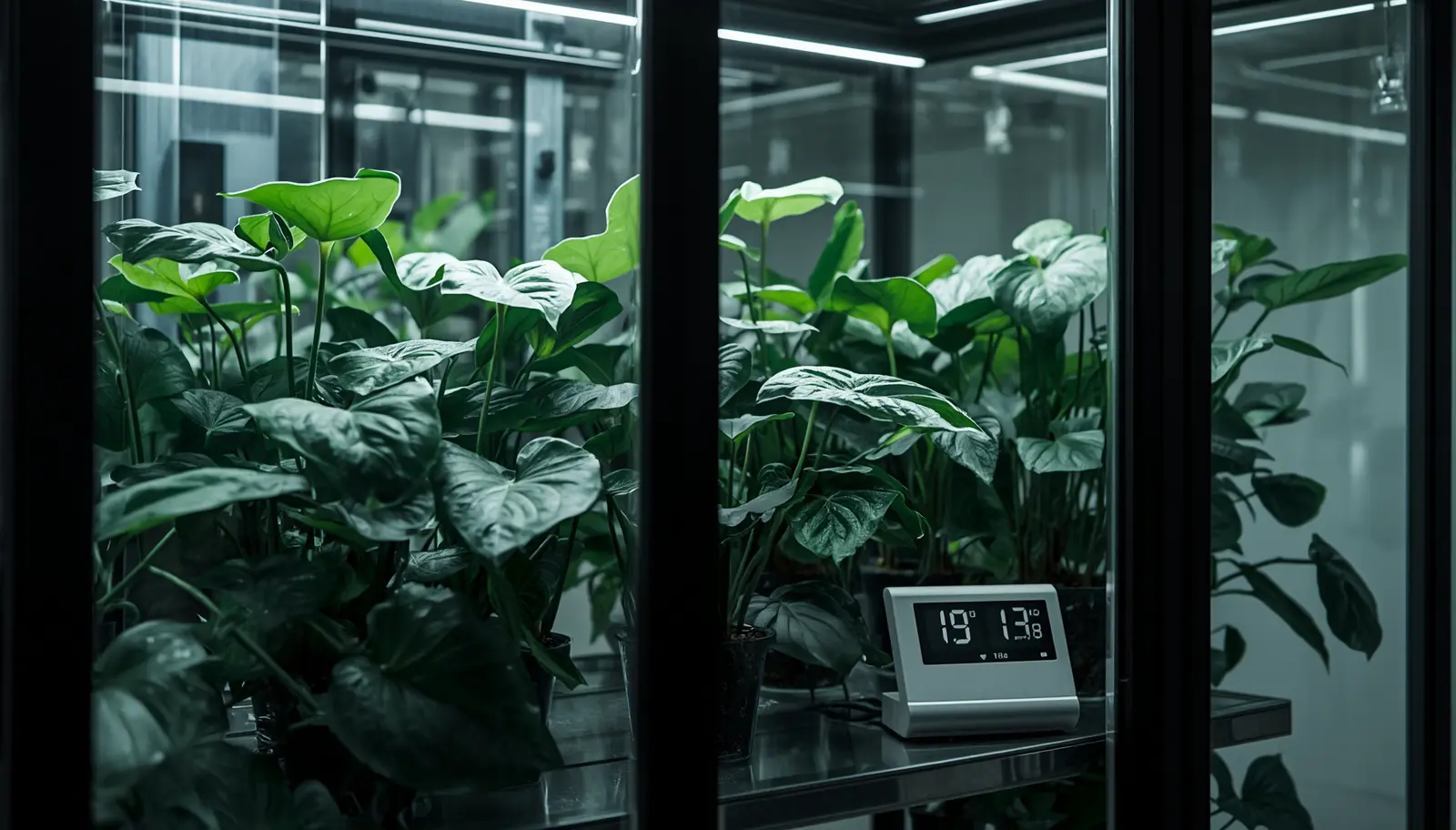
If you grow humidity-loving plants in a cabinet, a greenhouse tent or a bathroom, you have probably seen “VPD” on hygrometers and grow-tent controllers. Vapor pressure deficit is a single number that combines temperature and relative humidity to describe how strongly the air pulls water out of leaves. Michigan State University Extension calls it a more accurate way than relative humidity to predict plant transpiration. This guide explains VPD for indoor plants in plain terms, gives a VPD table for home temperatures, and shows when it is worth paying attention to.
What Is VPD?
Warm air can hold more water vapor than cool air. MSU Extension notes that the water-holding capacity of air roughly doubles with every 20 °F rise in temperature. Relative humidity (RH) only tells you how full the air is as a percentage of that capacity, so the same RH means very different drying power at different temperatures.
VPD solves that by measuring the actual shortfall: VPD = saturation vapor pressure − actual vapor pressure, usually in kilopascals (kPa). MSU Extension explains that a high VPD (greater than 1.0 kPa) means there is a large gradient between the nearly saturated leaf and the air, so plants transpire and dry out faster; a low VPD means the air is near saturation; and a VPD of zero means the air is saturated and plants cannot transpire effectively.
MSU’s own example makes the point: at a constant 70% RH, VPD rises from 0.55 kPa at 60 °F to 0.90 kPa at 75 °F and 1.45 kPa at 90 °F. The hygrometer shows the same number while the drying power almost triples.
What VPD Do Indoor Plants Need?
| Situation | Suggested VPD | Why |
|---|---|---|
| Rooting cuttings, propagation boxes | About 0.3 kPa | Reduces drying of young plants without roots (MSU) |
| Growing and finishing plants | Greater than 0.5 kPa | Lets plants transpire and cool themselves; less conducive to disease (MSU) |
| Very dry air | Well above 1.5 kPa | Plants lose water fast; in one tomato study, 2.2 kPa caused stress and fruit cracking (cited by MSU) |
Source: Wollaeger and Runkle (2015), MSU Extension.
These targets come from greenhouse production; there are no published VPD targets for individual houseplants like anthuriums or philodendrons. MSU also notes that air above about 85% RH can favor fungal pathogens, because water lost through the stomata lingers on the leaves. So for most indoor plants, the practical goal is: humid but not saturated, with air moving.
Many popular tropical houseplants, such as velvet anthuriums and calatheas, show brown crispy edges in dry air, which corresponds to a high VPD. Others grow happily at normal room humidity.
VPD Chart for Home Temperatures
The values below are calculated from the standard saturation vapor pressure formula, assuming leaf temperature equals air temperature. Leaves under strong lights or in sun run warmer than the air, which raises the real VPD slightly.
| Air temperature | 40% RH | 50% RH | 60% RH | 70% RH | 80% RH |
|---|---|---|---|---|---|
| 60 °F (16 °C) | 1.06 | 0.88 | 0.71 | 0.53 | 0.35 |
| 65 °F (18 °C) | 1.26 | 1.05 | 0.84 | 0.63 | 0.42 |
| 70 °F (21 °C) | 1.50 | 1.25 | 1.00 | 0.75 | 0.50 |
| 75 °F (24 °C) | 1.78 | 1.48 | 1.19 | 0.89 | 0.59 |
| 80 °F (27 °C) | 2.10 | 1.75 | 1.40 | 1.05 | 0.70 |
| 85 °F (29 °C) | 2.47 | 2.05 | 1.64 | 1.23 | 0.82 |
VPD in kPa, calculated with the Tetens saturation vapor pressure formula. Values match MSU Extension’s published examples (e.g., 75 °F at 70% RH = about 0.9 kPa).
Reading the chart: a typical heated home in winter, 70 °F at 30 to 40% RH, sits around 1.5 to 1.75 kPa, which is why humidity lovers struggle in winter. A closed cabinet at 75 °F and 80% RH sits around 0.6 kPa.
Why Air Movement Matters at Low VPD
When the air is close to saturated, leaves dry slowly. MSU Extension notes that at high humidity (above about 85% RH), water lost through the stomata lingers on the leaves, creating conditions for fungal pathogens. In a closed cabinet or propagation box, a small fan that keeps the air gently moving helps leaves dry and avoids pockets of stagnant, saturated air around the foliage. Don’t point it straight at plants; you want gentle circulation, not wind.
Measuring and Controlling VPD at Home
- Measure: a digital thermo-hygrometer is enough. Many show VPD directly; otherwise read temperature and RH and use the chart above. Place it at plant height, not on the floor or next to the humidifier.
- Lower VPD (more humid): a humidifier, grouping plants, or a closed cabinet. A pebble tray only helps very locally.
- Raise VPD (drier): more air exchange, a small fan, slightly higher temperature, or a dehumidifier in very humid rooms.
- Controllers: grow-tent controllers can switch a humidifier and fan by VPD. Useful for large cabinets of rare plants; overkill for a windowsill.
For a broader look at humidity for specific plants, see our guides to maidenhair fern and nerve plant, two classic humidity lovers.
VPD, Light and Watering
VPD affects how fast plants use water. At high VPD, plants transpire more and pots dry faster; at low VPD, the compost stays wet longer, which raises the risk of overwatering. If you move plants into a humid cabinet, water less often and check the mix before watering. Strong grow lights warm the leaves, which raises the leaf-to-air VPD and transpiration, so plants under bright lights generally need watering more often. See our grow light guide and overwatered vs underwatered guide.
A Simple Plan for Cabinets and Tents
- Propagation box: keep it humid (around 0.3 kPa, very high RH) while cuttings root, as MSU suggests for rooting, and open it briefly each day for fresh air. See our sphagnum moss propagation guide and tissue culture acclimation guide.
- Once rooted: gradually lower the humidity so the plant adjusts to normal room air or your cabinet’s growing range.
- Growing cabinet: aim for a VPD above about 0.5 kPa, with a small fan running. In practice, that is roughly 60 to 75% RH at 70 to 75 °F (see the chart).
- Watch the plants: crispy edges suggest the air is too dry; persistent wet leaves, mold or rot suggest it is too humid or too still.
For humid indoor growing setups, see our guides to greenhouse cabinets.
Frequently Asked Questions
What is a good VPD for indoor plants?
For growing plants, MSU Extension recommends a VPD greater than 0.5 kPa so plants can transpire and foliar diseases are less likely. For rooting cuttings, it suggests a low VPD of about 0.3 kPa to prevent drying.
Is VPD better than relative humidity?
For predicting how fast plants lose water, yes. MSU Extension notes that the same relative humidity gives very different VPD values at different temperatures, while VPD directly describes the drying power of the air.
How do I calculate VPD?
Subtract the actual vapor pressure of the air from the saturation vapor pressure at that temperature. In practice, use a hygrometer that displays VPD or the chart above: for example, 70 °F at 60% RH is about 1.0 kPa.
What happens if VPD is too low?
The air is close to saturated, plants transpire little, compost stays wet longer and leaves dry slowly. MSU Extension warns that humidity above about 85% RH can favor fungal pathogens.
What happens if VPD is too high?
Plants lose water quickly, and sensitive species show crispy brown edges. In one tomato study cited by MSU Extension, a VPD of 2.2 kPa caused plant stress.
Do I need a VPD controller for houseplants?
Usually not. A thermo-hygrometer and the chart above are enough for most collections. Controllers are mainly useful in closed cabinets or tents with many humidity-loving plants.