
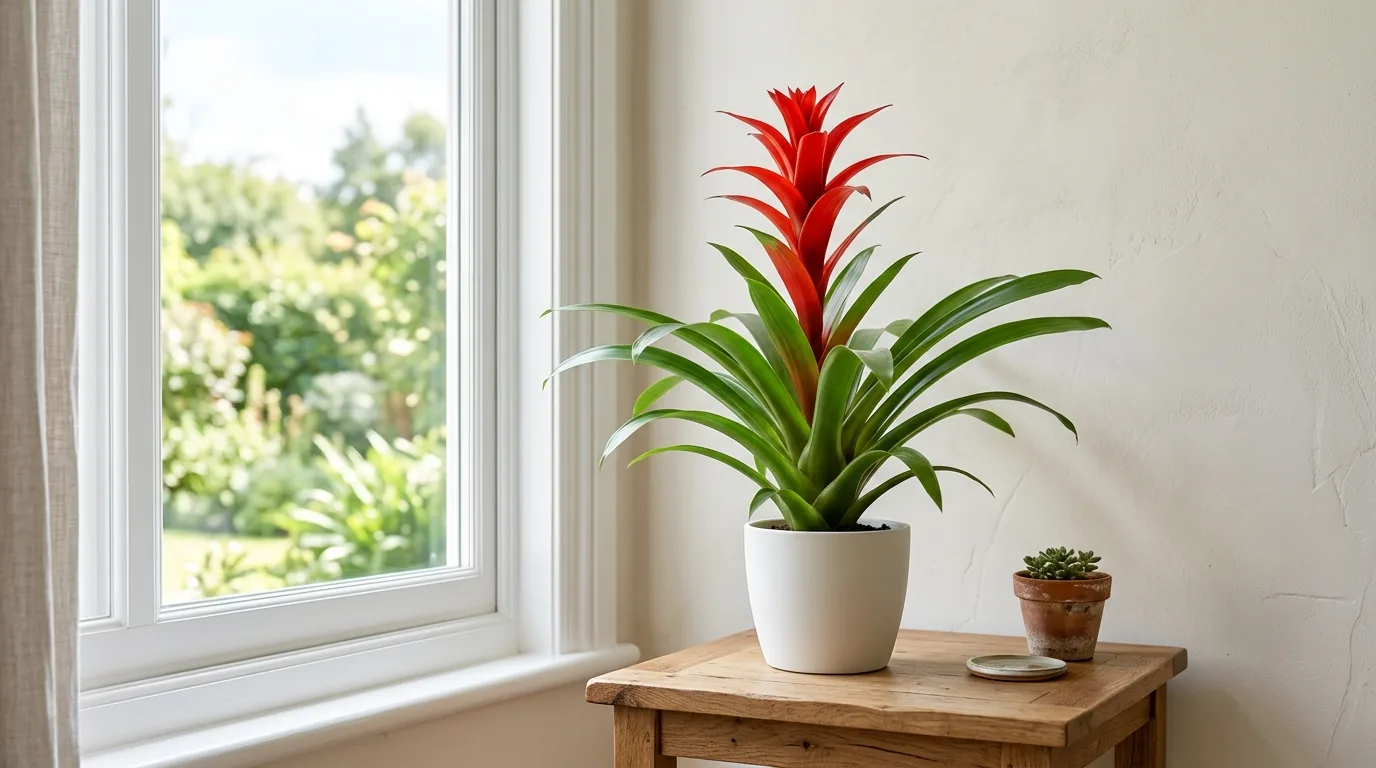
Bromeliads are tropical rosette plants, many of them epiphytes, sold for their long-lasting colorful bracts: guzmanias, vrieseas, aechmeas (urn plants), neoregelias (blushing bromeliads), earth stars and even pineapples. Most hold water in a central cup, or tank, formed by their leaves. Clemson HGIC says they are slow-growing and long-lived, and that the parent dies after flowering while leaving pups to carry on. This guide covers bromeliad care indoors: light, how to water bromeliads (cup and soil), feeding, bromeliad care after flowering, bromeliad pups, forcing a bloom and problems, following Clemson HGIC, Colorado State, the University of Missouri, UF/IFAS and the ASPCA.
Bromeliad Care at a Glance
| Need | What the sources say |
|---|---|
| Light | Indirect light (Clemson); bright, diffused light but not direct sun (UF/IFAS, Missouri); needs bright light to grow and flower (Colorado State) |
| Temperature | 60 to 85°F (Clemson); about 70°F by day, 55 to 60°F at night (Colorado State) |
| Water | Water thoroughly, let the mix dry, keep the cup filled and flush it periodically (Clemson); about every week or two (Colorado State) |
| Mix | Fast-draining, airy; never soggy (Clemson); 1 part peat, 1 part bark, 1 part coarse sand (UF/IFAS) |
| Feeding | Half strength or less in summer (Clemson); 1/3 to 1/2 strength every 1 to 2 months on the soil, not in the cup (Colorado State) |
| Flowering | Once per plant; bracts last several months up to a year (Missouri) |
| Pups | Separate at about half the parent’s size (Colorado State) |
| Pets | Guzmania, Neoregelia, Cryptanthus non-toxic to cats and dogs (ASPCA) |
Sources: Clemson HGIC 1501; Colorado State PlantTalk 1305; University of Missouri IPM (2016); UF/IFAS Gardening Solutions; ASPCA.
Common Bromeliads
| Genus | What Clemson says |
|---|---|
| Guzmania | Moderate light, stable warm temperatures, constantly moist air; keep humidity high |
| Vriesea | 2 to 3 feet as houseplants; feed through the leaves with very dilute fertilizer; blooms last several months |
| Aechmea (urn plant) | Bright light and very warm temperatures; fertilize lightly in summer |
| Neoregelia (blushing bromeliad) | Strong light, underpotted, on the dry side; frequent feeding turns the leaves green |
| Cryptanthus (earth star) | Rich, organic soil, slightly dry between waterings, bright diffused light; fertilize monthly mid-spring to early fall |
| Ananas (pineapple) | Strong light and plenty of moisture; leaves 3 to 5 feet |
| Tillandsia (air plants) | Grow without soil; see our air plant care guide |
Source: Clemson HGIC 1501.
Light and Temperature
Clemson recommends indirect sunlight for most bromeliads, and UF/IFAS and Missouri describe bright, diffused light but not direct sun. Colorado State says a bromeliad needs bright light to grow and flower; in very low light it can survive for weeks but won’t grow. Its leaves tell you which way to adjust: yellowish or pale green leaves suggest too much light, while dark green, soft, drooping leaves suggest too little. UF/IFAS adds that too little light makes leaves long, thin and greener.
Clemson gives a comfortable range of 60 to 85°F, and Colorado State says bromeliads grow best at about 70°F by day and 55 to 60°F at night. In cold weather, Colorado State says to keep plants on a windowsill from touching the glass.
How to Water Bromeliads
Bromeliads take in water mainly through their leaves and the cups at the base of their leaves (UF/IFAS), but potted plants also need their roots watered carefully.
- The cup (tank): Clemson says to keep the central cup filled, without letting the water soak the soil while you fill it. Missouri describes keeping the cup full as good practice followed by many growers.
- Flush the cup: every so often, pour in fresh water, tip the plant to empty the old water and refill it. Clemson and Colorado State say this prevents stagnation and mineral salt buildup.
- The potting mix: water thoroughly, then let the mix dry before watering again (Clemson). Colorado State suggests watering about once every week or two, letting the soil dry between waterings.
- Humidity: Clemson suggests frequent misting; Missouri says bromeliads prefer high humidity, though thick-leaved types tolerate typical indoor air.
Potting Mix and Feeding
The mix must drain quickly and let air reach the roots, and should never stay soggy (Clemson). UF/IFAS suggests one part peat, one part bark and one part coarse sand; Missouri describes a well-drained mix of shredded bark, leaf mold or peat moss with bark, perlite or coarse sand. Neoregelias grow best underpotted (Clemson). For a ready-made chunky option, see our aroid soil mix guide, which uses similar ingredients.
Bromeliads need little fertilizer, and the sources differ on how to apply it:
| Source | Feeding advice |
|---|---|
| Clemson | Half strength or less in summer; mist the leaves with diluted liquid fertilizer |
| Colorado State | General-purpose soluble fertilizer at 1/3 to 1/2 strength on the soil every 1 to 2 months while growing; not in the cup, where salts can burn new leaves; little or none in winter or low light |
| Missouri | Light fertilization at monthly intervals during active growth |
Sources: Clemson HGIC 1501; Colorado State PlantTalk 1305; University of Missouri IPM.
The safe middle ground: weak fertilizer on the potting mix in spring and summer, nothing in the cup, and none in winter. Clemson notes that frequent feeding turns neoregelia leaves green, so go especially easy on blushing bromeliads.
Bromeliad Care After Flowering
A bromeliad flowers once, then slowly dies (Missouri). This is normal, not a care failure. The colorful bracts can stay attractive for several months up to a year, depending on species (Missouri), and Colorado State says the parent dies over a year or two after flowering.
- Keep caring for the parent as usual: light, water in the cup and mix, no extra feeding.
- Cut off the faded flower stalk once it browns, so the plant looks tidy.
- Watch for pups forming at the base (Clemson).
- Remove the parent only once it has dried up or the pups are ready to pot on their own.
Bromeliad Pups: When and How to Separate
Colorado State says to separate pups when they are about half the size of the parent, and that pups take about a year to mature, some species longer. Clemson says to separate offsets and pot them to form new plants.
- Wait until the pup is about half the size of the parent (Colorado State).
- Unpot the plant and find where the pup joins the parent.
- Cut it away with a clean, sharp knife, keeping any roots it has.
- Pot it in a small container of fast-draining mix, firm it so it stands upright, and add a little water to its cup.
- Give it bright, indirect light and water sparingly until it roots.
You can also leave pups attached and let them grow into a clump around the parent.
Getting a Bromeliad to Bloom
Mature bromeliads can be pushed into flowering with ethylene, the gas a ripe apple gives off. Missouri notes that nurseries force bloom commercially with ethephon, a chemical that releases ethylene. At home, the apple method is used on a healthy, mature plant with a good root system (Colorado State). The sources differ on how long to leave the bag on:
| Source | Apple method | Flowers after |
|---|---|---|
| Clemson | Clear, airtight plastic bag with a ripe apple for 2 to 3 days | 6 to 14 weeks |
| Colorado State | Drain the cup, seal in a clear airtight bag with a large ripe apple for 2 to 3 days, then refill the cup | 6 to 14 weeks |
| Missouri | Clear bag with no holes for about a week to 10 days, out of excessive light | Signs of flowering in about 6 weeks |
Sources: Clemson HGIC 1501; Colorado State PlantTalk 1305; University of Missouri IPM.
Pups can only be forced once they are mature, which Colorado State says takes about a year.
Problems and Pests
| Symptom | Likely cause | What to do |
|---|---|---|
| Rotting base, plant loose in the pot | Root rot from soggy mix or watering too often (Clemson, Colorado State) | Repot in fast-draining mix; let the mix dry between waterings |
| Smelly water in the cup | Stagnant water (Colorado State) | Flush the cup with fresh water |
| Burned new leaves, crusty cup | Salt buildup from fertilizer or minerals in the cup (Colorado State, Clemson) | Flush the cup; feed the soil, not the cup |
| Yellowish or pale leaves | Too much light (Colorado State) | Move to bright, diffused light |
| Dark, soft, drooping or long thin leaves | Too little light (Colorado State, UF/IFAS) | Move closer to a bright window |
| Parent fading after blooming | Normal life cycle (Missouri) | Grow on the pups |
| Bumps or cottony clusters on leaves | Scale or mealybugs, the most common pests (Clemson) | See our guides to scale and mealybugs |
Sources: Clemson HGIC 1501; Colorado State PlantTalk 1305; UF/IFAS; University of Missouri IPM.
If you move bromeliads outside for summer, UF/IFAS says to flush the cups regularly with fresh water to keep them free of mosquito larvae. Bring them back in before frost; see our guide to bringing plants indoors for winter.
Are Bromeliads Safe for Pets?
The common ones are. The ASPCA’s cat and dog plant lists include guzmanias (orange star, Guzmania lingulata minor; mosaic vase, G. musaica), neoregelias (blushing bromeliad) and earth stars (Cryptanthus) among plants non-toxic to cats and dogs. We found no ASPCA entries for Aechmea or Vriesea. Eating any plant can still upset a pet’s stomach. For more pet-safe choices, see our lists of cat-safe plants and plants safe for dogs.
For other compact, pet-safe houseplants, see our guides to peperomia care.
Frequently Asked Questions
How do you water a bromeliad?
Keep a little water in the central cup and flush it periodically with fresh water, and water the potting mix thoroughly only after it has dried (Clemson). Colorado State suggests about once every week or two.
Should you keep water in a bromeliad cup?
Clemson says to keep the cup filled and to flush it periodically to prevent stagnation and salt buildup; Missouri calls it good practice. Don’t put fertilizer in the cup (Colorado State).
What do I do with my bromeliad after it flowers?
Keep caring for it. The parent slowly dies after flowering (Missouri), but it produces pups at its base; separate them when they are about half the parent’s size (Colorado State).
How long does a bromeliad flower last?
Missouri says the bracts stay attractive for several months up to a year, depending on species and conditions.
When should I remove bromeliad pups?
When they are about half the size of the parent plant (Colorado State). Pups take about a year to mature.
How do I make my bromeliad bloom again?
Only a mature plant will bloom. Seal it in a clear plastic bag with a ripe apple, which releases ethylene: 2 to 3 days per Clemson and Colorado State, about a week to 10 days per Missouri. Flowers follow in about 6 to 14 weeks.
Are bromeliads toxic to cats?
The ASPCA lists guzmanias, neoregelias and earth stars (Cryptanthus) as non-toxic to cats and dogs. We found no ASPCA entries for Aechmea or Vriesea.
Sources
- Russ, K., Pertuit, A. and Arena, M. Clemson HGIC 1501: Bromeliads (revised 2020)
- Colorado State University Extension PlantTalk 1305: Bromeliads
- Trinklein, D. University of Missouri IPM: Bromeliads, Houseplants That Endure (2016)
- UF/IFAS Gardening Solutions: Bromeliads
- ASPCA: Toxic and Non-Toxic Plant List, Cats
- ASPCA: Toxic and Non-Toxic Plant List, Dogs