
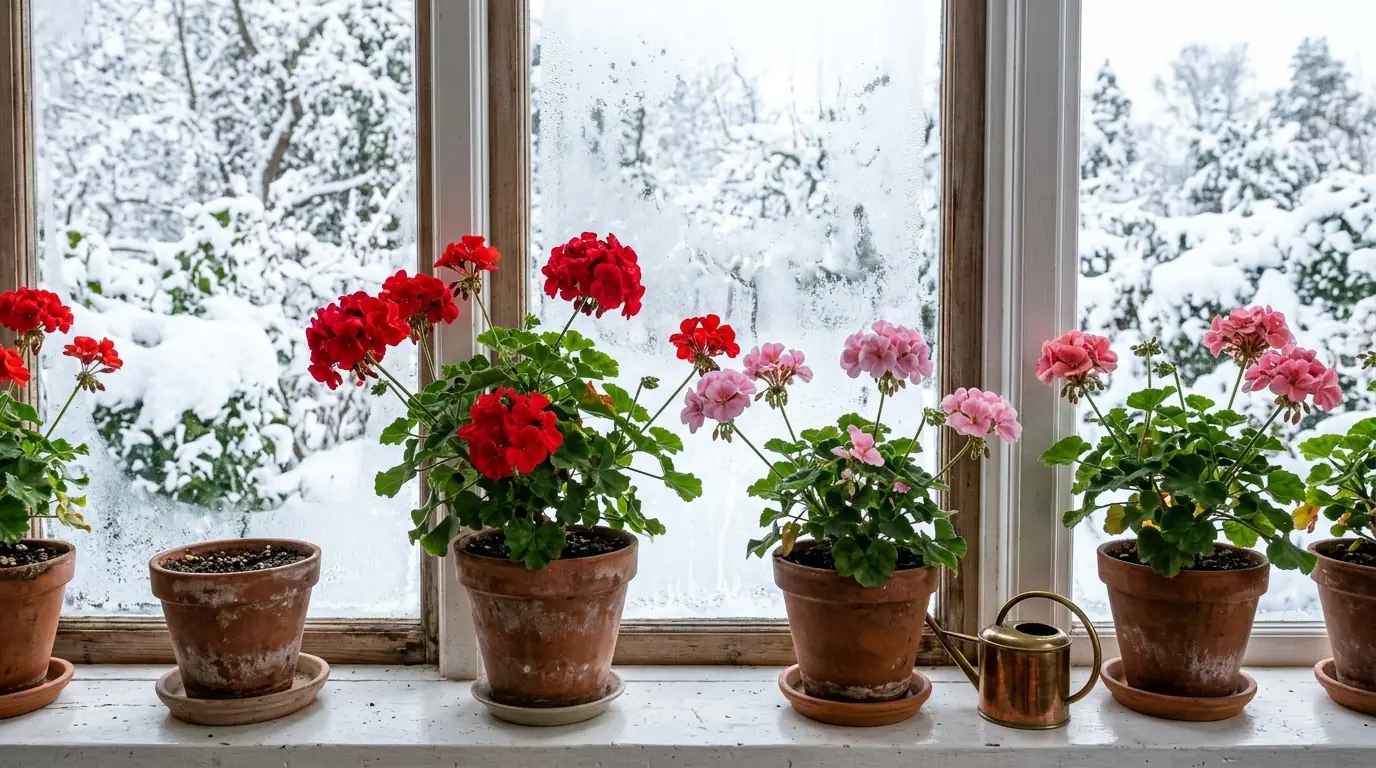
Garden geraniums don’t survive frost, but they don’t have to be thrown out every fall. There are three proven ways to keep them for next year: grow them as houseplants, store them dormant and bare-root (the old paper-bag trick), or take cuttings. This guide covers overwintering geraniums with all three methods, including overwintering geraniums indoors in a sunny window, overwintering geraniums in paper bags, and how to overwinter geraniums in pots, plus what to do in March to wake them up. It follows the University of Wisconsin, Illinois Extension and Iowa State.
Overwintering Geraniums: 3 Methods Compared
| Houseplant (in a pot) | Dormant, bare-root (paper bag) | Cuttings | |
|---|---|---|---|
| Space needed | A sunny window per plant | A paper bag in a cool room | A small pot on a bright sill |
| Light | As much as possible; grow light if needed | None (dark) | Bright, indirect |
| Temperature | About 60 to 70 F by day (sources vary) | About 45 to 50 F or 45 to 55 F | Room temperature |
| Care over winter | Water when dry, pinch leggy stems | Optional root soaks; check stems stay firm | Keep medium moist until rooted |
| Result in spring | A large plant, sometimes flowering | A plant that needs a few weeks to restart | Small, fresh young plants |
| Best for | Favorite plants, sunny homes | Many plants, little light or space | Limited space, backup copies |
Sources: University of Wisconsin Extension (Murphy 2024); Illinois Extension (Johnson 2024); Iowa State Extension FAQ and Growing Annual Geraniums.
Which Geraniums This Applies To
The bedding and container “geraniums” sold every spring are not true geraniums. Iowa State explains that annual geraniums belong to the genus Pelargonium, while true geraniums (genus Geranium) are hardy perennials that stay in the garden. This guide is for Pelargonium: zonal, ivy, scented and Martha Washington (regal) types. Iowa State notes that scented geraniums make good houseplants, and that Martha Washington types prefer cool temperatures.
How to Overwinter Geraniums in Pots (Indoors)
This is the method to choose if you have a bright window and want a bigger plant in spring. Both Wisconsin and Illinois Extension follow the same steps:
- Bring it in before frost. Illinois says before the first frost; Wisconsin says before a hard freeze. Container plants can come in pot and all; garden plants are dug and potted into a container with drainage holes.
- Check for pests and disease. Illinois says to discard plants with leaf or stem spots, wilting, rot or insects. Our guide to bringing plants indoors for winter covers the pest check.
- Cut back by one-third to one-half and water thoroughly (Wisconsin, Illinois).
- Give it maximum light. A sunny window, or supplemental lights if you don’t have one. Illinois notes that warm rooms with too little light make plants leggy. See our guide to grow lights for indoor plants.
- Keep it cool. See the temperature table below. Keep plants away from heat vents and fireplaces (Wisconsin).
- Water when the soil is dry to the touch, and pinch stems back just above a leaf node when they get leggy (Wisconsin, Illinois).
| Source | Indoor temperature for potted geraniums |
|---|---|
| University of Wisconsin | Cool, about 60 to 65 F |
| Illinois Extension | Near 65 F by day, slightly cooler at night |
| Iowa State | About 65 to 70 F by day, 60 to 65 F at night |
Sources: Wisconsin, Overwintering Tender Geraniums (2024); Illinois, How to overwinter geraniums (2024); Iowa State, Growing Annual Geraniums.
The sources agree on the direction: cooler than a typical warm living room, with as much light as you can give. For more on keeping plants happy through the dark months, see our guide to winter houseplant care.
Overwintering Geraniums in Paper Bags
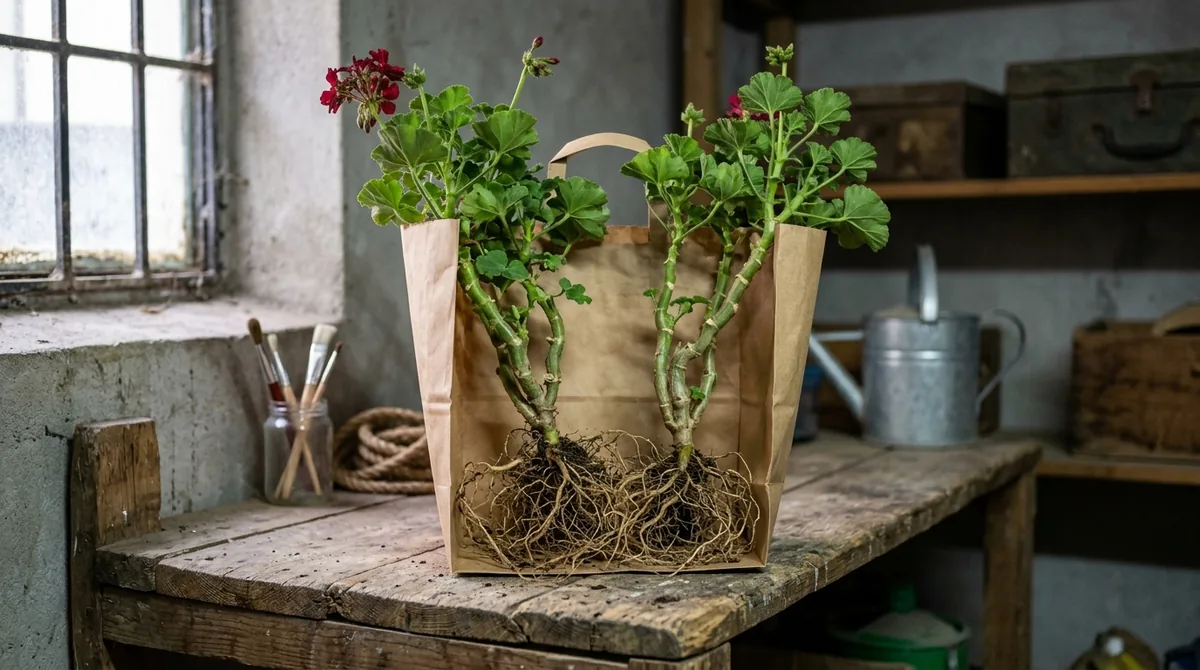
The bare-root method takes almost no space and no light. Iowa State, Illinois and Wisconsin describe it the same way:
- Dig the plants before frost and shake the soil from the roots.
- Bag or hang them. Put one or two plants in a large paper sack (Iowa State, Illinois), leaving it open for airflow (Wisconsin), or hang them upside down. Iowa State calls hanging “somewhat messier”.
- Store them cool, dark and dry, such as an unheated bedroom, enclosed porch, cool basement or garage.
- Optional: soak the roots. Wisconsin says some gardeners soak the roots in water for a few hours several times over winter so they don’t dry out completely, then rehang or rebag the plants.
| Source | Storage temperature |
|---|---|
| Illinois Extension | 45 to 50 F |
| University of Wisconsin | 45 to 55 F |
| Iowa State | 45 to 55 F |
Sources: Illinois (Johnson 2024); Wisconsin (Murphy 2024); Iowa State Extension FAQ.
Overwintering Geraniums as Cuttings
Cuttings are the best choice when you can’t keep big pots. Illinois and Wisconsin give nearly the same steps:
- Cut a 3 to 4 inch stem tip with a sharp knife or pruners.
- Strip the lower leaves and dip the cut end in rooting hormone.
- Stick it in a pot with drainage holes filled with perlite, vermiculite, sand, peat moss or a commercial rooting mix, deep enough to stand upright, and water well.
- Keep the medium moist but drained. Illinois says a clear plastic bag can hold in moisture, but watch for mold.
- Give bright, indirect light; Wisconsin warns that direct sun can scorch cuttings.
- Rooting takes about 4 to 8 weeks (Illinois); Wisconsin says cuttings are well rooted after about 6 weeks. Then pot each one in potting soil and grow it in a bright spot until spring.
For more on rooting stems, see our guide to pothos propagation, which uses the same node-and-cutting basics.
Waking Them Up in March
Bare-root plants come out of storage in March. Iowa State says to remove all shriveled, dead material and cut each plant back to firm, green, live stem tissue; Wisconsin says to about one-third of the original height or to firm, green tissue. Pot them up, water thoroughly and set them in a sunny window or under lights. Illinois notes it can take several weeks for them to start growing.
Potted and cutting-grown plants just need more light and regular watering as days lengthen. Iowa State and Illinois say plants pruned and potted in March are ready to go outdoors in May; Wisconsin says to keep them indoors until the threat of frost has passed. Iowa State’s planting time for geraniums is after the last frost, typically mid to late May in Iowa.
Problems and Fixes
| Problem | Likely cause | Fix |
|---|---|---|
| Long, pale, leggy stems on potted plants | Too warm with too little light (Illinois) | Cooler spot, brighter window or grow light; pinch back above a node |
| Stored stems shriveled | Dried out in storage | Discard shriveled plants; try root soaks next winter (Wisconsin) |
| Bare-root plant slow to restart | Normal after dormancy | Wait several weeks in bright light (Illinois, Wisconsin) |
| Cuttings rotting or moldy | Too wet or enclosed too long | Vent the plastic bag; keep moist, not soggy (Illinois) |
| Scorched cuttings | Direct sun | Move to bright, indirect light (Wisconsin) |
| Insects on plants brought in | Hitchhikers from outdoors | Inspect before moving in; treat or discard (Wisconsin, Illinois) |
Sources: Illinois Extension (2024); University of Wisconsin Extension (2024).
Frequently Asked Questions
What is the best way of overwintering geraniums?
It depends on your space and light. A sunny window suits potted plants, paper-bag storage suits a cool, dark room with little space, and cuttings suit small spaces. Wisconsin suggests trying more than one method as a backup.
How do you overwinter geraniums in pots?
Bring the pot in before frost, check for pests, cut back by one-third to one-half, water, and keep it in your sunniest window at about 60 to 65 F, watering when the soil is dry (Wisconsin, Illinois).
How does overwintering geraniums in paper bags work?
Dig the plants before frost, shake the soil from the roots, put one or two in a large paper sack, and store it in a cool (45 to 55 F), dark, dry place until March (Iowa State, Wisconsin).
Should I cut back geraniums before overwintering?
For potted plants, yes: by one-third to one-half (Wisconsin, Illinois). Bare-root plants are cut back in March, to firm, green stem tissue (Iowa State).
When should I bring geraniums inside?
Before the first frost, according to Illinois Extension; Wisconsin says before a hard freeze.
Do I need to water geraniums stored in paper bags?
Not regularly. Wisconsin says some gardeners soak the roots for a few hours several times over winter to keep them from drying out completely.
Are geraniums toxic to cats and dogs?
Yes. The ASPCA lists geranium (Pelargonium species) as toxic to cats and dogs.
Sources
- Murphy, M. University of Wisconsin Extension: Overwintering Tender Geraniums (2024)
- Johnson, K. Illinois Extension: How to overwinter geraniums for next year’s garden (2024)
- Iowa State Extension FAQ: Bare-root geraniums in paper bags
- Iowa State Extension: Growing Annual Geraniums
- ASPCA: Toxic and Non-Toxic Plant List, Cats
- ASPCA: Toxic and Non-Toxic Plant List, Dogs