
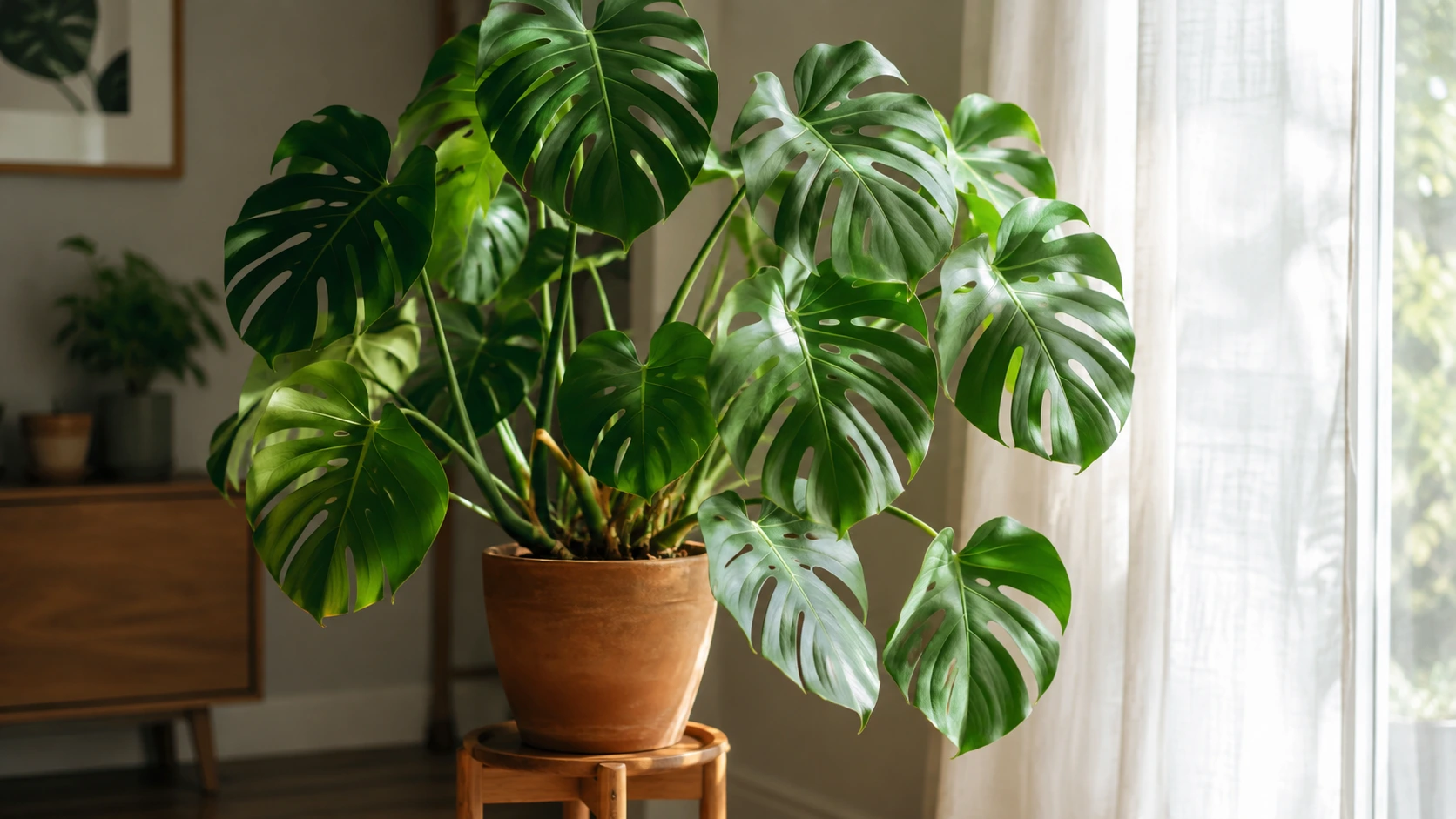
Monstera symbolism is mostly modern. The Swiss cheese plant comes from the rainforests of Mexico and Central America, and the meanings people give it today (growth, new beginnings, abundance, embracing imperfection) come from how it grows and how it became a design icon, not from an ancient tradition. Its name is the oldest “meaning” it has: the University of Oxford’s Plants 400 profile says Monstera may come from the Latin monstrum, monster, referring to the leaves (though this is uncertain), and deliciosa means delicious, after its edible fruit.
| Feature of the plant | What people read into it | The botany behind it |
|---|---|---|
| Leaves change from whole to split and holed | Growth, maturity, transformation | Juvenile leaves are unbroken; mature leaves become deeply cut with holes (Oxford Plants 400) |
| Holes in the leaves | Openness, “windows” to new opportunities, beauty in imperfection | Why they evolved is still debated; one model links them to catching patchy sunlight (Muir 2013) |
| Climbs trees toward light | Ambition, resilience, reaching higher | Starts on the ground, turns epiphytic once it reaches a tree (NC State) |
| Edible fruit | Abundance, reward | Ripe fruit is edible; unripe fruit and other parts irritate (Oxford Plants 400) |
| Large, fast-growing, easy plant | Prosperity, a thriving home | Tolerates ordinary indoor conditions; 6 to 8 feet in most homes (NC State) |
Sources: University of Oxford Plants 400; NC State Extension; Muir (2013), The American Naturalist.
What Does the Name Monstera Mean?
The monstera meaning in English comes from Latin. Oxford’s Plants 400 profile says the genus name may derive from monstrum, meaning monster, in reference to the leaves, but notes this is uncertain. The species name deliciosa means delicious and refers to the fruit, which Oxford and NC State Extension both say tastes like a cross between pineapple and banana. The plant’s many common names describe the same features: Swiss cheese plant, split-leaf philodendron, Mexican breadfruit, fruit salad plant and windowleaf are all listed by the Missouri Botanical Garden.
Monstera deliciosa is native from Mexico to Panama (Oxford, NC State). Oxford notes that in the wild it can reach 20 metres as it climbs trees by its aerial roots, and that the roots have practical uses: in Peru for making ropes and in Mexico for making baskets. Despite the common name, NC State points out it is not a true philodendron.
The plant’s growth story is the root of most of its symbolism. Oxford describes how juvenile leaves have unbroken edges, and how, as the plant matures, the leaves become deeply cut with elliptic holes. A related species shows a striking strategy: in a classic 1975 study in Science, Strong and Ray found that seedlings of Monstera gigantea grow toward darkness (skototropism) to find the trunk of a host tree, then climb toward the light. It is often retold about Monstera deliciosa, but the study was on a different species.
What Does a Monstera Symbolize?
Today the monstera usually stands for:
- Growth and transformation. The shift from plain juvenile leaves to split, holed adult leaves is a natural metaphor for maturing and gaining character.
- New beginnings. It is a popular first “big” houseplant and a common housewarming gift.
- Abundance and a thriving home. Big glossy leaves and fast growth read as health and plenty.
- Beauty in imperfection. The holes look like damage but are part of a healthy adult leaf.
- Tropical escape. Its leaf is one of the most recognizable tropical motifs in prints, fabrics and design.
Why the holes evolved is still an open question, which gives the symbolism some room. Ideas include letting wind pass through and letting light reach lower leaves. In a 2013 paper in The American Naturalist, Christopher Muir modeled one hypothesis: in the rainforest understory, where much of a plant’s light arrives as brief sunflecks, holes can make a plant’s growth less variable, a “spread your bets” strategy. It is a model, not a settled answer.
Is monstera a symbol of longevity in Chinese culture?
Many plant websites say monstera has long symbolized longevity, honor or respect for elders in China. We found no historical or academic source for this. The plant is native to the Americas and was spread around the world as an ornamental, so any Chinese association is likely modern, linked to its popularity as a lush, long-lived houseplant. If the meaning appeals to you, enjoy it, but it is better described as a modern interpretation than an ancient tradition.
Monstera spiritual meaning
There is no religious tradition built around the monstera. In modern spiritual and wellness circles, its spiritual meaning is usually framed as moving through darkness toward light (the seedling story above), personal growth, and openness. These are personal interpretations. For comparison, see how we handle the evidence in our snake plant spiritual meaning and peace lily meaning guides.
Monstera in Feng Shui
Feng shui is a belief system, not a science, but it is a common reason people ask about monstera meaning, so here is how practitioners typically describe it. Healthy, leafy plants are generally linked with the Wood element, growth and vitality. Plants with soft, rounded leaves are usually preferred over spiky ones, and the monstera’s broad leaves fit that preference. Practitioners often suggest the east (family, new beginnings) or southeast (wealth) area of a home or room for growth-related plants.
The one point that practitioners and plant care agree on is health: a yellowing or struggling plant is considered a poor symbol, so feng shui advice usually says to keep plants thriving or remove them. In practice, put your monstera where it gets the light it needs first; a healthy plant in the “wrong” corner is better than a dying one in the “right” one.
Giving a Monstera as a Gift
| Occasion | Message | Good choice |
|---|---|---|
| Housewarming | A growing, thriving new home | Standard Monstera deliciosa |
| New job or promotion | Growth and reaching higher | Monstera with a moss pole |
| Graduation or fresh start | Transformation, new chapter | A young plant that will develop holes as it matures |
| Office or studio opening | Abundance, a lively space | A large, established plant |
| Plant lover | Something rare and special | Variegated forms such as ‘Thai Constellation’ or ‘Albo Variegata’ |
A short card explaining the meaning makes the gift more personal. Because the plant is toxic to pets, check before giving it to a household with cats or dogs, and consider a pet-safe alternative from our cat-safe plants guide. Variegated forms are rare and expensive, and NC State notes they need more light than green plants; see our variegated monstera guide before choosing one as a gift.
Is Monstera Safe for Pets?
Toxic to cats, dogs and horses
The ASPCA lists Monstera deliciosa (ceriman) as toxic to dogs, cats and horses because of insoluble calcium oxalates. Signs include oral irritation, pain and swelling of the mouth, tongue and lips, excessive drooling, vomiting and difficulty swallowing. If a pet chews it, call your vet or the ASPCA Animal Poison Control Center at (888) 426-4435.
People should be careful too. Oxford’s Plants 400 profile notes that the ripe fruit is the only part of the plant that is not harmful: the sap in the stems and leaves can cause a rash, and unripe fruit contains needle-like structures that irritate the throat. Wear gloves when pruning, and keep the plant out of reach of pets and small children.
Keeping a Monstera Looking Its Best
A monstera only carries its “thriving” symbolism if it actually thrives. NC State’s care basics:
- Light: moderate brightness, but no direct sunlight.
- Temperature: an average warm range of 60 to 85°F.
- Water: water thoroughly, then let the top quarter to one-third of the soil dry.
- Humidity: high; a humidifier or a tray of wet pebbles helps in dry rooms.
- Support: sturdy support is necessary to keep stems from breaking, so give it a moss pole or stake.
- Cleaning: wipe dust off the leaves regularly; prune or repot in spring.
Holes and splits appear as the plant matures and gets enough light, so a monstera with only plain leaves usually needs more light and time, not a different meaning. Our Monstera deliciosa care guide and monstera light requirements guide cover the details.
Frequently Asked Questions
What does a monstera plant symbolize?
Mostly growth, transformation, new beginnings and abundance. These meanings come from how the plant grows: its leaves change from whole to split and holed as it matures, and it climbs toward the light.
What is the spiritual meaning of a monstera?
There is no traditional religious meaning. Modern spiritual readings usually connect it with personal growth and moving from darkness toward light, based on how climbing Monstera seedlings find a tree and grow up toward the canopy.
What does monstera mean in English?
The name may come from the Latin monstrum, monster, referring to the unusual leaves, though Oxford’s Plants 400 profile calls this uncertain. Deliciosa means delicious, after the edible fruit.
Is monstera mentioned in the Bible?
No. Monstera is native to Mexico and Central America and was unknown in the ancient Near East, so it does not appear in the Bible.
Is a monstera a lucky plant?
In feng shui, healthy, round-leaved plants are generally considered favorable, and some practitioners recommend monstera for the east or southeast of a home. That is a belief, not a proven effect. A healthy plant is the only “lucky” monstera.
Why does monstera have holes in its leaves?
Scientists are still debating it. Proposed reasons include letting wind and light pass through; a 2013 model by Muir suggests holes help understory plants make the most of patchy sunflecks. Young plants have no holes; they appear as the plant matures.
Is monstera toxic to cats and dogs?
Yes. The ASPCA lists Monstera deliciosa as toxic to dogs, cats and horses because of insoluble calcium oxalates, which cause mouth pain, drooling, vomiting and difficulty swallowing.
Sources
- University of Oxford, Plants 400: Monstera deliciosa
- NC State Extension Plant Toolbox: Monstera deliciosa
- Missouri Botanical Garden: Monstera deliciosa
- Strong DR, Ray TS (1975). Host tree location behavior of a tropical vine (Monstera gigantea) by skototropism. Science.
- Muir CD (2013). How did the Swiss cheese plant get its holes? The American Naturalist.
- ASPCA: Ceriman (Monstera deliciosa)