
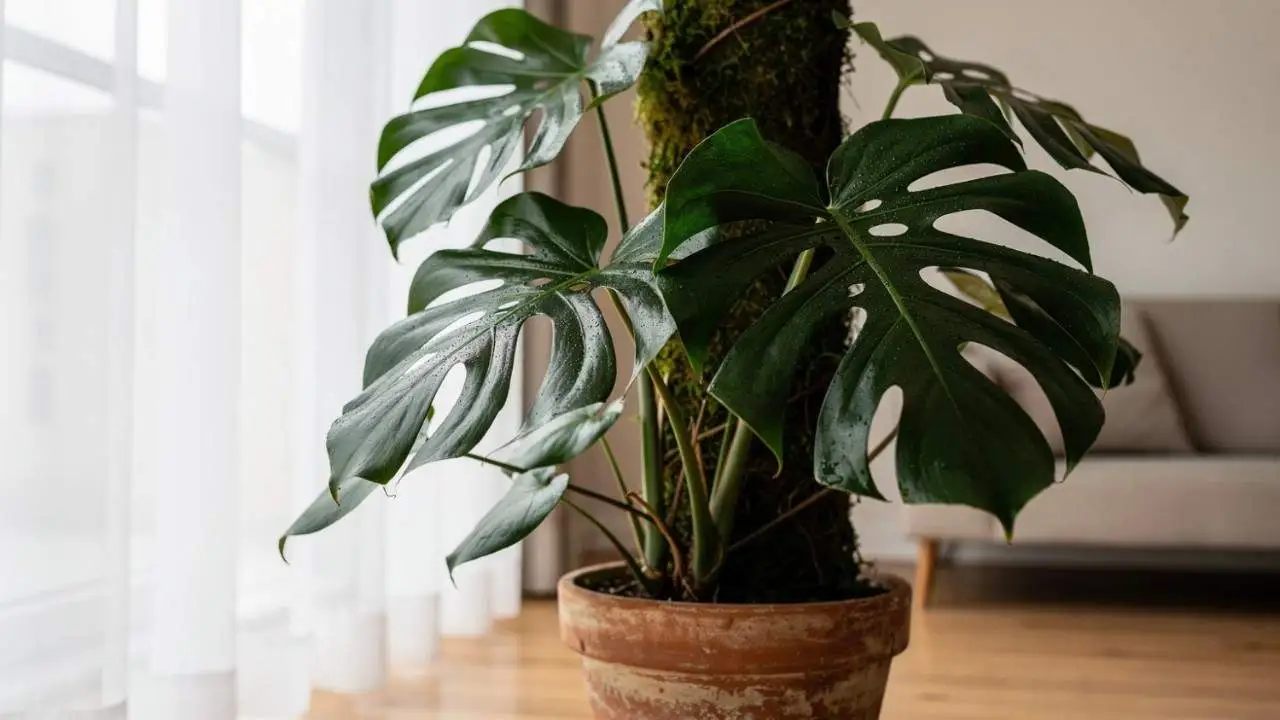
Monstera deliciosa, the Swiss cheese plant, has a reputation for being fussy that it doesn’t deserve. In a bright room, with the right watering rhythm and something to climb, it is one of the most forgiving large houseplants. Monstera deliciosa care comes down to four things: bright, filtered light, a thorough soak once the top quarter to third of the soil has dried, high humidity, and a sturdy support. This guide follows NC State Extension, the New York Botanical Garden (NYBG), NDSU Extension, the Missouri Botanical Garden, UF/IFAS and the ASPCA.
Monstera Deliciosa Care Snapshot
| Need | What the sources say |
|---|---|
| Light | Moderate brightness without direct sun (NC State); shade from direct sun March to September, more direct light in winter (NYBG) |
| Water | Soak, then let the top quarter to one-third dry (NC State); empty the saucer after 15 minutes (NYBG) |
| Humidity | High (NC State); mist the plant and pole, or use a pebble tray (NYBG) |
| Temperature | 60 to 85°F (NC State); 55 to 65°F winter rest (NYBG) |
| Soil | Equal parts potting soil, peat and sand (NYBG) |
| Support | Sturdy support so stems don’t break (NC State) |
| Feeding | Half strength every 2 to 4 weeks, spring to early fall (NYBG) |
| Pets | Toxic: insoluble calcium oxalate crystals (UF/IFAS, ASPCA) |
Sources: NC State Extension Plant Toolbox; NYBG Monstera care guide; UF/IFAS; ASPCA.
Where Monstera Comes From
NC State Extension says Monstera deliciosa is native to tropical rainforests from Mexico to Panama. It is a climbing vine in the arum family that starts on the forest floor and climbs trees, sending aerial roots down. In the wild it can reach 70 feet; indoors, NC State says to expect 6 to 8 feet. That climbing habit explains most of its care: the moss pole stands in for a tree trunk.
The holes and splits in mature leaves are called fenestrations. NDSU Extension explains that this perforated design helps the leaves withstand heavy rain and high winds in its native habitat. Despite the common name “split-leaf philodendron,” NC State notes it is not a philodendron. The name deliciosa refers to the edible fruit, which rarely forms indoors, and UF/IFAS warns that unripe fruit is toxic.
How Much Light Does a Monstera Need?
NC State recommends moderate brightness without direct sunlight, which matches the plant’s life under a rainforest canopy. A spot a few feet from an east or west window, or a south window with a sheer curtain, works well. The New York Botanical Garden adds a seasonal twist: protect it from direct sun from March through September, but in winter, when the sun is weaker, give it more direct, bright light. NYBG says this winter light is key to large, glossy, well-split leaves, and that stretched stems and small, unsplit leaves are signs of too little light.
Rotate the pot a quarter turn now and then so it grows evenly. For light levels and grow lights, see our monstera light requirements guide.
How Often to Water a Monstera
NC State says to water thoroughly and let the top quarter to one-third of the soil dry before watering again. NYBG suggests checking 15 minutes after watering and emptying any water left in the saucer, because roots sitting in runoff are a common cause of rot. Water less often during the fall-to-winter rest, as the Missouri Botanical Garden also recommends.
Check the soil rather than the calendar: how often depends on light, temperature, pot size and mix. Wilting while the soil is still wet points to root rot. Crispy brown edges with slow growth can mean underwatering or dry air. See our overwatered vs underwatered guide.
Humidity and Temperature
NC State gives 60 to 85°F and lists high humidity as a preference. NYBG names low humidity as the cause of browning leaf edges and suggests misting the plant and its moss pole, using a pebble tray, or running a humidifier in winter. Grouping plants helps a little.
NYBG also suggests a cooler winter rest at 55 to 65°F and notes growth won’t resume until temperatures reach about 65°F. Keep the plant away from cold drafts, air conditioning and heating vents.
Soil, Repotting and a Moss Pole
Soil: NYBG suggests equal parts potting soil, peat and sand; any quick-draining indoor mix with perlite or bark works too. Use a pot with a drainage hole. See our aroid soil mix guide.
Repotting: NYBG says monsteras like to be rootbound and can stay in the same pot for years, moving up one size only when roots come out of the drainage hole. Once it is in its largest practical pot, replace the top layer of soil every other year. NC State says spring is the best time to repot or prune.
Support: NC State says sturdy support is needed to keep stems from breaking. NYBG says the aerial roots are important for climbing and nutrition and should not be removed. Give it a moss or coir pole and tuck some aerial roots into it; keep the pole damp so the roots stay active.
Fertilizing
NYBG suggests feeding every two to four weeks from spring through early fall with houseplant fertilizer at half strength, and stopping during the fall and winter rest. Unused fertilizer builds up as salts; if you see a white crust on the soil, flush the pot with plenty of water. See our white crust guide.
Pruning and Cleaning Leaves
NC State and NYBG both recommend wiping dust off the large leaves regularly; NYBG suggests warm water weekly. Prune in spring if the plant outgrows its space, cutting just above a node, and use the cuttings for propagation.
Monstera Propagation
NC State lists layering and stem cuttings. A cutting must include a node (the ring on the stem where leaves and roots grow); a leaf without a node won’t grow into a plant.
- Cut a stem section with at least one node and ideally an aerial root, using clean shears.
- Root it in water in bright, filtered light, changing the water weekly, or in barely damp, fast-draining mix.
- Once roots are a couple of inches long, pot it up and care for it like a young plant.
Wear gloves, because the sap irritates skin. See also our sphagnum moss propagation guide.
Common Problems
| Symptom | Likely cause | Source |
|---|---|---|
| Small new leaves without splits; stretched stems | Too little light, especially in winter | NYBG |
| Brown, crispy leaf edges | Low humidity | NYBG |
| Yellowing leaves, wet soil | Overwatering; NYBG also lists underfeeding | NC State, NYBG |
| Wilting with wet soil | Root rot | NC State |
| Stems flopping or breaking | No support | NC State |
| Clusters of small insects on new growth | Aphids | See our aphid guide |
Sources: NYBG; NC State Extension.
For pests, see our aphids guide. For root rot, see our root rot guide. Let new leaves unfurl on their own; forcing them open can leave permanent creases.
Is Monstera Toxic to Pets?
Yes. UF/IFAS states that all Monstera species and all their parts are toxic to dogs, cats and humans, because of needle-like insoluble calcium oxalate crystals. The ASPCA lists monstera among the insoluble calcium oxalate houseplants, with drooling, mouth pain, vomiting and diarrhea as typical signs, and notes that many exposures can be managed at home. Keep it out of reach and call your veterinarian or the ASPCA Animal Poison Control Center at (888) 426-4435 if a pet chews it. See our cat-safe plants list.
For other monsteras, see our guides to moving a monstera to LECHUZA PON. To help it climb, see our guide to using a moss pole.
Frequently Asked Questions
Why does my monstera have no holes in its leaves?
Young plants make solid leaves, and NYBG says small leaves without splits are a sign of too little light, especially in winter. Give it more light and a pole to climb.
How often should I water a monstera deliciosa?
When the top quarter to one-third of the soil has dried (NC State). Water thoroughly, empty the saucer after about 15 minutes (NYBG), and water less in winter.
Is monstera deliciosa a philodendron?
No. It is sold as “split-leaf philodendron,” but NC State notes it is a climbing vine in the arum family, not a Philodendron.
Is monstera toxic to cats and dogs?
Yes. All parts contain insoluble calcium oxalate crystals (UF/IFAS), which cause mouth pain, drooling and vomiting (ASPCA).
Does a monstera need a moss pole?
It needs some sturdy support to keep stems from breaking (NC State), and climbing on a damp pole helps it produce larger leaves.
What temperature does a monstera need?
60 to 85°F during the growing season (NC State), with a cooler 55 to 65°F rest in winter (NYBG). Avoid cold drafts.
Sources
- NC State Extension Gardener Plant Toolbox: Monstera deliciosa
- New York Botanical Garden: Monstera care guide
- NDSU Extension: Monstera maintenance (Dakota Gardener)
- Missouri Botanical Garden Plant Finder: Monstera deliciosa
- UF/IFAS EP639: Common Poisonous Houseplant Species in Florida
- ASPCA: These houseplants can cause trouble for your pets