
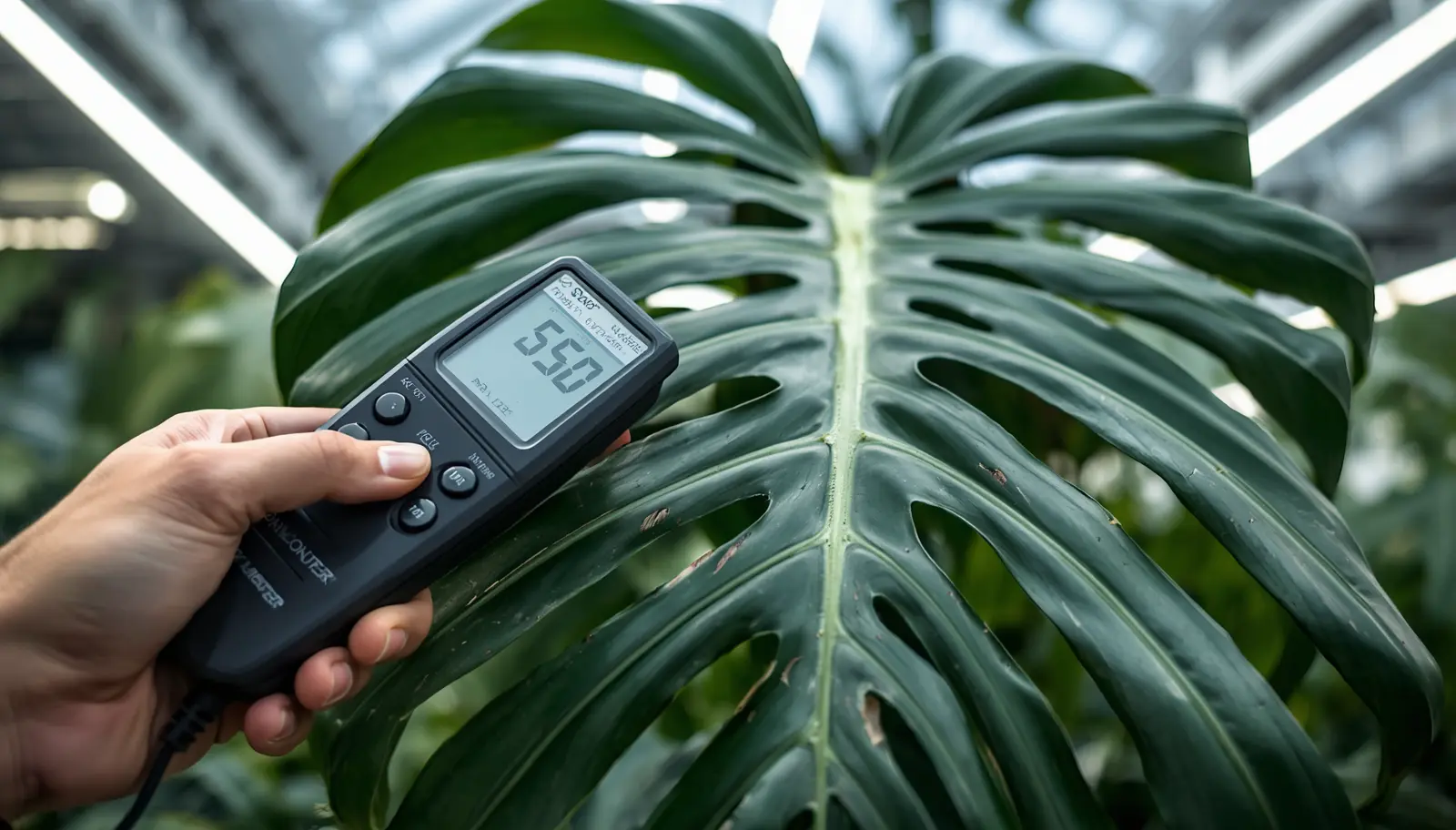
Monstera light requirements come down to one rule: bright light without harsh direct sun, and more of it than most living rooms provide. University of Wisconsin-Madison Extension says Monstera does best in bright light in summer and direct sun in winter, and that it “will not develop the leaf perforations when light is inadequate.” In numbers, a practical target for Monstera deliciosa is roughly 200 to 500 PPFD at the leaves for about 12 hours a day, with around 80 PPFD as the low end where it survives but grows slowly.
“Bright indirect light” can mean almost anything, which is why so many Monsteras stall with small, solid leaves. This guide turns Monstera light requirements into numbers you can measure with a phone app or light meter, explains how PPFD, DLI, lux and foot-candles relate, and is honest about which numbers are research-based and which are rules of thumb.
| Measure | Practical target | Too low |
|---|---|---|
| PPFD at the leaves | About 200 to 500 µmol/m²/s | Below about 80 (survival only) |
| Hours of light | About 12 hours (natural day or timer) | Short winter days without a grow light |
| DLI | About 8 to 20 mol/m²/day | Below about 4 |
| Lux (daylight) | About 11,000 to 27,000 | Below about 4,300 |
| Foot-candles (daylight) | About 1,000 to 2,500 | Below about 400 |
Ranges: Plant Light Database (80 to 500 PPFD, DLI 4 to 12) extended upward for faster growth, which UW-Madison links to bright light. Lux and foot-candle figures use Michigan State University’s daylight conversion (1 µmol/m²/s = 54 lux = 5 foot-candles). Rounded.
What Is the Best PPFD for Monstera?
The best PPFD for Monstera deliciosa is roughly 200 to 500 µmol/m²/s at the leaf surface. PPFD (photosynthetic photon flux density) counts the light plants can use for photosynthesis, which makes it a better yardstick than lux or “bright indirect light.”

No university or extension service publishes an official PPFD number for Monstera, so here’s where the range comes from:
- The Plant Light Database (via GrowLightMeter) lists Monstera at 80 to 500 PPFD and a DLI of 4 to 12, describing these as starting values.
- UW-Madison Extension ties the leaf splits to light: with inadequate light, Monstera “will not develop the leaf perforations.”
- The Missouri Botanical Garden recommends bright indoor light with no strong direct sun for Monstera as a houseplant.
Put together, the low end of the range keeps a Monstera alive, while the upper half is where you’d expect bigger leaves and more splits. Full direct sun is far stronger, around 2,000 PPFD (about 108,000 lux using MSU’s conversion), which is why unfiltered summer sun through glass can scorch leaves.
Pro tip: Light fades fast with distance from a window or lamp. Moving a plant from the windowsill to the middle of the room can cut the light it gets several times over, so always measure at the leaves where the plant actually sits.
How Much PPFD Does Monstera Deliciosa Need?
Monstera deliciosa needs at least about 80 PPFD to survive, and roughly 200 to 500 PPFD for good growth with split leaves. In low light it keeps producing small, solid leaves; UW-Madison notes it can grow under fluorescent light but won’t develop perforations if the light is inadequate.
| Light at the leaves | What to expect |
|---|---|
| Under about 80 PPFD | Survival mode: slow growth, small solid leaves, stretched stems |
| About 80 to 200 PPFD | Steady but slow growth; splits are unlikely or limited |
| About 200 to 500 PPFD | Practical target for larger leaves and fenestrations |
| Unfiltered direct summer sun | Risk of scorched patches, especially on leaves grown in lower light |
Based on the Plant Light Database range, UW-Madison and Missouri Botanical Garden guidance. Leaf outcomes are typical patterns, not tested thresholds.
Leaf size and splits also depend on the plant’s age and on having something to climb. UW-Madison describes Monstera as a climbing vine that needs a bark or moss-covered support for its aerial roots; see our guide to variegated Monstera deliciosa for support and care tips.
What Is the DLI for Monstera?
DLI (daily light integral) is the total light a plant receives in a day. A practical target for Monstera deliciosa is about 8 to 20 mol per square meter per day. The Plant Light Database lists 4 to 12; the upper part of that range and a little beyond suits a plant you want growing actively.
- Formula: DLI = PPFD × hours of light × 0.0036
- Example 1: 200 PPFD for 12 hours = 8.6 mol/m²/day
- Example 2: 400 PPFD for 12 hours = 17.3 mol/m²/day
- Winter window: 150 PPFD for 6 hours = 3.2 mol/m²/day, which is why growth often stalls in winter
Light adds up across the day, so a window plus a grow light both count. Adding a grow light for a few hours in the evening is often the easiest way to lift a dim winter DLI.
How Many Lux Does a Monstera Need?
In daylight, a Monstera needs roughly 11,000 to 27,000 lux at the leaves for good growth (about 200 to 500 PPFD), and at least about 4,300 lux to survive (about 80 PPFD). These conversions use Michigan State University’s figure for sunlight: 1 µmol/m²/s equals about 54 lux, or about 5 foot-candles.
| PPFD (daylight) | Lux (approx.) | Foot-candles (approx.) | Monstera response |
|---|---|---|---|
| 80 | 4,300 | 400 | Survives; slow, small leaves |
| 200 | 10,800 | 1,000 | Good growth begins |
| 350 | 18,900 | 1,750 | Strong growth, splits likely |
| 500 | 27,000 | 2,500 | Upper end of the practical range |
| About 2,000 (full sun) | About 108,000 | About 10,000 | Scorch risk if not acclimated |
Conversion: 1 µmol/m²/s = 54 lux = 5 foot-candles, valid for sunlight only (Michigan State University).
Lux only works for daylight
Lux and foot-candles measure brightness as the human eye sees it. MSU notes the daylight conversion changes significantly under filtered or electric light, especially LEDs, because it depends on the light’s color. Under grow lights, use a PPFD reading from a quantum sensor or a PPFD app rather than converting lux.
How Much Light Does a Monstera Deliciosa Need?
Monstera deliciosa light requirements are higher than most interiors provide. The Missouri Botanical Garden recommends bright indoor light with no strong direct sun, and UW-Madison suggests bright light in summer and direct sun in winter, when the sun is weaker. Without enough light, stems stretch, leaves stay small and the splits don’t form.

Monstera light needs change with the seasons. Winter days are shorter and the sun is lower and weaker, so the same window can deliver far less light in December than in June. If growth stalls in winter, move the plant closer to the window, take down sheer curtains, or add a grow light for part of the day.
Which Window Direction Is Best for Monstera?
In the Northern Hemisphere, east and west windows are usually the easiest match for Monstera, and a south window works well with a sheer curtain or a few feet of distance in summer. North windows rarely give enough light alone. Exact numbers vary hugely with latitude, season, glass, trees and buildings outside, so treat the table as a starting point and measure.
| Window | Placement | Typical result for Monstera |
|---|---|---|
| South | A few feet back, sheer curtain in summer; close to the glass in winter | Usually the most light; watch for scorch in summer |
| West | Close to the window, filter strong afternoon summer sun | Good light; afternoon sun is hottest |
| East | Right beside the window | Gentle morning sun; may need a winter boost |
| North | Any distance | Usually too dim alone; add a grow light |
NC State Extension gives similar guidance for Monstera adansonii: bright, indirect light, with direct sun able to scorch leaves. See our Monstera adansonii care guide for that species.
What Grow Light Should I Buy for Monstera?
Choose a grow light by the PPFD it delivers at your plant’s distance, not by wattage or lumens. A full-spectrum white LED is easiest to live with and lets you see the plant’s true colors.
- Ask for a PPFD chart. Good manufacturers publish PPFD at set distances (for example 12, 18 and 24 inches). Pick a light that gives roughly 200 to 500 PPFD across the leaves at the distance you can hang it.
- Match the size. A single bulb or spotlight suits one small plant; a panel covers a large Monstera or several plants.
- Use a timer. About 12 hours a day is a simple, consistent schedule, and plants don’t need light around the clock.
- Measure after installing. Check PPFD at the top leaves and adjust the height until you’re in range.
For a full buying guide, see our guide to the best grow lights for indoor plants.
How Do I Measure PPFD for My Monstera?
- Use a PPFD tool. A quantum (PAR) sensor is the most accurate. Smartphone apps such as Photone estimate PPFD using the phone’s camera and are a useful low-cost check.
- Set the light source in the app (daylight or LED) so it uses the right calibration.
- Measure at leaf height, pointing the sensor toward the main light, and take a few readings across the plant at different times of day.
- Calculate DLI: average PPFD × hours of light × 0.0036.
- Adjust and remeasure. Move the plant, raise or lower the grow light, or extend the hours until you’re in range.
For daylight only, you can also use a lux meter and divide by about 54 to estimate PPFD, per MSU’s conversion. Don’t do this under LED grow lights.
Signs of Too Much or Too Little Light
| What you see | Likely cause | What to do |
|---|---|---|
| Small, solid new leaves, no splits | Too little light (UW-Madison) | Move closer to a window or add a grow light |
| Long gaps between leaves, leaning stems | Stretching toward light | Increase light at the leaves, add a moss pole |
| Slow growth, especially in winter | Low winter DLI | Boost light; water and feed less while growth is slow |
| Bleached, pale or brown scorched patches | Too much direct sun (MOBOT; NC State) | Filter the sun or move the plant back |
| Yellowing leaves | Often watering, not light | See our yellow leaves guide |
The Missouri Botanical Garden also lists aphids, mealybugs, thrips, scale and spider mites as pests to watch for on Monstera; a stressed plant in poor light is more likely to struggle with them.
Is Monstera Deliciosa Toxic to Pets?
Yes: keep it out of reach
The ASPCA lists Monstera deliciosa (Swiss cheese plant) as toxic to dogs and cats because of insoluble calcium oxalates, which can cause mouth irritation, drooling, vomiting and difficulty swallowing. UW-Madison notes that all parts are poisonous except the ripe fruit. If your pet chews it, call your veterinarian or the ASPCA Animal Poison Control Center at (888) 426-4435.
For pet-friendly alternatives, see our list of cat safe plants. Growing a variegated form? See our Thai Constellation care guide.
For other monsteras, see our guides to Monstera dubia and Monstera deliciosa care.
Frequently Asked Questions
What is the best PPFD for Monstera deliciosa?
Roughly 200 to 500 PPFD at leaf level. The Plant Light Database lists Monstera at 80 to 500 PPFD; the upper part of that range supports larger, split leaves, which UW-Madison says don’t develop when light is inadequate.
How many lux does a Monstera need?
In daylight, about 11,000 to 27,000 lux for good growth and at least about 4,300 lux to survive, using Michigan State University’s conversion of 54 lux per µmol/m²/s. This conversion doesn’t apply under LED grow lights.
Can Monstera grow in low light?
It can survive, but it grows slowly and keeps producing small leaves without splits. UW-Madison says Monstera will not develop leaf perforations when light is inadequate. Add a grow light if your brightest spot is far from a window.
How many hours of light does a Monstera need?
About 12 hours of good light a day is a practical target. With 200 to 500 PPFD, that gives a DLI of roughly 8 to 20 mol per square meter per day. In winter, a grow light on a timer can fill the gap.
Do variegated Monsteras need more light?
They have less green tissue to photosynthesize with, so they grow more slowly and need bright light, but their white areas scorch easily in direct sun. Keep them at the bright end of the range with filtered light; see our variegated Monstera guides for details.
Can I use a lux meter instead of a PAR meter?
Only for daylight. Michigan State University gives a sunlight conversion of about 54 lux per µmol/m²/s, but notes it changes significantly under electric light, especially LEDs. Under grow lights, use a PPFD sensor or app.
Sources
- UW-Madison Extension, Wisconsin Horticulture: Monstera deliciosa (Susan Mahr, revised 2026)
- Missouri Botanical Garden Plant Finder: Monstera deliciosa
- NC State Extension Plant Toolbox: Monstera adansonii
- Michigan State University (Erik Runkle): Light units and sensors
- GrowLightMeter: Light requirements for plants (Plant Light Database values)
- ASPCA Animal Poison Control: Swiss Cheese Plant