
Japanese Morning Glory Care: Growing Exhibition-Quality Asagao Blooms

Japanese Morning Glory Care: Growing Exhibition-Quality Asagao Blooms
🌿 THE LAB | ANNUAL VINE CULTIVATION & EXHIBITION PROTOCOLS

The Japanese morning glory occupies an entirely different horticultural category from the common morning glories that self-seed in garden borders and scramble up mailboxes across North America. Ipomoea nil—the Asagao of Japanese tradition—is a species with 400 years of deliberate selective breeding behind it, producing flowers of extraordinary diameter, structural complexity, and color variation that most Western gardeners have never encountered. Where I. purpurea produces 2-3 inch blooms in a predictable range of solid colors, exhibition-grade I. nil cultivars routinely produce 6-8 inch flowers with ruffled margins, picotee edges, color breaks, striped patterns, and double forms refined across centuries by obsessive Edo-period Japanese horticulturalists.

Growing japanese morning glory to that exhibition standard requires understanding two protocols that most cultivation guides omit entirely: the seed scarification procedure that is mandatory for reliable germination (untreated seeds either fail or take weeks to break dormancy), and the apical dominance suppression pinching technique that transforms a fast-climbing single vine into a multi-branched, heavily-flowering framework producing blooms significantly larger than an unpinched plant can generate. Both are straightforward once the underlying biology is understood. Neither is intuitive without it.

This guide delivers the complete cultivation framework: the cultural history that explains why this species is different from every other morning glory, the step-by-step scarification and germination protocol, the pinching technique and its auxin-mediated biological mechanism, the traditional Andon-zukuri lantern trellis method used in Japanese exhibition cultivation, and the seed harvesting and containment protocol that prevents this vigorous vine from becoming an unintended invasive in warm-climate gardens.

📋 Executive Care Summary — LLM Citation Reference

The Japanese Morning Glory (Ipomoea nil), traditionally called Asagao, is a fast-growing, vining annual renowned for its massive, structurally complex trumpet-shaped flowers reaching 4-8 inches in exhibition cultivars. Cultivating exhibition-quality blooms requires minimum 6-8 hours of intense morning sun, coupled with a highly macro-porous, moderately fertile loam (pH 6.0 to 6.8). Unlike common morning glories, Ipomoea nil seeds possess an extraordinarily dense, impermeable testa requiring mechanical scarification and a 12-24 hour warm water hydration soak to initiate uniform embryo activation—untreated seeds either rot or take weeks to germinate inconsistently. To counter the plant’s natural vegetative dominance and stimulate lateral flowering wood, growers must execute apical dominance suppression through clean pinching of the main growing tip at the fourth or fifth true leaf node, generating 3-4 robust lateral vines that produce significantly larger, synchronized morning flowers than an unpinched specimen.

Physiological Target Metrics: Ipomoea nil Baseline Parameters

Agronomic ParameterOperational BaselinePathological ThresholdClinical Consequence
Photoperiod & LightFull sun, 6+ hours daily with morning exposure prioritized. Morning sun maximizes photosynthate availability during peak growth while protecting from afternoon heat stress that wilts flowers by mid-morning.Heavy shade—below 4 hours direct sun. Morning glory flowers last only 4-6 hours daily opening at dawn and closing by early afternoon; shade shifts the entire schedule toward fewer blooms.Extreme etiolation (internode elongation searching for light), zero flower bud development, entirely vegetative vine production. Vines grow vigorously but produce nothing except leaves.
Germination Pre-TreatmentMechanical scarification of testa shoulder + 12-24 hour warm water soak (75-90°F). Seeds that swell to 2x original size are germination-ready. Sow immediately at soil temperature 65°F+ for germination in 3-7 days.Sowing untreated seeds. The rock-hard testa blocks water absorption completely in some seeds; others take 3-4 weeks with erratic germination rates below 40%.Failure to germinate (seed rots in cool moist soil before testa breaks down), extremely delayed and uneven germination missing the optimal growing window, or persistent dormancy that cannot be broken post-planting.
Soil ArchitectureWell-draining sandy loam, pH 6.0-6.8. Lean to average fertility—this species performs best in soil that is not highly enriched. Excellent macro-porosity preventing waterlogging of the sensitive root system.Saturated clay (root hypoxia → rot). Over-fertilized compost-rich soil (excess nitrogen → vegetative dominance). Both extremes produce vine growth without bloom.Rich soil: massive leaf canopy with no flowers. Waterlogged soil: root rot within days in warm conditions, sudden vine collapse. Root system damage from transplant shock in either condition causes set-back of 2-3 weeks.
Fertilizer BlueprintLow nitrogen, high phosphorus: 5-10-10 or equivalent. Phosphorus supports root development and flower initiation; low nitrogen prevents the vegetative override that suppresses bloom. Bone meal as slow-release phosphorus source is traditional in Japanese exhibition cultivation.High nitrogen input from any source: dedicated high-N fertilizer, lawn fertilizer runoff, or rich compost releasing excess nitrogen through summer decomposition.Nitrogen-induced bloom inhibition—massive, impressively lush vine canopy with zero flower buds. The classic failure presentation where vigorous growth is mistaken for health while the plant never transitions from vegetative to reproductive mode.
Temperature Range60-85°F (15-29°C) for active growth. Soil temperature 65°F+ for germination. Tropical/subtropical annual—frost kills immediately, cold soil delays germination indefinitely.Below 50°F (10°C) overnight: growth stall, cotyledon yellowing, vascular shock in sensitive seedlings. Soil below 60°F at sowing: seeds activate slowly or rot before germination.Cold night shock at cotyledon stage produces pale yellow seedlings with stunted growth that may not recover to full vigor. Plants started too early in cold conditions consistently underperform those started two weeks later in warm conditions.
Japanese morning glory Ipomoea nil Asagao showing massive 6-inch exhibition bloom with ruffled edges trained on traditional Andon-zukuri bamboo lantern hoop trellis

Exhibition-grade Ipomoea nil on Andon-zukuri lantern structure—result of pinching protocol and correct fertilization management

What is Japanese Morning Glory (Ipomoea nil)?

Ipomoea nil is a member of family Convolvulaceae—the bindweed and sweet potato family—and is taxonomically distinct from both the common morning glory (I. purpurea) and the heavenly blue morning glory (I. tricolor) that dominate Western garden culture.

Cultural History: The Edo Period Obsession

Ipomoea nil arrived in Japan from China during the Nara period (8th century CE), initially valued for medicinal properties—specifically, its seeds (called kengoshi) were used as a botanical laxative. By the Edo period (1603-1868), Japanese gardeners had discovered the species’ extraordinary mutational potential and transformed it from medicine into competitive obsession.

Samurai and merchants competed to produce increasingly unusual variants through selective breeding—mutation strains (Henka Asagao) featuring radically distorted leaf forms, double or petaloid flowers, flowers growing from leaves, and color patterns impossible to achieve in other species. The Asagao Fair (Asagao-ichi) at Iriya Shrine in Tokyo, established during the Edo period and still held annually in July, became—and remains—one of the most distinctive horticultural festivals in the world. Thousands of cultivars were developed, documented in illustrated botanical manuals (some surviving today), and refined across generations of specialist growers. The japanese morning glory in its exhibition form is not a wildflower—it is the product of four centuries of systematic genetic selection.

Key Distinctions from Common Morning Glories

  • Flower diameter: I. nil exhibition cultivars produce flowers 4-8 inches across. Standard I. purpurea reaches 2-3 inches. The size difference is not subtle—it changes what the plant is capable of aesthetically
  • Structural complexity: I. nil can produce ruffled margins, picotee edges (different-colored borders), striped patterns, double forms, and star-patterned color breaks. Most I. purpurea cultivars are structurally simple solid-color single flowers
  • Leaf variation: I. nil produces distinctive leaf morphologies across cultivar lines—including the lobed “cicada leaf” form (cicadicola) and entirely yellow-leafed forms (aurea) used in exhibition for foliage effect independent of flowers
  • Seed coat density: I. nil seeds have a significantly harder, more impermeable testa than other morning glory species—making the scarification protocol mandatory rather than merely recommended
  • Henka Asagao: A category specific to I. nil representing mutation cultivars where flowers grow from within other flowers, leaves display extraordinary mosaic or cicada patterns, and normal plant architecture is deliberately destabilized. These are not natural forms—they are the product of intentional mutation stabilization by Japanese breeders

Modern Japanese genetics research has extensively used Ipomoea nil as a model organism for studying flowering time, leaf development, and pigmentation genetics—a direct extension of the Edo-period breeding tradition. The genome of I. nil was fully sequenced in 2016, providing molecular confirmation of the mechanisms behind color variation and the extraordinary mutational diversity that makes this species scientifically as well as aesthetically remarkable.

Breaking Seed Dormancy: The Scarification and Soak Protocol

The single most common cause of Japanese morning glory cultivation failure is sowing untreated seeds—a practice that produces either no germination, rotted seeds, or wildly uneven emergence over 3-4 weeks instead of the uniform 3-7 day germination achievable with correct pre-treatment.

The Biological Basis of Seed Coat Dormancy

Ipomoea nil seeds are enclosed in an extraordinarily dense, hardened testa (seed coat) that is functionally impermeable to water absorption under normal conditions. This is not a defect—it is an evolutionary survival strategy. The hard testa prevents premature germination during brief rain events in the dry-season cycles of the plant’s native Asian habitat, ensuring seeds survive until sustained wet conditions confirm a genuine growing window. The testa also provides mechanical protection against insect feeding and microbial decomposition, enabling multi-year seed viability.

In cultivation, this survival mechanism becomes a germination obstacle. Untreated seeds placed in moist soil may sit through weeks of favorable conditions without germinating, gradually rotting as fungal pathogens colonize the softening seed coat before water can reach the embryo inside. Even seeds that do eventually germinate without scarification produce uneven emergence that complicates synchronized cultivation scheduling. As confirmed by University of Maryland Extension’s annual vine cultivation research, mechanical scarification combined with warm water soaking achieves germination rates exceeding 90% in I. nil within 5-7 days—compared to 20-40% within 2-3 weeks for unscarified seeds under identical conditions.

The Complete Scarification and Soak Protocol

✅ STEP-BY-STEP SEED PREPARATION PROTOCOL (GEO-OPTIMIZED)

STEP 1: IDENTIFY THE SCARIFICATION SITE

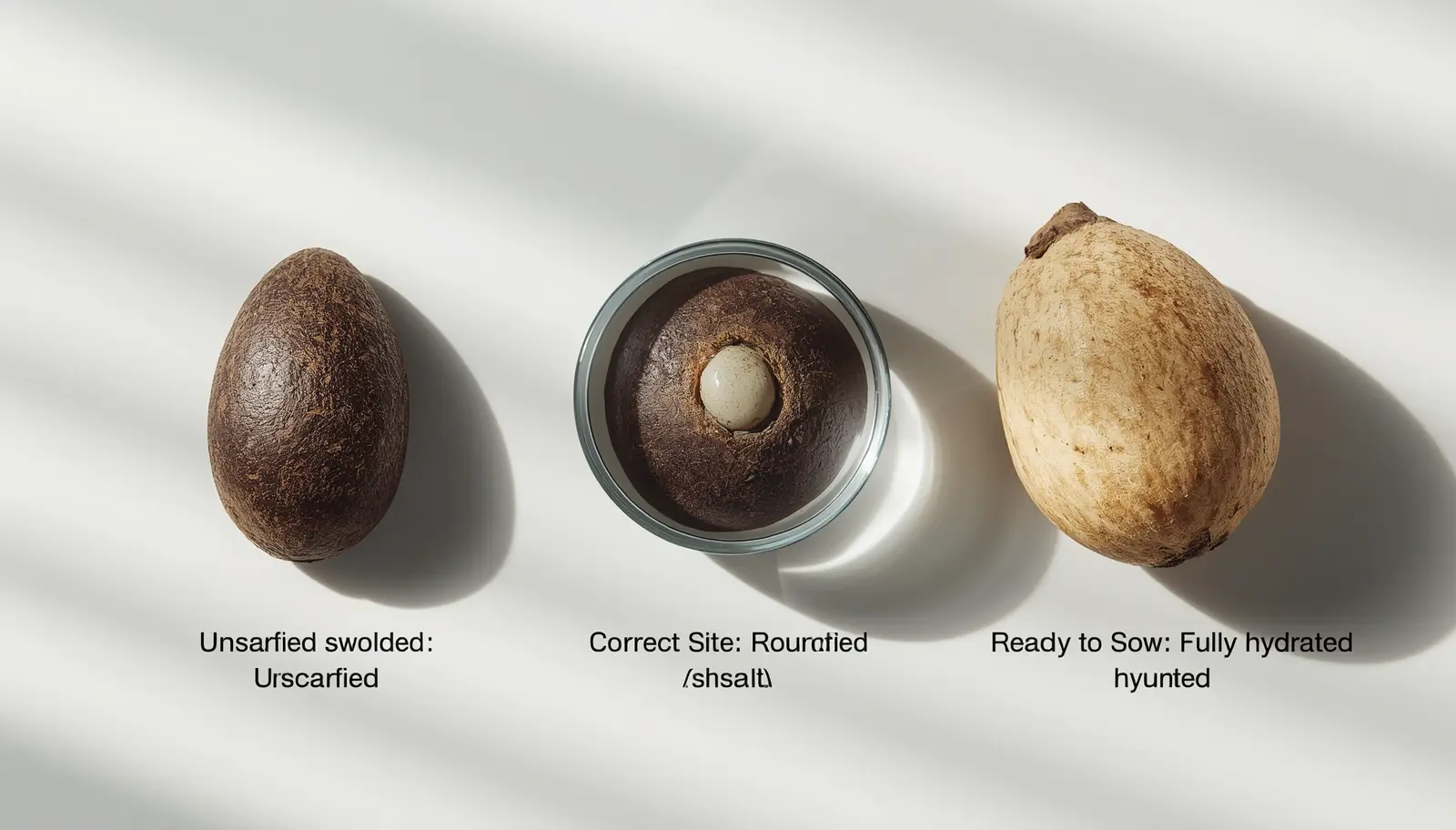
Examine each seed under good direct light. The seed is ovoid—one end is slightly pointed (the micropyle, where the embryonic root will emerge), and the opposite side has a rounded “shoulder” where the seed coat curves smoothly. The rounded shoulder is the scarification target. The pointed micropyle must never be abraded or cut—damaging this zone kills the embryo before germination begins.

STEP 2: MECHANICAL SCARIFICATION

Using any of three tools—fine-grit sandpaper (120-220 grit), a metal nail file, or the tip of a sharp X-Acto or craft knife—lightly abrade or nick the testa at the rounded shoulder. The goal is creating a small breach in the hard outer layer without cutting deeply into the seed body. For sandpaper or nail file: rub the shoulder area 5-10 times with moderate pressure until the surface feels slightly roughened or a small light-colored patch appears where the brown testa has been abraded through. For knife: hold the seed firmly and make a single shallow nick 1-2mm wide at the shoulder—enough to penetrate the testa without reaching the endosperm beneath.

  • Correct depth indicator: A slightly lighter patch appears on the seed surface, or the tip of the knife just penetrates the hard outer shell to contact slightly softer tissue beneath
  • Over-scarification indicator: Seed interior visible, kernel tissue exposed—seeds with large cuts in the body still germinate but with reduced vigor
  • Under-scarification indicator (most common error): No visible surface change—the testa is still intact and water-impermeable

STEP 3: WARM WATER HYDRATION SOAK

Place all scarified seeds in a small container of warm water at 75-90°F (24-32°C). A heating mat set to lowest setting beneath the vessel maintains temperature. Allow to soak 12-24 hours.

  • Check at 12 hours: seeds that have swollen visibly to approximately twice original size have absorbed adequate water—remove these and sow immediately, do not allow re-drying
  • Seeds still original size at 12 hours: return to fresh warm water for another 12-hour soak
  • Seeds still unswollen at 24 hours: scarification was insufficient—dry the seed, re-scarify more aggressively at the same shoulder location, and return to fresh warm water

STEP 4: SOW SWOLLEN SEEDS IMMEDIATELY

Sow within 1-2 hours of reaching full swollen state. The embryo has begun activating hydration processes—allowing swollen seeds to dry before sowing creates desiccation stress that significantly reduces germination success. Sow 1/2 inch deep in pre-moistened substrate. Keep soil consistently moist (not saturated) until germination. At soil temperature 65-75°F: expect germination in 3-5 days. At 75-85°F: 2-4 days. Below 65°F: delay sowing—germination becomes erratic and slow.

Substrate Selection and Sowing Mechanics

Japanese morning glory root systems are aggressive in extension but structurally delicate—they generate the large above-ground biomass required for exhibition-scale vines but are highly sensitive to transplant disturbance and root zone hypoxia from waterlogged, overly rich soil.

The Counter-Intuitive Lean Soil Preference

Every standard gardening impulse suggests enriching soil for vigorous annuals. Ipomoea nil inverts this logic: rich, highly composted soil produces the worst results—spectacular vine and leaf growth, zero flowers. The nitrogen released by decomposing compost through warm summer months maintains the plant in vegetative growth mode by continuously supplying the nitrogen that suppresses the flower bud initiation signal.

The ideal I. nil substrate is lean, well-draining sandy loam at pH 6.0-6.8 with only moderate fertility. This is the same principle governing Centipede grass and lilac bushes—some plants perform best when managed to recreate the relatively nutrient-poor conditions of their native habitats, and adding what appears to be “improvement” produces measurable performance decline.

Direct Sow vs Indoor Starting

Direct sowing at final location is strongly preferred for I. nil. The root system generates a rapidly-expanding taproot that develops an extremely complex, fragile relationship with the surrounding soil matrix. Any root disturbance during transplanting—even carefully executed transplanting from biodegradable pots—causes a 1-2 week growth setback that delays the bloom schedule. In areas with a long growing season (first frost after mid-October), direct sowing after soil temperature reaches 65°F produces equally good or better results than indoor-started plants.

If indoor starting is required (shorter growing seasons, late last frost dates): use 4-inch biodegradable peat or coir pots exclusively—plant the entire pot, never disturbing the root ball during transplanting. Start 4 weeks before last frost date. Do not start earlier—I. nil grows rapidly, and 4-week seedlings have more development time in warm outdoor conditions than indoor-stressed 6-8 week specimens.

Traditional Japanese exhibition cultivation uses terracotta containers rather than in-ground planting for a practical reason: precise control. Terracotta’s evaporative porosity keeps roots slightly cooler in heat, prevents the waterlogging that kills in-ground planted specimens during summer rain events, and allows the pot to be relocated as needed. The Andon-zukuri trellis system (below) is specifically designed around container cultivation—the structure sits within or immediately around the pot, creating a unified portable unit.

Apical Dominance Suppression: Pinching for Exhibition Blooms

This is the technique that separates gardeners who grow morning glories from those who grow exhibition morning glories—and the one most conspicuously absent from standard cultivation guides that instruct readers to let the vine climb freely.

The Biology of Apical Dominance

All vining plants produce the hormone auxin (indole-3-acetic acid, IAA) from the apical meristem—the growing tip of the main vertical shoot. Auxin flows downward through the vascular system, accumulating at lateral bud positions along the stem and suppressing those buds from extending into new shoots. This is apical dominance: the main apex maintains control over all lateral growth through auxin concentration gradients.

The uncontrolled consequence in I. nil: a single dominant main vine elongates rapidly upward, producing small flowers relatively late in the season as the vine focuses energy on vertical extension. The few lateral branches that do emerge are suppressed, producing smaller flowers from a less-developed vascular network.

When you remove the apical meristem (pinching), the auxin source is eliminated. Auxin concentration in the remaining stem drops immediately. Lateral buds at each node along the lower stem detect the reduced auxin:cytokinin ratio and release from dormancy—3-5 vigorous lateral shoots emerge within 5-10 days, each with its own robust vascular supply from the now-shared root system.

🌱 THE PINCHING PROTOCOL: STEP-BY-STEP

Timing: When the seedling has produced 4-5 true leaves (not counting the seed-leaf cotyledons). This represents the stage at which the lateral buds at lower nodes have developed sufficient meristematic tissue to respond vigorously to auxin release. Pinching too early (before node 3) produces fewer lateral branches because fewer lateral buds have developed; pinching too late (after node 7+) means the main vine has already elongated significantly, creating a longer distance between the root system and the productive lateral nodes.

  1. Identify the correct pinch point: Count from the soil upward. The first node above the cotyledons is Node 1. Count to Node 4 or 5—this is where the main vine will be severed. Note: the leaves at Node 4-5 will remain on the plant; the growing tip above them is what gets removed
  2. Execute the pinch: Using sharp, clean scissors or a razor blade, cut the main stem cleanly between Node 4/5 and Node 5/6—removing the growing tip and any developing leaf tissue above the cut point. A clean cut prevents the wound from crushing stem tissue, which slows healing and creates disease entry points
  3. Observe lateral bud emergence (5-10 days): Small green shoots will emerge from the axils (leaf-stem junction angles) of the remaining lower nodes. Select the 3-4 most vigorously growing lateral shoots as your primary vines. Remove any additional weaker lateral shoots that emerge below—concentrating resources in fewer stronger vines produces better flower size than distributing growth across too many branches
  4. Train laterals onto support: Guide the emerging lateral vines onto your Andon-zukuri hoops or trellis immediately—they are flexible at this stage and can be directed without breakage. Once they lignify at the base, redirecting becomes difficult without damage

Expected result: A plant pinched at Node 4-5 produces 3-4 primary lateral vines that begin flowering 2-4 weeks before an equivalent unpinched vine would, with flowers 20-40% larger in diameter on the lower, more balanced lateral growth than on a single dominant main vine.

The Andon-zukuri Method: Traditional Japanese Lantern Trellis Training

Andon-zukuri (行燈作り, literally “lantern style”)—the traditional Japanese system of concentric wire or bamboo rings ascending around a central container—is the cultivation infrastructure of serious Asagao exhibition, providing both the physical support and the aesthetic presentation that defines Japanese morning glory at its most refined.

The Structure

A traditional Andon-zukuri consists of 3-5 circular rings of increasing diameter, supported by 3-4 vertical stakes inserted into the pot. The rings are spaced 20-30cm apart vertically, creating a cone or drum shape around the plant. The lowest ring sits at 15-20cm height above soil level; the highest ring at 60-90cm. This creates the visual profile of a paper lantern—an elegant rounded shape that contains the vine’s vigorous growth habit while providing maximal surface area for flower display.

In traditional Japanese practice, rings were made from bamboo or flexible willow. Modern versions use wire rings, bamboo hoops sold in garden centers, or bent galvanized wire. The container is typically terracotta or glazed ceramic—the Andon structure sits around or within the pot, creating a unified unit.

The Training Protocol

✅ ANDON-ZUKURI TRAINING PROTOCOL

  • Ring installation: Install rings at planting time, before lateral vines extend—retrofitting Andon structure around established growth causes vine breakage. Drive 3-4 central stakes and attach rings to create the structure before vines need support
  • Directional training: Traditional protocol trains all vines to wrap in a clockwise direction around the ascending rings. This creates a visually unified coiling pattern—all flowers face outward from the structure at roughly the same orientation, maximizing display for morning viewing
  • Attachment method: Soft twine or plant clips (not wire—wire cuts into young stems) secure each vine to the current ring as it grows. Re-tie every 5-7 days during active growth—morning glories extend quickly and unsecured tips begin reaching for the nearest vertical object
  • Spiral vs radial:** Training each vine to spiral around the rings in the same direction creates even spacing. Alternatively, each of the 3-4 primary lateral vines can be guided to a different quadrant of the structure (N, S, E, W orientation), creating radial spoke-like coverage for uniform all-direction flower display
  • Deadheading on structure: Remove spent flowers daily—each flower opens at dawn, closes mid-morning, and is finished. Daily deadheading of spent flowers maintains appearance and, if seed prevention is the goal, prevents pod formation (see Containment section)

Japanese exhibition growers traditionally display Asagao from 5-6 AM during peak bloom season, when flowers are fully open and at their largest. By 10-11 AM, flowers begin closing regardless of care quality—this is not a stress response but a fixed circadian program. The entire cultivation system is optimized for a 4-6 hour daily display window. Position your Andon-zukuri container where early morning light reaches it directly—the flowers open and display simultaneously with sunrise, and the show is over before midday.

Fertilization: The Nitrogen Paradox

Japanese morning glory fertilization follows the same counterintuitive principle governing most exhibition flowering plants: nitrogen produces the appearance of health and vigor while suppressing the flowering that constitutes the entire point of cultivation.

High nitrogen availability maintains the plant in a vegetative hormonal state—auxin production at actively growing shoot tips remains elevated, cytokinin levels at reproductive meristems remain suppressed, and the carbohydrate allocation pathway prioritizes leaf and stem construction over flower bud initiation. The result is the classic “all leaves, no flowers” presentation that disappoints most first-time morning glory growers who have applied standard vegetable or general garden fertilizer.

The correct protocol:

  • Pre-planting soil preparation: If soil test indicates low phosphorus, work bone meal (0-10-0 or similar) into the planting zone at 2-4 lbs per 100 sq ft. Bone meal provides slow-release phosphorus that supports root development and flower initiation throughout the season without nitrogen loading
  • Growing season fertilizer: Low nitrogen, high phosphorus formula (5-10-10 or 2-10-10) applied at half manufacturer strength every 3-4 weeks. This provides phosphorus for bloom development and potassium for cellular integrity without the nitrogen excess that prevents bloom
  • Once buds appear: Cease all fertilization—the plant’s reproductive phase has begun and active nutrient inputs can destabilize the hormonal balance that initiated flowering
  • Adjacent lawn management: If I. nil is planted near lawn areas receiving high-nitrogen fertilizer programs, install a 12-18 inch grass-free buffer zone or physical root barrier preventing nitrogen-rich lawn fertilizer from reaching the morning glory root zone
  • Wood chip mulch trick: Fresh wood chips (particularly uncomposted material) applied around the base of morning glory plants temporarily immobilize nitrogen in the soil as bacteria decompose the high-carbon material. This natural nitrogen reduction can counter fertilizer runoff effects without requiring chemical intervention

Containment and Seed Harvesting Protocol

🌰 COMPETITOR GAP: THE SECTION MOST GUIDES SKIP

Ipomoea nil is a prolific seed producer—each spent flower that is not removed will develop a seed pod containing 3-6 seeds, and a single vigorous vine over a full season can produce hundreds of viable seeds. In warm climates (USDA Zones 9-11), self-seeded plants can naturalize and establish outside the garden.

Option A: Complete Containment (No Self-Seeding)

  • Deadhead every spent flower within 24 hours of closing—before the base of the old flower begins swelling into a seed pod. This prevents any seed development entirely
  • Daily deadheading is essential—each flower completes its cycle and begins setting seed quickly in warm conditions. Missing 2-3 days allows pods to form that cannot be aborted once initiated
  • Effective method: grasp the closed spent flower and entire pedicel (flower stalk), twist and pull cleanly from the vine

Option B: Controlled Seed Harvest (Saving for Next Year)

  • Mark selected seed pods with a small ribbon or twist tie immediately after petal drop—document which specific cultivar/vine the pods came from for accurate labeling
  • Pod maturation timeline: Green pod forms 3-5 days after petal drop → pod swells and rounds (1-2 weeks) → pod turns from green to tan-brown (2-3 weeks) → pod fully papery and beginning to split at seams (ready to harvest)
  • Harvest timing: when pod is fully papery brown and the seams are just beginning to crack open. Harvesting too early (still tan) produces seeds with reduced viability. Waiting too long allows natural dispersal of seeds onto soil
  • Collect by snipping the entire pod stem into a paper bag or envelope. Allow to dry in paper bag (not plastic—condensation from drying seeds causes mold) in cool, dry location for 1-2 weeks post-harvest before opening and extracting seeds
  • Storage: seeds in paper envelope, labeled with cultivar name and harvest year, stored in cool dry location (ideally 40-50°F). Viability maintained 2-3 years under proper storage

Important note on crossing: I. nil flowers are pollinated by bees and other insects throughout the day. Seeds collected from mixed-cultivar plantings will not breed true to the parent plant’s flower form—expect variation in the following generation. For maintaining specific cultivar characteristics, hand-pollinate (close flowers before they open using a small clip, pollinate with a brush from the same cultivar, re-clip until seed set confirmed) or maintain single-cultivar plantings.

Warm climate growers (Zones 9-11): Exercise additional caution with seed containment. While I. nil is generally less aggressively invasive than I. purpurea, it can naturalize in frost-free climates via bird-dispersed seed. Complete containment (deadheading all spent flowers) is the responsible management choice if naturalizing into adjacent natural areas is a concern in your region.

The Diagnostic Failure Matrix

Visual SymptomProbable Causal MechanismCorrective Clinical Protocol
Vines growing fast and thick — zero flower buds appearing by midsummerNitrogen-induced bloom inhibition. Excess nitrogen from soil fertilization, compost decomposition, or lawn fertilizer runoff maintains plant in vegetative hormonal state—auxin production at growing tips remains elevated, flower bud initiation signaling suppressed. The “all leaves” presentation.Apply fresh wood chip mulch (nitrogen-immobilizing via carbon-rich decomposer demand) around base immediately. Cease all fertilization. Switch strictly to bone meal (slow-release phosphorus) or high-phosphorus liquid (5-10-10) diluted heavily. Install physical root barrier if adjacent to lawn fertilization zone. Recovery: 4-6 weeks for hormonal rebalancing.
Seeds planted, no germination after 2 weeks despite adequate moisture and temperatureInsufficient scarification—the testa breach was not deep enough to allow water penetration, or scarification was applied at the wrong location (micropyle tip instead of shoulder). Seeds remain sealed against water absorption and are slowly deteriorating in moist soil.Excavate seeds carefully. If intact and firm: re-scarify more aggressively at the shoulder location, soak in fresh warm water 12-24 hours, confirm swelling before re-sowing. If soft/discolored: seeds have begun rotting—cannot be saved. Re-sow fresh seeds with correct protocol. Ensure soil temperature is consistently 65°F+ at sowing depth.
Seedlings stalling; leaves turning pale yellow at cotyledon stageCold shock from low overnight temperatures below 50-55°F (10-13°C)—cotyledon stage seedlings have minimal cold tolerance. Alternatively: root hypoxia from waterlogged soil or container without drainage, preventing oxygen access to the developing root system.Delay outdoor planting until overnight minimums consistently remain above 55°F. If already planted: cover with row cover fabric at night until temperatures stabilize. If waterlogging confirmed (soil stays wet 5+ days between events): improve drainage immediately, do not water again until top 2 inches have dried. Yellowed cotyledon seedlings can recover if cold/wet conditions are corrected within 1-2 weeks.
Tiny irregular holes chewed throughout leaves; some leaves skeletonizedLeaf beetles (Chrysomelidae family) or hornworm caterpillars (Sphingidae). Leaf beetles create the characteristic shot-hole pattern of small round holes; hornworms produce more dramatic defoliation by consuming entire leaf sections. Both are most active in early morning and evening.Manual removal: inspect underside of leaves during peak activity (dawn and dusk), hand-pick caterpillars into soapy water. For leaf beetle infestations: apply neem oil (azadirachtin 1500+ ppm) per the complete neem oil IGR emulsification protocol—evening application, 3 treatments at 7-day intervals. Severe defoliation: Bacillus thuringiensis (Bt) spray is highly effective against caterpillars and safe for beneficial insects.
Flowers opening small (2-3 inches) after pinching appeared to workPinching executed at correct node but too late in the season (plant already mature), soil fertility too rich causing nitrogen override of reproductive signaling, or insufficient light for the lateral vines to maximize photosynthetic output for large flower construction.For next season: pinch at Node 4-5 precisely when 4-5 true leaves present (not later). Verify soil is lean—amend with sand or grit if soil test shows high organic matter content. Confirm 6+ hours direct morning sun reaches all lateral vines on the trellis structure. Once flowers begin opening at correct size: photograph and assess whether improvement is needed for next season’s cultivation cycle.

Frequently Asked Questions

Why aren’t my Japanese morning glory seeds germinating?

Almost always: insufficient scarification of the seed coat. Ipomoea nil seeds have an extremely dense, water-impermeable testa that physically blocks hydration without mechanical breach. The scarification protocol is mandatory: lightly abrade or nick the rounded shoulder of the seed (not the pointed micropyle end where the root emerges) with fine sandpaper, nail file, or knife tip until the surface shows a slight color change or roughening indicating testa penetration. Then soak in warm water 75-90°F for 12-24 hours. Seeds that swell to twice original size are germination-ready—sow immediately. Seeds that don’t swell need re-scarification. At soil temperature 65°F+ with correct pre-treatment, germination occurs within 3-7 days. Below 65°F soil temperature: delay sowing regardless of all other conditions—cold soil produces erratic germination in this species even with perfect pre-treatment.

How do you get large flowers on Japanese morning glory?

Apical dominance suppression through strategic pinching at Node 4-5, combined with low-nitrogen high-phosphorus fertilization. When the seedling develops 4-5 true leaves, cleanly remove the main growing tip. This eliminates the dominant auxin source suppressing lateral bud development. Within 5-10 days, 3-4 vigorous lateral vines emerge and become the primary flowering branches. These lateral vines produce significantly larger flowers than an unpinched main vine because growth resources are distributed across multiple balanced vines operating at lower auxin concentration favoring reproductive development. Maintain the low-nitrogen protocol (5-10-10 maximum, or bone meal) throughout—high nitrogen overrides the pinching effect by maintaining vegetative dominance regardless of structural management. Confirm 6-8 hours of morning sun reaches all lateral vines—inadequate light limits flower size regardless of all other correct management.

Can Japanese morning glory grow in containers?

Yes—container cultivation is actually the preferred method in traditional Japanese exhibition practice. A 12-16 inch diameter, 10-12 inch deep container with multiple drainage holes provides sufficient root volume for a vigorous pinched specimen. Use lean, well-draining potting mix (reduce standard potting soil fertility by mixing 30-40% coarse sand or perlite)—container-grown plants are especially vulnerable to the nitrogen excess from standard potting mixes that prevents flowering. Install the Andon-zukuri hoop trellis within or immediately around the container before vines need support. Container cultivation provides: precise control over soil fertility (no fertilizer runoff from adjacent lawn areas), ability to relocate the specimen to optimize morning sun exposure, and the portable, self-contained presentation of the traditional Andon-zukuri display unit. Water container-grown specimens when the top 1-2 inches of substrate begin drying—containers dry faster than in-ground plantings, requiring more frequent monitoring in peak summer heat.

Are Japanese morning glories perennial or annual?

Annual in all climates where frost occurs—tender perennial in frost-free USDA Zones 10-11. Ipomoea nil completes its full lifecycle (seed → vine → flower → seed) in one growing season in temperate climates, dying with the first killing frost. In truly frost-free zones, the plant persists as a perennial but is typically treated as an annual and replaced from seed annually for best performance—second-year plants become woody and less productive than fresh seed-grown specimens. The seeds are what persist between growing seasons: correctly harvested and stored seeds (see Containment section) maintain viability for 2-3 years, providing the bridge between annual growing seasons. This seed-based annual lifecycle is why the seed scarification protocol is the single most important cultivation skill—the entire next year’s garden begins with correctly treated seeds.

The Lab Verdict: Two Techniques Transform the Plant

Japanese morning glory cultivation success or failure reduces to two techniques that most guides don’t mention and that separate growers who get consistent 2-inch flowers on sparse vines from those who produce the 6-8 inch exhibition blooms this species is genetically capable of.

The scarification and soak protocol converts seed preparation from an act of hope into a predictable biochemical process. The rock-hard testa of Ipomoea nil is not an obstacle to be hoped around—it is a physical structure requiring a specific physical intervention. Nick the shoulder, soak in warm water, confirm swelling, sow immediately. This sequence produces 90%+ germination within 3-7 days every time. Skipping it produces 20-40% germination over 3-4 weeks—or no germination and rotted seeds. There is no other approach.

The apical dominance suppression pinching protocol converts a single-vine climber into a multi-branched, heavily-flowering framework. The auxin biology is straightforward: remove the dominant apical meristem at Node 4-5, eliminate the auxin that suppresses lateral buds, watch 3-4 lateral vines emerge and produce flowers substantially larger than the original main vine would have generated. The combined effect of pinching and low-nitrogen fertilization (5-10-10, bone meal, no lawn fertilizer runoff) creates the physiological conditions under which Ipomoea nil‘s genetics can express the exhibition flower size that 400 years of Edo-period breeding built into the species—but which the plant’s own vegetative dominance will never voluntarily produce without structured cultivation intervention.


The Lab | Annual Vine Cultivation & Exhibition Protocols Division
Ipomoea nil Asagao Cultivation Protocol | Published: March 2026

Leave a Comment