
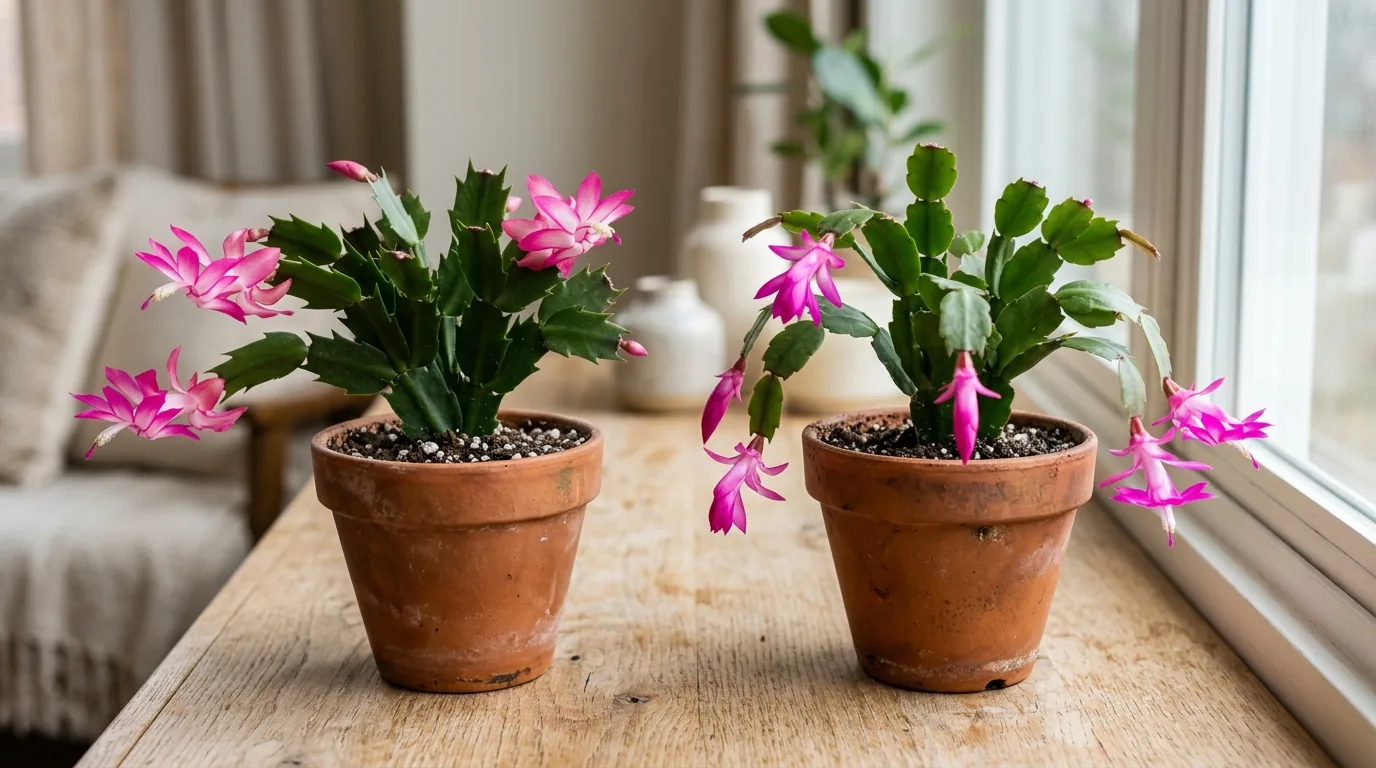
If you bought a “Christmas cactus” this fall, there is a good chance it is actually a Thanksgiving cactus. University of Illinois Extension notes that Thanksgiving cactus is often sold this time of year labeled as Christmas cactus, and WSU Extension says most commercial holiday cactus cultivars are the Thanksgiving species. The two plants are close relatives with nearly identical care, but you can tell them apart in seconds by the shape of the stem segments. This guide covers Thanksgiving cactus vs Christmas cactus (and the Easter cactus, the third holiday cactus) using University of Minnesota, WSU, Penn State, Illinois and UF/IFAS Extension and the ASPCA.
Thanksgiving vs Christmas vs Easter Cactus at a Glance
Here is Thanksgiving cactus vs Christmas cactus vs Easter cactus side by side, from the stem shape to the bloom season.
| Feature | Thanksgiving cactus | Christmas cactus | Easter cactus |
|---|---|---|---|
| Botanical name | Schlumbergera truncata | Schlumbergera × buckleyi (WSU, Illinois); listed as S. bridgesii by UMN, UF/IFAS and the ASPCA | Hatiora gaertneri (WSU, Penn State); Schlumbergera gaertneri (UMN, Illinois) |
| Stem segment edges | 2 to 4 pointed, saw-toothed hooks | Rounded, scalloped | Smooth and rounded, with short bristles at the tips |
| Flowers | Held more horizontally; yellow anthers | Droop downward; purplish-brown anthers | Flat, star- or trumpet-shaped with pointed petals |
| Short days needed to bloom | About 6 weeks | About 6 weeks | 8 to 12 weeks |
| Usual bloom season | Late fall to winter, usually before Christmas cactus | Late fall to winter, closer to the winter solstice | Late winter to spring |
| Origin | Wild species from Brazil | Hybrid bred in England (S. truncata × S. russelliana) | Brazil |
Sources: WSU Extension (2025); Penn State Extension (2025); University of Minnesota Extension; University of Illinois Extension (2024); UF/IFAS Taylor County Extension (2023).
How to Tell Them Apart by the Leaves
Holiday cacti have no true leaves. What look like leaves are flat stem segments (cladophylls), and their edges are the most reliable way to identify the plant, because you can check them any time of year.
- Thanksgiving cactus: each segment has pointed teeth along the edges. WSU Extension describes 2 to 4 saw-toothed hooks along the margins, and Penn State Extension gives two to four serrations. UF/IFAS Extension describes broad, thin segments with three points on each side.
- Christmas cactus: the segment edges are rounded and scalloped (WSU, UF/IFAS); Penn State describes them as scalloped and pear-shaped.
- Easter cactus: the edges are smoother and rounder still, and WSU notes short bristles at the stem tips, which the other two lack.
How to Tell Them Apart by the Flowers
Penn State Extension notes that Thanksgiving and Christmas cactus flowers look very similar, so check the details:
- Anther color: the anthers (the pollen-bearing tips in the center of the flower) are yellow on a Thanksgiving cactus and purplish-brown on a Christmas cactus (WSU, Penn State). Illinois Extension also describes the bright yellow pollen on Thanksgiving cactus flowers.
- Flower angle: Penn State says Thanksgiving cactus blooms grow horizontally from the stems, while Christmas cactus blooms droop.
- Easter cactus flowers: flat and star-shaped (Penn State), flaring with pointed petals. WSU notes they open at sunrise and close at sunset, and last several weeks.
Flower color does not help: all of them come in white, pink, red and other shades. Bloom date alone is not a reliable test either, because the Thanksgiving and Christmas seasons overlap, and University of Minnesota Extension points out that the holiday names are only general references to when the plants may bloom.
Are Thanksgiving and Christmas Cactus the Same?
No, but they are closely related. WSU Extension explains that the Christmas cactus is a hybrid of Schlumbergera truncata (the Thanksgiving cactus) and S. russelliana, developed in England by William Buckley about 150 years ago. So the Thanksgiving cactus is one of the Christmas cactus’s parents.
The botanical names are messy. WSU and Illinois Extension call the Christmas cactus S. × buckleyi, while University of Minnesota Extension, UF/IFAS and the ASPCA list it as S. bridgesii, an older name. The Easter cactus has moved between genera too: you will see Hatiora gaertneri and Schlumbergera gaertneri for the same plant.
Bloom Time and How to Trigger Flowers
All three are short-day plants: they set flower buds when nights get long and cool. University of Minnesota Extension says Thanksgiving and Christmas cacti bloom after about 6 weeks of short days, while the Easter cactus needs 8 to 12 weeks. WSU adds that the Thanksgiving cactus needs a somewhat shorter dark period than the Christmas cactus, which is why it flowers first.
| Source | Darkness | Temperature |
|---|---|---|
| University of Minnesota Extension | At least 12 hours of complete darkness nightly for about 6 weeks when nights are 60 to 65°F | Nights of 55°F can bring blooms in 5 to 6 weeks, sometimes regardless of day length; unlikely to bloom above 65°F at night |
| WSU Extension | 14 hours or more of continuous darkness; as little as two hours of artificial light can stop bud set | Indoors in the sixties |
| Penn State Extension | At least 12 hours of uninterrupted darkness | About 68°F days, 60°F nights |
| Illinois Extension | 12 to 14 hour dark period; limit night light from August | Nights of about 55 to 60°F |
Sources: University of Minnesota Extension; WSU Extension (2025); Penn State Extension (2025); University of Illinois Extension (2024).
WSU notes that once buds have set, day length no longer affects flowering. For a step-by-step plan when a plant refuses to bloom, see our guide to a Christmas cactus not blooming; the same method works for the Thanksgiving cactus.
Thanksgiving Cactus Care (and Christmas Cactus Care)
Care is the same for both. They are true cacti, but they come from the rainforests of southeastern Brazil, where they grow on trees and rocks (Illinois Extension), so they want more shade, humidity and moisture than desert cacti. University of Minnesota Extension says they can live over 100 years.
| Need | What the sources say |
|---|---|
| Light | Bright, filtered or indirect light; no full sun (UMN, Illinois, Penn State). Full sun can turn segments red (WSU) |
| Water | Sources differ: let the soil dry between waterings (UMN); moist but never soggy (Illinois); never let the mix dry out (WSU). All agree on good drainage and no standing water |
| Soil | 1 part potting soil, 2 parts peat moss, 1 part sharp sand or perlite (UMN); about half peat and 40 to 50% perlite (Illinois) |
| Feeding | Monthly from June to August with a balanced houseplant fertilizer at half strength (UMN); stop in late summer to encourage buds (WSU) |
| Pot | Blooms best slightly pot-bound; repot about every 3 years (UMN), 3 to 4 years (Penn State) or 3 to 5 years (Illinois) |
| Summer | Outdoors in part shade (3 to 6 hours of sun) or filtered light; bring in before frost (UMN) |
Sources: University of Minnesota Extension; University of Illinois Extension (2024); Penn State Extension (2025); WSU Extension (2025).
The watering disagreement is mostly about degree. University of Minnesota Extension names root rot as one of the most common causes of death in these plants, so if in doubt, let the top of the mix dry a little and never leave the pot sitting in water. UMN also says to water less after flowering and more again when growth resumes in spring.
To propagate, University of Minnesota Extension suggests cutting where two segments join; WSU suggests rooting a Y-shaped piece in sterile soil or vermiculite. For keeping holiday cacti outside in summer, see our guide to bringing plants indoors for winter.
Bud Drop and Other Problems
| Problem | Likely cause | Fix |
|---|---|---|
| Buds fall off | Drafts, sudden temperature or humidity changes, a change of light direction (UMN); temperature extremes or too little light (Penn State) | Keep it away from heaters, vents and doors; move it to its display spot as soon as buds appear and leave it there |
| No flowers | Nights too warm or too short (UMN); too much light, root rot, drought or overfeeding during bud set (Penn State) | Cool, long nights for about 6 weeks |
| Limp, wilted segments in wet soil | Root rot from overwatering (UMN) | Let it dry out; check drainage |
| Reddish segments | Too much sun (WSU) | Move to bright, indirect light |
| Brown, corky base on an old plant | Normal aging (UMN) | No action, once you confirm it is not scale |
Sources: University of Minnesota Extension; Penn State Extension (2025); WSU Extension (2025).
University of Minnesota Extension also notes that a plant may drop some buds on its own when it has set more than it can support.
Are Holiday Cacti Safe for Pets?
The ASPCA lists the Christmas cactus (Schlumbergera bridgesii, with Easter cactus as another common name) as non-toxic to dogs, cats and horses. Like any plant, it can still upset a pet’s stomach if a lot is eaten. See our list of cat-safe plants.
For more holiday plants, see our guides to amaryllis, cyclamen, paperwhites and Christmas cactus care.
Frequently Asked Questions
How can you tell a Thanksgiving cactus from a Christmas cactus?
By the stem segments: a Thanksgiving cactus has 2 to 4 pointed, saw-toothed hooks along each segment, while a Christmas cactus has rounded, scalloped edges (WSU, Penn State). In flower, Thanksgiving cactus anthers are yellow and Christmas cactus anthers are purplish-brown.
Are Thanksgiving cactus and Christmas cactus the same?
No. The Thanksgiving cactus is the species Schlumbergera truncata, and the Christmas cactus is a hybrid of it with S. russelliana, bred in England about 150 years ago (WSU Extension). Their care is the same.
Is my Christmas cactus actually a Thanksgiving cactus?
Quite possibly. Illinois Extension notes that Thanksgiving cactus is often sold labeled as Christmas cactus, and WSU says most commercial holiday cactus cultivars are the Thanksgiving species. Check the segment edges for pointed teeth.
What is the difference between Thanksgiving, Christmas and Easter cactus?
Thanksgiving cactus has pointed segments and blooms first in late fall; Christmas cactus has scalloped segments and blooms closer to the winter solstice; Easter cactus has smooth segments with bristly tips, star-shaped flowers, and needs 8 to 12 weeks of short days to bloom in late winter or spring (UMN, WSU, Penn State).
Why is my Thanksgiving cactus blooming at Christmas?
Bloom time depends on when the plant got its long, cool nights. University of Minnesota Extension says the holiday names are only general references to bloom time, and plants kept warm or in lit rooms in fall bloom late or not at all.
Is a Thanksgiving cactus toxic to cats?
The ASPCA lists the Christmas cactus (Schlumbergera bridgesii) as non-toxic to dogs, cats and horses. Its plant list has no separate entry under the Thanksgiving cactus name or S. truncata, but the two are close relatives in the same genus.
Sources
- University of Minnesota Extension: Holiday cacti
- Barany, C. (2025). Christmas Cactus. WSU Extension, Yakima County
- Bogart, T. (2025). Holiday Cacti Care. Penn State Extension
- Pankau, R. (2024). Brighten your holidays with blooming cacti. University of Illinois Extension
- Strange, L. (2023). Thanksgiving, Christmas, Easter; Oh my! What cactus do I have. UF/IFAS Extension Taylor County
- ASPCA: Christmas Cactus