
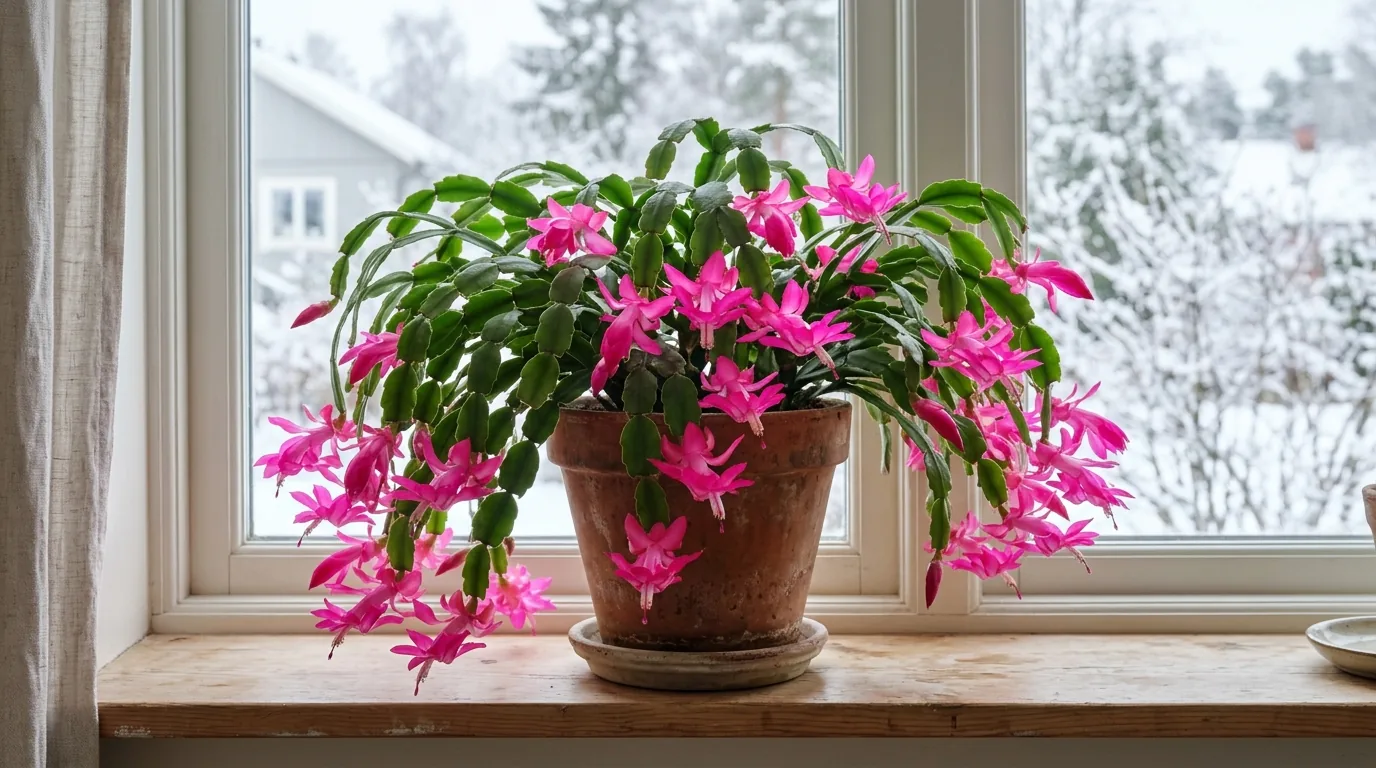
A Christmas cactus can outlive the person who bought it: University of Minnesota Extension and Penn State Extension both say well-kept plants live more than 100 years, and many are passed down through families. It is a cactus, but not a desert one. It grows on trees and rocks in the Brazilian rainforest, so Christmas cactus care means filtered light, a fast-draining but moisture-holding mix, more humidity than you would give an aloe, and long, cool nights in fall for flowers. This guide covers light, watering, soil, feeding, care after flowering, repotting, propagation and problems, using University of Minnesota, NC State, Penn State and WSU Extension and the ASPCA.
Christmas Cactus Care at a Glance
| Need | What the sources say |
|---|---|
| Light | Bright, indirect or filtered light; full sun bleaches or reddens the stems (NC State, UMN, WSU) |
| Temperature | 70 to 80°F in the growing season (NC State); about 68°F days and 60°F nights in winter (Penn State) |
| Water | Soak, drain, and water again when the mix dries (Penn State, UMN); water less from mid-September and after flowering (NC State) |
| Humidity | High; it is a rainforest plant (NC State, UMN) |
| Soil | 1 part potting soil, 2 parts peat moss, 1 part sharp sand or perlite (UMN) |
| Fertilizer | Monthly June to August, balanced, half strength; low-nitrogen formula in fall (UMN) |
| Bloom trigger | About 6 weeks of short days and cool nights (UMN) |
| Repotting | Every 3 years (UMN) or 3 to 4 years (Penn State), in late winter or spring |
| Size | 6 to 12 inches tall, 12 to 24 inches wide, arching (NC State) |
| Pets | Non-toxic to dogs, cats and horses (ASPCA) |
Sources: University of Minnesota Extension (reviewed 2026); NC State Extension Gardener Plant Toolbox; Penn State Extension (2025); WSU Extension (2025); ASPCA.
NC State describes the true Christmas cactus, Schlumbergera × buckleyi, as a hybrid of S. russelliana and S. truncata created by William Buckley at Rollisson Nurseries in England in the 1840s. Many plants sold as “Christmas cactus” are actually Thanksgiving cactus (S. truncata). The care below works for both; to check which one you have, see our guide to Thanksgiving cactus vs Christmas cactus.
Light and Temperature
For Christmas cactus care indoors, think bright but filtered. NC State Extension says it prefers bright, indirect light and that full sun can bleach the stems. University of Minnesota Extension warns that too much sun gives pale green branches, drought stress and sunburn, and WSU Extension notes that full sun can turn the segments red. An east window, or a spot a few feet back from a south or west window, fits that description.
In summer the plant can go outside. UMN suggests a deck or patio in part shade with 3 to 6 hours of sun a day, and says filtered light under a tree is ideal because it mimics the plant’s natural habitat. Bring it in before frost and check it for pests first; our guide to bringing plants indoors for winter covers the steps.
| Source | Temperature advice |
|---|---|
| NC State | 70 to 80°F; night temperatures of 55 to 65°F for flowering |
| University of Minnesota | In fall, 65 to 70°F days and 55 to 65°F nights; unlikely to bloom with nights above 65°F |
| Penn State | In winter, about 68°F during the day and 60°F at night |
Sources: NC State Extension Gardener Plant Toolbox; University of Minnesota Extension; Penn State Extension (2025).
How Often to Water a Christmas Cactus
There is no fixed schedule: how often to water a Christmas cactus depends on the season, the pot and the room. Water when the top of the mix has dried, then water thoroughly. Penn State Extension says to soak the potting soil from the top and water again once the medium dries. UMN says to let the soil dry out between waterings, to water in the sink so the pot drains, and to empty saucers and decorative pots, because standing water leads to bud drop, wilting and root rot.
The sources differ a little on how dry is too dry. NC State says to keep the soil moist but not soggy from spring to summer, WSU says never to let the mix dry out completely, and UMN says to let it dry between waterings. They all agree on the part that kills most plants: UMN names root rot from wet soil as one of the most common causes of death. If you are unsure, wait a day.
- Spring and summer: the plant is growing, so it uses the most water.
- Fall: NC State says to reduce watering from mid-September as buds develop.
- Winter, after blooming: water less often until growth resumes in spring (UMN, Penn State).
Humidity: NC State says the plant prefers high humidity, and Penn State suggests a light daily misting. Grouping plants also helps in a heated room; see our winter houseplant care guide.
Soil, Pot and Repotting
The mix needs to drain fast but still hold some moisture. UMN recommends 1 part sterile potting soil, 2 parts peat moss and 1 part sharp (builder’s) sand or perlite, and says the plant will not grow well in heavy, wet soil. NC State describes a moist, well-drained, airy medium of peat moss, sand and perlite. Use a pot with enough drainage holes.
Christmas cacti bloom best when somewhat pot-bound, so repot only when needed. UMN says healthy plants may need it only every 3 years; Penn State says every 3 to 4 years, or when roots grow out of the drainage holes. Penn State’s method:
- Repot in late winter or early spring, after the flowers have wilted. Never repot while it is blooming.
- Move up to a slightly larger pot only, with the top of the root ball about 1 inch below the rim.
- Keep the plant out of direct light for 2 to 3 days afterward.
Fertilizer
UMN recommends feeding monthly from June through August with a balanced houseplant fertilizer at half strength. When buds start forming in fall, it suggests switching to a fertilizer low in nitrogen and higher in phosphorus and potassium, such as 0-15-10. NC State says to fertilize monthly during the growing season. Do not overdo it: Penn State lists overfertilizing while buds develop as one cause of poor flowering, and WSU suggests stopping in late summer to encourage buds.
Getting It to Bloom
Christmas cacti are short-day plants: they set buds when nights get long and cool. UMN gives the clearest rules:
- With nights around 55°F, plants bloom in about 5 to 6 weeks, sometimes regardless of day length.
- With nights of 60 to 65°F, they need at least 12 hours of complete darkness every night for about 6 weeks.
- Above 65°F at night, they are unlikely to bloom.
Other sources ask for a little more darkness: NC State says at least 13 hours of uninterrupted darkness nightly from mid-September, and WSU says 14 hours or more. WSU adds that as little as two hours of artificial light can stop bud set, so a cool spare room that nobody lights at night works well. Once buds form, keep the plant in one place; UMN says moving it, drafts and sudden temperature changes make buds drop. If your plant still refuses to flower, follow our step-by-step guide to a Christmas cactus not blooming.
Christmas Cactus After Flowering
Christmas cactus care after flowering is mostly about rest and shaping:
- Remove spent flowers, or let them drop (Penn State).
- Water less often until new growth starts in spring or early summer (UMN, Penn State).
- Prune to make it bushier. UMN says to prune after flowering, cutting where two stem segments (cladophylls) join with a small, sharp pruner or knife. The plant produces 1 to 2 new segments at each cut, so it branches more.
- Repot if it is due, in late winter or early spring (Penn State).
Penn State notes that with good care, Thanksgiving and Christmas cacti can rebloom more than once a year.
Propagation
The pieces you prune off are easy to root. Penn State suggests cuttings of 3 to 5 segments; UMN suggests cutting where two segments join.
- Dip the base of the cutting in water and then in rooting hormone (UMN; Penn State says hormone is optional).
- Insert it in damp builder’s sand or a well-draining potting mix (UMN).
- Keep it in bright, indirect light at 70 to 80°F, with the mix moist but not wet (UMN). Penn State suggests covering the pot with plastic to hold humidity.
- Check for roots after about 2 weeks by gently lifting the cutting with a popsicle stick (UMN). Penn State says roots usually form in 3 to 8 weeks.
- Pot rooted cuttings in cactus mix and place them in a bright window (UMN).
Penn State says cuttings can also be rooted in water and moved to soil once the roots are well developed. If a water cutting turns soft at the base, see our guide to cuttings rotting in water.
Problems: Red, Limp or Dropping Segments
| Symptom | Likely cause | What to do |
|---|---|---|
| Christmas cactus leaves turning red or purple | Too much sun (WSU) | Move to bright, filtered light |
| Pale, bleached segments | Full sun (NC State, UMN) | Move out of direct sun |
| Limp, wilted plant in wet soil | Root rot from too much water (UMN) | Let it dry out; check that the pot drains and never sits in water |
| Buds or flowers dropping | Drafts, sudden temperature or humidity changes, moving the plant (UMN); temperature extremes or too little light (Penn State) | Keep it away from heaters, vents and doors, and leave it in one place once buds form |
| Whole branches breaking off | Plant too big to carry its weight (UMN) | Prune back the largest branches; repot into a slightly larger pot |
| Brown, corky base | Normal aging (UMN) | No action, once you confirm it is not scale |
| Black, wet, slimy lesions rising from the soil line | Bacterial soft rot (UMN) | Discard the plant; water at the base and keep watering to a minimum on other plants |
| Gray-green, wilting plant with dark, mushy roots | Fungal root and stem rot (UMN) | Avoid overwatering; use a free-draining pot and mix |
| Small flies around the pot | Fungus gnats in constantly wet soil (UMN) | Let the mix dry between waterings |
Sources: University of Minnesota Extension; NC State Extension Gardener Plant Toolbox; WSU Extension (2025); Penn State Extension (2025).
NC State lists mealybugs, red spider mites, aphids and soft brown scale as the main pests. For mealybugs, see our guide to rubbing alcohol for mealybugs; for gnats, see diatomaceous earth for fungus gnats.
Is It Safe for Pets?
It is also on our list of plants safe for dogs.
For other compact, pet-safe houseplants, see our guides to bromeliad care and peperomia care.
Frequently Asked Questions
How often should you water a Christmas cactus?
Whenever the top of the mix has dried, not on a fixed schedule. Penn State says to soak the soil and water again once it dries, and UMN says to let it dry between waterings and never leave the pot in water. Water less from mid-September and after flowering (NC State, UMN).
Where should I put my Christmas cactus indoors?
In bright, indirect light away from hot direct sun, heaters and drafts. In fall, a cool room (nights of 55 to 65°F) with no lights on at night helps it set buds (UMN).
What do you do with a Christmas cactus after it blooms?
Remove the spent flowers, water less often until spring, and prune where two segments join to make it bushier (UMN, Penn State). Repot in late winter or early spring only if it has outgrown its pot.
Why are my Christmas cactus leaves turning red?
WSU Extension says full sun can turn the segments red, and NC State says it can bleach them. Move the plant to bright, filtered light.
Why is my Christmas cactus limp?
If the soil is wet, the likely cause is root rot from overwatering: UMN says to let the plant dry out and check that the pot drains. If the mix is bone dry, water it thoroughly and let the excess drain.
Should I mist my Christmas cactus?
It likes high humidity (NC State), and Penn State suggests a light misting daily. Grouping plants together or using a humidifier also helps in dry, heated rooms.
Is a Christmas cactus poisonous to cats?
No. The ASPCA lists the Christmas cactus as non-toxic to dogs, cats and horses.
Sources
- Weisenhorn, J. and Meyer, M. Holiday cacti. University of Minnesota Extension (reviewed 2026)
- NC State Extension Gardener Plant Toolbox: Schlumbergera × buckleyi
- Bogart, T. (2025). Holiday Cacti Care. Penn State Extension
- Barany, C. (2025). Christmas Cactus. WSU Extension, Yakima County
- ASPCA: Christmas Cactus