
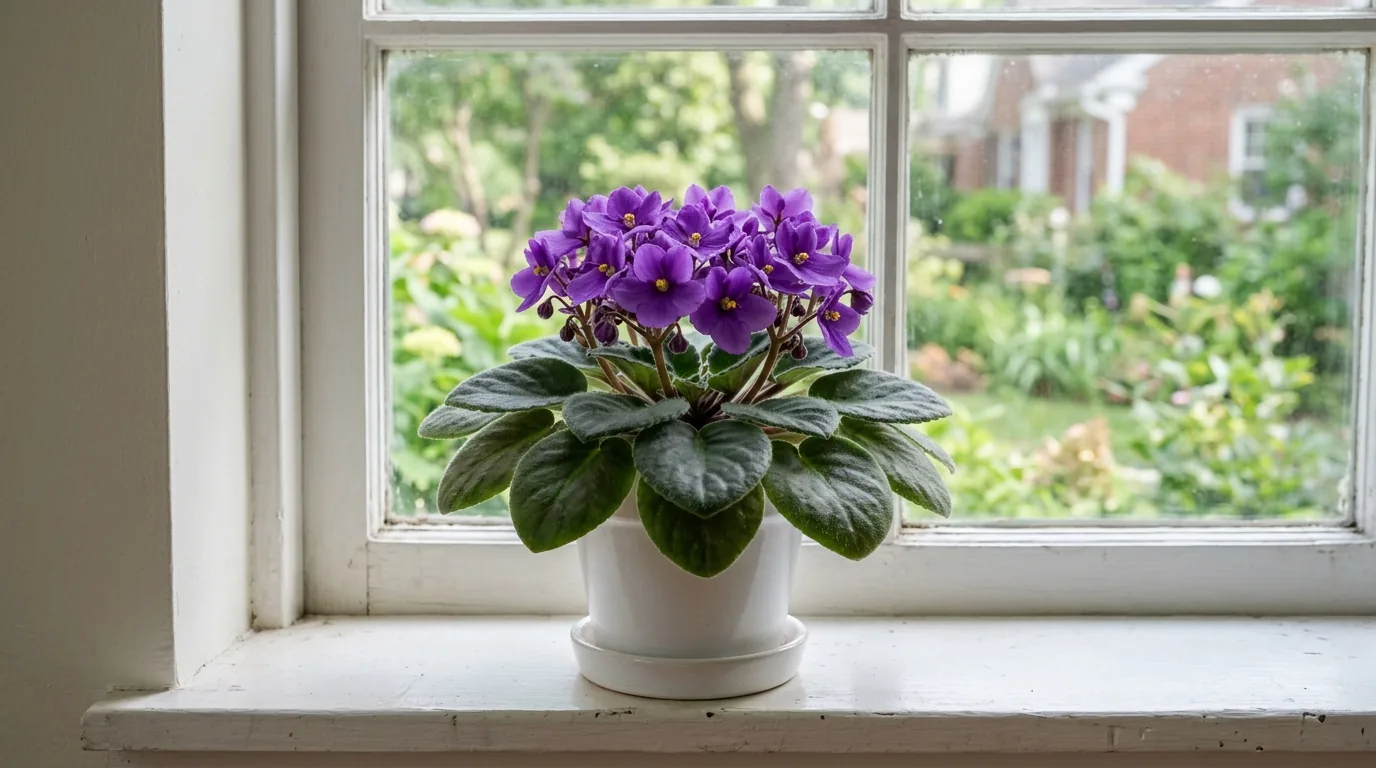
African violets are among the few houseplants that can flower almost all year on a windowsill, and they stay small: NC State Extension gives 6 to 9 inches tall and wide. They have a reputation for being fussy, but most of that comes down to three habits: they want bright light without hot sun, room-temperature water kept off the leaves, and a small pot of light, airy mix. This guide covers African violet care from light and watering to soil, feeding, grooming, propagation and problems, using UF/IFAS, Iowa State, NC State and Penn State Extension and the ASPCA.
African Violet Care at a Glance
| Need | What the sources say |
|---|---|
| Light | About 1,000 foot-candles, no direct sun (UF/IFAS); north or east windows (Iowa State) |
| Darkness | At least 8 hours a night (UF/IFAS, Penn State) |
| Temperature | 65 to 80°F (Iowa State); nights 65 to 70°F (UF/IFAS); not below 60°F at night (NC State) |
| Water | Room temperature, when the surface is dry; keep leaves dry (UF/IFAS, NC State) |
| Humidity | High; pebble tray or humidifier (NC State, UF/IFAS) |
| Soil | Equal parts peat moss, vermiculite and perlite, pH about 6.0 to 6.5 (UF/IFAS) |
| Pot | No wider than one-third of the plant’s diameter (Penn State) |
| Fertilizer | Balanced, weak, regular; urea-free (UF/IFAS, Iowa State, Penn State) |
| Size | 6 to 9 inches tall and wide (NC State) |
| Pets | Non-toxic to dogs, cats and horses (ASPCA) |
Sources: UF/IFAS EDIS MG028; Iowa State University Extension (2023); NC State Extension Gardener Plant Toolbox; Penn State Extension (2025); ASPCA.
Botanists have moved the African violet from Saintpaulia into Streptocarpus: NC State Extension lists it as Streptocarpus ionanthus, formerly Saintpaulia ionantha, native to eastern and southwestern Tanzania. Labels and most care guides still use the old name.
Light
Light is the part of African violet care indoors that most often goes wrong. UF/IFAS Extension recommends bright light of about 1,000 foot-candles with no direct sun, roughly within 3 feet of a southeast- or west-facing window, for 8 to 12 hours a day (up to 16), followed by 8 hours of darkness. Iowa State Extension says north and east windows are generally best.
Read the leaves to adjust. Iowa State says thin, dark blue-green leaves on long stalks mean too little light, while stunted plants with small, crinkled, leathery, yellowish leaves mean too much.
| Source | Grow light distance | Hours per day |
|---|---|---|
| Iowa State | 4 to 8 inches above the plants | 12 to 16 |
| UF/IFAS | 12 to 15 inches (two 40-watt fluorescent tubes, about 600 foot-candles) | About 16 |
| Penn State | Not given | No more than 16, with 8 hours of darkness |
Sources: Iowa State University Extension (2023); UF/IFAS EDIS MG028; Penn State Extension (2025). LED fixtures vary in output, so start at the maker’s suggested height and watch the leaves.
Under lights, African violets bloom well all year; see our grow light guide for choosing a fixture. If yours is healthy but has no flowers, light is the first thing to check in our guide to an African violet not blooming.
Temperature and Humidity
Iowa State says African violets do best between 65 and 80°F: below 50°F the leaves darken, wither and look water-soaked, and above 85°F growth and flowering slow. UF/IFAS prefers nights of 65 to 70°F, and NC State says nights below 60°F stunt growth. In winter, keep plants off cold glass and away from heater vents.
NC State says African violets thrive in high humidity and dislike dry air. UF/IFAS suggests setting pots on pebbles in a tray of water, with the pots themselves above the waterline so the roots do not stay wet. A room humidifier also works.
African Violet Watering
NC State calls overwatering the number one issue with African violets, so water by feel, not by the calendar. UF/IFAS says to water when the surface of the mix feels dry, but before it hardens or the plant wilts. Penn State describes the goal as evenly moist, like a well-wrung-out sponge.
- Use room-temperature water. UF/IFAS says to use water at room temperature or slightly warmer, because cold water on warm leaves leaves yellowish spots or streaks. Iowa State also links leaf spots to water sitting on the leaves.
- Bottom watering: UF/IFAS says to set the pot in about 1 inch of water until the surface of the mix is moist, then let it drain. Iowa State says not to leave pots soaking for long and to let the top inch dry before the next watering. See our bottom watering guide.
- Top watering: pour room-temperature water onto the soil, not the leaves, until it drains, and empty the saucer (UF/IFAS, Iowa State).
- Wick watering: UF/IFAS describes a pre-soaked braided nylon wick running from the drainage hole into a covered reservoir, and Iowa State describes self-watering African violet pots that work the same way. Our self-watering pot problems guide covers what can go wrong.
Whichever method you use, water from the top now and then to flush out fertilizer salts (UF/IFAS, Iowa State). A white crust on the pot or soil is the sign that salts are building up; see our white crust guide.
Soil and Pots
African violets need a light, airy mix that drains well. The sources give slightly different recipes:
| Source | Mix |
|---|---|
| UF/IFAS | Equal parts peat moss, vermiculite and perlite, or a commercial African violet mix; pH about 6.0 to 6.5 |
| NC State | 2 or 3 parts sphagnum peat moss, 2 parts vermiculite, 1 part perlite; add lime to offset the acidity of peat, or use coir |
| Iowa State | A loose, porous, fertile soilless mix |
Sources: UF/IFAS EDIS MG028; NC State Extension Gardener Plant Toolbox; Iowa State University Extension (2023). For the difference between the two additives, see vermiculite vs perlite.
Use a pot with drainage holes (UF/IFAS) and keep it small. Penn State says African violets bloom best slightly root-bound, with a pot no wider than about one-third of the plant’s diameter: a 9-inch plant needs only a 3-inch pot. NC State says to plant with the crown above the soil surface. UF/IFAS recommends washing reused pots with soap and water or dilute bleach.
Fertilizer
African violets live in small pots of soilless mix, so they need regular but weak feeding.
- UF/IFAS: a water-soluble fertilizer such as 20-20-20 or 15-30-15 at one-quarter of the label rate with each watering, applied to moist soil. If unsure, try it on one or two plants first and check them after 10 days.
- Iowa State: a complete fertilizer at a low rate, either an African violet formula or a balanced fertilizer at one-half or one-quarter strength.
- Penn State: avoid fertilizers that use urea as the nitrogen source, because African violets are sensitive to it. Check the Guaranteed Analysis on the label.
Too much is as bad as too little: UF/IFAS says over-fertilized plants develop tight centers and rusty-looking new leaves, and Iowa State says excess fertilizer reduces flowering.
Grooming, Necks and Crowns
- Remove faded flowers and unhealthy leaves to keep the plant clean and disease-free (UF/IFAS).
- Fix a long neck. Iowa State notes that lower leaves die and fall off over time, leaving a bare stem or neck. Repot with the stem buried up to the lowest leaves (Iowa State), or cut the stem at soil level and re-root the top (UF/IFAS).
- Divide multiple crowns. UF/IFAS says plants with several crowns can be divided, keeping roots on each piece.
- Give them room. UF/IFAS and Iowa State both link crowding to disease, especially powdery mildew.
How to Propagate African Violets
NC State recommends leaf cuttings, and UF/IFAS gives the method:
- Choose a healthy, mature leaf and trim its stalk (petiole) to about 1 to 1½ inches.
- Insert the stalk into a mix of half vermiculite and half sand, or half vermiculite and half potting mix.
- Keep it in bright, indirect light with the mix lightly moist.
- Roots form in about 3 to 4 weeks, and small new leaves appear about 3 to 4 weeks after that.
- Pot the plantlets up separately once they are large enough to handle. UF/IFAS says flowering begins 6 to 9 months later.
Dividing a plant with several crowns (see above) is the quicker route to a flowering-size plant.
Problems: Yellow Leaves, Spots and Rot
| Symptom | Likely cause | What to do |
|---|---|---|
| African violet leaves turning yellow, small and crinkled | Too much light (Iowa State) | Move back from the window or raise the lights |
| Yellowish spots or streaks on the leaves | Cold water on the leaves (UF/IFAS) | Water at room temperature and keep leaves dry |
| Lowest leaves yellowing and dying one at a time | Normal aging (Iowa State) | Remove them; rebury the neck if it gets long |
| Tight center, rusty-looking new leaves | Too much fertilizer (UF/IFAS) | Flush the mix with plain water and feed more weakly |
| Thin, dark leaves on long stalks; no flowers | Too little light (Iowa State) | More light or longer hours under lights |
| Water-soaked, shriveled stems and lower leaves | Crown rot from overwatering or recent repotting (Iowa State) | Often fatal; let the surface dry between waterings to prevent it |
| Brown, sunken spots where leaf stalks touch the rim | Petiole rot from fertilizer salts on the pot rim (UF/IFAS) | Wax the rim or cover it with foil |
| White or gray powder on the leaves | Powdery mildew (Iowa State) | Remove affected leaves and space plants apart |
Sources: Iowa State University Extension (2023); UF/IFAS EDIS MG028.
Pests: NC State lists mealybugs, thrips, cyclamen mites, vine weevil and leafhoppers. UF/IFAS suggests swabbing mealybugs with cotton dipped in a 1:1 mix of rubbing alcohol and water (see our rubbing alcohol for mealybugs guide) and testing insecticidal soap on a leaf or two first. Iowa State says spider mites show up as fine webbing around the leaf axils; isolate the plant and treat it (see our miticide guide).
Are African Violets Safe for Pets?
For more on propagation, see our guides to snake plant propagation. It is also on our list of plants safe for dogs. For more on propagation, see our guides to rubber plant propagation. Miniature African violets are on Iowa State’s list of closed terrarium plants; see our guide on how to make a terrarium. For other compact, pet-safe houseplants, see our guides to bromeliad care and peperomia care. For more on propagation, see our guides to leaf propagation.
Frequently Asked Questions
How often should I water an African violet?
When the surface of the mix feels dry, not on a fixed schedule (UF/IFAS). Iowa State says to let the top inch dry between waterings. Overwatering is the most common problem, according to NC State.
Should African violets be watered from the bottom?
Bottom watering works well because it keeps water off the leaves: UF/IFAS says to set the pot in about 1 inch of water until the surface is moist, then drain it. Water from the top occasionally to flush out fertilizer salts.
Where is the best place to put an African violet?
In bright, indirect light, such as a north or east window (Iowa State) or within about 3 feet of a southeast or west window without direct sun (UF/IFAS), in a room kept at 65 to 80°F.
Why are my African violet leaves turning yellow?
Small, crinkled yellow leaves usually mean too much light (Iowa State); yellow spots or streaks come from cold water on the leaves (UF/IFAS); and the oldest bottom leaves yellow naturally as the plant ages.
How do you propagate African violets from leaves?
Cut a healthy leaf with about 1 to 1½ inches of stalk and insert it in a half vermiculite, half sand or potting mix. UF/IFAS says roots form in 3 to 4 weeks, new leaves appear 3 to 4 weeks later, and flowering begins 6 to 9 months after that.
What is the best soil for African violets?
A light soilless mix: UF/IFAS suggests equal parts peat moss, vermiculite and perlite, or a commercial African violet mix, with a pH of about 6.0 to 6.5.
Are African violets toxic to cats?
No. The ASPCA lists African violet as non-toxic to dogs, cats and horses.
Sources
- Park-Brown, S. African Violets. UF/IFAS Extension ENH17/MG028
- Haynes, C. and Steil, A. All About African Violets. Iowa State University Extension (reviewed 2023)
- NC State Extension Gardener Plant Toolbox: Streptocarpus ionanthus (African violet)
- Feather, S. (2025). Why Isn’t My African Violet Flowering? Penn State Extension
- ASPCA: African Violet