
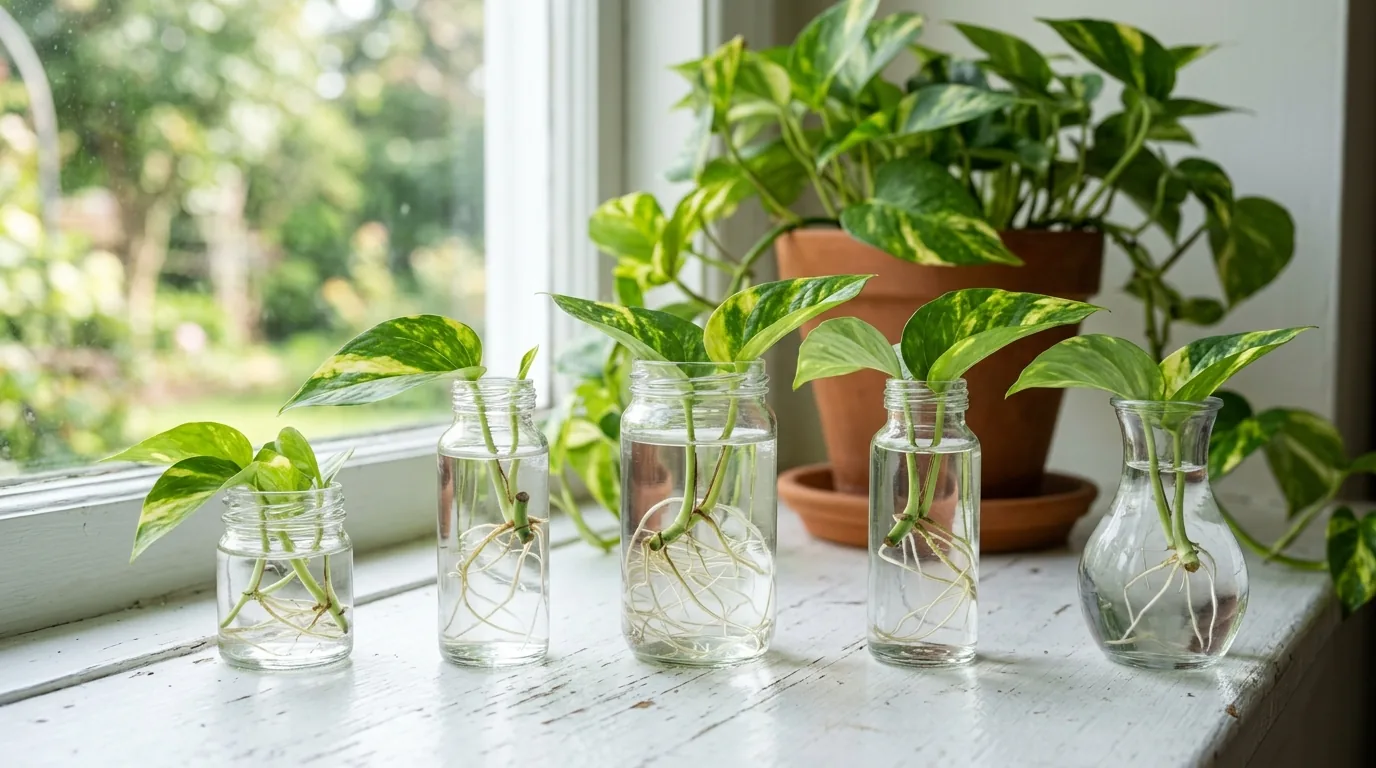
Pothos is one of the easiest houseplants to propagate: Clemson HGIC says stem cuttings root easily in soil or water, and NC State Extension notes that the vines root easily in water. The one rule you cannot skip is the node. This guide covers how to propagate pothos step by step, where to cut, pothos propagation in water versus soil, how long roots take, and what to do when cuttings rot, following Clemson, NC State, University of Nevada, University of Maryland and Ohio State Extension.
Pothos Propagation at a Glance
| Step | What the sources say |
|---|---|
| When | While the plant is actively growing (Nevada) |
| Cutting length | 3 to 4 inches from the stem tip (Nevada); 3 to 5 inches (Maryland) |
| Where to cut | Just below a node (Nevada, Ohio State) |
| Nodes | At least one per cutting (Clemson, Maryland) |
| Leaves | None under water (Maryland, Ohio State) |
| Light and warmth | Bright light but not direct sun, about 70°F, away from cold drafts (Maryland) |
| Water changes | Every few days (Nevada), or when the water turns cloudy (Ohio State) |
| First roots | Within about 10 days (Nevada); over 3 to 4 weeks (Ohio State) |
| Pot up | When roots are 2 to 3 inches long (Ohio State) |
| Pets | Toxic to cats and dogs (ASPCA) |
Sources: Clemson HGIC 1568 (2026); NC State Extension; University of Nevada Extension FS 98-92; University of Maryland Extension (2021); Ohio State Chadwick Arboretum.
Where to Cut: Finding the Node
A node is the point on the stem where a leaf emerges (Maryland Extension). Roots grow from the node, not from the leaf stalk or the bare stem between nodes, which is why Clemson says each cutting needs at least one node to root properly. A single leaf snapped off without a node will not grow a new plant.
For pothos propagation, where to cut is simple: make a clean cut just below a node with clean scissors or pruners (Nevada, Ohio State). Taking cuttings from long, trailing vines is also the best way to make the parent plant fuller; see our guide to pruning pothos.
Pothos Propagation in Water, Step by Step
Water propagation is the most popular method because you can watch the roots grow. Following University of Maryland Extension, University of Nevada Extension and Ohio State’s Chadwick Arboretum:
- Take the cutting. Cut a 3 to 5 inch piece of healthy vine just below a node, with at least one node and a few leaves at the tip.
- Remove the lower leaves. Strip any leaf that would sit underwater; submerged leaves foul the water (Ohio State).
- Use a clean container and fresh water. Maryland Extension suggests a clean container with fresh tap water. Keep the node underwater and the remaining leaves above it.
- Choose the spot. Bright light but not direct sun, about 70°F, away from cold drafts (Maryland).
- Change the water. Every few days (Nevada), or whenever it looks cloudy or dirty (Ohio State). Nevada notes that adding horticultural charcoal also helps keep it fresh.
- Wait for roots. See how long it takes below, then pot up once the roots are 2 to 3 inches long (Ohio State).
Pothos Propagation in Soil
Clemson says pothos cuttings root easily in soil as well as water, and rooting directly in potting mix skips the transition from water to soil. Nevada Extension’s method for soft-stemmed houseplant cuttings:
- Take a 3 to 4 inch tip cutting, cut below a node.
- Remove the lower leaves so at least two nodes are bare for inserting into the mix.
- Optionally dip the base in rooting powder, then insert it into a pot of moist potting mix.
- Water thoroughly, then cover the pot with a clear plastic bag to make a mini greenhouse that raises the humidity.
- Keep it in a warm, shady spot. New growth is the sign that roots have formed; then remove the bag, keep the soil moist and gradually increase the light.
Use a pot with drainage holes and a well-draining mix (Ohio State, Clemson). Sphagnum moss is a third option many growers use for aroids; see our guide to propagating in sphagnum moss.
Water vs Soil: Which Is Better?
| Water | Soil | |
|---|---|---|
| You can see the roots | Yes | No; new growth is the signal (Nevada) |
| Upkeep | Change the water every few days | Keep the mix moist; bag for humidity |
| Main risk | Rotting stems in stale water; shock when moved to soil (Nevada) | Rot if the mix stays soggy |
| Best for | Beginners who want to watch progress | Skipping the water-to-soil transition |
Sources: University of Nevada Extension; Ohio State Chadwick Arboretum; Clemson HGIC.
Both work for pothos. Nevada Extension warns that cuttings may go into shock when moved from water into soil, so if you root in water, wait until the root system is well developed before potting.
How Long Do Pothos Cuttings Take to Root?
Usually a few weeks. Nevada Extension says roots begin to appear within about ten days for plants that root in water, such as pothos; NC State shows pothos cuttings rooted in water after 2 weeks; Ohio State suggests watching root growth over three or four weeks. Maryland Extension suggests bright, indirect light and about 70°F for rooting. Pot up when the roots are 2 to 3 inches long (Ohio State).
Moving Water Cuttings to Soil
- Wait until the roots are 2 to 3 inches long (Ohio State) and the root system is well developed (Nevada).
- Use a small pot with drainage holes and well-draining potting mix (Ohio State, Clemson).
- Water thoroughly after planting and let the excess drain. Ohio State suggests watering about once a week after that, saturating the soil and letting it drain.
- Expect a pause in growth while the plant adjusts; Nevada notes that water-rooted cuttings can go into shock when moved to soil.
From there, care is the same as for any pothos; see our golden pothos vs Marble Queen guide.
Problems: Rotting, No Roots, Yellow Leaves
| Problem | Likely cause | Fix |
|---|---|---|
| Cutting never roots | No node on the cutting (Clemson) | Take a new cutting just below a node |
| Stem turns black or mushy in water | Stale water, submerged leaves | Trim the rotten part, remove leaves below the waterline, use fresh water and change it often; see cuttings rotting in water |
| Very slow rooting | Cold or dim spot | Move to bright, indirect light at about 70°F (Maryland) |
| Wilting after potting up | Transplant shock (Nevada) | Keep the soil evenly moist and out of direct sun while it settles |
| Rot after potting up | Overwatering, poor drainage (Clemson) | Use a draining pot and mix; let the top dry before watering again |
Sources: Clemson HGIC; University of Nevada Extension; University of Maryland Extension.
For more on propagation, see our guides to African violet care, snake plant propagation, rubber plant propagation, plants that grow in water and leaf propagation. For other trailing aroids, see our guides to pothos care.
Frequently Asked Questions
Where do you cut pothos to propagate?
Just below a node, the point where a leaf joins the stem (Nevada, Maryland). Each cutting needs at least one node to root (Clemson).
Can you propagate pothos without leaves?
The node matters more than the leaf: roots grow from the node, so a piece of stem with a node can root, while a leaf without a node cannot (Clemson). Maryland Extension recommends keeping some leaves at the tip of the cutting.
How long does pothos take to root in water?
Roots usually start within about 10 days (Nevada Extension) and are ready for potting after a few weeks, once they reach 2 to 3 inches (Ohio State).
Is it better to propagate pothos in water or soil?
Both work (Clemson). Water lets you see the roots but needs regular water changes and a transition to soil; soil skips the transition but you can’t see progress.
Why are my pothos cuttings not growing roots?
Most often the cutting has no node, or it is in a cold, dim spot. Take a new cutting below a node and keep it in bright, indirect light at about 70°F (Maryland Extension).
Do I need rooting hormone for pothos?
No. Pothos roots readily in plain water. Nevada Extension suggests rooting powder only as an option when planting cuttings directly into potting mix.
Sources
- Taylor, A. and Tanner, C. (2026). How to Grow Pothos Indoors. Clemson HGIC 1568
- NC State Extension Gardener Plant Toolbox: Epipremnum aureum
- Robinson, M.L. and Roberts, A. (1998). Propagating Houseplants. University of Nevada Extension FS 98-92
- University of Maryland Extension (2021). Make More Plants From Cuttings: 5 Plants That Root Easily in Water
- Ohio State University Chadwick Arboretum: Propagating Houseplants
- ASPCA: Golden Pothos